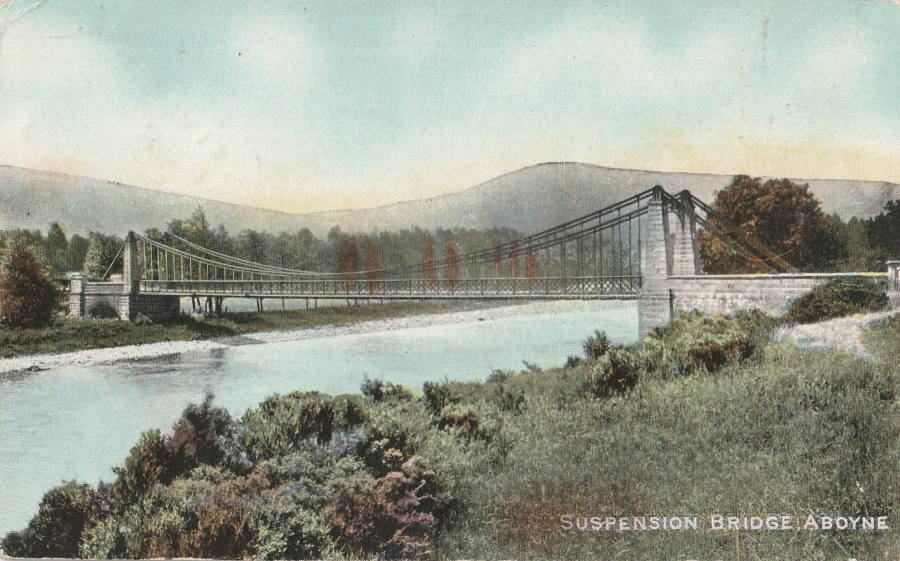
Survey work has begun to assess how potential construction options for Aboyne Bridge could affect flooding along the River Dee, as engineers weigh whether to repair the existing structure or pursue a modular replacement.
The study, now underway, will examine how each option interacts with the surrounding flood plain and what long-term implications may arise from altering the river environment. Early modelling is already in progress, drawing on hydrometric data, historical flood records and mapping, with further on-site investigation scheduled over the coming days.
At the centre of the assessment is a key structural distinction. Repairing the existing bridge would require installing a central support within the river itself, while a modular replacement would instead involve supports positioned near the riverbanks and along part of the southern embankment. Each approach carries different implications for water flow, sediment movement and flood risk.
The findings will help determine not only which option is technically viable, but how each might alter the behaviour of the river during periods of high flow. Any intervention in a river system of this scale requires careful consideration, particularly in a location where flooding patterns are already shaped by natural topography and seasonal variation.
Consultants from Binnies have been commissioned to carry out detailed topographical surveys of up to 50 river cross sections. This work, conducted by boat, is expected to continue until 14 April and is intended to provide a more precise understanding of the river’s shape and flow characteristics.
In parallel, ground investigations are being advanced by WSP to assess the conditions beneath and around the bridge site. These studies will inform decisions about foundation design and structural feasibility, particularly where new supports may be required.
Some preliminary data exists. Borehole records dating back to the 1930s offer an initial indication of ground conditions, supplemented by more recent site visits and digital resources such as the British Geological Survey’s GeoIndex. However, that historical data does not meet modern engineering standards and must be updated through new intrusive investigations.
The reliance on early twentieth-century data underlines both the longevity of the structure and the challenges involved in assessing it to contemporary design codes. While the existing information provides a useful baseline, engineers will need more detailed and compliant data before any final decisions can be made.
Environmental considerations are also shaping the study. The River Dee is a sensitive ecological corridor, supporting important fish populations and habitats. Ahead of the survey work, consultation has taken place with the Dee Salmon Fisheries Board, local fishing interests and Scottish Natural Heritage to ensure that the investigations adhere to environmental requirements.
That engagement reflects the need to balance infrastructure needs with ecological protection. Any construction activity in or near the river has the potential to affect fish migration, spawning grounds and water quality, particularly if it alters flow patterns or disturbs riverbed sediments.
The study will also consider mitigation measures, though details of these have not yet been set out. Such measures could include design adjustments to minimise disruption to water flow or ecological features, but their effectiveness will depend on the specific impacts identified through modelling and fieldwork.
What remains less clear at this stage is the broader context for the project. The material available focuses on the technical assessment of options rather than the condition of the existing bridge or the urgency of intervention. It does not specify whether the structure is deteriorating, subject to weight restrictions or otherwise in need of replacement.
Nor does it address cost, funding or timescale beyond the current phase of investigation. These factors are likely to play a significant role in determining which option, if any, is ultimately pursued.
The choice between repair and replacement often involves trade-offs. Repairing an existing structure may be less disruptive and potentially less costly in the short term, but could introduce ongoing maintenance requirements. A modular replacement, while potentially more adaptable to modern standards, may involve greater initial expense and construction complexity.
Flood risk adds a further layer of consideration. Introducing a central support into the river, as proposed under the repair option, could affect flow dynamics in ways that need to be carefully modelled. Equally, embankment-based supports for a new structure may alter how water moves across the flood plain during high flows.
These are not purely technical questions. They have implications for local communities, transport resilience and environmental management along the River Dee. However, the current phase of work is focused on establishing the evidence base rather than setting out conclusions.
The involvement of multiple consultants and datasets suggests a methodical approach, though it also indicates that the project remains at an early stage. Decisions on design, cost and delivery will follow only after the current investigations are complete and assessed.
For now, the work underway represents the first step in determining how best to secure the future of a key crossing while managing the risks associated with building in a dynamic river environment. The outcome will depend on how the competing demands of engineering practicality, environmental protection and flood resilience are resolved in the months ahead.
#ModernScot