
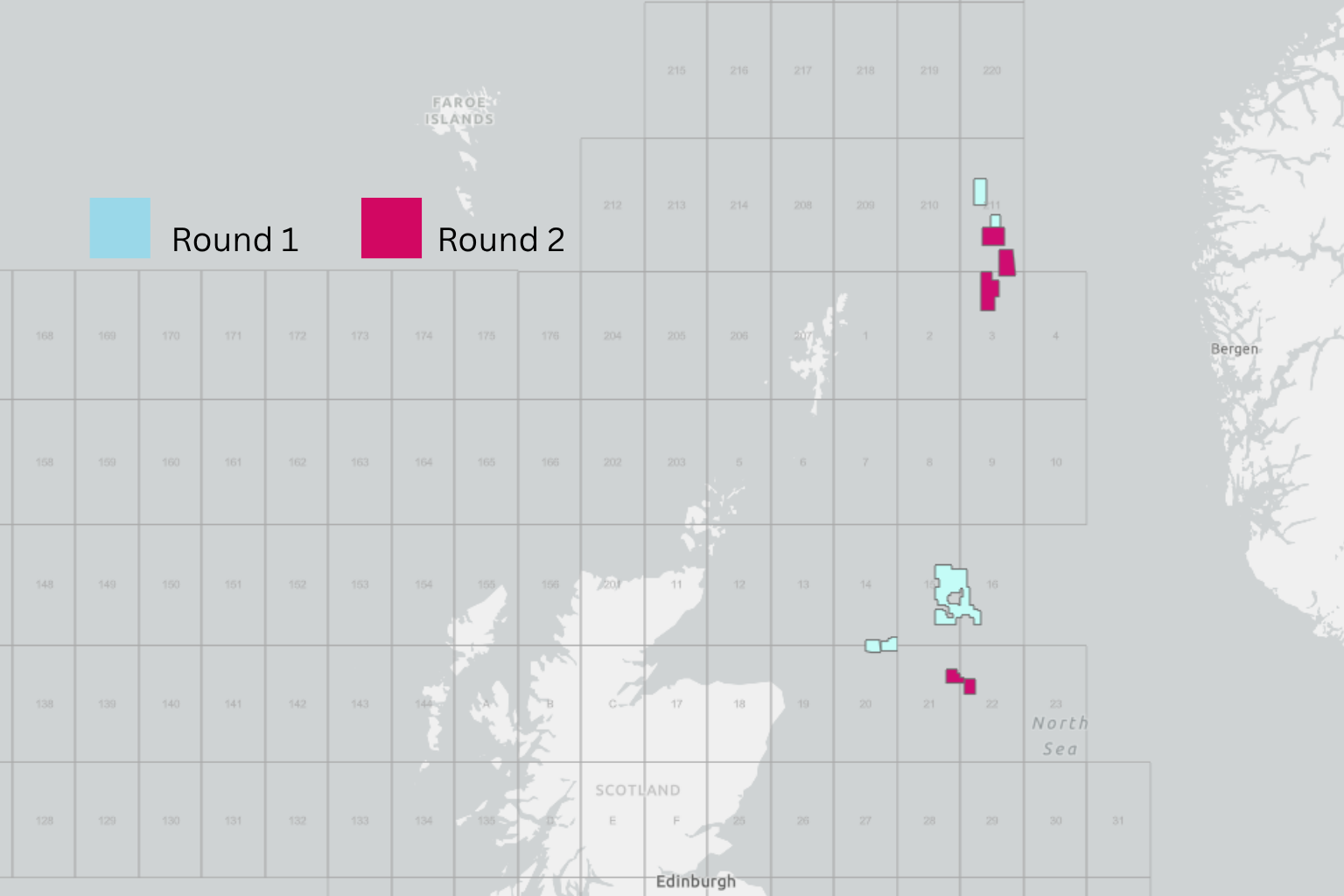
Bids to develop carbon storage sites across more than 2 million acres of the North Sea include multiple areas in Scottish waters, placing Scotland at the centre of the UK’s latest attempt to scale up carbon capture and storage as part of its net zero strategy.
The applications, submitted to the North Sea Transition Authority following the closure of its second carbon storage licensing round on 24 March, cover 14 offshore areas, five of which lie within zones managed by Crown Estate Scotland.
These Scottish areas are concentrated in two regions: the Northern North Sea, east and north-east of Shetland, and the Central North Sea, east of Aberdeenshire. Both regions are closely aligned with existing oil and gas infrastructure, including mature fields such as Forties and Brent, which are widely seen as potential candidates for repurposing as carbon storage reservoirs.
At this stage, however, no licences have been awarded, with applications now under review by the regulator. The authority has begun a review process that will include consultation with regulators, seabed managers and other marine users before any decisions are made, with outcomes expected in 2027.
The scale of the applications is being presented as evidence of growing industry momentum. Carbon storage is intended to capture carbon dioxide from industrial sources, transport it offshore and inject it into deep geological formations, often in depleted oil and gas reservoirs.
For Scotland, the significance lies in geography as much as policy. Much of the UK’s offshore infrastructure, expertise and potential storage capacity sits in or adjacent to Scottish waters. That creates both opportunity and exposure, tying the country’s economic future to the success or failure of technologies that remain, in many respects, unproven at scale.
The UK government has positioned carbon capture and storage as a cornerstone of its climate strategy. The Climate Change Committee has stated that meeting net zero targets will be significantly more difficult without it. Projects such as Endurance off Teesside and HyNet in north-west England are already moving towards possible injection dates later this decade.
In Scotland, attention has focused on the Acorn project at St Fergus, which aims to store carbon dioxide beneath the North Sea using existing infrastructure. Scottish Government policy identifies such developments as key to decarbonising industry while preserving elements of the offshore energy sector.
Yet the gap between ambition and delivery remains considerable.
The current round concerns exploration and appraisal rights rather than operational storage. Developers are seeking permission to investigate whether specific areas are suitable for long-term carbon storage. That process involves geological assessment, environmental studies and, eventually, regulatory approval before any injection can take place.
Crucially, the identities of the companies behind the latest applications have not been disclosed in the available material, nor has the distribution of bids across specific Scottish sites been detailed. Without that information, it is difficult to assess the commercial strength or seriousness of the proposals.
Environmental constraints also remain a significant factor. Some of the areas offered in the licensing round overlap with, or lie close to, designated marine protected areas. Any future development would need to navigate strict environmental requirements, and in some cases may not proceed if impacts cannot be mitigated.
There are also broader questions about cost and accountability. Carbon capture and storage projects are capital-intensive, requiring substantial investment in capture facilities, transport networks and offshore infrastructure. While the government has committed funding to early projects, the long-term financial model—particularly who bears the risk if projects underperform—has not been fully resolved in public detail.
For Scotland, these uncertainties are sharpened by the scale of potential involvement. The clustering of proposed storage areas near established offshore fields suggests a continuation of the North Sea’s role in the energy economy, albeit in a different form. That may support employment and supply chains tied to offshore engineering, but it also raises questions about how quickly such a transition can realistically occur.
Historical precedent offers some perspective. The North Sea oil and gas industry, developed from the 1970s onwards, relied on decades of sustained investment, technological development and regulatory evolution. Carbon storage, while building on that legacy, is at an earlier stage and faces different technical and economic challenges.
The geological case for storage is often presented as strong, drawing on the same formations that once held hydrocarbons. However, long-term monitoring, liability for stored carbon and the integrity of storage sites over decades remain areas of ongoing scrutiny.
The current licensing round therefore represents a preparatory phase rather than a decisive step. It signals interest and intent, but not delivery.
For coastal and offshore communities in north-east Scotland and Shetland, the implications may become clearer only as projects move beyond the application stage. Decisions on licensing, followed by appraisal and potential development, will determine whether the region becomes a central hub for carbon storage or remains a prospective landscape.
What is clear is that Scotland is not a peripheral player in this process. Its waters, infrastructure and expertise place it at the heart of the UK’s carbon storage ambitions. Whether that translates into lasting economic and environmental outcomes will depend on the projects that emerge from this early round of applications and the extent to which they can move from proposal to operation in the years ahead.
#ModernScot