
In 2006, something changed in how people used the internet, though it was not announced as a change.
Search results began to feel more precise. Social platforms no longer showed information in simple order. Online shops started to anticipate what a customer might want before it had been asked for directly. The systems behind these shifts were not new in principle, but they were no longer confined to research. They had been placed into everyday use.
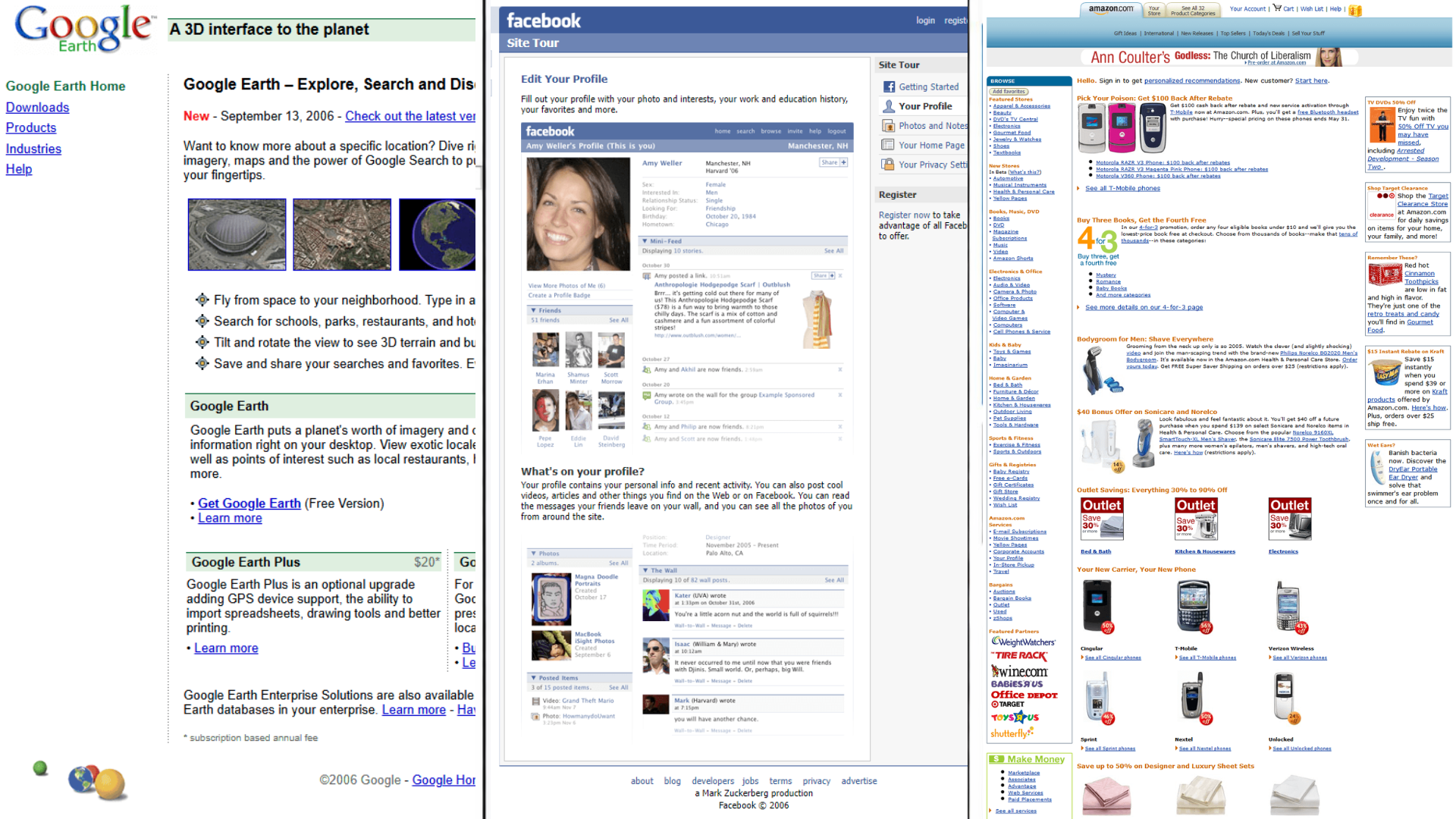
At the centre of this shift were companies such as Google, Facebook and Amazon. Each applied artificial intelligence to its core service, not as a separate feature, but as part of how the service itself operated.
For Google, the change was visible in search and advertising. The company had long relied on algorithms to rank pages, but in 2006 it began to apply machine learning more directly to the interpretation of queries. Rather than matching keywords alone, the system analysed patterns in user behaviour and language to infer what a user was likely to be seeking. This allowed search results to become more relevant, not because the information had changed, but because the interpretation of the query had improved.
At the same time, the company’s advertising systems began to use similar methods. Through services such as AdSense, user behaviour was analysed to determine which advertisements were most likely to be effective. The result was a form of targeting that responded to browsing history and patterns of interaction. This approach became central to the company’s revenue, establishing a model in which advertising was shaped by prediction rather than placement alone.
Facebook introduced a different form of change. In 2006, it launched the News Feed, altering how information was presented to users. Instead of displaying posts in chronological order, the platform used algorithms to rank and prioritise content. The system learned from user behaviour, identifying which posts were more likely to hold attention and placing them accordingly. At the same time, features such as “People You May Know” used similar techniques to suggest connections, drawing on shared networks and patterns of interaction to predict relationships.
These changes altered how information was encountered. What a user saw was no longer determined solely by time or by direct choice. It was shaped by a system that inferred preference from behaviour.
Amazon applied these methods to commerce. Its recommendation systems analysed previous purchases and browsing patterns to predict what a user might wish to buy next. This approach, often described as collaborative filtering, allowed the platform to present products that were tailored to individual behaviour. By 2006, these systems had been refined to a point where they became central to the experience of using the site.
At the same time, the company began investing in speech recognition and voice related technologies. These efforts did not yet produce widely recognised products, but they established the groundwork for later systems that would respond to spoken input. The development of voice based interfaces would follow from this work.
Taken together, these changes marked a shift in how artificial intelligence was applied. Earlier work had often been visible as a demonstration or confined to specialised tasks. In 2006, it became embedded in services used by large numbers of people. It operated without being named, shaping results, recommendations and interactions in ways that were not always apparent.
This shift had several effects. Artificial intelligence became part of routine activity, present in searching, reading and shopping without being identified as such. Personalisation became a central feature of digital systems, with content and products adjusted to individual behaviour. These methods also proved commercially effective. Advertising became more targeted, and recommendations increased engagement and sales, encouraging further investment.
The influence extended beyond these initial applications. Systems developed for search informed later work in voice interfaces and assistants. Methods used in social platforms evolved into more complex systems for ranking and recommendation. Techniques developed for commerce were applied to other forms of content, including media and entertainment.
The result was not a single invention, but a change in deployment. Artificial intelligence moved from being a subject of research to being part of the structure of widely used systems. It became less visible as a concept and more present as a function.
The effects of that shift continue to shape how digital systems operate. The underlying methods have developed, and their scale has increased, but the pattern remains. Systems interpret behaviour, infer intent and adjust their output accordingly.
What began as an integration in 2006 did not draw much attention at the time. It did not require it. The change was absorbed into the experience of using these services, and from that point on, it became difficult to separate the system from the behaviour it was shaping.