
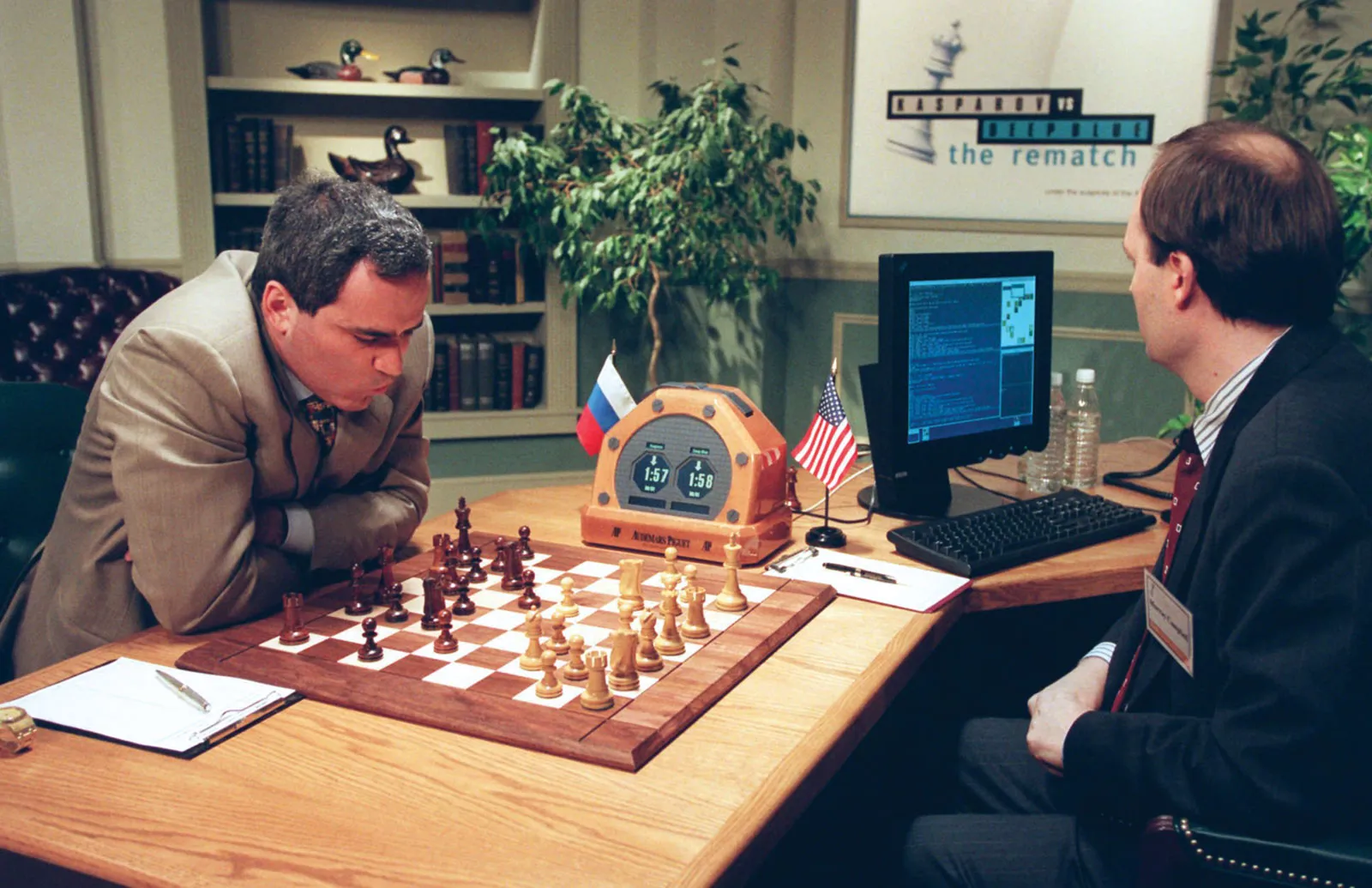
In February 1996, a world champion resigned a game he had expected to control.
It lasted thirty seven moves. The opponent was a machine.
The system was Deep Blue, developed by IBM. The player was Garry Kasparov, the reigning world champion and widely regarded as the strongest player of his time. The match formed part of a six game contest, but it was the first game, played on 10 February 1996, that drew attention.
Kasparov had faced computer systems before and had not lost. His approach to this match reflected that confidence. He played the Sicilian Defence, an opening associated with complex, tactical positions. The intention was to move the game into territory that required long term planning, where machines had previously struggled.
Deep Blue did not respond as expected. It did not pursue risky lines or fall into traps. Its play remained controlled, favouring solid positional moves. As the game progressed, the balance shifted. Kasparov made a number of inaccuracies, allowing the system to build an advantage that it was able to convert in the endgame. After thirty seven moves, he resigned. It was the first time a reigning world champion had lost a game to a computer under tournament conditions.
The result did not decide the match. Kasparov adjusted his approach in the games that followed, adopting strategies designed to expose weaknesses in the system’s evaluation. He went on to win the match four games to two. The initial loss, however, altered how the contest was understood.
Deep Blue’s strength did not come from learning in the modern sense. It relied on a combination of hardware and search. The system was built on a specialised parallel computing architecture, capable of analysing up to two hundred million positions per second. It used search methods such as minimax and alpha beta pruning to evaluate possible lines of play. Its assessment of positions was guided by heuristics developed with the assistance of human grandmasters, providing a structured way to judge advantage.
This approach was often described as brute force, but the term does not fully capture its effect. The system did not understand the game in the way a human player might, but it could examine a volume of possibilities that no human could match. In certain positions, this was sufficient.
The first game demonstrated that this method could produce a result at the highest level. It showed that a system based on calculation and evaluation could defeat a player whose strength lay in intuition and experience. The contrast between these approaches became part of the narrative of the match, which was widely framed as a contest between human judgement and machine computation.
The outcome also drew attention beyond chess. It suggested that systems designed to analyse large numbers of possibilities could be applied to other forms of decision making. Areas such as finance, logistics and predictive modelling began to attract interest as potential fields for similar techniques.
IBM treated the match as a public demonstration of progress in artificial intelligence. The visibility of the result contributed to increased attention and investment in the field. Although the system itself was limited to a specific domain, the implications of its performance were taken more broadly.
The following year, the contest was repeated with a revised system. The updated version of Deep Blue defeated Kasparov over a full match, marking a further shift. The result in 1996, however, remains distinct. It was the first indication, under formal conditions, that the balance between human expertise and machine calculation could change.
The game itself did not appear unusual in isolation. It unfolded within the structure of a conventional match. Its significance lay in who had won it, and how. The resignation after thirty seven moves did not settle the question of what such systems might achieve. It made it more difficult to dismiss.