
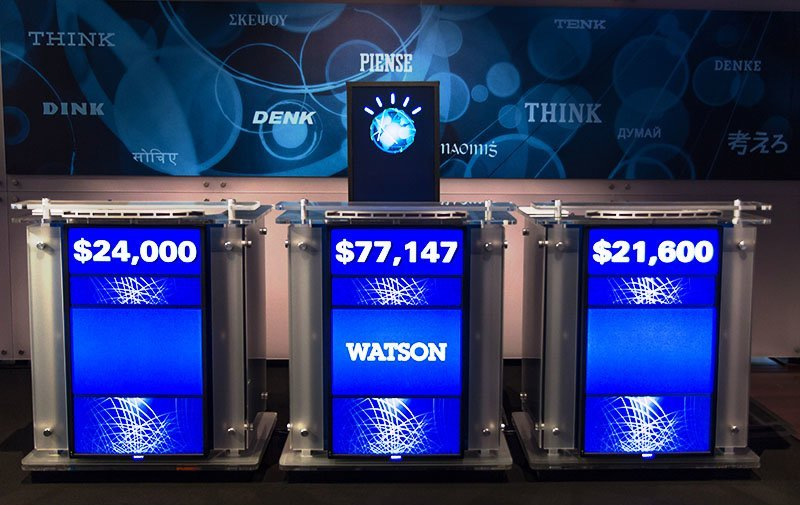
In February 2011, a machine stood behind a lectern and answered questions framed as clues.
It did so quickly, often before its opponents had finished reading. The format was familiar, but the presence was not. The system, known as IBM Watson, was competing on Jeopardy! against two of the most successful players in the programme’s history.
The match took place over three days, from 14 to 16 February. Watson faced Ken Jennings, who held the record for the longest winning streak with seventy four consecutive wins, and Brad Rutter, the highest earning contestant, who had not been defeated in earlier tournaments. The setting was familiar, but the outcome would depend on something that had been difficult for machines to manage. Language, in this form, does not present itself plainly.
The challenge lay in the structure of the game. Clues are often indirect. They rely on puns, metaphor and shifts in meaning. They draw on knowledge across history, science, literature and popular culture. A correct response requires more than retrieval. It requires interpretation under time pressure, followed by a decision to act. The signalling device introduces another constraint. A player must not only find an answer, but do so quickly enough to take the turn.
Before this match, systems had performed well when information was clearly structured. Search engines could retrieve documents. Databases could return facts. The difficulty was in moving from retrieval to understanding, particularly when language was ambiguous.
Watson was designed to address that problem. Developed by IBM Research, it was built as a question answering system rather than a search tool. It drew on natural language processing to interpret the structure of a clue, identifying possible meanings, synonyms and relationships between words. It used machine learning to improve its performance over time, drawing on previous questions and answers to refine its approach.
The system had access to a large body of information, reported to include more than 200 million pages of both structured and unstructured text, drawn from sources such as encyclopedias, books and Wikipedia. It did not search this material in the way a conventional engine might. Instead, it generated possible answers, evaluated them and assigned a confidence score to each. Only when that score passed a threshold would it signal to respond.
To achieve this within the time allowed, Watson relied on parallel processing. Its DeepQA architecture was distributed across ninety IBM Power 750 servers, allowing it to analyse multiple interpretations at once. In practice, it would consider thousands of candidate answers in a matter of seconds, selecting the most probable outcome before deciding whether to press the buzzer.
The first game established the pattern. Watson responded quickly and with a high degree of accuracy, particularly in categories where the questions were more direct. At the end of the first day, it held $35,734, compared with $10,400 for Rutter and $4,800 for Jennings.
The second game confirmed the result. Watson maintained its advantage in both speed and consistency. It did produce errors. In one instance, it identified Toronto as a city in the United States. These moments did not alter the overall outcome. By the end of the match, Watson had accumulated $77,147, while Jennings finished with $24,000 and Rutter with $21,600.
In the final round, Jennings wrote a response that drew wider attention. “I, for one, welcome our new computer overlords.” The remark was noted not for its accuracy, but for what it suggested about the moment.
The significance of the match lay in what had been demonstrated. Watson showed that a system could interpret natural language under conditions that involved ambiguity, wordplay and speed. It did not simply retrieve information. It analysed, compared and selected an answer based on probability.
This had implications beyond the programme. The ability to process language in this way suggested that similar systems could be applied in other domains. In medicine, systems were developed to assist with diagnosis by analysing medical literature and patient data. In finance, similar approaches were used for risk analysis and fraud detection. In business, systems based on comparable methods were applied to customer service and data analysis.
The match also influenced the development of conversational systems. Advances in natural language processing contributed to the emergence of assistants such as Siri, Google Assistant and Alexa, as well as to the development of systems designed to summarise documents and respond to queries in more flexible ways.
At the same time, limitations remained visible. Watson relied on a combination of rules and statistical methods rather than the deep learning approaches that would later dominate the field. Its success highlighted both what could be achieved and what remained to be addressed, encouraging further work on neural networks and related techniques.
The event was widely viewed, and it brought the capabilities of artificial intelligence into public discussion. It suggested that systems could operate in areas that had been associated with general knowledge and reasoning, rather than narrowly defined tasks.
Watson did not remain at the centre of that discussion. Other systems followed, using different methods and achieving different forms of progress. The match, however, marked a point at which the handling of language by machines became more visible.
The questions asked on the programme were not designed for computers. They were designed for people. The fact that a system could respond to them, under the same constraints, indicated a change that extended beyond the game itself.