
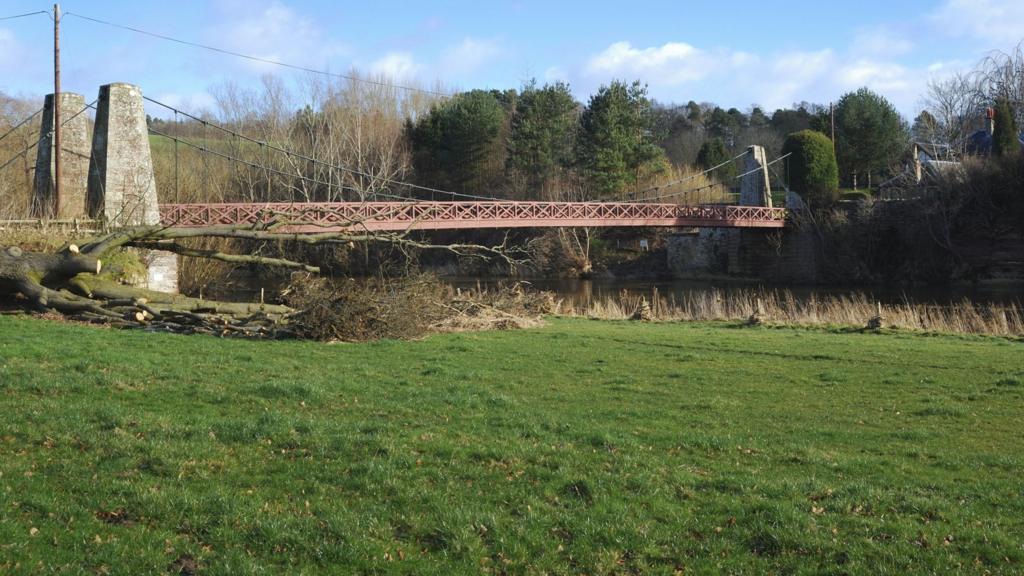
Along a quiet stretch of the River Teviot, a slender survivor of Britain’s early industrial ambition has been granted a reprieve. The Kalemouth Suspension Bridge, a rare chain-bar structure approaching its bicentenary, is to undergo restoration after securing £249,999 from the The National Lottery Heritage Fund. For a structure that has quietly endured the passage of nearly two centuries, the award represents not merely financial support, but an affirmation of its national significance.
Constructed around 1835 and spanning the River Teviot just south of Kelso, the bridge is attributed to Captain Samuel Brown, a pioneer in the use of wrought iron chains for suspension bridges. Brown’s work belongs to the formative period of suspension bridge design, preceding the widespread adoption of wire cable systems that would later define the great spans of the Victorian age.
Chain-bar suspension bridges such as Kalemouth rely on linked wrought iron bars rather than bundled wire cables. It is a method both elegant and, by modern standards, structurally unforgiving. Many such bridges were replaced, reinforced beyond recognition, or simply lost as engineering standards advanced. That Kalemouth survives in largely original form makes it one of the last of its kind in Scotland and a rare physical record of early nineteenth-century ingenuity.
Its A-listed status reflects that rarity. In British conservation terms, such designation is reserved for structures of national or international importance, placing the bridge among a small and carefully guarded architectural and engineering elite.
Decline, closure, and the necessity of intervention
Time, however, is indifferent to historical prestige. By 2020, deterioration in the structure forced its closure to vehicular traffic. Ageing ironwork, exposure to the elements, and the cumulative fatigue of nearly two centuries had rendered continued use increasingly untenable without intervention.
Yet unlike many relics of its era, Kalemouth has never been merely ornamental. It has remained a working crossing, particularly valued by walkers and cyclists navigating the Borders landscape. In an age now preoccupied with sustainable transport, the bridge’s modest scale and original purpose have acquired renewed relevance.
Caroline Clark of the Heritage Fund described it, with some understatement, as “a magnificent piece of engineering,” noting that restoration will include both essential structural work and the addition of interpretation panels. These will aim to explain not only the bridge’s mechanics but its place within the broader story of Britain’s industrial development.
Engineering heritage in a national context
To understand Kalemouth is to situate it within a wider lineage. Brown himself was responsible for the nearby Union Bridge of 1820, often cited as the oldest vehicular suspension bridge still in use. These early designs marked a decisive transition from masonry arches to lighter, longer spans made possible by iron.
They were, in essence, experimental. Engineering theory had not yet fully caught up with ambition, and many early suspension bridges suffered from instability or were later strengthened. Each surviving example, therefore, is not merely infrastructure but evidence of a learning process that shaped modern civil engineering.
Scotland, with its abundance of rivers and industrial appetite in the nineteenth century, became an important proving ground for such innovations. The survival of Kalemouth offers a rare glimpse into that formative period, before the standardisation and scale that would follow later in the century.
A project of preservation, not reinvention
Councillor John Greenwell has framed the funding as a decisive step toward safeguarding the bridge’s future, though he has been careful to note that further planning and financing remain necessary. Restoration projects of this nature are seldom straightforward. Conservation must balance authenticity with safety, often requiring painstaking repair rather than wholesale replacement.
The intention, crucially, is not to modernise beyond recognition but to preserve. In heritage terms, that distinction is everything. A restored Kalemouth must remain visibly itself, its iron chains and historic character intact, even as unseen reinforcements quietly ensure its continued use.
More than a bridge
There is, inevitably, a broader significance. In an era inclined toward demolition and replacement, the decision to preserve a structure like Kalemouth reflects a different philosophy one that values continuity over convenience. It is an acknowledgment that infrastructure can carry cultural meaning as surely as any cathedral or stately home.
If completed as envisioned, the project will do more than stabilise an ageing crossing. It will extend the life of a rare engineering artefact, reconnect a community route, and reassert the quiet dignity of early industrial design.
For now, the bridge waits. But with funding secured and plans advancing, one of Scotland’s last chain-bar suspension bridges appears set to endure, not as a relic, but as a living piece of history still doing the job it was built to do nearly two centuries ago.
#ModernScot