
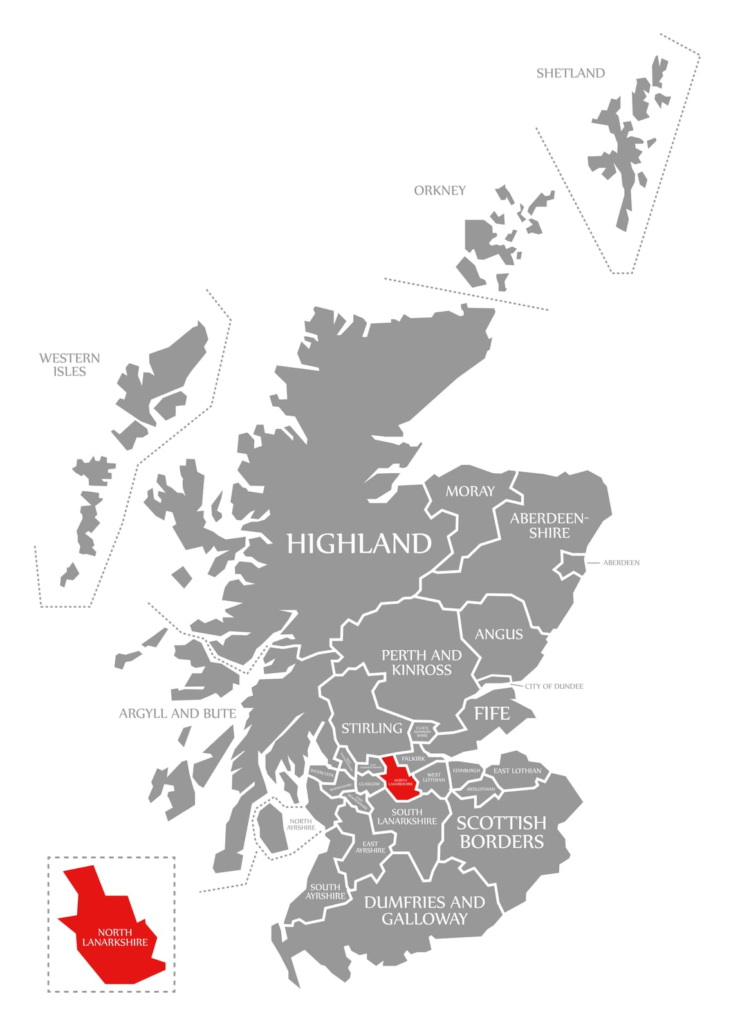
North Lanarkshire lies east of Glasgow and occupies a central position in Scotland’s industrial belt. It is one of the country’s larger council areas by population and includes towns whose histories are closely tied to coal, iron, steel, railways and post war development. Motherwell is the administrative centre, while Cumbernauld, Coatbridge, Airdrie, Wishaw and Bellshill form major parts of the settlement pattern.
The area’s industrial history is fundamental. Coatbridge became one of Scotland’s most important iron producing centres in the nineteenth century and was sometimes known as the Iron Burgh. Motherwell and Wishaw were closely associated with steel, coal and heavy industry. Ravenscraig steelworks, which closed in 1992, remains one of the defining symbols of late twentieth century industrial decline in Scotland.
Cumbernauld adds a different layer. Designated as a new town in 1955, it was intended to relieve overcrowding in Glasgow and create a modern planned settlement. Its architecture and planning have often been debated, criticised and reassessed, but the town remains one of Scotland’s most significant post war urban experiments.
The council area is crossed by major transport routes, including motorway and rail connections between Glasgow, Edinburgh and the wider central belt. This has made it a logistics and commuting location as much as an industrial one.
North Lanarkshire’s story is not simply one of decline. It is a place where Scotland’s industrial past has been partially dismantled, partially repurposed and still remains physically visible. Its towns carry the memory of production at national scale, even as the economy now depends on services, logistics, public employment and regeneration.