
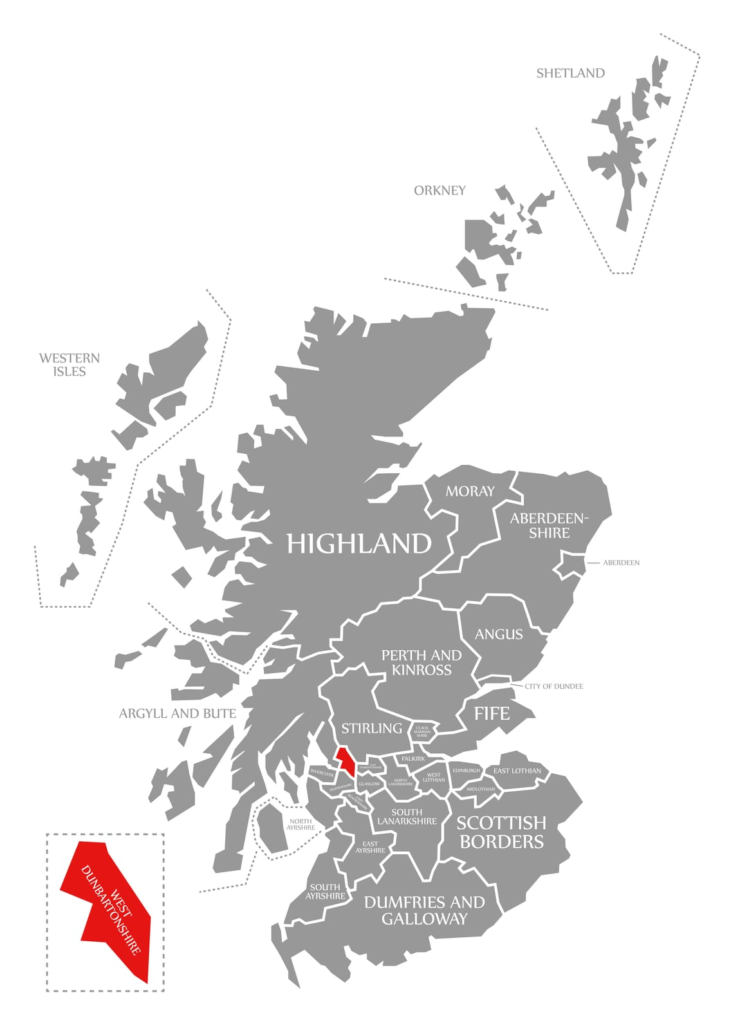
West Dunbartonshire lies along the north bank of the Clyde, stretching from the edge of Glasgow toward Loch Lomond. It is a compact council area, but its history is dense with industry, transport, shipbuilding, whisky, glass and strategic geography. Dumbarton is the administrative centre, while Clydebank and Alexandria are also central to the area’s identity.
Dumbarton Rock gives the area one of its oldest and most dramatic historic sites. The fortress there was associated with the kingdom of Strathclyde and remained strategically important for centuries. The town’s later development was tied to shipbuilding, engineering and its position on the Clyde.
Clydebank became one of Scotland’s major industrial towns, especially through shipbuilding and engineering. John Brown’s shipyard built some of the most famous vessels of the twentieth century, including major liners and warships. The Clydebank Blitz in March 1941 caused severe destruction and remains one of the defining events in the town’s modern history.
The Vale of Leven developed through textiles, dyeing, printing and later whisky associated industries. Balloch, at the southern end of Loch Lomond, gives the council area a strong tourism and gateway function, connecting the industrial Clyde corridor to one of Scotland’s most visited landscapes.
West Dunbartonshire’s modern economy reflects a long post industrial transition. Public services, tourism, commuting, retail and regeneration now sit where heavy industry once dominated. Yet the older industrial and strategic layers remain visible.
The council area is small, but it contains a remarkable compression of Scottish history: ancient kingdom, river industry, wartime destruction and modern access to Loch Lomond. Few places hold so much in such a narrow strip of land.