
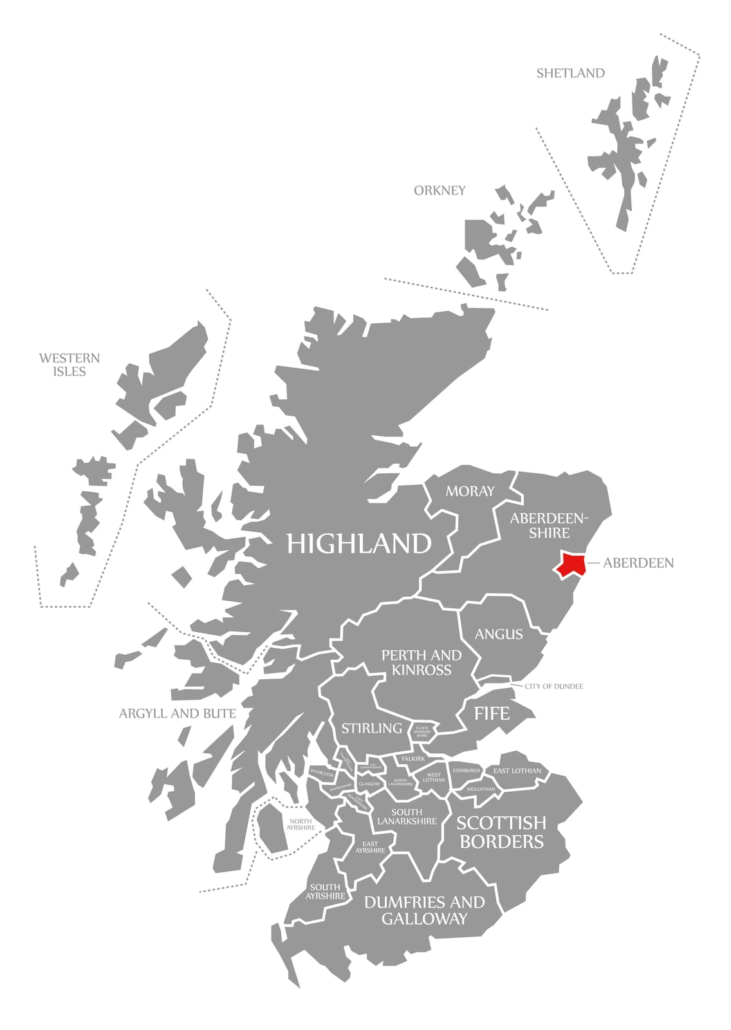
Aberdeen City sits on Scotland’s north east coast, where the Dee and Don meet the North Sea and where geography has long dictated the city’s purpose. It is a compact council area by Scottish standards, but its influence has rarely been confined to its boundaries. Aberdeen developed as a port, a university city and an industrial centre before becoming one of the principal bases of the North Sea oil and gas industry in the second half of the twentieth century.
Its civic history is unusually deep. The burghs of Old Aberdeen and New Aberdeen developed separately, with Old Aberdeen closely associated with King’s College, founded in 1495, and New Aberdeen growing around trade, harbour activity and municipal power. The two were formally united in 1891, a date that still matters because the modern city carries both histories within it.
The granite that defines much of Aberdeen’s built character was not merely decorative. It came from the region’s own quarrying and construction traditions, giving the city a hard, pale texture that changes sharply with weather and light. Marischal College, begun in the nineteenth century and long associated with the University of Aberdeen, remains one of the clearest statements of that civic confidence.
Aberdeen’s economy was reshaped dramatically after the discovery and development of North Sea oil. From the 1970s onward, the city became a centre of offshore engineering, logistics and energy services. That role brought wealth and volatility in equal measure. Today, the city’s future is tied not only to oil and gas, but to the question of how a place built around offshore expertise adapts to energy transition.
The council area is urban, but its position is maritime. The harbour, airport, rail station and road links all point outward. Aberdeen is not simply a city at the edge of Scotland. It is a city that has repeatedly turned its edge into an advantage.