
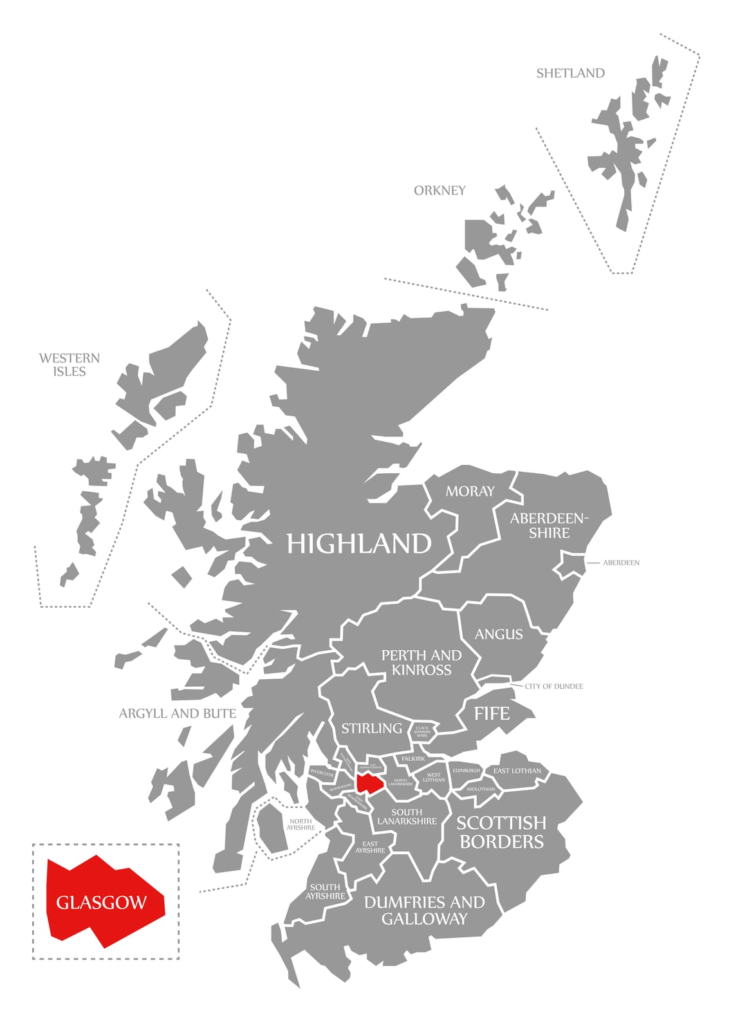
Glasgow City is Scotland’s largest city and one of the most consequential urban authorities in the country. It sits on the River Clyde, whose industrial and commercial history shaped not only the city but much of modern Scotland. Its council boundary is relatively tight, but its urban influence extends far into the surrounding conurbation.
Glasgow grew rapidly during the eighteenth and nineteenth centuries through trade, manufacturing, engineering and shipbuilding. The Clyde became one of the world’s great shipbuilding rivers, and the city’s population expanded dramatically as industry drew workers from across Scotland, Ireland and beyond. That expansion created wealth, civic confidence and severe urban hardship in the same breath.
The city’s cultural and educational institutions reflect its scale. The University of Glasgow was founded in 1451, making it one of Scotland’s ancient universities. The city also contains major museums, theatres, music venues and art collections, including Kelvingrove Art Gallery and Museum and the Burrell Collection.
Glasgow’s twentieth century was marked by industrial decline, housing change and repeated attempts at renewal. Comprehensive redevelopment, motorway construction, high rise housing and later regeneration all reshaped the city, not always gently. The title of European City of Culture in 1990 marked a major moment in the city’s repositioning, but it did not erase older inequalities.
Modern Glasgow is a city of strong identity and unresolved contrasts. It is a cultural capital, a university city, a transport hub and an economic centre. It is also a place where health, poverty and infrastructure pressures remain sharply visible. Glasgow’s force lies in the fact that it never quite allows itself to be reduced to its image.