
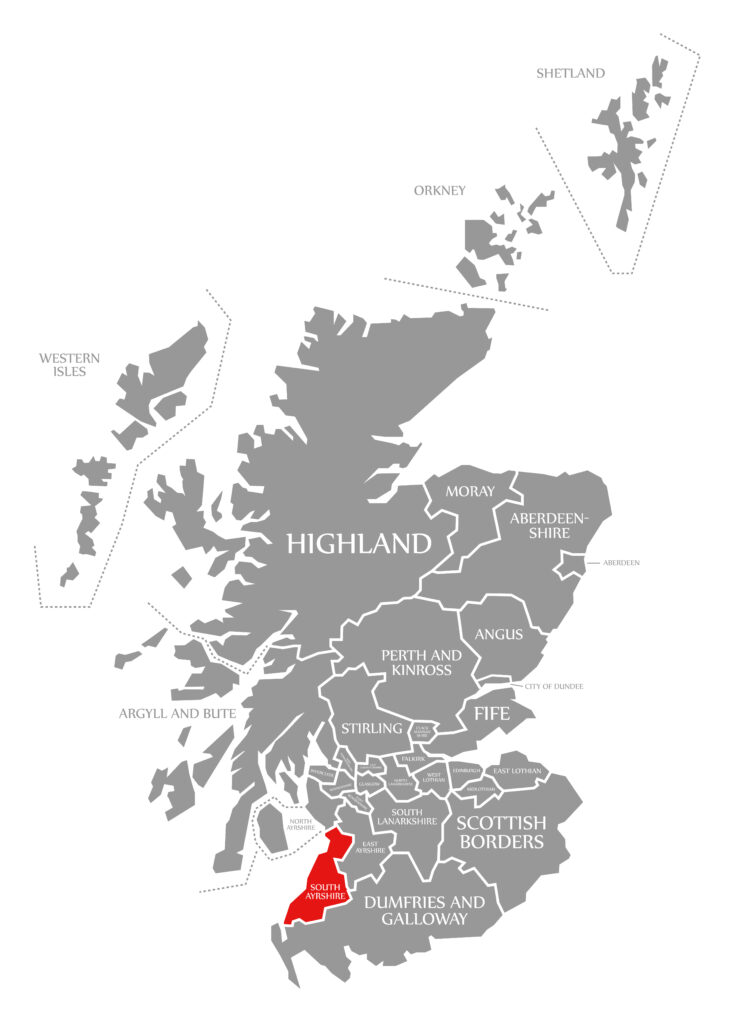
South Ayrshire occupies a long stretch of the Ayrshire coast, with Ayr as its administrative centre and largest town. The council area includes coastal resorts, rural hinterland, historic settlements and parts of the Carrick landscape to the south. Its identity is shaped by the Firth of Clyde, agriculture, tourism and literary memory.
Ayr has long been one of the principal towns of south west Scotland. It developed as a royal burgh and market town, with harbour activity, administration and later tourism shaping its growth. Nearby Alloway gives the area one of its strongest cultural associations. Robert Burns was born there in 1759, and the landscape around Alloway, including the Auld Kirk and Brig o’ Doon, became part of Scotland’s literary imagination.
The wider council area includes Prestwick, Troon, Maybole, Girvan and smaller communities. Prestwick has a long aviation history, with Prestwick Airport playing an important role in transatlantic aviation during the twentieth century. Troon is internationally known through golf, particularly Royal Troon, which has hosted The Open Championship.
South Ayrshire’s rural south includes parts of Carrick, a historic district associated with medieval lordship and later agriculture. The coastline remains central to the area’s identity, supporting tourism, recreation, transport and local economies.
The modern economy includes public services, tourism, agriculture, aviation, retail and food production. Like much of Ayrshire, the area has had to manage the long transition from older industrial and transport economies to a more service based and visitor oriented structure.
South Ayrshire is often seen through leisure and coastline, but its history is more serious than that. It is a place where Scottish literature, transport, rural land and coastal identity intersect.