
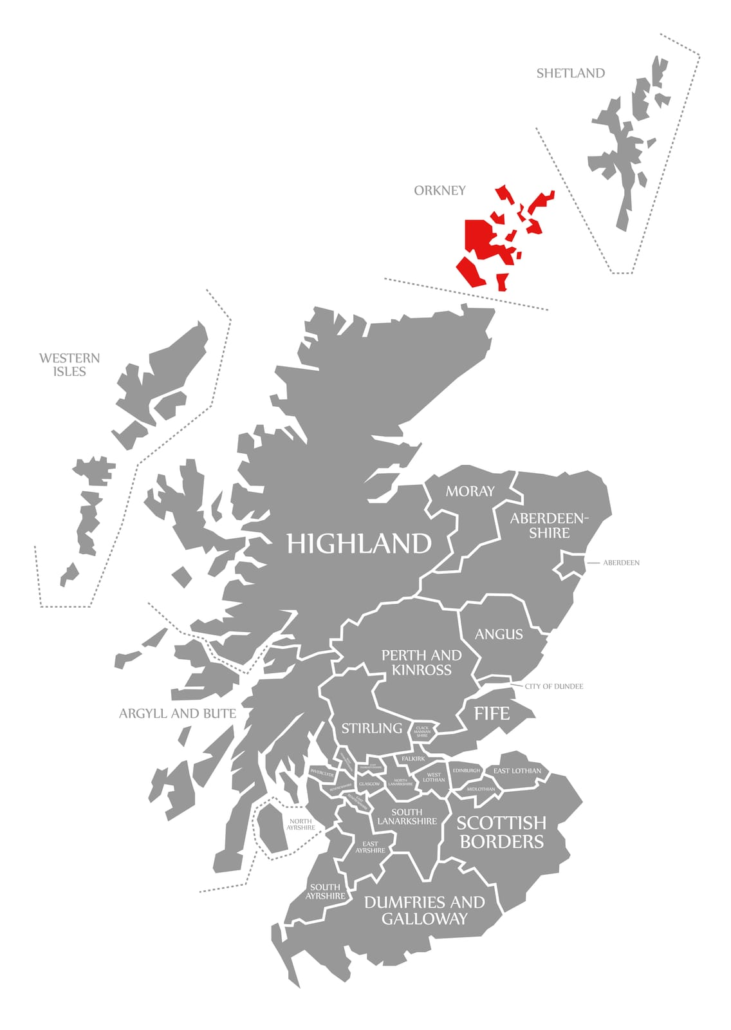
Orkney Islands form a council area whose geography sets it apart from mainland Scotland. The islands lie north of Caithness, where the North Sea and Atlantic meet, and where distance, weather and sea routes shape almost every aspect of public life. Kirkwall is the administrative centre and largest settlement, with Stromness forming the other principal town.
Orkney’s prehistoric significance is exceptional. The Heart of Neolithic Orkney, including Skara Brae, Maeshowe, the Stones of Stenness and the Ring of Brodgar, was inscribed as a UNESCO World Heritage Site in 1999. These sites place Orkney at the centre of Neolithic Europe, not at its edge.
The islands also carry a strong Norse inheritance. Orkney was under Norse rule for centuries before becoming part of Scotland in the fifteenth century. St Magnus Cathedral in Kirkwall, founded in the twelfth century, remains one of the clearest architectural expressions of that period.
The modern economy includes agriculture, fishing, tourism, renewable energy, public services and marine research. Orkney has become especially important in marine energy testing, with the European Marine Energy Centre established in 2003 to support wave and tidal energy development.
Transport is central to daily life. Ferries and air services connect the islands internally and to mainland Scotland. These connections are not conveniences; they are lifelines for health care, education, trade and ordinary movement.
Orkney is often presented as ancient, and it is. But it is also technically modern, agriculturally active and strategically placed. Its history is deep, but its present is not static.