
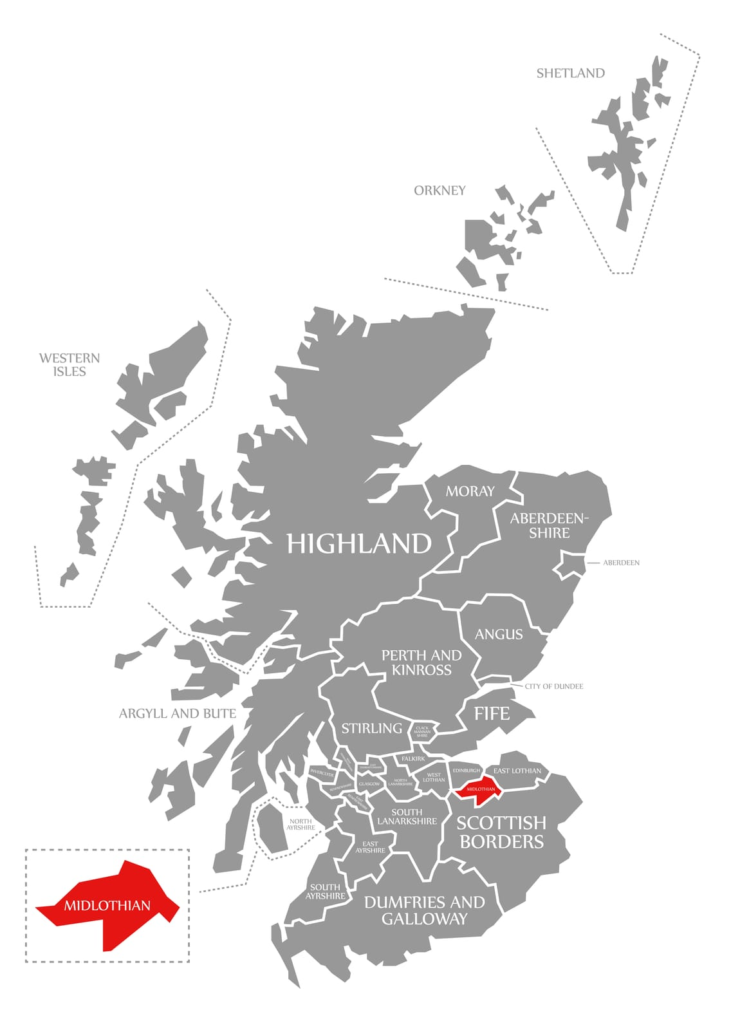
Midlothian lies immediately south of Edinburgh, close enough to the capital to be shaped by its growth, but distinct enough to retain its own history, settlements and landscape. It is a compact council area of former mining communities, commuter towns, farmland and historic sites, with Dalkeith as its administrative centre.
The area’s settlement pattern includes Dalkeith, Bonnyrigg, Penicuik, Loanhead, Gorebridge and Newtongrange. Many of these places grew through industry, especially coal mining, paper making and related manufacturing. The decline of those industries left a social and economic legacy that continues to shape parts of the area.
Newtongrange is home to the National Mining Museum Scotland, based at the former Lady Victoria Colliery, which opened in the nineteenth century. The site preserves a central part of Midlothian’s industrial history and stands as one of the clearest reminders of how coal shaped communities across the Lothians.
Midlothian also has much older layers. Rosslyn Chapel, founded in the fifteenth century, remains one of Scotland’s most distinctive late medieval buildings. Dalkeith Palace and its estate reflect aristocratic and administrative histories, while the wider landscape contains routes and settlements tied to the long development of south east Scotland.
Transport changed significantly with the reopening of the Borders Railway in 2015, restoring passenger rail services through parts of Midlothian and into the Scottish Borders. This altered commuting patterns and strengthened links with Edinburgh, while also increasing pressure for housing and development.
Midlothian is often treated as Edinburgh’s edge, but that is too simple. Its history is industrial, ecclesiastical, rural and residential. It is close to the capital, but it has never been only a suburb of it.