
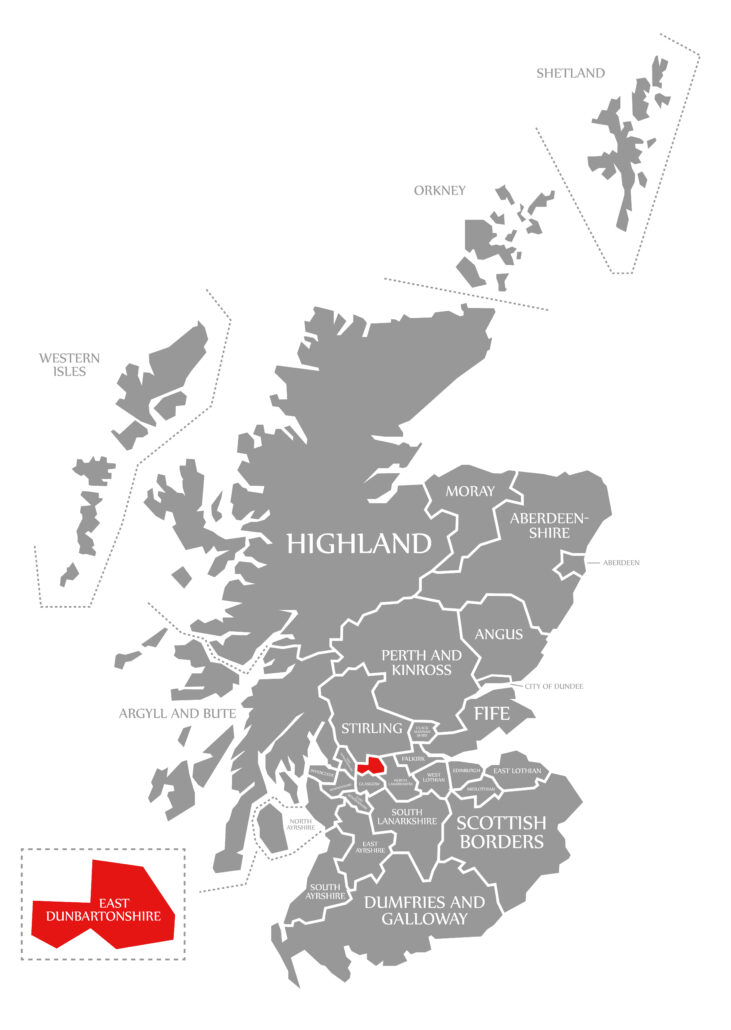
East Dunbartonshire sits north of Glasgow, a compact council area containing suburban settlements, commuter towns, older villages and parts of the Forth and Clyde Canal corridor. It is close to Scotland’s largest city, but it is not simply an extension of it. Its identity lies in the overlap between urban proximity and local continuity.
Kirkintilloch is the administrative centre and one of the area’s most historically significant towns. The Antonine Wall, constructed by the Romans in the second century, passed through this wider corridor, and remains one of the most important archaeological features in central Scotland. Bearsden also contains Roman remains linked to the wall’s military frontier.
The Forth and Clyde Canal, opened in the late eighteenth century, helped shape industrial and transport development across the area. Kirkintilloch became closely associated with canal traffic and later with heavy industry, including iron founding. The canal’s restoration and continuing public use now give the area a visible link between industrial infrastructure and leisure.
Milngavie, Bearsden, Bishopbriggs and Lenzie reflect the area’s modern residential character, with strong commuting links to Glasgow. Yet each carries a different settlement history. Milngavie is associated with the start of the West Highland Way, opened in 1980, which runs north to Fort William and connects an affluent edge of the metropolitan area to one of Scotland’s best known long distance routes.
East Dunbartonshire is often read through the lens of commuting and housing, but that is only part of the story. Its older layers are Roman, canal based, industrial and rural. The council area is small, but its ground has been used repeatedly as a route, boundary and place of settlement.