
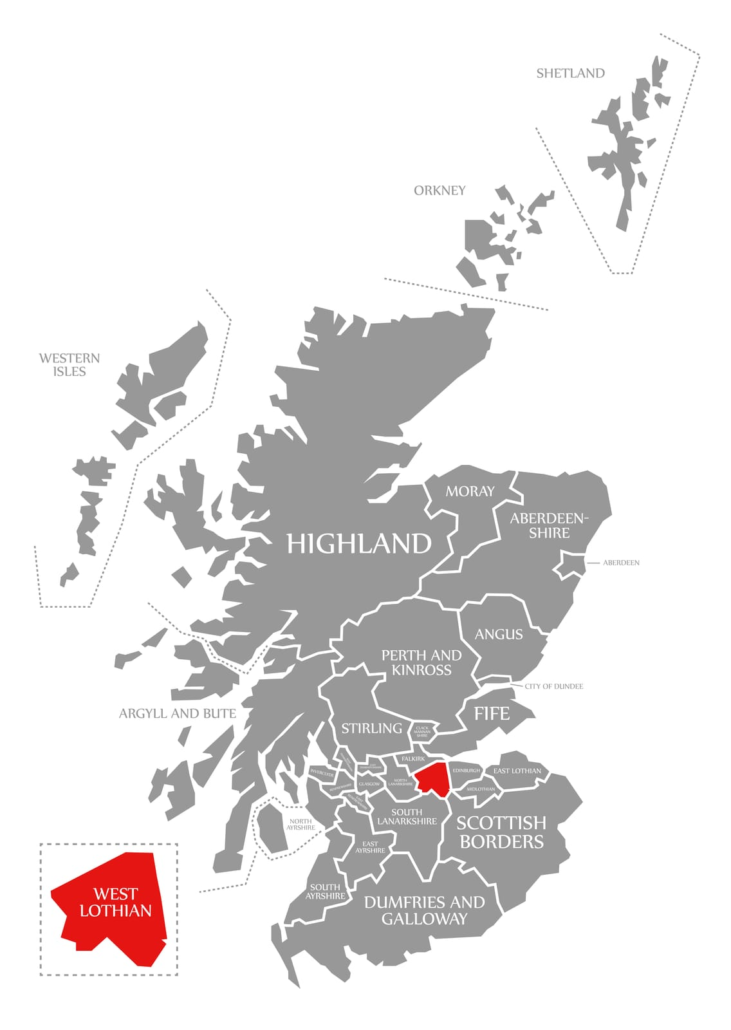
West Lothian sits between Edinburgh and Glasgow, a council area shaped by shale oil, coal, new town development, transport and rapid residential growth. Livingston is the administrative centre and largest town, though the area’s older identity was formed through burghs, villages and industrial settlements long before the new town era.
Livingston was designated as a new town in 1962, part of Scotland’s post war programme to address overcrowding and reorganise population and industry. Its planned growth reshaped West Lothian’s settlement pattern and gave the area a modern commercial and administrative centre.
Older towns such as Linlithgow, Bathgate, Broxburn and Whitburn carry different histories. Linlithgow is particularly important through Linlithgow Palace, birthplace of Mary, Queen of Scots in 1542 and one of Scotland’s major royal residences before falling into ruin. Bathgate and Broxburn were shaped by industry, especially shale oil extraction and processing.
West Lothian was one of the key centres of the Scottish shale oil industry in the nineteenth and early twentieth centuries. The red bings that still mark parts of the landscape are not accidental spoil heaps. They are the physical remains of an industry that once placed the area at the forefront of mineral oil production.
The modern economy includes distribution, retail, public services, commuting and manufacturing. Its location between Scotland’s two largest cities gives West Lothian strong transport advantages but also exposes it to development pressure.
West Lothian is often read as a commuter region, but that undersells it. Beneath the new roads and housing lies a landscape of royal power, industrial experiment and planned modernity.