
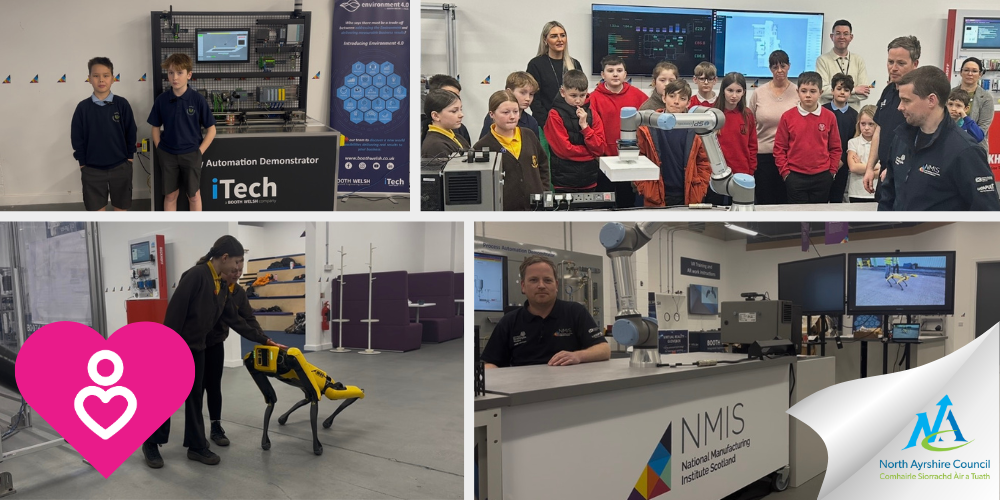
In a quiet corner of Ayrshire, something rather more consequential than a school trip has taken place.
At the Digital Process Manufacturing Centre in Irvine, dozens of primary pupils from across North Ayrshire have been introduced not merely to machines, but to the architecture of the future itself. Robotics, artificial intelligence, advanced manufacturing, and 5G technologies were no longer abstract ideas confined to textbooks. They were tangible, interactive, and—perhaps most importantly—within reach.
The visit, hosted by the National Manufacturing Institute Scotland and delivered in partnership with North Ayrshire Council and the University of Strathclyde, marked the first dedicated interactive learning session at the facility for primary-aged children. Thirteen schools took part, each bringing pupils into direct contact with technologies that will likely define their working lives.
There is, in this, a quiet but profound shift. For decades, the conversation around industry has been one of decline and replacement. Here, however, was something different—renewal, and with it, invitation.
From curiosity to capability
The children were not passive observers. They designed, built, and imagined. In one workshop, parts of a decommissioned wind turbine were repurposed into imaginative structures—solar shelters, play spaces, and community assets—before being digitally rendered for future development. It was, at once, environmental education and engineering in miniature.
Such exercises speak to a broader truth. The industries of tomorrow will not simply demand technical skill; they will require adaptability, creativity, and a degree of social conscience that older models of manufacturing rarely asked for.
John Harman of NMIS captured the moment with measured clarity, describing the experience as one that “sparks curiosity and confidence in the next generation of innovators.” One suspects he is correct—but perhaps understated the case.
The economic reality behind the inspiration
This initiative is not occurring in a vacuum. According to Skills Development Scotland, manufacturing remains the highest value sector in North Ayrshire, contributing an estimated £713 million to the local economy. Over the next decade, more than 7,000 roles will need to be filled across STEM industries in the region.
That is not a distant projection. It is an approaching inevitability.
Against that backdrop, the importance of early engagement becomes rather less a matter of policy preference and rather more one of economic necessity. The pipeline, as policymakers are fond of calling it, must begin somewhere. Increasingly, it begins here—at primary school age, where curiosity is abundant and preconceptions are few.
A model worth watching
Councillor Margaret Johnson framed the visit within a broader ambition: a “wellbeing economy” that prioritises resilience, prosperity, and fairness. It is the sort of phrase that can easily drift into abstraction. Yet in Irvine, it was given a more concrete form.
Children learning how technology can serve communities. Industry opening its doors rather than guarding them. Education stepping beyond the classroom and into the real world.
There is, undeniably, a strategic intent behind it all. But there is also something more human—an understanding that inspiration, once lit early enough, tends to endure.
And so, while the machinery at the Digital Process Manufacturing Centre may be cutting edge, the principle at work is rather older: show the young what is possible, and they may yet build something better than what came before.
#ModernScot