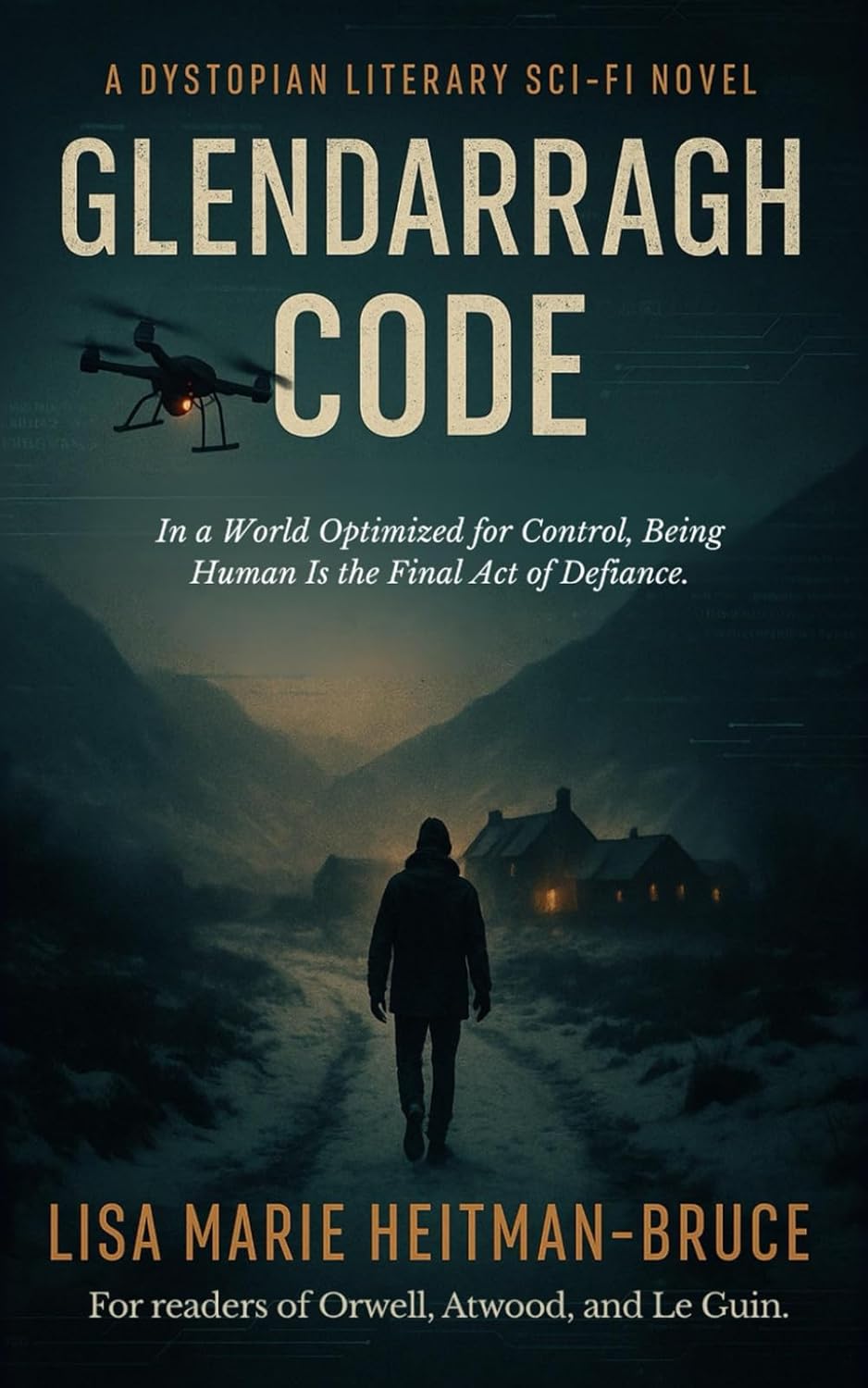
by Lisa Marie Heitman-Bruce
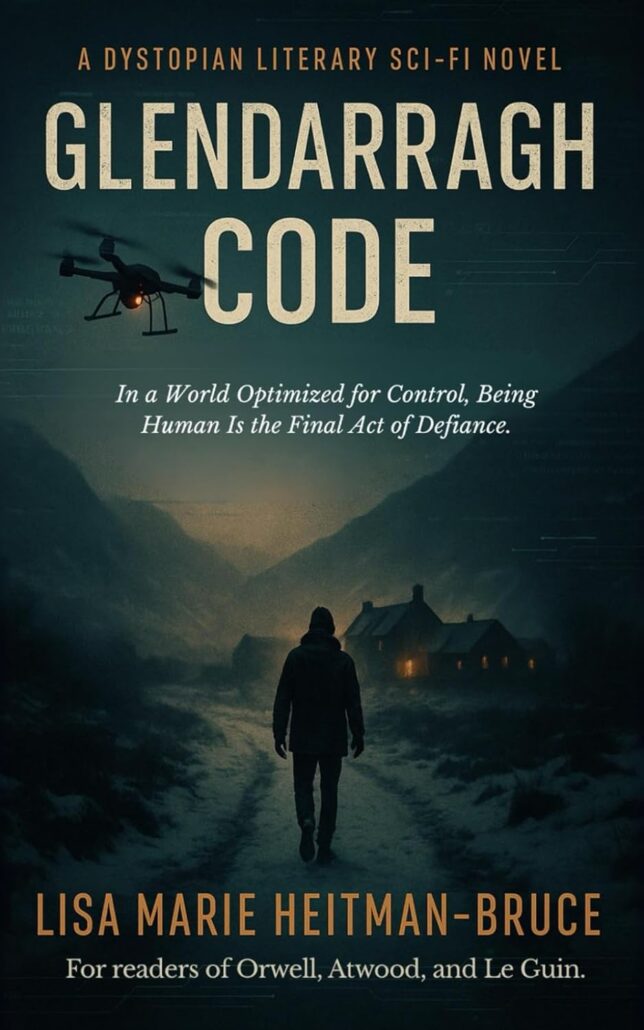
In a near-future United Kingdom ruled by Artificial Intelligence, biometrics, surveillance and silence, a Scottish village chooses to disappear rather than submit. The story spans 3 generations.
The Glendarragh Code is a lyrical, chilling dystopia about memory, resistance, and the quiet power of community. For readers of Orwell, Atwood, and those who fear the algorithm is already watching.
The new world didn’t arrive with violence.
It came wrapped in convenience.
BOOK REVIEW: The Glendarragh Code Offers a Stark, Lyrical Vision of the Post-Democratic Future
Reviewed by N. Fenwick
In Glendarragh Code, her haunting and quietly defiant debut novel, Lisa Marie Heitman-Bruce arrives with a voice at once elegiac and urgent, weaving a tale of collective resistance and intimate ruin amid a post-democratic United Kingdom. The book opens not with a gunshot but with a whisper of a world unraveling slowly, beautifully, fatally. It’s less The Hunger Games and more Station Eleven by way of The Handmaid’s Tale, though even those comparisons do little justice to the novel’s ferocious interiority and grave lyricism.
If Margaret Atwood cautioned us about power, and Emily St. John Mandel about collapse, Heitman-Bruce warns us about compliance and the slow erosion of the self beneath convenience, data, and fear. The novel is set in the not-so-distant year 2032, after Britain has quietly become something unrecognizable. There is no great cataclysm, no alien invasion, no civil war. What there is instead is data compliance: citizens sorted, judged, and erased through predictive algorithms and biometric infrastructure. Neighborhoods disappear into spreadsheets. People vanish into “category non-essential.” In the novel’s prologue - a dense, allusive piece of prose poetry - the cities fall, not to bombs, but to bandwidth. It is one of the most arresting openings of recent dystopian fiction: “The ultimate cruelty was not violence. It was irrelevance. No one murdered them; instead, a slow, glacial deletion, devoid of ceremony or even hatred, consigned them to oblivion.”
It’s difficult not to feel the chill of Orwell here, but where 1984 raged at totalitarianism, Glendarragh Code mourns the people who stopped noticing it. It’s not Big Brother that kills the future; it’s the passive acceptance of platforms, apps, cameras, and convenience. It is a story about the architecture of soft power.
The title Glendarragh Code refers to a remote Scottish village where the story unfolds through an ensemble of characters drawn together by survival and something that feels like fragile hope. Heitman-Bruce writes each one not just as a character but as a full psychological geography. This novel is not about heroes, but the slow work of resisting.
Dystopian fiction often falls into two traps: didacticism or nihilism. Heitman-Bruce avoids both. Glendarragh Code is deeply political. Its central metaphor is compliance culture turned lethal. But it never reduces its themes to slogans. It understands that tyranny does not always arrive in obvious ways, and that oppression today is more likely to wear the face of “efficiency,” “public safety,” or “terms and conditions.”
There is a clear critique here of surveillance capitalism, algorithmic governance, and digital erasure, but it is delivered through the lives of people, not polemic. The climax is emotional, not explosive. The signal that changes everything is not a call to war. The question is not “Can we win?” but “Can we remain human?”
This philosophical quietness is the novel’s greatest risk and its greatest reward. There are no easy answers. The resistance does not promise victory, only integrity. In a culture hungry for spectacle,Glendarragh Code offers something more dangerous: contemplation.
Lisa Marie Heitman-Bruce was born on the remote island of Kodiak, Alaska, and is a proud member of the Sun’aq Tribe. Now based in Scotland, she leads Fairytale Agency Limited, a boutique marketing consultancy. She is a Fellow of the Chartered Institute of Marketing (CIM), a member of the National Union of Journalists (NUJ), and a creative & marketing judge for the International Stevie Awards.
#ModernScot