
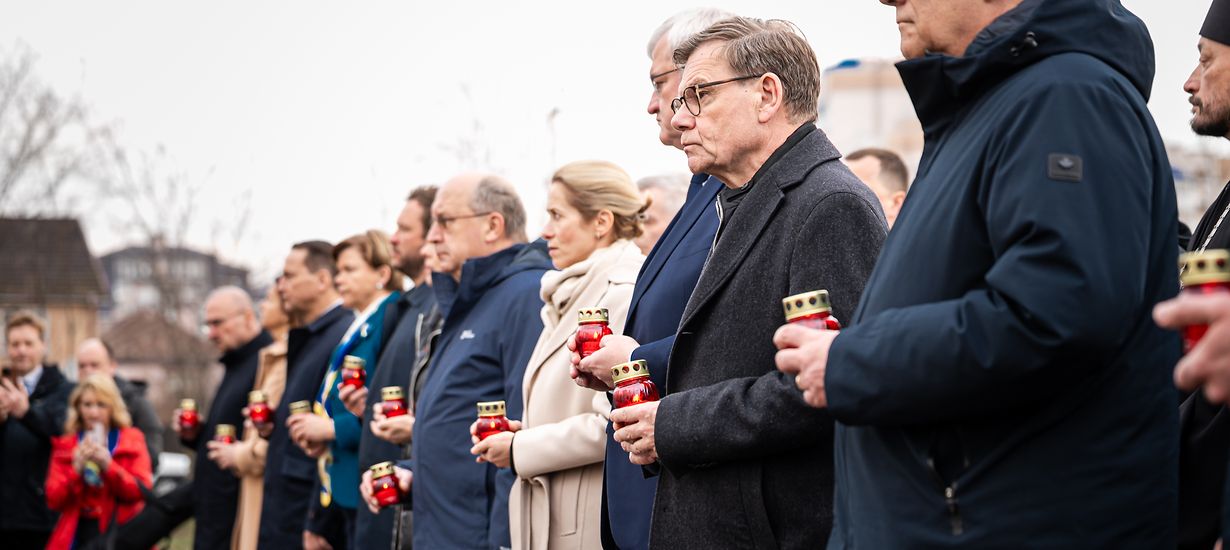
European foreign ministers gathered in Ukraine yesterday in a highly symbolic show of unity, as Germany’s Foreign Minister Johann Wadephul joined counterparts for an informal European Union meeting held in both Bucha and Kyiv.
The decision to convene in Bucha was deliberate and laden with meaning. The town has become one of the most potent symbols of the brutality associated with Russia’s full scale invasion of Ukraine, widely referred to as the Russian invasion of Ukraine. When Ukrainian forces retook Bucha in 2022, they uncovered evidence of mass civilian killings, torture, and other grave abuses that shocked the international community.
Speaking upon arrival, Wadephul described Bucha as both a site of immense tragedy and a marker of resilience. He recalled the aftermath of the occupation, where hundreds of civilians were found dead, some buried in mass graves while others lay where they had been killed in homes and streets. Survivors recounted harrowing experiences, including executions and sexual violence.
Yet the minister also framed Bucha as a place of hope. Its liberation by Ukrainian forces, he noted, demonstrated both military resolve and the determination of a population unwilling to yield to what he characterised as Moscow’s imperial ambitions.
The meeting coincides with the anniversary of Bucha’s liberation and serves as a broader reminder of other devastating घटनाओं attributed to Russian forces, including the massacres in Izyum, the deadly strike on the Kramatorsk railway station, and the prolonged destruction of Mariupol.
A central theme of the discussions was accountability. Wadephul reiterated Germany’s backing for international mechanisms aimed at prosecuting those responsible for alleged war crimes. Among these efforts is the proposed Special Tribunal for the Crime of Aggression against Ukraine, alongside a claims commission designed to pursue financial reparations for war damage.
Germany has also deployed legal and forensic experts to assist Ukrainian authorities in gathering and preserving evidence. The intention, according to Wadephul, is unequivocal: those responsible for atrocities must face justice. He stressed that accountability is owed not only to the victims but also to their families and communities.
Beyond justice, the gathering underscored Ukraine’s continuing centrality to European foreign policy. Wadephul described Ukraine as part of the European family, arguing that its fight for sovereignty and freedom is inseparable from the security of Europe as a whole. The presence of EU ministers on Ukrainian soil, particularly in a location as symbolic as Bucha, was intended to reinforce that message.
The meeting also reaffirmed long term commitments, including continued military, political and economic support, as well as backing for Ukraine’s path towards eventual European Union membership. At the same time, ministers emphasised the need to maintain pressure on Russia, viewing sustained support for Ukraine as essential not only for Kyiv’s future but for the stability of the wider continent.
In the quiet streets of Bucha, where the scars of युद्ध remain visible, the diplomatic gathering served as both commemoration and warning: a remembrance of what has occurred, and a signal that Europe intends neither to forget nor to relent.
#ModernScot