
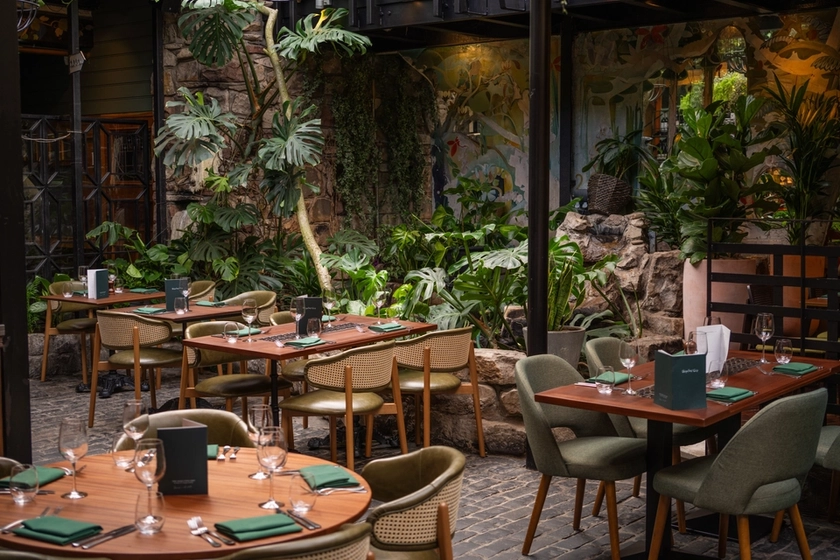
One of Glasgow’s most storied dining institutions, The Ubiquitous Chip, has been awarded Category B listed status by Historic Environment Scotland (HES), recognising both its architectural character and its deep cultural ties to the city’s artistic life.
Tucked away on Ashton Lane in the West End, the restaurant occupies a former stables and livery yard, a setting it has called home since 1974. Established in 1971, “The Chip” has long been more than a place to dine—it has served as a gathering point for writers, artists and thinkers who have shaped modern Glasgow’s cultural identity.
At the heart of the listing are two murals by celebrated Scottish artist and author Alasdair Gray, widely regarded as one of the country’s most distinctive creative voices. Painted between 1977 and 1981, the works—Florid Jungle and Arcadia—are considered rare surviving examples of late 20th-century public mural art in Scotland.
Florid Jungle, a richly detailed and vibrant scene, fills the restaurant’s courtyard with dense foliage and colour. Meanwhile, Arcadia offers a more social tableau, depicting friends, staff and regular patrons gathered in a leafy setting, complete with food, drink and conversation. True to Gray’s style, the mural incorporates his own aphorisms, including the oft-quoted line: “Work as if You Live in the Early Days of a Better Nation,” adapted from Canadian poet Dennis Lee.
These works were created just before the publication of Gray’s landmark novel Lanark in 1981, a book that would go on to cement his literary reputation. Yet Gray’s contribution to Scottish culture extended far beyond literature. Over a career spanning decades, he moved fluidly between novels, poetry, plays, political essays and visual art, with a particular passion for placing art in everyday public settings—from pubs and churches to parks and civic spaces.
Dara Parsons, Head of Designations at Historic Environment Scotland, said the listing acknowledges both the rarity and importance of the murals. She described Gray as “one of Scotland’s most well-known cultural figures” and noted that the works at The Ubiquitous Chip stand as significant examples of his contribution to public art.
Sorcha Dallas, Custodian of the Alasdair Gray Archive, welcomed the decision, emphasising that the murals embody Gray’s belief in making art accessible. She noted that the works capture the spirit of Glasgow’s West End cultural community and reflect how Gray’s visual art, writing and social ideals were closely intertwined.
The designation ensures that both the building and its interior features—including the murals—will be protected as part of Scotland’s national heritage. It is a fitting recognition for a venue that has quietly played host to decades of creative exchange, and whose walls quite literally tell the story of a city’s artistic evolution.
#ModernScot