

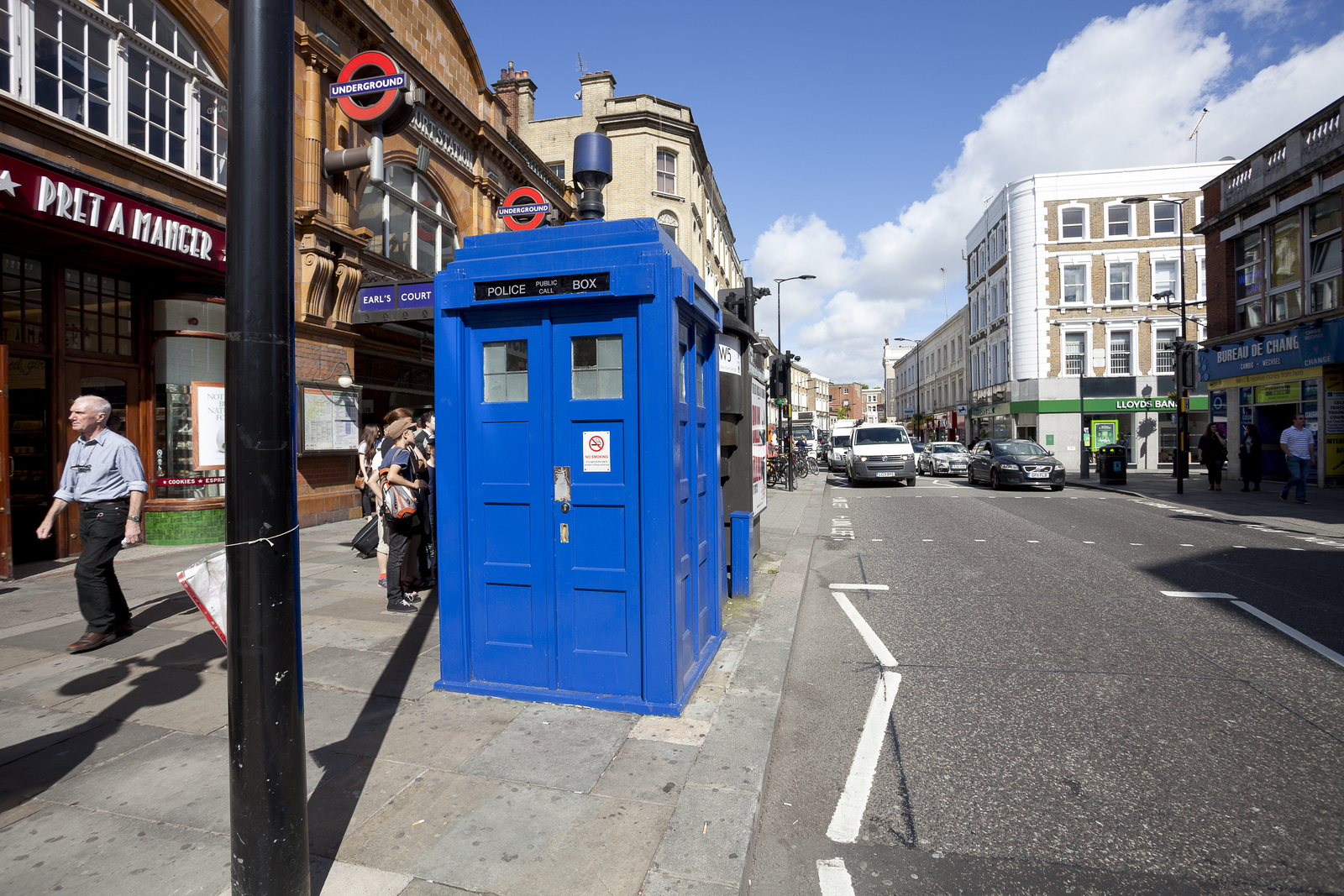
On Thursday evening, the King and Queen arrived in Glasgow by TARDIS.
This was encouraging.
For years, those of us living in the Highlands have been told that distance is a difficult problem. It affects buses, trains, broadband engineers, hospital appointments, postal deliveries and anyone attempting to obtain a replacement part for a washing machine. The general impression has been that the north of Scotland lies beyond the practical limits of organised movement.
We now know this is untrue.
The answer is a blue police box capable of travelling through time and space.
This is considerably more efficient. Naturally, it was launched in Glasgow. I would like to know whether the service is available to the public.
Sir Chris Hoy was sent to collect the royal couple. This was sensible. If Scotland has developed a machine able to pass through centuries and galaxies, it should be entrusted to a man who understands both speed and the importance of arriving at the correct line.
I do not know whether he was required to show identification.
The King and Queen emerged safely inside the arena, without replacement buses, engineering works or an announcement explaining that their journey had been delayed because of sheep on the line.
No luggage appeared to have been lost.
This immediately places the TARDIS ahead of several established operators.
There has been no information about tickets. One assumes the royal party travelled first class, although in a vehicle that is larger on the inside, all seating may be regarded as first class. There should be room for a buffet carriage, a quiet coach and a small department dealing with complaints from previous centuries.
The public will need to know whether concessionary passes are accepted.
I have looked at the Transport Scotland website but can find no TARDIS timetable. There is no indication of whether it stops in Aviemore, whether booking is essential or whether passengers in the north will be expected to reach Inverness before using it.
This last arrangement would be familiar.
A rural TARDIS service would undoubtedly begin as a limited pilot. The vehicle would visit three communities on alternate Wednesdays, provided the road was suitable and no one had placed a planter where it needed to materialise.
Passengers would be advised to arrive ten minutes before departure and two hundred years before their appointment.
The booking system would ask for a postcode and then explain that the service was not currently available in the area.
There would be a map.
The Highlands outside of Inverness would be pale grey.
The TARDIS itself would remain in central Glasgow, where officials could observe that demand from Caithness had been disappointing.
A consultation would follow.
People would be invited to identify barriers to time travel. Responses would mention distance, cost and the absence of a ferry. The final report would conclude that rural communities lacked confidence in temporal mobility and would benefit from digital awareness training.
A new strategy would then be launched.
The TARDIS would be renamed the Integrated National Chronological Access Platform.
This would make it sound available.
There would be a photograph of three ministers standing beside it in hard hats.
The box would not move.
Even so, the possibilities are considerable.
A TARDIS could solve the problem of medical letters arriving after the appointment. Patients could simply travel back to attend. The NHS would record a substantial reduction in missed visits, although only after introducing a form to confirm that the patient had not knowingly caused a temporal paradox.
Road repairs could be completed before the pothole appeared.
New ferries could be collected from the future, assuming the future had managed to build them.
Planning applications could be determined during the lifetime of the applicant.
A person attempting to telephone a public body could travel forward to the precise moment when an adviser became available.
Parcel delivery would be transformed.
A driver could leave a package behind a bin on Tuesday, photograph it on Thursday and deliver it to the correct house the previous Monday.
This may already be happening.
The vehicle would be particularly useful for anyone living in a place whose existence is disputed by automated systems.
Our address is recognised by the council, the postman and people who have been here. It is less persuasive to computers. Depending on the website, we live in the Highlands, another district, a nearby village or nowhere at all.
But a TARDIS should be able to manage this because it needs only coordinates and perhaps a willingness to accept that a house can exist beyond the nearest distribution centre.
There would still be difficulties.
A blue police box left unattended in the Highlands would not remain an intergalactic transport system for long.
By the second day, someone would have put a notice on it advertising eggs.
By the end of the week, it would contain a shelf of home-made jam, two knitted hats, courgettes and a biscuit tin for payment.
The door would carry a handwritten message:
Back shortly. Please shut properly because of sheep.
Tourists would assume it was an honesty shop.
One would leave £2.50 and travel accidentally to the reign of James VI.
The Commonwealth Games ceremony also included Nessie.
This was less surprising.
Nessie has spent generations avoiding sonar, research vessels and people holding cameras. She was always likely to appear eventually in Glasgow, where unusual creatures can move about without attracting unnecessary comment.
It is possible that she came for the sport.
It is equally possible that someone promised catering.
But a reliable source has told me Nessie was willing to appear in Glasgow because there was paid work. This demonstrates the strength of the city’s creative industries.
The ceremony was held indoors, which shows that organisers had learned at least one thing from Scottish history.
Outdoor events in Scotland are planned on the understanding that weather is not a passive background condition. Scottish weather is a participant. It attends rehearsals, alters costumes, removes signage and tests temporary structures.
Putting the event beneath a roof was an act of administrative maturity.
The Games themselves were assembled after Victoria withdrew from hosting. Glasgow took what remained, reduced it to a manageable size and carried on.
This is also familiar.
It is how most Scottish households prepare for visitors.
You discover on Thursday that fourteen people are arriving on Saturday. You move the laundry, borrow chairs, put more water in the soup and describe the result as intimate.
By the time everyone arrives, there is a monster, a teacake, several pipers and the monarch emerging from a time machine.
No one admits that this was not the original plan.
The royal arrival has nevertheless set a precedent.
Scotland now possesses a proven transport method capable of collecting passengers from distant locations and delivering them indoors on time.
It requires no road, no rails and no visible timetable.
It may not even require the present.
This is an important improvement.
All that remains is to extend the service.
I have completed the consultation form.
I expect a reply sometime in 2047.