
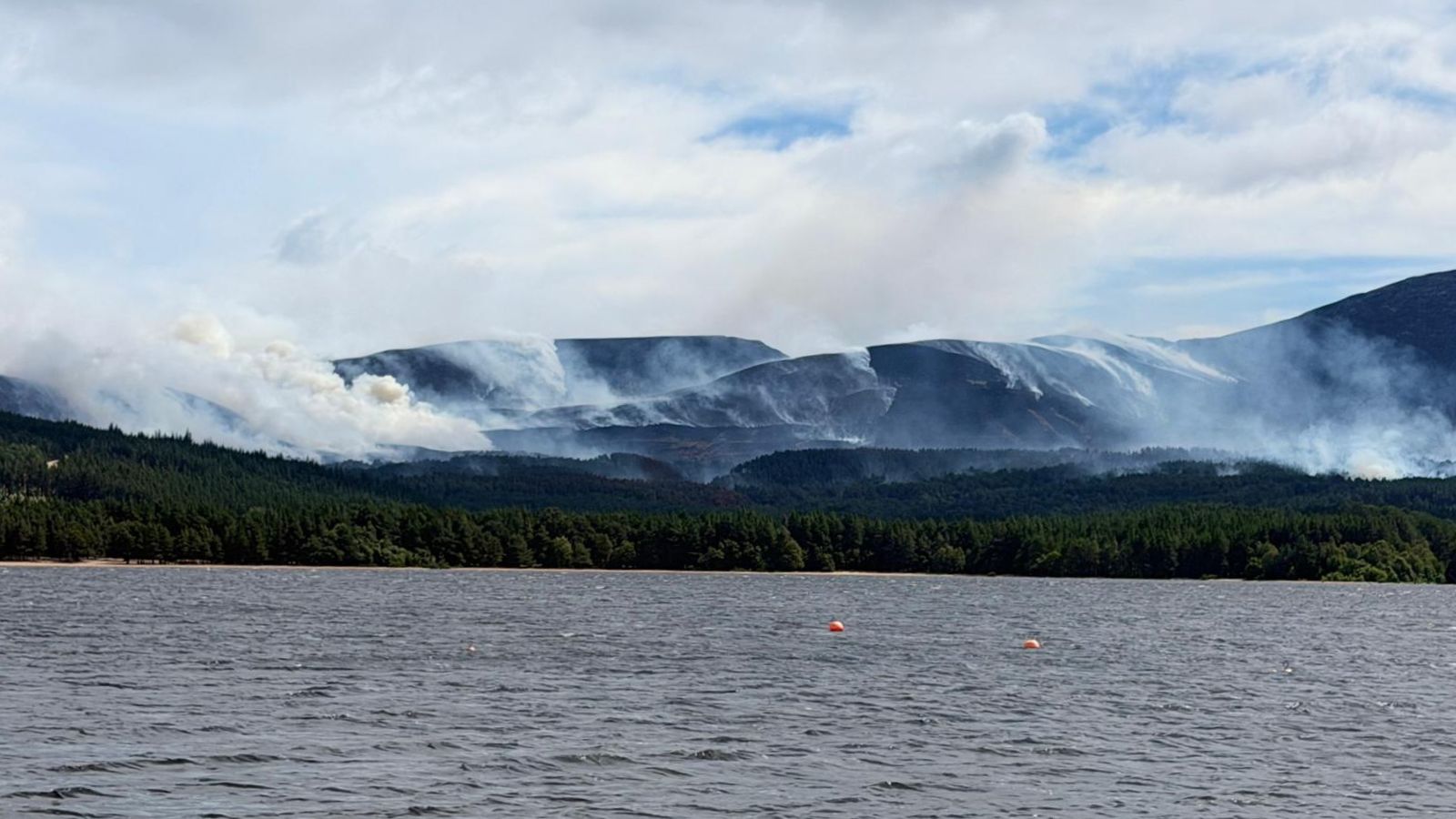
An entire Highland village has been evacuated after strengthening winds drove a long-running wildfire towards Nethy Bridge, turning an operation that had appeared to be making progress into a major incident. Smoke has travelled across the north-east as far as Aberdeen, while large parts of the Cairngorms National Park remain closed.
Police Scotland declared a major incident on Friday evening after worsening wind conditions changed the behaviour of the Cairngorms wildfire and pushed it towards Nethy Bridge.
All residents of the village were told to leave as a precaution. Access roads were closed and people were directed to a respite centre at the Macdonald Aviemore Hotel, where Highland Council established support arrangements. Police said additional officers were being deployed to contact residents, identify vulnerable people and maintain cordons around the affected area.
The decision marked a serious escalation in a fire that began near Ryvoan Bothy and Glenmore shortly before noon on Wednesday 15 July.
More than 500 firefighters have been mobilised during the response, although that figure represents personnel deployed over the course of the incident rather than the number working at one time. Specialist wildfire appliances, all-terrain vehicles, helicopters and ground crews have been used across difficult moorland, woodland and mountainous terrain.
The Scottish Government’s Resilience Room met on Friday night under First Minister John Swinney. The meeting included Police Scotland, the Scottish Fire and Rescue Service, ministers and other agencies involved in the response.
Mr Swinney said changes in wind conditions had increased the speed at which the fire was spreading. Firefighters were concentrating on creating a firebreak while police supported the evacuation.
Nine Days Of Fire
The incident was first reported at about 11.50am on 15 July. The fire initially spread across heathland near Ryvoan Bothy, between the Glenmore and Abernethy areas of the national park.
Properties and businesses around Glenmore were evacuated during the early stages, the Cairngorm Ski Road was closed at Coylumbridge and walkers were assisted from the hills. The fire was estimated to be affecting about six square kilometres by the following day.
Crews used a high-volume pump to draw water from Loch Morlich, while helicopters carried out repeated water-bombing operations. Firefighters and land managers also worked to create firebreaks intended to stop flames spreading through heather, woodland and other dry vegetation.
By 21 July, the Scottish Fire and Rescue Service said approximately ten square kilometres of land had been affected across Glenmore and Abernethy. More than 100 firefighters had taken part by that stage, with substantial hotspots remaining across a large and complex area.
Reports earlier in the week had described visible improvement and progress on both sides of the fire. Firefighters nevertheless continued to warn that wildfires can change rapidly when temperature, wind direction or wind strength alters.
That warning became reality on Friday.
Strengthening winds increased the rate and unpredictability of the fire’s movement, causing it to spread towards Nethy Bridge. An operation that had been expected to continue through the weekend dealing with hotspots and possible reignition became an evacuation and village-protection operation.
Smoke Reaches Aberdeen
Smoke from the wildfire has travelled far beyond the immediate fireground.
The Scottish Fire and Rescue Service said people in eastern Aviemore, Inverurie, Banchory, Kintore, surrounding parts of Aberdeenshire and Aberdeen could see or smell smoke through the weekend.
Residents affected by smoke have been advised to keep windows and doors closed as a precaution. Anyone experiencing concerning symptoms should seek advice from NHS 24.
Smoke direction can change quickly with the wind. Its presence many miles from the fire does not necessarily mean flames are approaching those areas, but it shows the geographical reach of the incident and the volume of vegetation still burning or smouldering.
The fire service has described conditions as dynamic and unpredictable, with the possibility of flare-ups, reignition and changes in the direction of smoke.
Large Area Remains Closed
Members of the public have repeatedly been told not to enter restricted parts of the national park or attempt to pass cordons.
Closed or restricted areas include paths around Glenmore, Loch Morlich and Badaguish. Restrictions also affect the Old Logging Way and routes towards Cairngorm Mountain, the Northern Corries, Meall a’ Bhuachaille, the Green Loch, Strath Nethy and Bynack More.
Paths through Abernethy Forest south of Forest Lodge towards Ryvoan Bothy are also affected.
These restrictions are not confined to the visible fire line. Helicopters are operating at low altitude, firefighting vehicles require access and apparently extinguished ground can continue burning below the surface.
Police have also warned drone operators not to fly near the emergency response. Unauthorised aircraft can interfere with helicopter operations and place crews at risk.
Arthur’s Seat Fire Extinguished
The Cairngorms incident is the only current Scottish wildfire confirmed publicly as a major incident.
A separate grass fire broke out on Arthur’s Seat in Edinburgh on the evening of Sunday 19 July. Six fire appliances and specialist resources were sent to the scene.
Firefighters remained until Tuesday 21 July, extinguishing hotspots and damping down the affected area. The Scottish Fire and Rescue Service subsequently confirmed that crews had left the scene.
Its timing, during the same prolonged period of dry and warm weather, placed further strain on the fire service while substantial resources were already committed in the Highlands.
The very-high wildfire warning covering the Central Highlands and parts of southern and eastern Scotland was scheduled to remain in effect until Friday 24 July. The warning period has now ended, but the Cairngorms fire remains active and weather-driven conditions continue to govern its behaviour.
What Remains Unknown
No official cause of the Cairngorms fire has been announced.
There has also been no final assessment of ecological damage, losses to forestry or moorland, harm to wildlife, damage to buildings or the total financial cost of the response.
The ten-square-kilometre figure was issued before Friday’s renewed spread. It should therefore not be treated as a final measurement of the affected area.
The number of people evacuated from Nethy Bridge has not yet been formally published, nor has a timetable been given for residents to return.
The immediate priority remains protecting life and preventing the fire from reaching homes. A full environmental and operational assessment will follow only after the incident has been brought under control.
Residents should follow Police Scotland, Highland Council and Scottish Fire and Rescue Service updates rather than relying on unofficial reports or images circulating online.
Anyone who sees a wildfire should move to a safe place, call 999 and provide the location, nearest access point, direction of spread and any visible danger to people or property. People should not attempt to fight a large outdoor fire themselves.
Information in this report was checked against official updates available at approximately 3am on Saturday 25 July 2026. The situation remains fast-moving and may change after publication.