

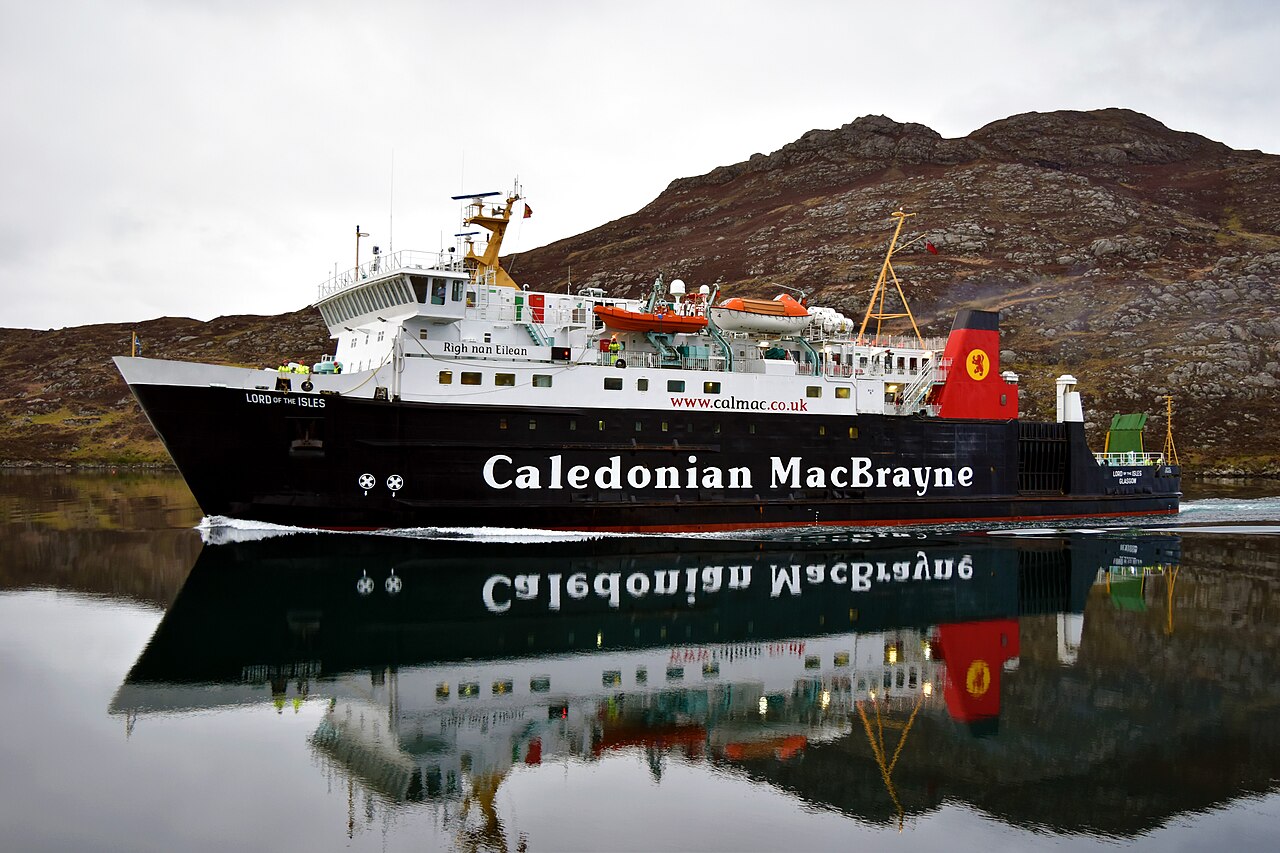
Scotland is procuring another major lifeline ferry, but the public will not be told which shipyards are competing for the work while the tender is under way.
The position was challenged in the Scottish Parliament on 30 September, when ministers were asked about reports that Caledonian Maritime Assets Ltd would no longer publish the names or locations of shipyards bidding for the replacement of MV Lord of the Isles or for future vessel contracts.
Economy, Tourism and Transport Secretary Stephen Flynn did not reject that description of CMAL’s approach. He said decisions about publication rested with CMAL and that the organisation had to balance openness and transparency against commercial sensitivity, fair competition and value for taxpayers. It deserves examination because CMAL is not a private shipowner spending private money.
It is wholly owned by the Scottish Government. Scottish Ministers are its sole shareholders. It owns vessels and infrastructure used to provide lifeline ferry services, and it is itself a public authority subject to the Freedom of Information (Scotland) Act 2002.
The ship it is replacing carries people, vehicles and goods between Mallaig and Lochboisdale. The existing Lord of the Isles entered service in May 1989. An independent assurance review obtained through freedom-of-information legislation described it as already beyond the 30-year normal serviceable life assumed for the fleet and 36 years old when the review was written.
This is therefore not an obscure commercial purchase.
It is public procurement of infrastructure on which an island community depends.
The public authority behind the tender
CMAL formally launched the procurement on 1 April.
The contract is for the detailed design and construction of one passenger-and-vehicle ferry for the Mallaig–Lochboisdale service. It is being conducted as a restricted procedure: interested shipyards first have to pass the selection stage, after which no more than six of the highest-ranked candidates can proceed to the full tender. The published contract duration is 34 months.
CMAL will place its own project manager and site team in whichever shipyard wins, overseeing design, construction and commissioning. The procurement is covered by the Government Procurement Agreement, reflecting the international procurement framework within which the competition is being conducted.
What the public notice does not reveal is who has survived the first stage.
Those names now matter for reasons extending well beyond ordinary commercial curiosity.
Scotland is simultaneously trying to sustain a publicly owned shipbuilding business at Port Glasgow.
Ferguson Marine was brought into public ownership after the collapse of its former owner. The Scottish Government has repeatedly said it wants the yard to become commercially sustainable, retain skilled employment and build a reliable pipeline of work. In March ministers proposed directly awarding four publicly funded vessels to Ferguson — two small ferries, a replacement research vessel and a fisheries-protection vessel — subject to legal, commercial and subsidy-control requirements.
But Ferguson is not competing for Lord of the Isles.
Scotland owns a shipyard that is outside the competition
The position was stated plainly at the Scottish Parliament’s Transport Committee on 9 September.
Donald MacKinnon MSP described Ferguson Marine as having been excluded from the bidding process for the Lord of the Isles replacement and asked whether the procurement remained on schedule. Flynn replied that, on the information available to him, everything remained on track. He did not dispute the description of Ferguson’s position.
The GMB union has said the problem lies in CMAL’s qualification criteria. According to the union, bidders were required to demonstrate recent delivery of at least two vessels longer than 75 metres within the previous five years. Ferguson had completed Glen Sannox, but Glen Rosa remained under construction, leaving the yard unable to satisfy that threshold. That account comes from the union rather than from the publicly accessible contract notice, which refers bidders to separate tender documentation for the detailed technical criteria.
There is a rational procurement argument for requiring recent evidence of successful ship delivery.
Scotland’s ferry programme has already experienced severe delays and cost overruns. Island communities have a direct interest in CMAL selecting a yard capable of delivering a reliable vessel on time.
There is also an equally real industrial-policy problem.
A shipyard that needs contracts to establish a record of recent delivery can struggle to satisfy procurement rules requiring that recent record before it is allowed to compete for those contracts.
The Scottish Government itself has acknowledged the circular problem from another direction. Flynn told the Transport Committee that Ferguson needs to deliver vessels on time and on budget in order to demonstrate to the wider market that it can do so and thereby attract commercial work.
Scotland therefore owns a shipyard because ministers consider retaining commercial shipbuilding capability important. It is considering direct awards to provide that yard with work. Yet the same publicly funded ferry system is conducting a separate major procurement for which that yard is outside the competition.
And the public is not being told which yards are inside it.
Community benefit will not decide the winner
The published tender notice contains another significant detail.
CMAL says community benefits are included in the procurement, but it does not intend to impose mandatory community-benefit requirements because delivery and acceptance of the vessel will occur at the shipyard where it is built.
Bidders are invited to propose benefits such as apprenticeships and student outreach.
But those proposals are explicitly described as a “non-scored response”.
That means the community-benefit submission identified in the public notice does not itself earn marks in the competition.
The notice does not establish that wider economic considerations are absent from every part of the detailed tender documents; those award criteria are contained in procurement material not reproduced in the public notice. What can be stated from the published record is narrower and important: there is no mandatory community-benefit requirement in the contract notice, and the community-benefit proposal is non-scored.
The same notice lists the delivery location as “Outside Scotland”.
That field should not by itself be read as proof that CMAL has predetermined a foreign winner. It does, however, underline the international nature of the procurement and makes the identity and location of the shortlisted yards a matter of obvious public interest.
Scotland has already sent major ferry construction overseas
There is nothing hypothetical about Scotland purchasing publicly funded ferries from foreign shipyards.
CMAL’s four-vessel Islay and Little Minch programme has been under construction at Cemre in Turkey. Seven smaller electric ferries are being built by Remontowa in Poland.
In March this year, CMAL awarded the contract for two Northern Isles freight-flex ferries to Guangzhou Shipyard International in China.
The formal Public Contracts Scotland award notice records a contract value of £175 million excluding VAT. It records four tenders, all from non-EU bidders, with Guangzhou Shipyard International named as the successful contractor.
CMAL says that procurement was evaluated 70 per cent on technical criteria and 30 per cent on financial criteria and that the Chinese yard achieved the highest combined score.
That award may have satisfied CMAL’s evaluation. It also moved another large block of publicly financed vessel construction outside Scotland and outside the UK.
The question now is whether Lord of the Isles will follow the same pattern.
Until CMAL identifies the shortlisted yards, the public cannot know.
Westminster has moved in the opposite direction on shipbuilding procurement
The confidentiality dispute has arrived just as UK procurement policy has begun treating domestic shipbuilding capacity more explicitly as a strategic issue.
In June, the UK Government issued Procurement Policy Note 025, identifying shipbuilding as one of four sectors considered critical to national security. The guidance says shipbuilding capability and capacity should be sustained so skilled workers and facilities remain available during periods of high national demand, including crises and war. It encourages the use of procurement to shape and preserve that capability.
Paul Sweeney invoked that policy in Parliament when challenging CMAL’s decision.
There is an important legal qualification. The UK note applies directly to specified UK central-government organisations; it does not automatically impose its procurement rules on CMAL simply because shipbuilding appears within it. Scotland operates its own devolved public-procurement regime.
The significance is therefore not that CMAL has necessarily breached that UK policy.
It is the policy contrast.
One government is explicitly reframing commercial shipbuilding capacity as strategic infrastructure whose survival may justify a more interventionist procurement approach. Scotland, meanwhile, owns its last major commercial Clyde shipyard, is trying to secure work for it through separate direct awards, but is proceeding with a major lifeline-ferry competition in which that yard is outside the contest and the competing yards are not being disclosed.
Commercial confidentiality is real, but it is not unlimited
There is a legitimate case for protecting information during a live tender.
Scottish procurement guidance recognises that public authorities must protect information genuinely designated as confidential by bidders. Premature disclosure can damage commercial interests or interfere with competition.
That is the principle on which ministers are relying.
But Scottish freedom-of-information guidance also makes clear that “commercial confidentiality” is not an automatic blanket.
The Scottish Ministers’ current Section 60 FOI code says authorities cannot simply accept confidentiality claims without scrutiny. Where the commercial-interests exemption is relied upon, the authority must be able to demonstrate real, actual and significant harm from disclosure. It also notes that information may be sensitive while a tender is live but cease to be sensitive once the contract is awarded.
CMAL itself tells the public that, as an organisation wholly owned by Scottish Ministers, it is subject to freedom-of-information law. Its publication scheme says people should be able to access information concerning the cost and standard of services, facts forming the basis of decisions, matters of public importance and reasons for decisions.
That does not give the public an automatic legal right to every bidder’s identity at every stage.
It does make the balance between confidentiality and accountability a legitimate question for a publicly owned procurement body handling lifeline infrastructure.
The minister could have demanded more transparency
When challenged on 30 September, Flynn placed responsibility for publication with CMAL.
He said CMAL should balance openness with commercial sensitivity and fair procurement. When asked directly to order publication of the shortlist, he did not do so. Instead, he defended the approach as protecting fair competition and securing value for island communities.
That is the Government’s position.
But describing CMAL as the procuring authority does not make it institutionally remote from government.
Scottish Ministers are its sole shareholders. Transport Scotland sponsors it on their behalf. Ministers determine ferry policy and fund the wider investment programme within which these vessels are acquired.
The separation of procurement functions has legal and operational importance. It should not obscure ownership or political accountability.
Two publicly owned organisations, two different directions
The contradiction is now difficult to avoid.
Scottish ministers own CMAL.
Scottish ministers own Ferguson Marine.
They say Ferguson needs a credible pipeline of work in order to become sustainable.
They are considering direct awards because of that need.
At the same time, Ferguson sits outside the competition for another publicly financed Scottish ferry.
CMAL’s tender says community benefits are non-mandatory and non-scored.
The published procurement record lists delivery outside Scotland.
And the Government is defending a position under which the public will not be told during the competition which shipyards may receive the work.
None of those facts establishes corruption, criminal conduct or an unlawful procurement.
They establish a significant accountability problem.
If the winning yard ultimately offers the strongest technical performance and best overall value, CMAL will be entitled to demonstrate that when the contract is awarded.
But scrutiny after a decision is not the same thing as scrutiny while policy choices are still being made.
The island cannot wait indefinitely
There is also a public interest on the other side which cannot be dismissed.
South Uist needs the vessel.
The existing Lord of the Isles has exceeded the normal 30-year service-life assumption used in fleet planning. The independent assurance review described the case for investment as replacement of a life-expired asset together with improvements to reliability, capacity and emissions.
Transport Scotland’s Islands Connectivity Plan previously put the earliest estimated delivery of the replacement at the end of 2028, subject to funding and procurement.
Stopping the procurement merely to reopen the industrial-policy argument would carry its own cost. Delay would leave an island community relying longer on an ageing fleet.
The public interest therefore has more than one component: a reliable ferry delivered without another prolonged procurement failure; prudent use of public money; protection of Scottish industrial capability where that can be justified; and sufficient transparency for Parliament and taxpayers to understand how those competing priorities were balanced.
That is precisely why keeping the shortlist from public view matters.
What taxpayers still cannot see
The public procurement notice tells Scotland that up to six bidders can reach the tender stage.
It tells Scotland the project will last 34 months.
It tells Scotland that CMAL will supervise construction inside the winning shipyard.
It tells Scotland that community benefits are not mandatory and will not be scored.
It even identifies the delivery location as outside Scotland.
What it does not tell Scotland is which shipyards are actually competing for the ferry.
That information is particularly consequential because Scotland is simultaneously spending public money trying to preserve a domestic shipbuilding capability which is not participating in this contest.
CMAL and ministers argue that non-disclosure protects competition.
The test of that position will come when the competition ends.
At that point, taxpayers should be able to see considerably more than the winning yard’s name. The public interest will extend to who competed, why candidates qualified or failed to qualify, the final evaluation methodology, the technical and financial scores that can lawfully be released, the treatment of Scottish economic benefit, the reasons for the successful decision and the evidence on which claims of value for money are based.
Until then, Scotland is being asked to accept an unusual arrangement on trust.
A publicly owned company is purchasing a lifeline vessel with public money. Another publicly owned company that ministers say they want to save is not competing for it. The work may again go overseas.
And during the process, the identities of those seeking the contract remain behind the procurement wall.
Sources
Meeting of the Parliament — CMAL Procurement Processes — Scottish Parliament, 30 September 2026.
Transport Committee — Programme for Government — Scottish Parliament, 9 September 2026.
Shipyard Detailed Design and Build Contract RoPax Vessel, CMAL0335 — Public Contracts Scotland, 1 April 2026.
About Us — Caledonian Maritime Assets Ltd.
Freedom of Information — Caledonian Maritime Assets Ltd.
Investing in Ferguson Marine — Scottish Government, 3 March 2026.
Ferguson Marine: Deputy First Minister’s statement — Scottish Government, March 2026.
Contract Award Notice: Northern Isles Freight Flex Ro-Pax Vessels — Public Contracts Scotland, 8 June 2026.
Contract Signed for Northern Isles Freight Flex Vessels — Caledonian Maritime Assets Ltd, 17 March 2026.
Mallaig–Lochboisdale New Vessel Gateway Review — Scottish Government / Independent Assurance Review, released 2026.
Islands Connectivity Plan: Vessels and Ports Plan 2025–2045 — Transport Scotland.
PPN 025: Protecting the UK’s National Security Through Public Procurement — UK Cabinet Office, June 2026.
FOI/EIR Section 60 Code of Practice — Scottish Government, 2026.