
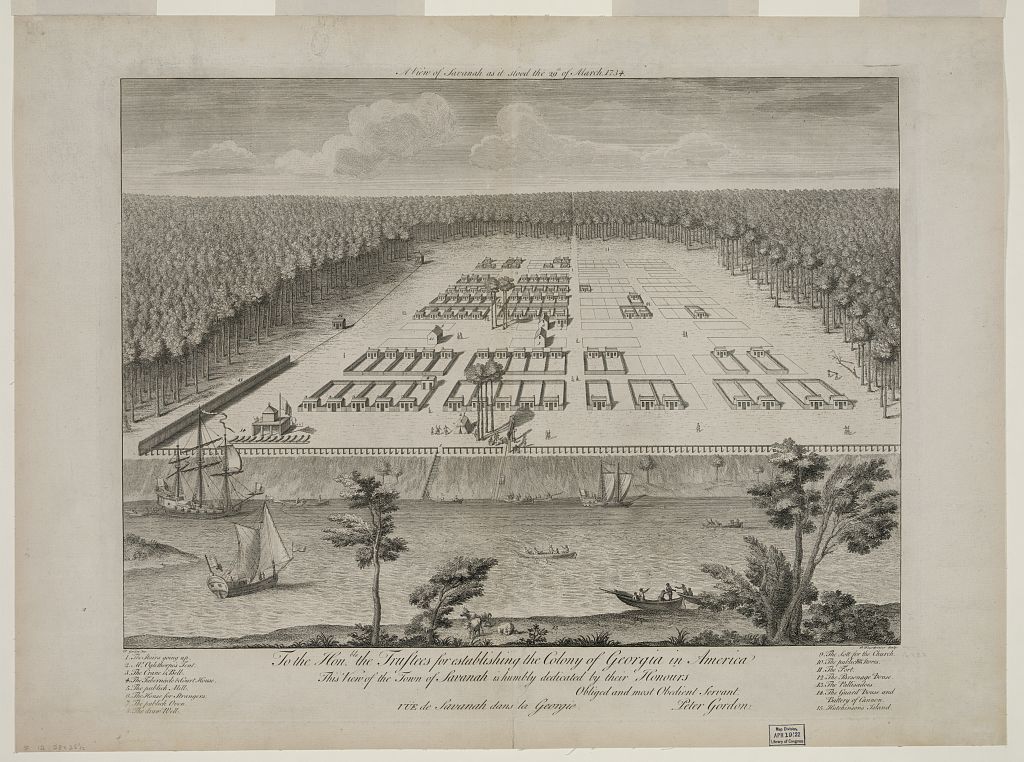
On 3 January 1739, eighteen Highland Scots at Darien (then called the New Inverness), on the southern frontier of the British colony of Georgia, put their names to one of the most striking documents from the colony’s early history. They asked James Oglethorpe to reject demands from Savannah settlers who wanted the right to use enslaved African labour.The sentence for which the document is now best known is unequivocal. Perpetual hereditary slavery, the Darien settlers wrote, was “Shocking to human nature”. They added that freedom “must be as dear” to the enslaved as it was to themselves.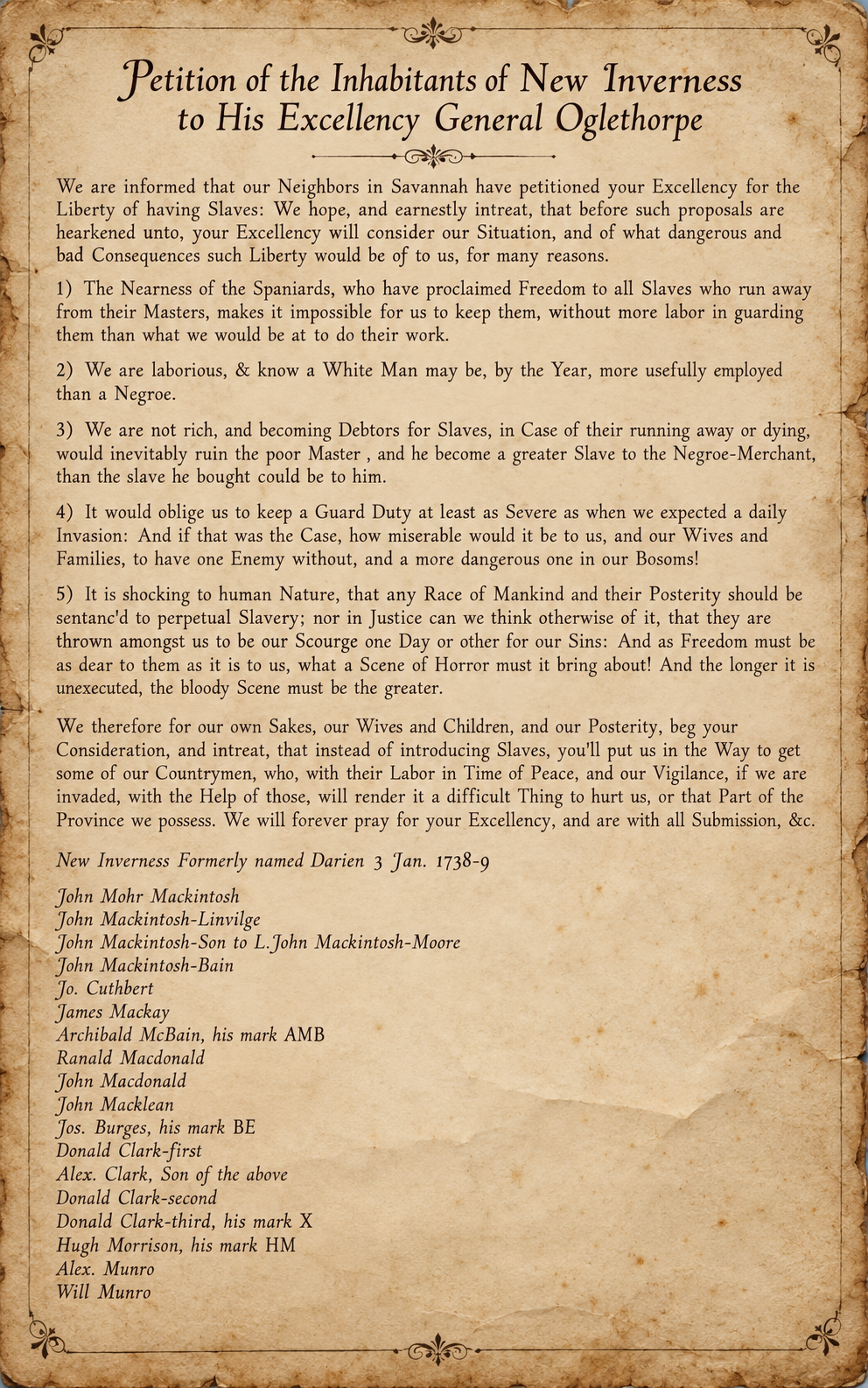
Those words have helped give the petition a long afterlife as evidence of an unusually principled Scottish rejection of slavery in early America. The original records make the history harder to compress into that account. The moral language is there, and it should not be explained away. But it is the fifth of five arguments. The first four concern Spanish policy, the comparative value of white labour, the financial risk of buying enslaved people, and the danger of maintaining a potentially hostile enslaved population on an exposed military frontier.
The petition closes by asking for help not for the sake of the enslaved but “for our own Sake, our wives & children, & our Posterity”. The same archive shows that a substantially larger group in Savannah had already petitioned for permission to use enslaved Africans. Some of the organisers of that campaign were themselves Scots.
One of the eighteen Darien signatories, Alexander Munro, later swore that he had been induced to sign a paper without knowing what it contained and only afterwards concluded that it was the petition subsequently published by the Georgia Trustees. His statement came from the bitter political struggle over the government of Georgia and cannot be treated as proof that the petition was fraudulent, or that the other seventeen men did not support it. It does, however, prevent the surviving sheet of signatures from being treated as uncomplicated evidence of eighteen identical motives.
The Darien petition was a real objection to the introduction of slavery. It contained genuine moral language. It was also written inside a struggle over land, labour, imperial defence and the economic future of Georgia, while enslaved people were themselves crossing the frontier to Spanish Florida in search of freedom.
Georgia Had Already Banned Slavery
The argument began before the Darien petition was written. Georgia was established as the last of Britain’s mainland North American colonies, and in 1735 its Trustees secured an act prohibiting the importation and use of enslaved Black people. The title itself stated the principal official purpose: “An Act for rendering the Colony of Georgia more defensible by prohibiting the Importation and Use of Black Slaves or Negroes into the same.”
Georgia’s prohibition was not simply an eighteenth-century version of the abolitionism that would emerge much later. The Trustees wanted a colony of small white landholders, supported by European indentured labour, that could also serve as a defensive barrier between the richer plantation colony of South Carolina and Spanish Florida. They feared that a large enslaved population would reduce the number of white settler-soldiers, encourage large plantation estates, create the possibility of revolt and give Spain a population whose desire for freedom could be used against Britain.
That strategic reasoning did not exclude moral opposition. Oglethorpe’s own correspondence shows that the two existed together. In a letter of 17 January 1739, only a fortnight after the Darien petition, he told the Trustees that permitting slavery would violate the principles on which Georgia had been established and would cause the “misery of thousands in Africa” by encouraging people to be bought and carried into perpetual slavery.
The evidence shows several arguments operating at once: humanitarian objection, a preference for white smallholders, fear of rebellion and escape, military planning, and an economic model deliberately different from neighbouring South Carolina.
The Savannah Petition Came First
The immediate trigger for the Darien document was a representation drawn up in Savannah on 9 December 1738. Its supporters wanted two fundamental changes. They sought stronger private ownership of land and permission for “the use of Negroes with proper limitations”.
The two demands belonged together. The pro-change settlers argued that Georgia could not compete with South Carolina while Carolina planters had access to enslaved labour and Georgians did not. Land that could be bought, sold and inherited more freely would also support a different kind of agricultural economy from the smallholdings envisaged by the Trustees.
The scale of the Savannah representation was considerably larger than the Darien response. An abstract preserved in the Hargrett papers counts 36 Savannah freeholders who had been sent to Georgia at the Trustees’ expense, another 44 Savannah freeholders, seven freeholders elsewhere who had been sent at the Trustees’ expense, 11 other freeholders outside Savannah, and 21 subscribers not known to be freeholders. That total is 119. Some later histories give 121 signatories, so the safest description is that the surviving Hargrett tally records 119 while later accounts commonly report 121.
The organised faction became known as the Malcontents. The New Georgia Encyclopedia describes it as composed primarily of Scottish settlers around Savannah, with the Scottish physician Patrick Tailfer among its leaders. Tailfer opposed the restrictions on both landholding and slavery.
That single fact makes a national interpretation of the Darien petition impossible. This was not a dispute between Scots and non-Scots. Scots were prominent on both sides. Highland settlers at Darien were signing against the introduction of slavery while Scottish settlers around Savannah were helping lead the campaign to permit it.
What the Eighteen Men at Darien Actually Said
The Darien petition, preserved in the Hargrett Rare Book and Manuscript Library and available through the Digital Library of Georgia, was dated 3 January 1738/9 under the dating convention then in use. In modern dating it is 3 January 1739. The surviving transcription contains eighteen signatories, not twenty as some retellings have stated.
Its five arguments deserve to be read in sequence because the sequence reveals the world in which it was written.
The first was geographical and military. The settlers pointed to the proximity of Spanish territory, where people escaping British slavery had been promised freedom. Buying enslaved workers, they argued, would require so much guarding against escape that the cost of supervision could exceed the value of their labour.
The second was a claim about labour. The Darien settlers described themselves as accustomed to work and argued that a white man employed for a year could be more useful than an enslaved African. It was not an argument for racial equality. It was an argument that the colony did not need plantation slavery in order to survive.
The third was financial. Darien’s settlers said they were not rich. If a man borrowed money to buy an enslaved person who then escaped or died, the purchaser could be ruined by the debt. Their language turned the point into a bitter comparison: the indebted owner might become, in their words, more enslaved to the merchant than the person he had bought was to him.
The fourth returned to security. The settlers warned that slaveholding would require a permanent internal guard as well as vigilance against Spain. Their fear was expressed in stark terms: an enemy outside the colony and another “in our bosom”. It is one of the passages that most clearly exposes the petition’s racial assumptions and the settlers’ expectation that people held in bondage might resist those holding them.
Then came the fifth clause. It is the passage most often extracted from everything around it, but it is also stronger than a mere expression of inconvenience. The petition says that sentencing any race and its descendants to perpetual slavery is “Shocking to human nature”. It recognises the enslaved person’s attachment to liberty, saying that freedom must be as dear to them as to the petitioners. It then imagines a future violent reckoning if that freedom continued to be denied.
The document therefore does not support two easy readings. It cannot safely be reduced to a purely humanitarian manifesto, because four of its five numbered arguments and its closing appeal are rooted in the interests and security of the settlers. But neither can its humanitarian language simply be dismissed as an afterthought. The archive establishes what was written; it does not tell us that the men who signed it regarded its fifth argument as unimportant.
Spanish Florida Made the First Argument Real
The Darien settlers’ reference to Spain was not speculative. It described a frontier policy already changing the lives of enslaved people in British North America.
In 1693, King Charles II of Spain issued a decree offering freedom and protection to enslaved Africans who escaped from British territory, accepted Catholicism and served Spain. Further decrees in 1733 reinforced the policy. Enslaved people did not merely hear of that promise; they acted on it, leaving British plantations and making their way towards St Augustine.
By 1738, the year before the Darien petition, Spanish governor Manuel de Montiano had established Gracia Real de Santa Teresa de Mose, usually known as Fort Mose, about two miles north of St Augustine. The National Park Service describes it as the first legally established free African settlement in what is now the United States. Around one hundred people lived there, including a militia of free Black men whose military service formed part of Spain’s defence of Florida.
From the British side of the border, Spanish sanctuary was an imperial threat. From the perspective of the people escaping slavery, it was an available route towards liberty. Both realities belong in the history. The Spanish Crown had strategic reasons to weaken Britain’s plantation colonies; the freedom seekers had reasons of their own for crossing the frontier.
When the Darien petitioners wrote that the neighbouring Spaniards had “proclaimed freedoms” to people who escaped their enslavers, they were describing an existing system, not imagining a hypothetical one.
Eight Months Later, Stono
The timing gives the Darien petition another dimension. Eight months after it was signed, on 9 September 1739, the Stono Rebellion began in South Carolina.
A group of enslaved people armed themselves and moved through the countryside, gathering others as they went. National Park Service accounts describe the rising as the largest slave uprising in Britain’s mainland colonies before the American Revolution. The group moved south, apparently intending to reach Spanish Florida, and shouted for liberty as it advanced. The number involved rose to scores and may have reached about one hundred before colonial forces suppressed the rebellion.
It would be misleading to say the Darien settlers predicted Stono. There is no evidence that their petition anticipated a particular revolt eight months later. What the chronology does show is that the conditions behind their first and fourth arguments were immediate. Spanish sanctuary, escape, armed resistance and frontier warfare were not remote possibilities in the southern colonies of 1739.
Stono also makes it especially important not to describe Spanish policy only as something done to manipulate enslaved people. Those who escaped towards Florida and those who rose at Stono were actors in the history. They were attempting to change their own condition, using the divisions between European empires where those divisions created an opening.
A Dossier Against the Pro-Slavery Petitioners
The papers surrounding the two petitions show that the argument was already being fought as a political campaign.
In the Hargrett volume is a long document headed “Character of the Persons who Sign’d the Representation for Negroes 9 Dec. 1738.” It proceeds through the Savannah subscribers one by one, recording information about property, cultivation, occupation, debts and behaviour. Some entries are descriptive. Others are plainly hostile.
Patrick Tailfer, the Scottish physician who became one of the Malcontents’ best-known leaders, is described as the “Ring leader for Negroes, and change of Tenures”. Other subscribers are attacked for debt, disorderly behaviour, poor judgement or personal disputes. Merchant Robert Williams is accused of encouraging the campaign because he expected to profit from supplying enslaved people and, through debt, to acquire settlers’ land.
The document closes under the name of William Norris, the clergyman sent to Georgia by the Trustees in 1738. It should not be read as a neutral catalogue of biography. It was a dossier produced inside a political fight, and allegations about individual motives are allegations rather than established facts.
Its importance lies elsewhere. It shows the intensity of the conflict and the methods being used. The argument over slavery was also an argument over who was credible, who was solvent, who had improved his land and who stood to gain economically from a change in policy. Supporters of slavery accused the Trustees of obstructing Georgia’s prosperity. Their opponents scrutinised and attacked the character and interests of the men demanding change.
Did Every Darien Signatory Know What He Was Signing?
The most difficult evidence came later from Alexander Munro, one of the eighteen men whose name appears on the Darien petition.
In a sworn statement subsequently published with the Malcontents’ case against the Trustees, Munro described severe disillusionment in Darien in late 1738. He said settlers had considered leaving collectively for South Carolina after struggling to make a living. According to his account, Oglethorpe responded with promises of assistance if they remained, including provisions, cattle and a breeding mare.
Munro then alleged that he was called to John McIntosh More’s house and told that men who signed a paper would receive cattle, servants and Oglethorpe’s favour, while those who refused would fare badly. He said he signed without knowing the paper’s contents. Only afterwards, he claimed, did he learn that the document was the petition from the eighteen published by the Trustees, at which point his conscience troubled him.
This evidence has to be handled with restraint. Munro’s statement emerged from a deeply factional dispute, and the Malcontents had an obvious interest in undermining a document the Trustees were using against them. His account does not establish that all eighteen signatures were obtained in the same circumstances. It does not prove that the humanitarian clause was fabricated, or that the other men rejected it. Nor does it erase the petition itself.
It does establish that at least one named signatory later disputed the circumstances in which his name had been obtained. Modern scholarship has therefore treated the Darien petition not simply as a transparent statement of collective conscience but as a document produced inside a contested political campaign. Harvey H. Jackson examined the question directly in his 1977 study, “The Darien Antislavery Petition of 1739 and the Georgia Plan”, while later work on colonial Georgia has continued to cite Munro’s deposition when discussing the episode.
The Trustees Used Darien’s Petition
The Darien document mattered in London because it gave the Trustees an answer to the Savannah representation. The pro-slavery faction could claim that Georgia’s inhabitants were being held back by rules imposed from Britain. The Trustees could point to Darien and say that colonists themselves were asking for the prohibition to remain.
Trustee correspondence praised the Darien petition and used opposition from Darien and elsewhere to reinforce the existing policy. In their response to the campaign for change, the Trustees presented the restrictions on slavery and the alienation of land as safeguards for the colony’s system of liberty and property.
Darien was not the only settlement to oppose slavery. The German-speaking Salzburgers at Ebenezer also presented objections in 1739. Their ministers argued from their own experience that white settlers could work successfully in Georgia and asked that enslaved labour not be introduced into their district. Their reasoning, like Darien’s, mixed religion, economics, labour and fear of the consequences of enslavement.
The colony was therefore divided more intricately than a simple story of one heroic community standing alone. Savannah’s Malcontents were pressing for plantation labour and freer landholding. Darien’s Highland settlers were formally opposing them. Ebenezer’s Salzburgers also resisted slavery. The Trustees were using those local objections to defend a colonial model under growing pressure.
The Prohibition Began to Collapse
The policy did not survive.
By the late 1740s the Trustees were conceding that the ban had become increasingly difficult to enforce. Their 1749 correspondence records a decision to petition the Crown for repeal of the 1735 act and to prepare a replacement under which enslaved Africans could be admitted subject to restrictions.
Even at that stage the old military fear remained. The Trustees wrote that they could “never lose Sight” of Georgia’s position as a frontier. They worried about a large imbalance between Black and white men and about the ease with which enslaved people might escape to St Augustine. One proposed regulation required an indentured white male servant for every four enslaved Black males over the age of fourteen.
Events had already overtaken the law. A 1750 census found 202 Black men, 147 Black women and an uncounted number of children in a total Georgia population of about 2,500. That placed the Black population at roughly 17 per cent even before the old prohibition was fully replaced.
Legislation permitting slavery took effect in 1751. Georgia’s experiment as the only British mainland colony to prohibit Black slavery as a matter of public policy was over.
Darien Entered the Plantation Economy It Had Once Resisted
The longer history brings the argument back to the place where the eighteen names were written.
John McIntosh Mor was the leading Highland figure at Darien and one of the men associated with the 1739 petition. His son George McIntosh later lived at Rice Hope, a rice and indigo plantation. A Georgia Historical Society marker records that when British forces attacked during the American Revolution they burned the house and carried off McIntosh’s enslaved people and livestock.
The son’s slaveholding cannot be projected backwards onto his father. It tells us nothing certain about what John McIntosh Mor privately believed in January 1739. It does show how completely the economic environment surrounding the family changed once Georgia abandoned the prohibition.
The transformation extended far beyond one household. During the antebellum period, rice and Sea Island cotton plantations made McIntosh County one of the wealthier parts of the South Atlantic coast. More than six million pounds of rice were shipped from the Altamaha delta in 1859. On nearby Sapelo Island, Thomas Spalding and his children held 385 enslaved labourers in the 1850s.
That is the long historical distance between the Darien petition and the society that followed it. In January 1739, eighteen Highland settlers signed a document warning that hereditary slavery was contrary to human nature, economically dangerous and potentially catastrophic for a frontier colony. Within little more than a decade, Georgia had authorised slavery. In the generations that followed, the district around Darien became deeply integrated into a plantation economy sustained by enslaved labour.
The archive therefore gives no support to a simple national legend in either direction. It does not show that “the Scots” rejected slavery: Scottish settlers were conspicuous among the campaigners demanding it. It does not show that Darien’s moral language was meaningless: the petition plainly condemns perpetual slavery, and Oglethorpe separately wrote of the misery the trade would inflict on Africans. It does not show that all eighteen signers approached the document in the same way: Alexander Munro later said he had signed without knowing its contents.
What survives is more useful than a legend. It is a record of people arguing over a system that was not yet fixed in Georgia: over who would own the land, who would work it, how the colony would be defended, who would profit, and what freedom meant when people held in bondage could see another imperial jurisdiction across the frontier offering a route out.
The words “Shocking to human nature” belong in that history. So do all the words around them.
Sources
- Letters from Georgia, v. 14203, 1737 June–1739 January — Trustees for Establishing the Colony of Georgia in America; Hargrett Rare Book and Manuscript Library, University of Georgia Libraries, via Digital Library of Georgia; original records 1737–1739. Digital Library of Georgia.
- The Colonial Records of the State of Georgia: Entry Books of Commissions, Powers, Instructions, Leases, Grants of Land, Etc. by the Trustees, 1732–1738, Volume 32 — University of Georgia Press; open-access reissue 2021; includes records of the 1735 prohibition on Black slavery. University of Georgia Press.
- Trustees’ Letter Book, 1738–1745, Volume 30 — Colonial Records of the State of Georgia, University of Georgia Press; open-access reissue 2021. University of Georgia Press.
- Trustees’ Letter Book, 1745–1752, Volume 31 — Colonial Records of the State of Georgia, University of Georgia Press; open-access reissue 2021. University of Georgia Press.
- “The Darien Antislavery Petition of 1739 and the Georgia Plan” — Harvey H. Jackson, The William and Mary Quarterly, Vol. 34, No. 4, October 1977, pp. 618–631. JSTOR.
- “Liberty and Slavery in Colonial America: The Case of Georgia, 1732–1770” — Andrew C. Lannen, The Historian, Vol. 79, No. 1, Spring 2017, pp. 32–55. Taylor & Francis.
- Scottish Highlanders in Colonial Georgia: The Recruitment, Emigration, and Settlement at Darien, 1735–1748 — Anthony W. Parker, University of Georgia Press, 1997. JSTOR.
- “Malcontents” — New Georgia Encyclopedia, originally published 14 February 2003; last edited 29 September 2020. New Georgia Encyclopedia.
- “Slavery in Colonial Georgia” — Betty Wood, New Georgia Encyclopedia, originally published 19 September 2002. New Georgia Encyclopedia.
- “African Americans in St. Augustine, 1565–1821” — National Park Service; accessed 1 October 2026. National Park Service.
- “Stono Rebellion” historical material — National Park Service; accessed 1 October 2026. National Park Service.
- Detailed Reports on the Salzburger Emigrants Who Settled in America, Volume Six, 1739 — Johann Martin Boltzius and Israel Christian Gronau; University of Georgia Press edition, 1981; open-access reissue. Digital Library of Georgia.
- A Southern Underground Railroad: Black Georgians and the Promise of Spanish Florida and Indian Country — University of Georgia Press; open-access edition, 2023; Chapter 1 and notes, including the 1750 Georgia census. University of Georgia Press.
- “Rice Hope” — Georgia Historical Society historical marker, erected 1957; accessed 1 October 2026. Georgia Historical Society.
- “McIntosh County” — New Georgia Encyclopedia; accessed 1 October 2026. New Georgia Encyclopedia.
- “Sapelo Island” — New Georgia Encyclopedia; accessed 1 October 2026. New Georgia Encyclopedia.