
Aberdeen is not usually the first Scottish city people associate with spirits. Its modern image is more often built around granite and oil. Yet the city has a deeper drinks history than many might expect.
In 2019, University of Aberdeen researchers identified a 1505 record in the city’s Burgh Records referring to a still for making “aquavite”, a Latin term meaning “water of life” and a Middle Scots term associated with whisky. The university said the find may be the earliest known reference to a still for making aquavite in Scotland. That does not make Aberdeen the settled birthplace of Scotch whisky, but it does show that the north east has a place in Scotland’s long distilling story.
The House of Botanicals sits at the modern end of that line: not reviving old whisky myth, but making contemporary cocktail ingredients in a city whose drinks history is more interesting than its reputation suggests.
The Aberdeen business, established in 2009 by Adam Elan-Elmegirab and now run with Steffie Elan-Elmegirab, is considered to be the UK’s oldest bartender-owned spirits brand. Adam began his drinks career as a bartender toward the end of 2001, then spent the next decade working across bars in Aberdeen. The potential to grow cocktail culture in his home city eventually outweighed possible moves to Edinburgh, London or New Orleans.
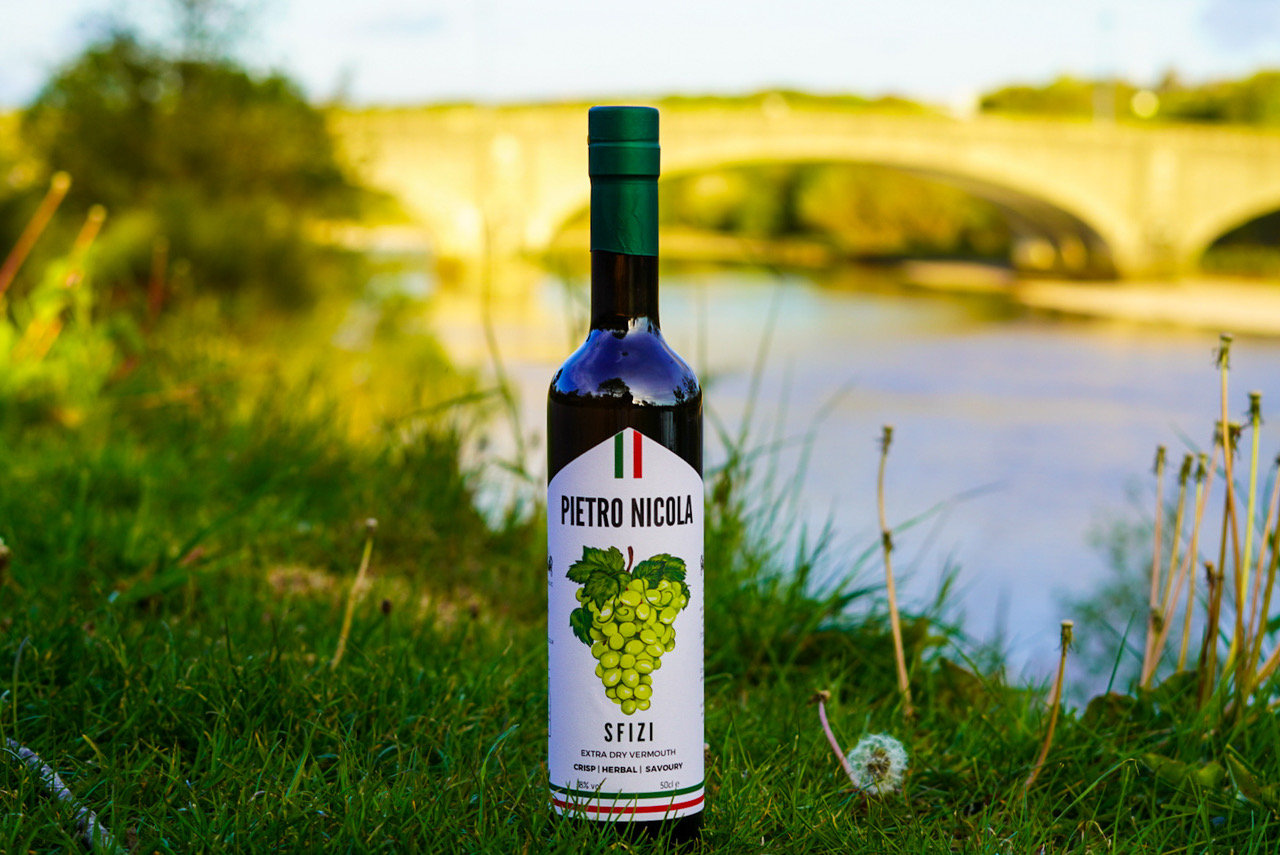
The House of Botanicals has now released Sfizi Extra Dry Vermouth under its Italian-inspired Pietro Nicola aperitivi and digestivo range. Made in Aberdeen by fortifying Italian white wine and aromatising it with wormwood, citrus peel, herbs, flowers, seeds and spices, Sfizi adds a Scottish-made dry vermouth to a portfolio already built around gin, bitters and cocktail ingredients.
There is confidence in that choice. Scotland has enough gin. It has whisky in abundance. What it has less of is a visible culture of the smaller, sharper things that make a drink work: bitters, vermouths, aperitivi, digestivi, liqueurs and the carefully judged ingredients that sit between the bottle and the glass.
Those are bartender’s products. They are made for balance. A vermouth can disappear into a Martini if it is poor, or hold the drink together if it is good. Bitters are measured in drops, but can decide the whole character of a glass.
That is where The House of Botanicals has found its place. Its business is built on bar knowledge, flavour, service and the understanding that a drink is a structure. Gin may be the frame. Bitters may be the hinge. But vermouth may be the line that gives the whole thing poise.
Sfizi, pronounced “sfeet-zee”, takes its name from an Italian word that translates as “whimsical, delicious or satisfying a craving.” The Pietro Nicola range itself is named after Dora Pietro Nicola Casella, the founder’s grandmother, and draws on family roots that include Scottish, Italian and Libyan influence. The result is a Scottish-made product born through the routes by which flavour, family and culture travel.
The vermouth is bottled at 18% ABV. The nose is white flower, lemon zest, crisp apple and a gentle sage-like quality. On the palate it is bright citrus, chamomile tea, elderflower, honey, apple, woody coriander seed and a subtle hint of rose, with a crisp, long and herbaceous finish. It has been made for a particular sort of drinking: the aperitivo hour, the Dry Martini, the Vermouth and Soda, the Cardinale and the Pompier.
For Aberdeen, the city’s economic image has long been dominated by heavy industries and hard infrastructure: oil, shipping, engineering, offshore work, university research and the practical labour of a port city. But cities also need smaller makers, places of taste, design and craft, businesses that give a street or railway arch another kind of life.
The House of Botanicals is based in the heart of Aberdeen. It is independent, family-owned, and positioned as an alternative to a traditional distillery.
The Sfizi label was designed in-house by Steffie Elan-Elmegirab, while the main graphic was illustrated by Abi Read, who previously worked on illustrations for Dr. Adam’s Book of Bitters. The bottle, cap and label are fully recyclable, in keeping with the company’s low-waste approach running through its daily operations.
The wider Pietro Nicola range already includes Pescaro, a peach aperitivo, and Caffè Margaux, a coffee amaro, alongside Cioccolato, a cacao butter liqueur, and Limoncello made with Amalfi lemon. Sfizi now gives that range its dry vermouth: the cleaner, more Martini-facing member of the family.
Scotland’s drinks economy has widened considerably in the past decade and a half. The gin boom showed how quickly smaller producers could create new Scottish drinks identities using botanicals, local stories and more flexible production. The stronger businesses are usually those that know what they are for.
The House of Botanicals appears to know. The company’s own release places the launch against a wider revival of vermouth, aperitivo culture and lower-alcohol serves. Recent market estimates place the global vermouth market at roughly £8.5bn to £10.8bn annually, with several forecasts expecting continued growth into the 2030s as cocktail culture, aperitivo drinking and lower-alcohol serves remain in favour.
There is a fine Scottish achievement here. The House of Botanicals has taken the knowledge of the bar and turned it into a manufacturing business. It has done so in Aberdeen, one of the less expected places in Scotland’s modern drinks story, during a period when the city has had to absorb the strain of economic change and look again at what kind of work, craft and enterprise can carry it forward.
SOURCES:
The House of Botanicals — Company website
https://thehouseofbotanicals.co.uk/
The Gin Shelf — The House of Botanicals profile
https://theginshelf.uk/2022/01/29/the-house-of-botanicals-do-you-believe-in-magic/
University of Aberdeen — Was Aberdeen the birthplace of Scotch Whisky?
https://www.abdn.ac.uk/news/13204/
Aberdeen Registers Online — earliest record of a still for aquavite in Scotland
https://aberdeenregisters.org/2019/07/
Scottish Local Retailer — House of Botanicals unveils Sfizi Extra Dry Vermouth
https://www.slrmag.co.uk/sfizi-vermouth-pietro-nicola-launch/
Market Data Forecast — Vermouth Market Size, Share, Trends & Growth Report, 2034
https://www.marketdataforecast.com/market-reports/vermouth-market
The Insight Partners — Vermouth Market Analysis by Size, Share and Growth 2034
https://www.theinsightpartners.com/reports/vermouth-market
SkyQuest — Vermouth Market Size & Share | Growth Report 2033
https://www.skyquestt.com/report/vermouth-market
Research and Markets — Vermouth Global Strategic Business Report
https://www.researchandmarkets.com/report/vermouth