
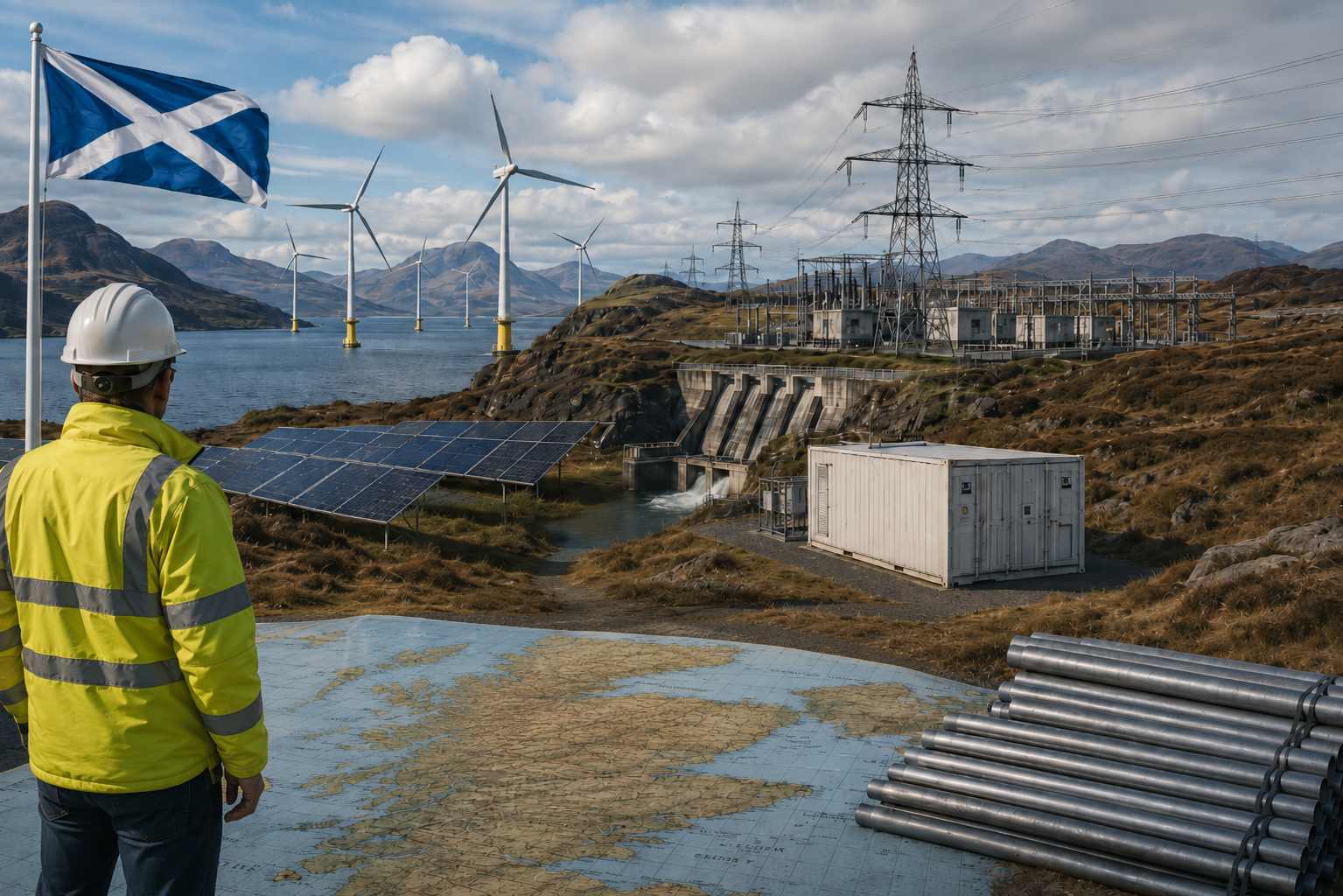
From grid connections and pumped storage to North Sea consent and household bills, decisions now approaching will determine whether Scotland builds an energy economy of its own or merely hosts infrastructure controlled elsewhere.
Scotland has 1,236 renewable energy and storage projects in its planning pipeline, with a combined estimated capacity of 85.4 gigawatts. That figure demonstrates the scale of developer interest, but it does not tell us which projects will be connected, financed or built. Nor does it establish how much of the resulting industry, income and employment will remain in Scotland.
Over the coming months, regulators, governments and the National Energy System Operator will make decisions affecting electricity storage, North Sea production, household prices and access to the grid. Some deadlines are fixed. Others remain inconveniently vague while live planning applications and commercial commitments continue to advance.
The central test is straightforward: who owns the assets, who receives the income, who pays for the network, where the industrial work is carried out and what remains in Scotland after the electricity leaves.
1. Already under way: Scotland’s largest projects receive their grid verdicts
The National Energy System Operator is issuing new grid-connection offers under its reformed Gate 2 process. Scotland is the first part of Great Britain in which offers are being issued.
Gate 2 phase-one offers for transmission-connected and large embedded projects are due between mid-May and mid-September 2026. Gate 2 projects can receive a confirmed connection date, connection point and place in the queue. Projects that remain at Gate 1 receive no confirmed date, although they may seek to qualify through a future application window.
These decisions will separate Scotland’s plausible energy projects from the much larger collection of proposals that look impressive in planning statistics but may have no workable route to the network.
The consequences extend beyond individual developers. The Port of Cromarty Firth has been awarded £55.7 million of UK Government support for expansion intended to serve floating offshore wind, with further investment required before the proposed facilities become operational. If the projects expected to use such infrastructure are delayed or excluded from the grid, port expenditure and supply-chain plans can be left without sufficient demand.
The Scottish Government should seek and publish a national assessment of the offers as they arrive. The public should not be expected to reconstruct Scotland’s industrial outlook from a series of unrelated company announcements.
Pay attention to: revised connection dates, reduced capacities, abandoned developments and statements blaming unspecified “market conditions”. The connection offer may be the real reason a project advances or disappears.
2. 7 August: the storage settlement that could place private risk on public bills
Ofgem’s consultation on the first long-duration electricity-storage awards closes on 7 August 2026.
The regulator has provisionally selected 16 projects with a combined capacity of 7,645 megawatts for possible support through a cap-and-floor revenue system. Seven are in northern Scotland, including the proposed Coire Glas, Earba and Loch Kemp pumped-storage schemes and four large battery projects. Final awards are expected in autumn 2026.
Scotland needs more storage. It would allow surplus renewable electricity to be held when generation is high and released when demand rises or wind output falls. It could also reduce the need to pay renewable generators to switch off when the network cannot carry their electricity.
The financial mechanism requires close examination. Under the proposed arrangement, consumers would make up some of the difference when a supported project’s revenue falls below its agreed floor. When revenues exceed the cap, money would be returned to consumers. Ofgem says direct effects on bills are expected to be broadly neutral over time, with wider savings produced through reduced system costs. That outcome depends upon the final financial terms and the projects being delivered competently.
Scotland could gain valuable storage while retaining little ownership of the assets. Consumers could help guarantee private revenues while Highland communities host dams, tunnels, reservoirs, roads, substations and transmission works.
Pay attention to: the final revenue floors, protection against overruns, delivery conditions, Scottish procurement, community benefit and whether public financial support produces any public or community ownership.
3. 10 August: the Jackdaw consultation closes
The latest public consultation on the Jackdaw gas-field development closes on 10 August 2026.
The field remains under review. The UK Government requested further environmental information in March, received the developer’s response on 19 June and opened the latest consultation on 8 July.
The earlier consent decisions for Jackdaw and Rosebank were overturned by the Court of Session in January 2025 because the environmental assessments had not properly considered the emissions that would result when the extracted oil and gas were eventually burned. Development work was allowed to continue at commercial risk, but extraction cannot begin without new consent.
The danger to Scotland runs in both directions.
Approval could prolong dependence upon a declining oil and gas industry without ensuring that replacement industries will be ready when production falls. A weak or legally vulnerable decision could also bring another court challenge, extending uncertainty for workers and suppliers.
Refusal would not create replacement employment. Aberdeen and the north-east could lose skilled work and supply-chain activity before offshore wind, decommissioning, carbon capture or other industries are able to absorb the workforce.
Approval is not an energy transition. Refusal is not an employment strategy. Any decision must be accompanied by a credible account of what happens to the workforce under either outcome.
Pay attention to: how downstream emissions are assessed, the evidence behind employment claims, the likely destination and pricing of the gas, the risk of further litigation and the specific replacement work available to affected Scottish workers.
4. 26 August: the autumn household price cap is announced
Ofgem is due to announce the price cap covering October to December on 26 August 2026.
The present cap rose by 13 per cent on 1 July, taking the illustrative annual bill for a typical direct-debit household to £1,862. Electricity increased to an average of 26.11 pence per kilowatt hour and gas to 7.33 pence. Actual bills depend upon consumption, payment method and region; the cap is not a maximum household bill.
Scottish Government modelling estimates that around 800,000 Scottish households could be in fuel poverty between July and September, equivalent to 31 per cent of all households. Approximately 420,000 could be in extreme fuel poverty. These are modelled estimates rather than recorded household outcomes, but they show the scale of exposure before colder weather returns.
Rural and island households often have higher heating requirements, fewer alternatives and homes that are more expensive to improve. National averages can conceal much harsher local circumstances.
The deeper danger is the widening separation between energy production and energy affordability. Scotland can generate large quantities of renewable electricity while people living beside the turbines, reservoirs and transmission lines receive no automatic local price advantage.
Consent for further infrastructure will become harder to maintain if Scotland’s expanding energy estate remains invisible in household bills.
Pay attention to: Scottish regional unit rates and standing charges, the January price forecast, rural and island effects and whether governments propose structural change rather than another temporary payment scheme.
5. By mid-September: the first major connection results become visible
By mid-September, NESO and the transmission owners expect to have issued the first phase of Gate 2 offers for transmission-connected and large embedded projects. The process will reveal which Scottish wind farms, storage schemes and major energy users have obtained firm positions in the reformed queue.
Connections reform is intended to remove speculative developments from a GB queue that had grown to more than 738 gigawatts, far beyond the capacity required for the UK Government’s 2030 clean-power plans. Projects must now demonstrate readiness and alignment with national strategic requirements.
The danger lies in who defines strategic value. A project may be useful to a Scottish port, council area or manufacturing base without ranking highly under a GB-wide electricity plan. Scottish floating-wind projects may also require longer development periods because ports, grid connections, supply chains and offshore technology must be assembled together.
The queue is therefore doing more than organising engineering work. It is making economic choices about which industries and regions are allowed to proceed.
Pay attention to: whether Scottish projects receive later dates than expected, whether large projects reduce their proposed capacity and whether employment-intensive developments lose out to schemes offering much less permanent Scottish work.
6. By mid-November: local businesses and community projects learn where they stand
Gate 2 phase-one distribution offers are scheduled to continue until mid-November 2026. These decisions may receive less national attention but could affect smaller generators, community-energy schemes, batteries, housing developments and local businesses seeking additional power. Phase-two decisions will continue into 2027.
Their cumulative effect could be substantial. A manufacturer unable to obtain additional capacity may expand elsewhere. A community-energy project can become commercially impossible. New housing can be delayed by local network constraints. An energy-intensive development may receive a connection while another project offering more employment waits.
This does not mean that Scotland has one simple pool of electricity in which every connection directly removes another. Capacity depends upon location, voltage, timing and the reinforcement required. It does mean that poorly coordinated decisions can favour developments capable of navigating the connection process rather than those offering the greatest public return.
Pay attention to: regional differences, the type of demand being approved, local businesses unable to expand, delayed community schemes and whether developers are paying the full cost of the network work they require.
7. Early 2027: Scotland gets its first proper view of Britain’s spatial energy plan
NESO’s draft Strategic Spatial Energy Plan and accompanying environmental report are due to enter public consultation in early 2027.
The plan will map broad zones, technologies, capacity and timing for electricity and hydrogen generation and storage across Great Britain between 2030 and 2050. It will not select individual projects, but it will influence future investment, network planning and the strategic assumptions against which projects are judged.
NESO says the plan will be optimised for cost across demand and high-level network needs while also considering environmental, societal and other spatial interests. The Scottish, Welsh and UK governments jointly commissioned the work.
The danger is that a plan optimised across Great Britain may not maximise Scottish employment, manufacturing or ownership. Floating offshore wind in Scottish waters may appear more expensive than fixed-bottom projects closer to large southern demand centres once transmission and technology costs are included.
Scotland could lose port development, fabrication, maintenance work and supply-chain expertise if too little Scottish offshore capacity is included. It could also receive extensive generation and transmission infrastructure while the equipment is imported and the assets are owned elsewhere.
Scotland can therefore lose by being excluded or by being included on poor terms.
Pay attention to: the assumptions used for transmission costs, the treatment of floating wind, whether Scottish industrial effects are measured and whether jobs, ownership and manufacturing are considered alongside the lowest theoretical GB system cost.
8. Date unknown: Scotland awaits decisions on data centres and its own energy strategy
Two of the most consequential Scottish decisions have no published deadline.
On 25 June, the First Minister said the Scottish Government was giving active consideration to national planning guidance for hyperscale data centres and would treat the work as a priority. He acknowledged concerns about the effect of multiple applications on energy resources and climate objectives. Fife and Edinburgh were cited in Parliament as councils seeking greater clarity while live proposals were being considered.
The danger is that applications are determined separately before Scotland establishes their cumulative electricity, water, network and environmental effects. A data centre may be useful where it can consume otherwise constrained renewable generation and reduce demand at system peaks. An inflexible centre in the wrong location may require costly reinforcement while producing relatively few permanent jobs.
Scotland also remains without a final Energy Strategy and Just Transition Plan. The Scottish Government’s current policy page still refers to the draft published in January 2023 and says that subsequent UK policy developments, the creation of NESO and recent court decisions are informing its position. No publication date is given.
The absence has become harder to defend. Connections are being allocated, storage is moving towards regulated support, North Sea fields are under review and planning authorities are considering very large new sources of electricity demand.
Scotland risks publishing its strategy after the structure of the energy system has already been decided by regulators, UK institutions and private companies.
Pay attention to: a firm publication timetable, cumulative data-centre demand, enforceable supply-chain requirements, public and community ownership, household affordability and a clear hierarchy for housing, heat, transport, manufacturing, exports, hydrogen and digital infrastructure.
What Scotland should ask before every decision
These events will often be reported separately: a consultation closes, a connection offer arrives, a price cap changes or a developer withdraws a proposal. Scotland should read them as parts of one system.
The country possesses extensive renewable resources, seabed, natural storage geography and a skilled energy workforce. It does not exercise complete control over electricity markets, transmission pricing, grid connections, offshore production consent or Britain’s strategic energy planning.
That imbalance creates the possibility of an extraordinary national failure. Scotland could become covered in energy infrastructure while remaining burdened by high household bills, limited domestic ownership, imported equipment and insecure employment.
The questions before every project and policy decision should therefore remain the same.
Who owns it? Who pays for it? Who works on it? Who receives the income? What remains in Scotland when the power leaves?
Without satisfactory answers, an energy development may be situated in Scotland without belonging meaningfully to Scotland at all.
Sources
National Energy System Operator — Connections reform timeline
https://www.neso.energy/industry-information/connections-reform/connections-reform-timeline
National Energy System Operator — About connections reform
https://www.neso.energy/industry-information/connections-reform/about-connections-reform
Ofgem — Long-duration electricity storage consultation
https://www.ofgem.gov.uk/consultation/long-duration-electricity-storage-window-1-minded-decisions
Ofgem — Window 1 minded-to decisions consultation document
https://consult.ofgem.gov.uk/energy-generation/ldes-window-1-minded-to-decision/supporting_documents/ldes-window-1-minded-to-decisions-consultationpdf
Ofgem — Long-duration storage provisional selections
https://www.ofgem.gov.uk/press-release/ofgem-boosts-long-duration-storage-secure-more-homegrown-energy-customers
UK Government — Jackdaw Field Development
https://www.gov.uk/government/publications/jackdaw-field-development
Reuters — Court ruling on Jackdaw and Rosebank
https://www.reuters.com/business/energy/uk-must-reconsider-shell-equinors-north-sea-gas-oil-projects-court-rules-2025-01-30/
Ofgem — Energy price-cap rates and announcement dates
https://www.ofgem.gov.uk/information-consumers/energy-advice-households/energy-price-cap-unit-rates-and-standing-charges
Scottish Government — Fuel-poverty scenario modelling
https://www.gov.scot/publications/fuel-poverty-scenario-modelling-based-on-ofgem-energy-price-caps-up-to-july-to-september-2026/pages/findings/
National Energy System Operator — Strategic Spatial Energy Planning
https://www.neso.energy/what-we-do/strategic-planning/strategic-spatial-energy-planning-ssep
Scottish Government — Energy strategy and markets
https://www.gov.scot/policies/energy-infrastructure/energy-strategy-and-markets/
Scottish Government — Renewable electricity pipeline
https://www.gov.scot/publications/energy-statistics-for-scotland-q1-2026/pages/renewable-electricity-pipeline/
Scottish Parliament — Hyperscale data centres, 25 June 2026
https://www.parliament.scot/chamber-and-committees/official-report/search-what-was-said-in-parliament/meeting-of-parliament-25-06-2026?iob=224099&meeting=20188
Reuters — Port of Cromarty Firth offshore-wind investment
https://www.reuters.com/world/uk/britain-invest-71-million-scottish-port-offshore-wind-expansion-2025-03-05/