
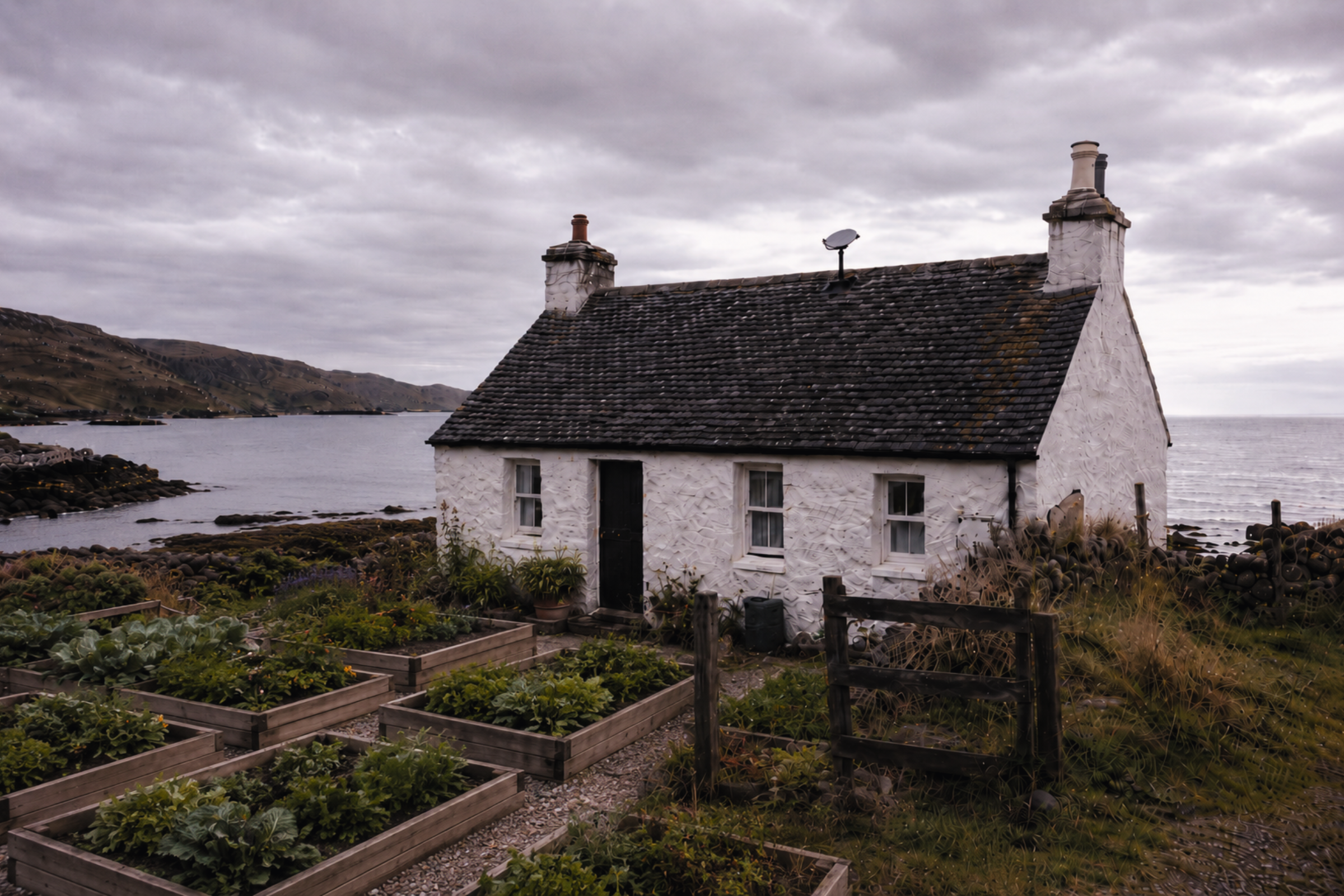
I did not rush into Starlink. I pondered it, which is what Highland women do when faced with a new machine, a large bill, or a man saying, “It will only take five minutes.”
Connectivity in the Highlands is not so much a service as a hopeful rumour, frequently interrupted by weather and whatever mood the router is in. One day the internet works well enough to send an email. The next day it stops halfway through loading a page, as if the request has been sent by post. I have stood in corners of the house holding a phone at arm’s length, moving it slowly through the air, as if I were blessing the room with disappointment.
So I began to consider Starlink.
It sounded thrilling. Satellites. Space. Low Earth orbit. A dish speaking directly to the heavens. I imagined myself becoming a woman of international communications. Not quite a spy, you understand, but certainly the sort of person who might be asked to keep an eye on things.
There would be a mysterious white dish outside, tilted toward the sky like it knew something about the Russians. I would sit inside with a cup of tea, quietly connected to the cosmos. Perhaps Elon Musk himself would arrive to install it, wearing practical boots and the expression of a man who has just remembered he left a rocket running. Perhaps there would be a Starlink users’ group, where William Shatner appeared every Thursday to say something encouraging about the final frontier. Perhaps, when the signal connected, I would hear Carl Sagan murmuring in the background about the stars while the kettle came to a respectful boil.
This is what brochures do to a person. They take an ordinary rural problem and dress it in the language of destiny. You are no longer trying to load the weather forecast. You are joining the future.
The future, as it turns out, comes in a box and requires you to stand outside in a jacket.
To be fair, one does have to admire the engineering. Starlink has sent satellites into low Earth orbit, arranged them in a moving net above the planet, persuaded a dish in my garden to speak to space, and delivered the internet to a house that still occasionally regards the kettle as advanced infrastructure. There are rockets involved. There are ground stations. There are signals travelling through systems that depend on physics, software, orbital mechanics and the kind of mathematics that would make an ordinary woman lie down with a cold cloth over her face.
And then, at the final moment, having crossed the heavens, the signal arrived in my kitchen and decided I live in London.
There is something almost poetic about that. The difficult part succeeded. The simple part failed. The satellite found the planet, but the service lost the woman.
At first I thought it was a small mistake. Modern life is full of small mistakes. A weather app announces sunshine while the rain comes in sideways.
But this was more ambitious. My internet had not merely lost the lane. It had relocated me entirely.
I did not discover the problem through anything dramatic. I discovered it because I wanted to send flowers to an old friend in Tain.
This is how modern disasters begin. Not with thunder. With a woman trying to order a nice bunch of flowers and perhaps avoid lilies because they look judgemental.
I searched for a florist near Tain, and a name appeared that I did not recognise. This troubled me. In the Highlands, not recognising a business is not a small matter. It suggests either that one has not been paying attention, or that somebody has opened a shop without consulting the invisible committee of women who know everything.
I looked at the name for a while.
I wondered who owned it. I wondered whether they did weddings. I wondered whether I had somehow missed a florist in Tain, which seemed unlikely, as one can miss many things in life, but a new florist in a Highland town tends to move through the air like church news.
Still, the internet had offered it to me, so I phoned.
A bright young woman answered.
“Good morning,” she said. “How can I help?”
“I’d like to send flowers to a friend in Tain,” I said.
There was a pause. Not a rude pause. A young pause. The sort of pause made by someone whose screen has not yet updated.
“Tain?” she said.
“Yes,” I said. “Tain.”
Another pause.
“Is that a street?”
“No,” I said. “It is a place. Do you have shops in more than one location?” I wondered whether one of those large American flower companies had finally found its way into the Highlands, the kind that sounds local but is really being operated from a warehouse where nobody has ever had to reverse past a sheep. That would explain why the ladies had not mentioned it. I decided I would place the order first and then call an emergency lunch meeting with the ladies, because if a new florist had entered the Highlands unnoticed, civilisation was clearly hanging by a thread.
“Oh,” she said. “Lovely. Is it in London?”
Now I had a choice. A woman of weaker character might have ended the call. But curiosity is a dangerous thing, especially when one is holding a cup of tea and the washing is already in.
“No,” I said. “It is in the Highlands.” I had noticed her English accent when she answered the phone, but I did not hold it against her. Many decent people have English accents through no fault of their own. I held it against her only when it became clear she had no idea where Tain was. For a moment I wondered whether I should hang up and send my friend a chippy instead. Flowers are lovely, but there are circumstances in which haddock has the clearer emotional message.
“The Highlands,” she said, with the careful tone of someone discovering a new setting on a microwave.
“Yes.”
“Is that near Richmond?”
“No,” I said. “Not spiritually.”
She was very sweet. I want that understood. There was no malice in her. She was trying her best in a world that had apparently placed me, my friend, Tain, and a medium bouquet of sympathy flowers somewhere inside Greater London.
“I’m just checking our delivery area,” she said.
“Of course.”
More clicking.
“We can deliver to Kensington,” she offered.
“That is not Tain.”
“No.”
“And it would not cheer my friend.”
“No,” she said, and I admired her for conceding the point.
I explained that I was in the Highlands, and that my friend was in Tain, and that Tain was also in the Highlands, which gave the whole arrangement a pleasing geographical consistency. The young woman then explained, very gently, that her shop was in London.
I looked at the screen again.
The internet had found me a florist near me, provided we accepted that “me” was now a fictional London woman with my name.
I was sitting in the Highlands, surrounded by Highland weather, Highland roads, Highland problems and Highland silence, while Elon Musk’s satellites appeared to be conducting a digital Highland Clearance.
So I contacted Starlink.
One likes to give modern technology a chance to explain itself before blaming it entirely. I was calm. I was polite. I did not begin by asking whether the satellite had been drinking.
I explained the situation.
“I am in the Highlands,” I said, “but the internet thinks I am in London.”
There was a pause. I have come to recognise this pause. It is the sound of a customer service system discovering that the real world has brought a problem not covered in training.
“I see,” said the Starlink representative. “Are you able to confirm your service address?”
I confirmed it.
“That shows correctly on your account,” he said.
“Good,” I said.
“So the service address is correct,” he said. “But websites may identify your location based on the IP address.”
“Of course,” I said, because one likes to sound as though one has not just been attacked by initials.
He explained that the dish knew where it was. Starlink knew where the dish was.
“But you are in London,” he said.
There it was. The future of humanity, floating gently somewhere between the Highlands and common sense.
“I see,” I said. “Can you fix it?”
There was another pause.
“I am sorry,” he said. “We are not able to manually change the geolocation.”
“Not manually?”
“No.”
“Electronically?”
“No.”
The satellite found the planet, but the service lost Scotland.
“So there is no button,” I said.
“No.”
“No small setting marked ‘return this woman to the Highlands’?”
“I’m afraid not.”
This was disappointing. I had assumed that a company capable of firing the internet through low Earth orbit might also be able to tell a florist I was not in Kensington.
“So what should I do?” I asked.
“You can try contacting the websites directly,” he said.
Now, I have lived long enough to know when a sentence has been designed to make a customer go away quietly. Contacting the websites directly is not advice. In my circumstance, it is a pilgrimage.
“I cannot find the websites to contact them directly,” I said.
“I’m really sorry,” he said.
That is a conversation that will stay with me.
Rural Scotland is always being told that technology will connect us. It will overcome distance. It will reduce isolation. It will help businesses. It will support local journalism. It will bring services closer. It will allow people to live and work in places that government departments often remember only when there is a photograph to be taken beside a pier.
And some of that is true. I am not against technology. I have no desire to return to the days when sending a file required an entire afternoon and nobody could use the phone to make or receive calls. Starlink may bring the internet to my roof, but if it cannot place me correctly, it takes away the local world the internet is supposed to help me reach.
Somewhere above the Earth, a highly advanced system has looked down at Scotland and said, “London. Close enough.”
Still, I am doing better than the man from Canada who posted recently that Starlink had placed him inside the United States. I suppose one must count one’s blessings. I have only been moved to London. He appears to have been annexed.