
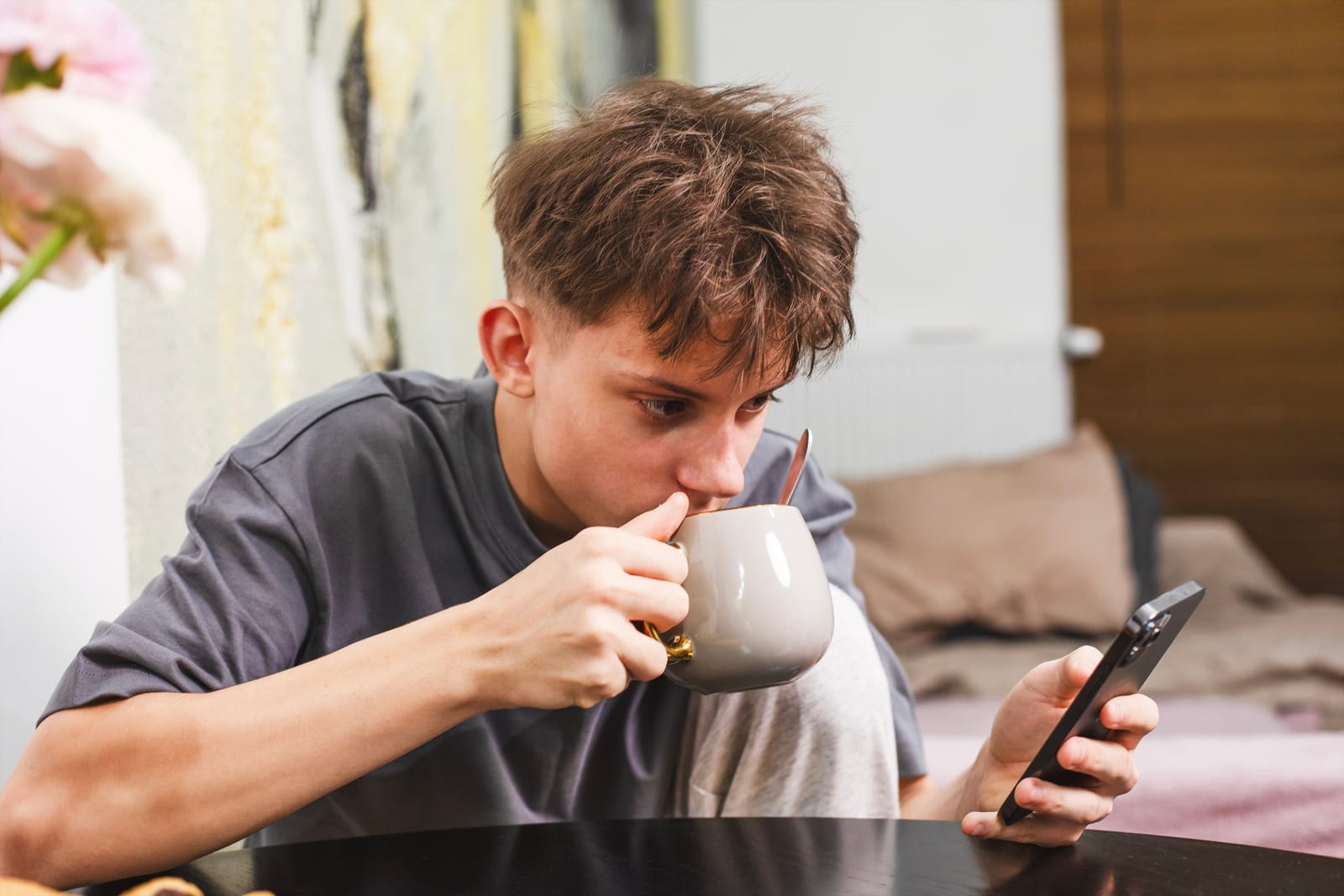
If I were under sixteen, I would be worried the moment the government said it was giving me my childhood back.
That is not how things usually work.
When your granny gives you something back, it is generally your jumper, washed, folded and smelling faintly of lavender. But when the government gives you something back, there is normally a pilot scheme, questionable contractors and a helpline that is experiencing unusually high demand.
So I would look around. Take notice that you have been seated at the kiddie table, wearing a paper hat, with orange juice in a plastic cup and a sausage roll cut in half for safety, while the adults are in the dining room discussing your future.
Every so often, someone opens the door to say, “You’ll thank us later.”
The present plan is to rescue under sixteens from social media by removing them from it.
This sounds lovely in the way a man sounds lovely when he says, “I’ve tidied the kitchen,” and you discover he has put everything in the wrong places.
It is as if childhood has been discovered in a cupboard at the back of Whitehall, beside a yo-yo, a skipping rope, and a dead Tamagotchi.
Apparently, childhood can now be returned. I am not sure that is how childhood works. Childhood is rather like virginity; it cannot be restored by a committee.
One imagines a minister holding it up proudly, like a lost mitten.
“Good news,” he says. “We found your childhood.”
Then he hands over a hula hoop, a sherbet fountain, a packet of chalk, two marbles, and a whistle that no longer whistles.
I am in favour of childhood. I am strongly in favour of it. I am also in favour of not pretending that childhood can be restored by banning a website. The modern child is told to become digitally skilled, digitally safe, digitally fluent and ready for the digital economy. Then Westminster responds by digitally blindfolding them.
The real question is not whether social media can be harmful. Of course it can. So can drink, debt, gambling, and a politician that hides his real agenda.
While under sixteens are being told they are too young for the digital world, their parents are being marched deeper into it. Adults do not have the luxury of opting out. They have mortgages, bills, jobs, tax and the weary business of keeping food in the cupboard and the lights on.
The adults will be the first cattle through the UK’s new digital gates. The young may find themselves kept outside for now, watching through the rails as their parents argue with forms, apps, banks, employers, platforms and public services that increasingly ask for proof before they offer access. Perhaps that is protection. Perhaps it is also a very convenient way of keeping the next generation from seeing too clearly what is being normalised in front of them.
They will see their parents give up small freedoms one at a time, not because they are weak, but because dinner must be bought, wages must be received, council tax must be paid, and children need new shoes. Tyranny does not always arrive like it does in the movies. Sometimes it arrives with a mandatory face scan to access your own money, travel, or unlock your smartphone.
This is why I would tell the under sixteens not to confuse exclusion with protection.
For a little while, being shut out may make them freer than the adults. Not freer in the grand heroic sense. Freer in the practical sense that no one yet forces them to prove their identity.
But the training has begun.
The lesson being offered is obedience. Wait outside until you are old enough to consent to your own surrender. Until you have been taught to call it a privilege, not the loss of your human rights.
If I were under sixteen, I would learn exactly how the gate works.
I would not simply get angry. Anger is useful only briefly. It is like boiling a kettle without making tea.
I would become difficult in the most productive way.
I would get a dumb phone, or at least keep one ready. Not because I wished to live like a Victorian orphan, but because a device that can call home, a friend, a lift, or for help is not primitive. It is civilisation in its most basic form.
A dumb phone is not a retreat. It is a device that does not include apps that feed the data centres.
Then I would learn the clever things properly.
I would learn programming, because it teaches a person that a computer is not magic. It is not a cloud, despite what the cloud people say. It is a machine with files, permissions, commands, logs and mistakes.
I would learn coding enough to understand that AI is not a deity.
I would learn how apps are built. I would learn how permissions work. I would learn what data is collected, where it goes, who profits, and what happens when “free” turns out to mean “you are the product”.
There is a type of adult who will tell young people that this is too complicated. This is the same adult who has thirty seven browser tabs open and cannot find the button to turn off a WhatsApp call.
Ignore them politely.
The young have always been underestimated.
Zora Ball was seven when she created a working mobile video game in Philadelphia, which is earlier than most adults learn where their passwords are kept.
Lim Ding Wen was nine when he wrote Doodle Kids, an iPhone drawing app for his younger sisters in Singapore.
Anne Marie Imafidon passed A level computing at eleven, an age at which many of us were still being defeated by long division.
Thomas Suarez was twelve when he was building iPhone apps and teaching other pupils how to make their own.
Tanmay Bakshi released his first iPhone app at nine and, while still only thirteen, was working with IBM’s artificial intelligence tools.
Nick D’Aloisio was fifteen when he created Trimit, the app that led to Summly.
The point is that young people are not empty vessels. Youth is not incompetence.
This is why the under sixteens should pay attention now. A young person with curiosity, tools and stubbornness is one of the few things that can still disarm a bad system.
If I were under sixteen, I would watch how government behaves when it says it is protecting me. I would watch who gets consulted. I would watch who gets paid. I would watch which companies become necessary. I would watch how quickly “temporary” becomes permanent. I would watch how often freedom is exchanged for convenience by adults who are too tired to argue because the boiler has gone and there is work in the morning.
Then I would prepare.
I would not prepare by becoming frightened. Fear is what these systems feed on. I would prepare by becoming useful.
I would learn things that cannot easily be taken away.
I would learn to speak clearly.
I would learn to write well.
I would study Maslow’s hierarchy of needs until I understood that food, shelter, safety, belonging and dignity are not digital privileges. They are human foundations. Any government that places a login screen in front of them has not misunderstood the hierarchy. It has inverted it.
I would read banned books until I understood why the books were banned.
I would learn to read a map. A real map. Yes, the kind that folds.
I would learn to keep a notebook of my thoughts and important things.
I would spend time with my elders. Not only because they love me, although that is no small thing, but because they carry knowledge no search engine can fetch. They know what people are like when the power goes out, when money is short, when systems fail, when neighbours matter, and when common sense is more reliable than ChatGPT.
I would learn how to use encryption. And then I would use it.
I would learn how to spot manipulation.
I would learn how advertising follows people around like a midgie with a business plan.
I would learn how to ask who benefits.
I would learn how to say no without apologising.
I would learn history, because every shiny new thing has usually happened before.
I would learn practical work with my hands, because AI can’t yet chop kindling, fix a hinge, repair broken things, bake bread, change a tyre, wire a plug, rescue a sheep from a foolish decision, or make soup from what is left in the fridge.
I would learn to garden, even if only in old, odd shaped containers by the backdoor, until I understood that self-sufficiency is freedom.
I would learn not only how to find new friends, but how to be a friend. And I would understand most people have only a handful of true friends throughout their lives.
I would learn to sit in a room full of people and not seek attention, but listen.
I would learn to be comfortable in my own silent company, or how to fill the space with my own creativity.
I would learn to be unreachable sometimes. That skill may become revolutionary.
And, importantly, I would learn how to be the sort of person who does not accept every term and condition because it is easier.
Youth should understand they are not being rescued from the digital future, they are being rehearsed for it.
So they should rehearse something better.
Then, naturally, I would put the kettle on.
Not because tea will stop digital authoritarianism. But because it gives a person something warm to hold while the adults explain that one is not old enough to understand the system being built for them.
And if the children are wise, they will nod politely, finish their biscuit, go back to the kiddie table, open a laptop, install Linux, and begin.