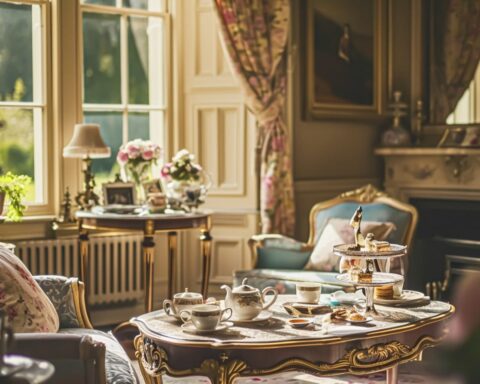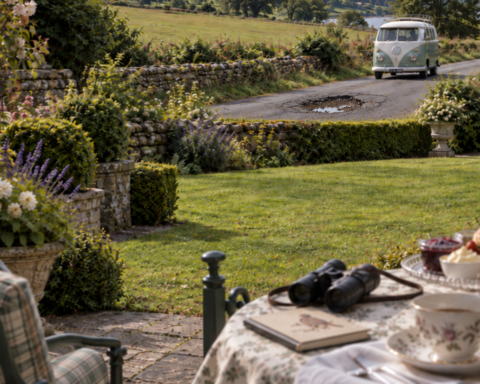

I had finished afternoon tea at a lovely establishment in the Highlands and was sitting on a bench outside, waiting for Mr Gunn. It had been a very satisfactory afternoon tea. The sandwiches had been small enough to suggest refinement, the cakes had been large enough to restore confidence, and the bill had been folded discreetly inside a little leather wallet so that one could discover the consequences in private.
Mr Gunn had gone to fetch the car. This sounds like a simple undertaking, but Mr Gunn does not merely fetch a car. He checks it. He walks around it. He looks beneath it for reasons known only to himself and the motor trade. He rearranges objects in the boot which were perfectly content in their original positions, and if another man is standing within twenty yards, Mr Gunn will generally learn where he is from, what he is driving and whether he has ever experienced trouble with the rear suspension.
I therefore settled down to enjoy the weather.
It was bright, calm and almost warm, which in the Highlands means that nothing had yet struck me horizontally. There were blue patches in the sky, and for several minutes it appeared possible that Scotland had been granted summer.
The bench was otherwise empty until a young woman appeared and sat down immediately beside me. There was plenty of room. There was a whole bench of room. There was enough unoccupied bench to accommodate a small walking party, their luggage and one of those dogs which insists upon having its own seat.
Nevertheless, she placed herself so close to my left side that we might reasonably have been mistaken for relatives awaiting the reading of a will.
She did not say hello.
I did not mind. Young people are under tremendous pressure now. They must monitor several emergencies on their phones and remain constantly prepared for someone over forty to ask what they will study at university. A greeting might have caused the entire system to collapse.
She appeared to have been instructed to sit there and wait for her parents. I knew this because she looked repeatedly towards the entrance with the particular expression of a young person whose family had once again failed to organise itself around her timetable.
I recognised the expression. Mr Gunn has seen it on my own face outside hardware centres.
The young woman carried an exceptionally large handbag. It was not really a handbag in the old sense. A handbag once contained a coin purse, a handkerchief, a comb and perhaps a boiled sweet of uncertain age. This was closer to a piece of military luggage with brass fittings. One could have packed a smaller handbag inside it, together with a change of clothes, a full picnic and, in difficult circumstances, a junior member of staff.
She opened it and removed a tablet of corresponding size.
I looked away.
I am not nosy. Nosiness requires deliberate effort, whereas things tend to present themselves directly in front of me without invitation. If a brightly illuminated screen the size of a tea tray is placed six inches from my shoulder, it seems wasteful not to develop a general understanding of events.
The young woman switched on the tablet and began reading a glossy magazine devoted to royal families, beautiful people, aristocratic weddings, expensive houses and parties attended by guests whose grandparents appear in oil paintings. There were photographs of beautiful people arriving at restaurants, beautiful people leaving yachts and beautiful people standing beside horses while pretending that neither the horse nor the photographer had inconvenienced them.
Every few pages there was an article about a private school. The pupils stood in ancient grounds wearing immaculate blazers and gazing confidently towards futures which had apparently already been reserved for them. Behind them were buildings with towers, chapels and several centuries of accumulated certainty.
At my school, we had a place to chain up bicycles and that was considered posh.
I put on my sunglasses. The sun was not directly in my eyes, but sunglasses have uses which are not always meteorological. I then opened my handbag and began searching for a mint.
I knew exactly where the mints were. I had put them in the front compartment shortly after lunch. Nevertheless, a woman is entitled to conduct a thorough search of her own possessions, particularly when reading someone else’s tablet. The young woman reached the fashion pages.
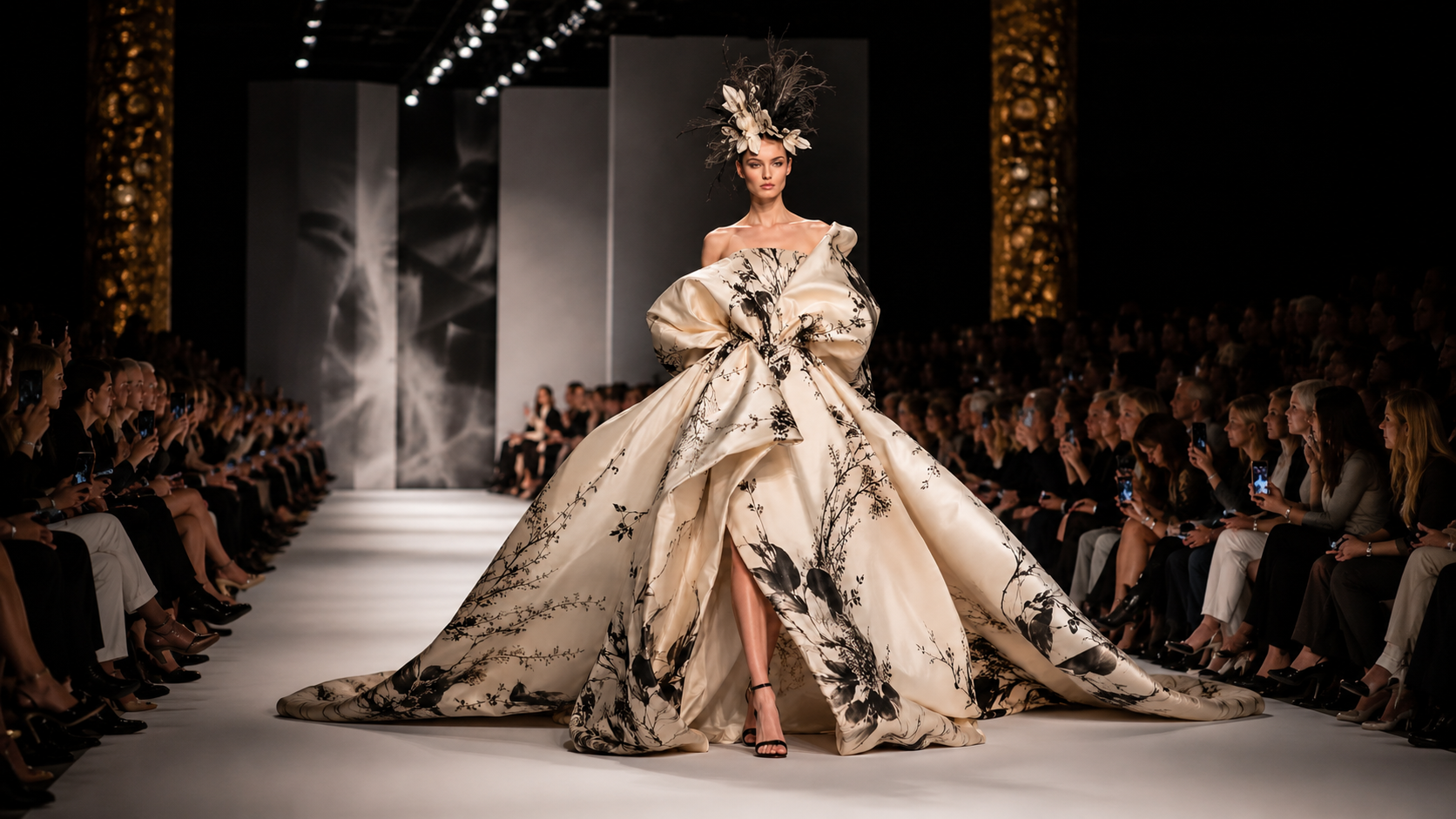
The first model appeared to be wearing a formal disagreement between a lampshade and a crustacean. The garment had shoulders, although the word hardly does them justice. They extended beyond the wearer with such determination that she could have cleared a path through a crowded railway station without speaking.
They had presence. They had authority.
The young woman enlarged the photograph.
I leaned further into my handbag, as though the missing mint might have burrowed beneath my purse. The dress rose around the model in several architectural developments. There was no obvious way of wearing it through a standard doorway, although anyone able to afford it presumably owned doors which withdrew silently into the walls when approached.
The model wore the solemn expression of someone transporting a priceless vase across an ice rink. This was understandable. The dress looked as though one careless breath might cause damage not covered by ordinary insurance.
I found the packet of mints and moved it into another compartment so that I could continue looking for it.
The next outfit had something substantial happening around the hips. It was not a skirt, exactly. It was more a declaration of boundaries. The wearer occupied the full width of the screen and appeared capable of preventing two-way traffic on the A9.
I tried to imagine wearing it into the village shop. I would enter first, followed some time later by the dress. By the time the garment had cleared the doorway, three customers would be trapped beside the greetings cards and someone would have had to move the bread display.
I would ask for a loaf and a pint of milk while the lower portion arranged itself around the freezer cabinets. Mr Gunn would say, “Mind the eggs,” shortly after it was too late to mind the eggs.
The young woman swiped again.
The next outfit was covered in flowers. At first, I thought it was rather pretty. Then I noticed that the flowers had been arranged with particular enthusiasm around an area not normally given its own floral display. They climbed over the model’s shoulders, crossed her chest and continued downwards until she appeared to be wearing a small ornamental shrub in a deeply personal location.
The young woman paused to examine the details.
I examined them too, although with considerably greater discretion.
The flowers appeared to be attached with wire. This answered one question and created several others, including what might happen in a thunderstorm and whether the wearer should remain indoors during stag season.
I wondered whether the model could sit down. A surprising number of expensive clothes appear to be designed for people who never sit, eat, visit the lavatory, enter a vehicle or retrieve anything from the bottom shelf. They are permitted to arrive, stand beautifully beside a column and then disappear before practical life resumes.
The young woman swiped again and arrived at a gown with a train.
The train had acreage. At a Highland wedding, it would collect half the churchyard before the bride reached the door. By the end of the ceremony, it would contain gravel, pine needles, two commemorative orders of service, several dead midges and at least one small dog.
The young woman continued studying the gown. Perhaps she was imagining wearing it.
I tried to imagine storing it.
It would require its own room. The room would need double doors, reinforced flooring and possibly a loading bay.
By then, I had begun to understand the purpose of the clothes. They were not intended to keep anyone warm. They were not intended to allow anyone to catch a bus, pack sensibly for a weekend or stand beside a muddy verge.
They existed to make an entrance.
An ordinary dress enters a room with its wearer. These dresses entered first, established a perimeter, notified the authorities and waited for the wearer to be brought in under escort.
The young woman closed the article and rested the tablet on her lap. For a moment, neither of us spoke.
“Some of them are a bit much,” the young woman said at last.
It was the first thing she had said to me. I lowered my sunglasses and considered the matter.
“I was thinking they might be quite useful,” I said.
She looked surprised. “For what?”
“Keeping people at a safe distance.”
She laughed. It was a proper laugh, not the small breath young people sometimes produce when an older person has spoken and they are uncertain whether assistance is required.
“I wouldn’t wear one,” she said.
“Neither would I,” I replied.
“Do you have any fashion advice?” she asked.
“No,” I said.
She smiled and looked back towards the entrance.
I looked down at my shoes.
They were flat, dark, sensible and entirely capable of carrying me across gravel, wet grass, an uneven car park and, if required, a modest national emergency.
I thought for a moment.
“There is one thing,” I said. “If I might.”
She turned back to me.
“Always carry a pair of flats in your bag, the kind you can change into if you need to.”
The young woman glanced at her enormous handbag.
“I probably could fit some in here.”
“You could fit a cobbler in there.”
She laughed again.
She looked down at my shoes.
“Are those the kind you mean?”
I looked at them too.
“Yes,” I said. “I arrived in high heels.”
Her eyes widened. “Really?”
“No.”
For a second she stared at me.
Then we both laughed.