
I was sitting in the front room on Sunday evening, enjoying the breeze after an unusually warm weekend. I had a book in my hand, one cat settled at my feet and another curled in my lap. The curtains moved gently, the house was quiet, and I had almost reached that rare domestic state in which nothing needed wiped, folded, moved, signed, soaked, charged or explained.
Then Mr Gunn crossed the hall carrying my blow dryer.
There are moments in a marriage when one must decide whether to speak at once or allow the evidence to develop. I chose the latter, because a husband walking past a doorway with a woman’s blow dryer in his hand is not an accident. It is a confession in transit.
He had the slow, careful walk of a man transporting evidence.
“Mr Gunn,” I said.
He stopped, but only with his feet. The rest of him continued to hope.
“Yes?”
“Are you carrying my blow dryer?”
There was a pause.
“No.”
This was disappointing.
“You are standing in the hall with my blow dryer in your hand.”
He looked down.
“So I am.”
“What are you doing with it?”
“I was only borrowing it.”
“Were you going to tell me?”
“I was going to return it.”
“That is not the same thing.”
He considered this, as men do when confronted with a moral distinction.
“It’s for a practical purpose,” he said.
“There was a wee leak under the cabinet,” he said. “I’ve fixed the pipe, but the wood’s damp. This is ideal.”
Ideal.
A blow dryer is ideal for drying hair. It is not ideal for drying the underside of a cabinet, though Mr Gunn said this with the confidence of a man unveiling a national infrastructure plan.
I followed him to where the cupboard door was open, a towel lay on the floor, and my blow dryer was being aimed into the darkness as if we were rescuing miners.
“Just five minutes,” he said.
This is not the first time one of my belongings has been promoted into hard labour. Years ago, my pink measuring cups disappeared. Not the plain ones. Not the spare ones. The nice pink ones. The ones with the comfortable handles and the cheerful little shape that made baking feel joyful.
For weeks I looked for them. I looked in the drawers, the cupboards, the dishwasher, the pantry, and finally the shed, which is where household items go when they have been kidnapped.
At last, Mr Gunn confessed.
I required a chair.
They had been, apparently, the perfect size for mixing the right amount of cement.
He had meant to rinse them, naturally. Unfortunately, he forgot, and the cement, having no respect for good intentions, had gone ahead and set.
When he tried to remove it, he broke them.
Since then he has bought replacements, each one more offensive than the last. One set was the wrong shade of pink. One had dreadful handles. One was too modern, by which I mean it looked as though it had been designed by someone who had never measured flour or loved a grandmother.
Mr Gunn cannot understand this.
“A measuring cup is a measuring cup,” he says.
This from a man who owns thirty-seven screwdrivers and claims each one has a distinct purpose.
When we were first married, Mr Gunn had moved into our house first. There was a bed, and a kettle.
When I arrived, I moved into a tool shed with curtains. There were also toolboxes, tool rolls, tool bags, tool trays, and several loose arrangements of metal things that looked as if they had been removed from a submarine during wartime. He had spanners in sizes that could only be useful if one were repairing a bridge. He had clamps, files, levels, drills, bits for drills, boxes for bits for drills, and a thing with a handle that I was told not to touch in the same tone usually reserved for unexploded ordnance.
I had brought pictures, books, a vase, music boxes from childhood, a wind chime, a set of nested mixing bowls, a glass blue bird, and several items whose only duty was to make a room look nice.
Mr Gunn would pick one up and ask, “What does this do?”
“It sits there,” I would say.
“But what is it for?”
“It is for looking nice.”
This troubled him deeply. To Mr Gunn, an object must cut, tighten, scrape, drill, measure, fasten, heat, sand, or emit a noise suggestive of male achievement. If it does none of these things, he suspects it of moral weakness.
And yet now, after all these years of his tool empire growing, he has begun complaining about my kitchen tools.
“Do we need all these?” he asks, standing before a drawer with the innocence of a man who has forgotten he owns seven hammers.
“Yes,” I say.
“What does this one do?”
“That is a pastry brush.”
“And this?”
“A citrus zester.”
“And this?”
“That is for taking the stones out of cherries.”
“How often do we take stones out of cherries?”
“As often as I choose.”
He sighs, as though the kitchen drawer is a public spending scandal. But he does not see the order of it. Kitchen tools are not clutter. They are the difference between making do and making something properly. A good whisk, a proper peeler, a measuring spoon that fits the jar, a spatula with the right edge… these things matter. The right tool in a kitchen is no less noble than the right tool in a shed. It is simply cleaner and less likely to require a tetanus injection.
Still, I have learned discretion.
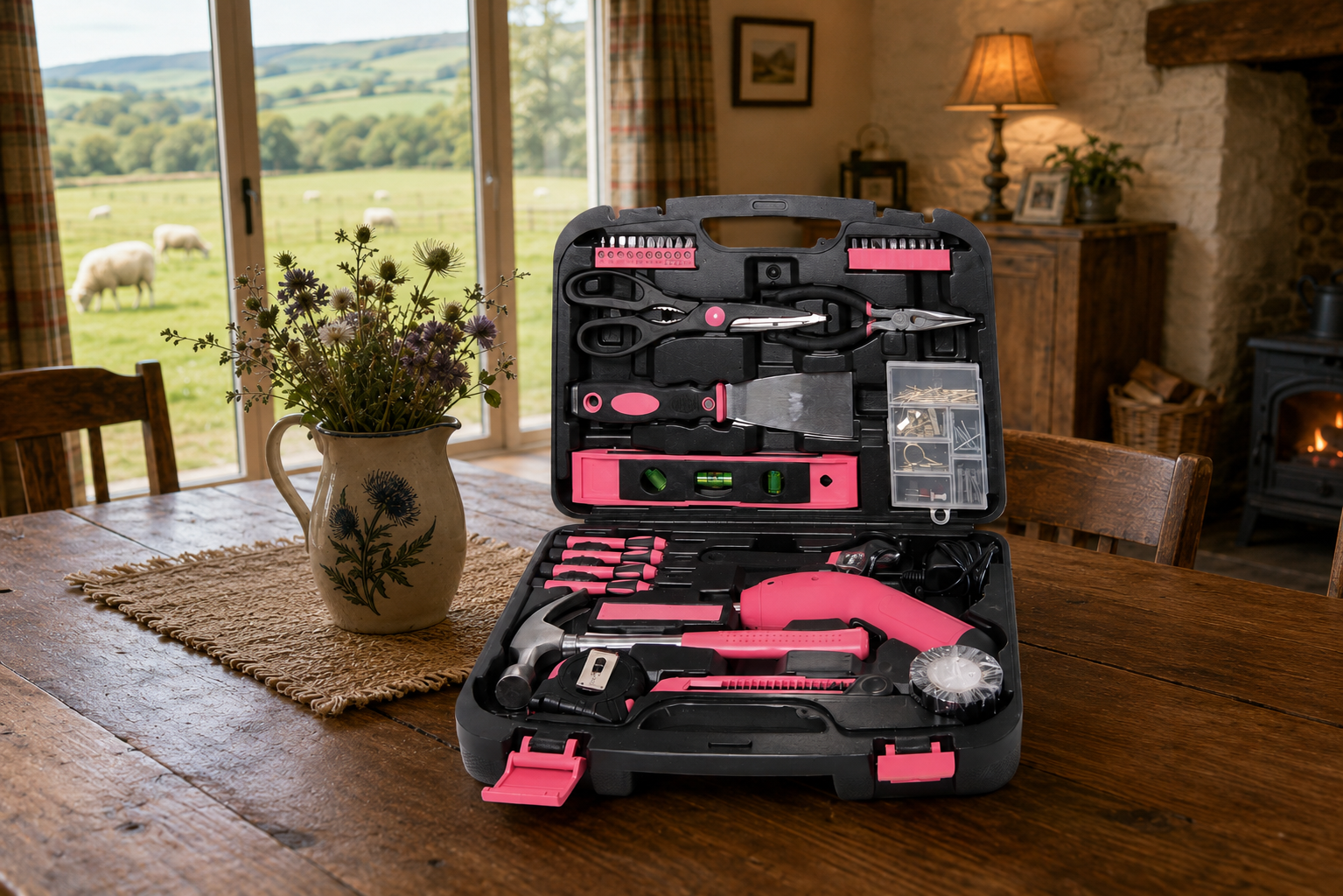
In a small box, tucked safely where no man would ever look because it is labelled “gift ribbon,” I keep my own wee set of pink tools. A hammer. A screwdriver. A tape measure. A little packet of picture hooks. A spirit level so small and pretty it would make Mr Gunn question the future of civilisation.
But these are for emergencies.
By emergencies, I mean occasions when a new piece of artwork enters the house and must be hung before Mr Gunn notices that another object with no practical function has been granted wall space.
I do not trouble him with this. Marriage requires kindness. Also timing.
If I ask him to hang a picture, there will be a consultation. He will stand back. He will measure. He will ask whether we need another picture. He will say the wall is fine as it is. He will mention plaster. He will fetch a pencil, then a different pencil, then a level, then a drill, then say he needs a rawlplug, and by the time the picture is hung, I will have lost the will to live.
So I use my pink tools.
Quietly.
The picture goes up. The room improves. Mr Gunn passes through two days later and says, “Was that always there?”
“Yes,” I say.
This is not, strictly speaking, a lie. It was always there in my mind, which is where most successful decorating begins.
Back in the kitchen, Mr Gunn switched off my blow dryer and looked very pleased with himself.
“There,” he said. “Dry as a bone.”
I took it from him and inspected the nozzle.
“It has not touched anything dirty,” he said.
“Your definition of dirty and mine have never shared a parish,” I replied.
He smiled, because he knew he was forgiven, though not acquitted. That is marriage: a long system of suspended sentences, with tea.
Later, when the house was quiet again and the evening breeze had returned to the sitting room, I looked at the wall where my newest little picture hangs. Mr Gunn has not noticed it yet. Or perhaps he has, and is wisely pretending not to. Either way, it hangs perfectly level. It has no function. It cuts nothing, tightens nothing, measures nothing, heats nothing, scrapes nothing, drills nothing, and cannot be used to mix cement.
It merely makes the room better.
And really, if that is not a purpose, I should like to know what is.