

Fifteen years after putting his name to a reform programme built around local integration, John Swinney leads plans for two strategic health boards, fewer national bodies, six to ten regional authorities and 120 to 160 community authorities.
The same politician who signed the Scottish Government’s response to the Christie Commission, placing local integration, community participation and effective local delivery among the foundations of reform, now leads the most extensive proposed redrawing of Scotland’s public administration since devolution. The Government has committed to replacing 14 territorial health boards with two strategic boards and reducing the number of national public bodies, while now proposing that existing local-government arrangements give way to between six and ten regional authorities and 120 to 160 community authorities. Behind those structural changes sit common corporate systems, wider data sharing, digital identity infrastructure and AI-assisted administration. The documentary record shows how Scotland’s model of public-service reform changed across the Salmond, Sturgeon, Yousaf and Swinney administrations.
On 21 September 2026, the Scottish Government put its first detailed institutional shape around the local-government reforms announced three weeks earlier.
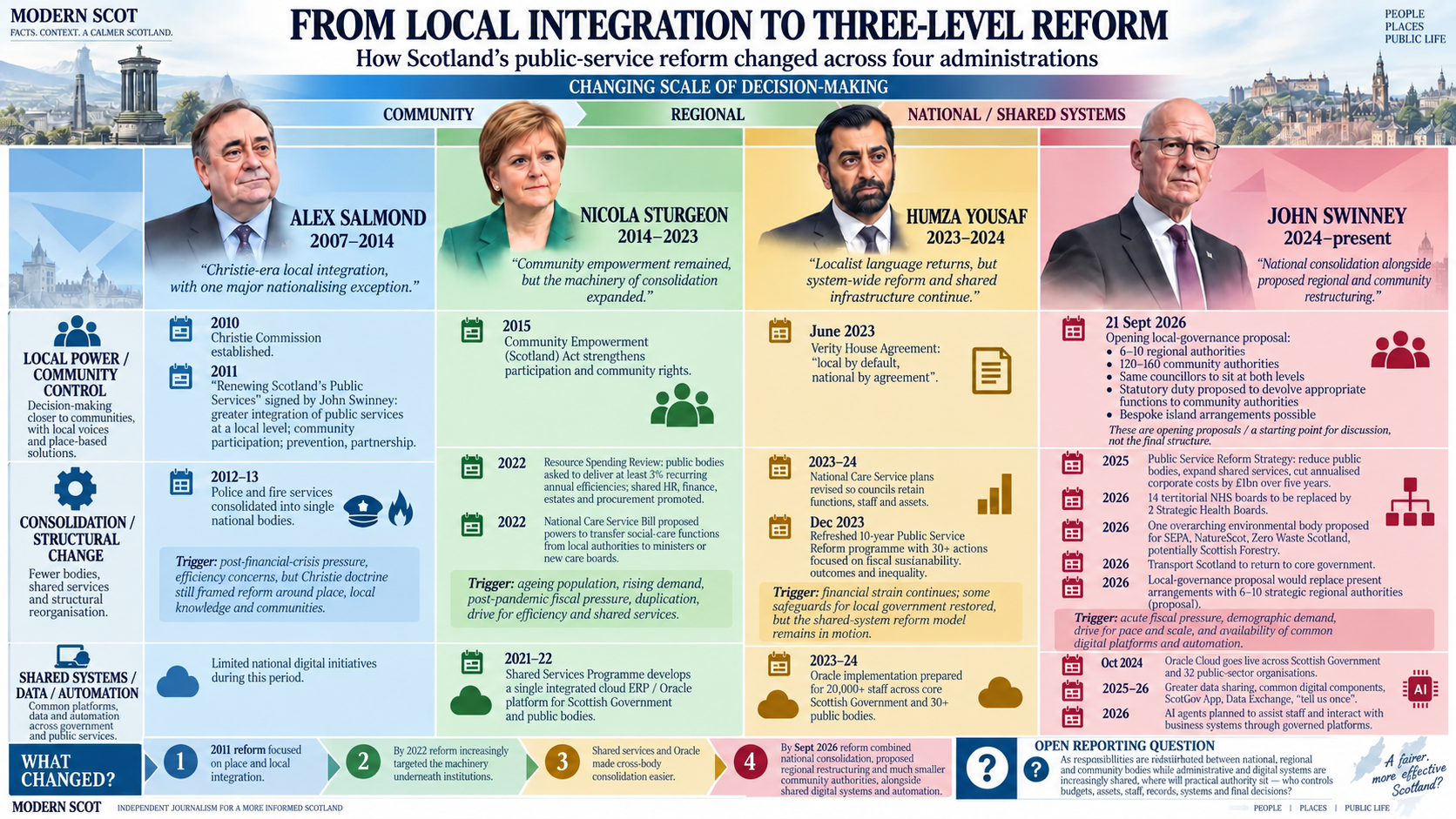
Its opening proposition is that Scotland’s present local-government arrangements should be replaced by between six and ten regional authorities responsible for strategic decision-making and between 120 and 160 community authorities operating much closer to individual towns, districts, neighbourhoods and islands.
The regional authorities could take enhanced responsibilities for economic development, housing, strategic planning, employability, transport and major public services. Community authorities could deal with functions including householder planning applications, licensing, community planning, historic environments, greenspace, town-centre regeneration and local leisure, sport and cultural facilities.
The proposal does not envisage another set of elected politicians. Councillors would continue to be elected at the present ward level and would sit on both the relevant community authority and the associated regional authority. The Government proposes that the same regional administrative and corporate structures would support both.
It also says there should be a statutory obligation on regional authorities to devolve appropriate functions to community authorities. Island communities could receive separate Single Authority arrangements reflecting their particular circumstances.
None of that is settled. The paper describes itself as a starting point for discussion. Boundaries, final functions, statutory duties, funding arrangements, revenue-raising powers and the precise relationship between the three proposed levels — national, regional and community — remain to be determined.
The proposal nevertheless alters the picture of Scottish public-service reform considerably. The programme can no longer be described simply as a movement towards larger institutions. Its stated design now combines consolidation at national and regional level with a substantial new layer of decision-making below the scale of Scotland’s existing 32 councils.
That development comes exactly 15 years after another Scottish Government reform document carrying John Swinney’s name.
On 21 September 2011, Swinney signed the foreword to Renewing Scotland’s Public Services: Priorities for Reform in Response to the Christie Commission, the Government’s formal response to the Christie Commission. Alex Salmond was First Minister and Swinney was Cabinet Secretary for Finance, Employment and Sustainable Growth.
The document set out four foundations for reform: a shift towards prevention; greater integration of public services at local level through partnership, collaboration and effective local delivery; greater investment in the public-service workforce; and a sharper focus on performance, transparency, innovation and digital technology.
Swinney’s name, title and signature appeared beneath the foreword.
The emphasis on locality ran through the substance of the response. Effective locally integrated provision was described as crucial to improving outcomes, with partnership at local-authority level central to that work. Christie had argued that public services should be built around people and communities, drawing on local capacity while strengthening autonomy and resilience.
Place-based partnership and joint planning were presented as mechanisms through which better outcomes and more effective use of public resources could be achieved.
That emphasis on local decision-making also sat within the Salmond Government’s wider constitutional argument for independence.
The 2013 independence white paper, Scotland’s Future, argued that decisions about Scotland should be taken by the people who live in Scotland rather than at Westminster. It also said independence would provide an opportunity to entrench the position of local government in a written constitution and consider the appropriate responsibilities of councils and communities. Local authorities, it stated, were democratically accountable to their own electorates rather than to the Scottish Government.
Salmond made the relationship between national self-government and local subsidiarity more explicit in the Lerwick Declaration of July 2013. Responding to the campaign by Scotland’s island councils for greater control, he said the principle of self-determination meant supporting subsidiarity and local decision-making.
The subsequent Empowering Scotland’s Island Communities programme examined how Orkney, Shetland and the Western Isles could obtain greater influence over economic, fiscal, environmental and resource questions in the event of independence.
The constitutional prospectus therefore operated at more than one level. It argued that powers exercised at Westminster should move to Scotland because decisions affecting Scotland were better made there. It also envisaged some powers being exercised closer to councils and communities.
That did not prevent the Salmond Government from creating large national institutions where ministers considered consolidation justified. Police Scotland and the Scottish Fire and Rescue Service replaced eight regional police forces and eight regional fire and rescue services.
National consolidation and local integration therefore existed alongside one another from the beginning of the post-Christie period.
Fifteen years later, both elements remain, although the institutional scale has changed considerably.
On 1 September 2026, Swinney’s Government committed itself to replacing Scotland’s 14 territorial NHS boards with two strategic boards and reducing the number of special health boards. It also set out plans to bring SEPA, NatureScot and Zero Waste Scotland into a single overarching environmental organisation, potentially including Scottish Forestry; return Transport Scotland to core government; review other transport organisations for possible merger; examine consolidation of organisations managing public land; rationalise inspectorates; and review the remaining public-body landscape for efficiency, joint working or merger.
The programme extends beneath the names and boundaries of institutions. Corporate services are increasingly shared. Estates and procurement are being treated across organisational boundaries. Data is intended to move more readily between services. A “tell us once” model is being developed. Common digital services, data definitions, national platforms and automated systems form part of the same programme.
Scotland’s emerging model is therefore no longer adequately described by a single centralisation-versus-localism axis. It is becoming a system in which the scale at which legal decisions are made can move in one direction while the administrative and technological infrastructure supporting those decisions moves in another.
Salmond: Reform Around Place
The starting point in 2011 was not a wholly decentralised model.
Police Scotland and the Scottish Fire and Rescue Service demonstrated that the Salmond Government was prepared to replace multiple regional organisations with national ones where it believed a Scotland-wide structure would reduce duplication and improve delivery.
Even with those major exceptions, the language of the Christie response was heavily concerned with place.
Local services were expected to work together. Budgets could be planned jointly. Frontline workers and communities were treated as sources of knowledge about how services should be organised. Greater integration at local level was one of the four foundations of reform, with effective place-based partnership identified as a means of improving outcomes and making better use of resources.
Financial pressure was already central to the debate. Christie was commissioned because increasing demand and constrained public expenditure were expected to make the existing system progressively more difficult to sustain.
The response adopted in 2011 was therefore a combination of prevention, local integration, collaboration and selected national consolidation rather than a single institutional model.
Sturgeon: The Administrative Direction Changes
Nicola Sturgeon became First Minister in November 2014.
The early part of her administration strengthened the localist side of the settlement through the Community Empowerment (Scotland) Act 2015. The legislation created stronger mechanisms for community bodies to participate in public decision-making and seek control of public assets.
Local empowerment therefore remained part of Scottish Government policy.
By the later Sturgeon period, however, a second form of reform was becoming increasingly prominent: consolidation not necessarily of the public bodies themselves, but of the machinery underneath them.
The 2022 Resource Spending Review required public bodies to plan for recurring annual efficiencies of at least 3 per cent and identified shared services, the public estate, procurement and grant management as areas in which savings should be pursued.
Bodies maintaining their own human-resources or finance functions were asked to consider whether corporate services could be shared. The estate programme envisaged fewer buildings, more co-location and greater interoperability across the public sector.
Christie had largely examined how separate organisations could work together around people and places. The newer programme increasingly examined why those organisations needed to maintain separate administrative machinery.
Human resources, finance, procurement, property and technology could be provided collectively even while organisations retained their individual legal identities.
The Resource Spending Review also placed digital infrastructure more firmly within the reform programme. Centralised payments, digital identity, cloud adoption and common platforms were presented as ways of allowing organisations to direct more people and resources towards service delivery rather than duplicate administrative functions.
The National Care Service Tested the Limits
The National Care Service (Scotland) Bill, introduced in June 2022 while Humza Yousaf was Health Secretary, went considerably further than shared administration.
As originally introduced, it would have allowed Scottish ministers to transfer specified social-care functions from local authorities and health boards to ministers or new care boards.
Scottish Parliament briefing material described those proposed care boards as directly accountable to Scottish ministers and directly funded by them, unlike existing integration arrangements linking accountability to health boards and local authorities. The legislation also contained mechanisms for transferring staff, property and liabilities.
The proposal generated sustained disagreement over local accountability and was subsequently altered.
By 2023, the developing agreement with COSLA meant councils would retain functions, staff and assets which earlier versions of the programme had contemplated transferring.
The episode demonstrated that movement towards national structures was neither automatic nor irreversible. The final location of powers depended upon political agreement, legislation and negotiations between national and local government.
Yousaf: Local by Default, While Reform Continues
Humza Yousaf became First Minister in March 2023.
Three months later, his Government and COSLA signed the Verity House Agreement, adopting the maxim “local by default, national by agreement”.
The agreement stated that public responsibilities should generally be exercised by the authorities closest to citizens. When ministers considered national delivery models affecting councils, local government was to be involved from the beginning of policy development.
The principle represented a clear restatement of local-government autonomy, but the wider programme of administrative reform continued alongside it.
Yousaf’s administration continued work on digital transformation, the public estate, common digital components and shared administrative services. The Scottish Government’s Shared Services Programme was preparing the Oracle Cloud platform that would later replace older human-resources and finance systems across core government and dozens of public organisations.
The Yousaf period therefore combined two strands that remain visible in the 2026 proposals: an explicit commitment to subsidiarity and continued development of infrastructure capable of operating across institutional boundaries.
Swinney: Consolidation Becomes Structural
John Swinney returned to government as First Minister in May 2024.
Oracle Cloud went live that October as part of the Shared Services Programme, introducing a common platform across Scottish Government core and 32 other public-sector organisations. Human-resources, finance and purchasing functions could increasingly operate through common infrastructure rather than through separate systems maintained by every organisation.
The Public Service Reform Strategy published in June 2025 expanded the programme.
It formalised a “Once for Scotland” approach to shared services, with plans to bring suitable organisations onto common human-resources, finance and purchasing infrastructure and develop shared services at greater scale.
The same strategy made Intelligent Automation a national workstream, proposing a hub-and-spoke approach across core government and public bodies and describing automation and AI as tools for increasing capacity, reducing costs and addressing operational pressures.
By September 2026, reform had moved from common systems into the institutional map.
The Programme for Government committed ministers to replacing Scotland’s 14 territorial NHS boards with two strategic health boards and reducing the number of special boards.
It also committed the Government to substantially reducing the number of public bodies. SEPA, NatureScot and Zero Waste Scotland are to be brought into an overarching environmental organisation, potentially including Scottish Forestry. Transport Scotland is to return to core government. Other transport bodies, inspectorates, public-land organisations and parts of the wider public-body landscape are subject to further review or consolidation.
Twenty days later, the local-government side became considerably more specific.
The Government’s 21 September paper proposes replacing the present arrangements with six to ten regional authorities and 120 to 160 community authorities.
Regional bodies could have enhanced responsibility for economic development and business support, housing, strategic planning, employability and transport. They would also retain responsibility for significant existing council services, including environmental services, regulatory functions and education, although some elements could be directed more locally.
Community authorities could take responsibility for functions including local planning decisions, licensing, community planning, greenspace, historic environments, town-centre regeneration and leisure, sport and cultural facilities.
Councillors would continue to be elected through the present ward structure and would sit on both levels. The same regional administrative and corporate structures would support the regional and community authorities.
The Government also proposes a statutory obligation requiring regional authorities to devolve appropriate functions to community authorities.
Some responsibilities presently exercised by national public bodies could also be transferred into regional or local democratic control.
The proposed local structure is not at the same stage as every other reform in the programme. The reduction from 14 territorial NHS boards to two strategic boards is stated as a Government commitment. The six-to-ten regional authorities and 120-to-160 community authorities are explicitly an opening proposition for negotiation.
Their boundaries do not yet exist. Their precise legal powers have not been allocated. Funding has not been settled. Local and regional revenue-raising powers remain under discussion. The detailed relationship between education, social care, housing, health, transport and the new structures has not been determined.
The Government says it wants agreement first on which responsibilities should sit at national, regional and community level, with funding arrangements following from that division.
The Same Signature at Both Ends
Swinney provides an unusual line of continuity across the period.
In 2011, his signature appeared beneath a Government response that made greater integration of public services at local level one of the foundations of reform.
In 2012, as finance secretary, he described local government as a central participant in the reform process and spoke about cooperation among councils, health services, police and the third sector at local level.
By 2025, as First Minister, he was still presenting his reform programme through the Christie principles of empowerment, integration, efficiency and prevention.
The administrative programme surrounding those principles had nevertheless changed.
His Government now intends to replace 14 territorial health boards with two strategic boards, reduce the number of national public bodies, combine environmental organisations, extend common corporate systems, increase data interoperability and expand AI-assisted administration.
At the same time, Swinney has argued that larger strategic institutions and stronger local government need not be opposites.
The proposal published on 21 September gives that position its clearest institutional form so far.
Instead of organising local government primarily around 32 unitary councils, the opening model would distribute responsibilities across three levels: national, regional and community. Six to ten regional authorities would sit above a network of 120 to 160 community authorities, with a proposed statutory duty requiring suitable functions to be devolved downwards.
The question is therefore no longer simply whether powers gathered into larger bodies will be matched by anything moving in the other direction.
The Government has now identified a mechanism through which it proposes that downward movement should occur.
What remains unresolved is the substance of that transfer: which statutory powers, budgets, assets, staff and legal discretion community authorities would actually receive; how much freedom regional authorities would have from national government; and which functions now belonging to national public bodies would move into democratically controlled regional or local institutions.
There is also a structural characteristic within the Government’s proposal that will require examination as the model develops.
Although community authorities would make decisions at a smaller geographical scale, they would use the same overall regional administrative and corporate structures as their regional authority.
Local decision-making and administrative decentralisation are therefore not necessarily the same thing under the model. A community authority could possess legal authority over a local function while payroll, procurement, technology, records or other administrative systems continued to operate at regional or national scale.
The result is more complex than a simple movement from local to central government.
Swinney’s 2011 reform programme sought locally integrated services within Scotland’s existing institutional landscape. His 2026 programme proposes substantially larger strategic institutions in some areas, substantially smaller democratic decision-making units in others, and more common administrative and digital infrastructure connecting them.
What Did Voters Actually Approve?
The 2026 Scottish Parliament election returned the SNP as the largest party with 58 of the Parliament’s 129 seats, leaving it short of an overall majority.
The SNP manifesto contained a clear public-service reform programme.
It promised to reduce the number of public bodies, invest in technology to support more joined-up and lower-cost services, reform and simplify the public-sector landscape and devolve power to people and communities.
It also committed the party to introducing a Public Service Renewal Bill during the first year of the Parliament.
The institutional arrangements announced after the election are considerably more specific.
The manifesto did not present voters with a proposal to replace Scotland’s 14 territorial NHS boards with two strategic boards.
It did not set out a model replacing present local-government arrangements with six to ten regional authorities and 120 to 160 community authorities.
Nor did it identify the subsequent proposal to combine SEPA, NatureScot and Zero Waste Scotland in a single overarching environmental organisation.
Public-service reform was therefore part of the electoral programme. The detailed institutional architecture through which ministers now propose to carry it out was developed subsequently.
Where those changes require legislation, they will proceed through a Scottish Parliament in which the Government does not hold an outright majority.
Twenty Thousand Users, One Corporate Platform
Oracle provides the clearest existing example of what shared administration means in practice.
The platform was introduced across Scottish Government core and 32 other public-sector organisations in October 2024. It covers corporate functions including finance, purchasing and, for many users, human resources and payroll.
That does not mean everybody using the platform can see everybody else’s records. Access is governed through permissions, and Oracle should not be confused with a single national repository containing health records, social-care files or every item of information held about citizens.
Its significance lies elsewhere.
Legally separate institutions can retain their own statutory identities while relying on common underlying infrastructure for essential administrative functions.
Cloud infrastructure can provide professional backup, replication, cybersecurity and disaster recovery that smaller independent systems may struggle to reproduce.
It can also create shared dependencies.
Where organisations operate completely separate systems, a failure can remain confined to one institution. Where many organisations depend upon the same platform, the resilience of that platform — and of the communications networks through which individual organisations reach it — becomes more significant.
Scottish public-sector cyber-resilience requirements call for tested backups, disaster-recovery arrangements, alternative transmission routes where necessary and contingency mechanisms capable of maintaining essential services, even at reduced levels, when primary information systems fail.
Less visible publicly is the detailed local fallback arrangement for each organisation using common infrastructure: whether urgent purchasing or payroll can continue, which essential information remains available locally, how long individual services can function without the central system and what happens when the cloud platform itself remains operational but a rural or island office loses the telecommunications connection needed to reach it.
These questions are not arguments against cloud computing.
They concern the balance between eliminating unnecessary administrative duplication and retaining genuinely independent resilience.
From Separate Records to “Tell Us Once”
The next layer concerns information about citizens.
The Government is developing a “tell us once” model alongside shared data definitions, common datasets, Data Exchange and reusable digital services.
The intention is to reduce repeated requests for the same information across public services and make information held within one organisation more useful where another service lawfully requires it.
That does not establish that every Scottish citizen record is being transferred into a single national database.
It does indicate movement away from information remaining entirely isolated within individual organisations and towards controlled reuse and interoperability.
Information does not have to be physically stored in one database for multiple organisations to be capable of retrieving or using it through connected systems.
ScotAccount: Scotland Already Has Digital Identity Infrastructure
ScotAccount forms part of that architecture.
It allows people to use one account across participating Scottish public services and can support identity verification and reuse of verified identity attributes.
At 1 June 2026, the Scottish Government reported just over 768,000 registered ScotAccount accounts.
The Government has also confirmed that the identity-verification process involves biometric data derived from official documentation and a user selfie, placing that information within the special-category provisions of UK data-protection law.
ScotAccount is therefore digital-identity infrastructure.
It is not presently a compulsory national identity system.
The Scottish Government has also said there are no current plans simply to connect ScotAccount to proposed UK national digital-identity infrastructure. Discussions concerning interoperability and federation with GOV.UK One Login were exploratory when the Government responded to an FOI request in August 2026, with no agreed technical design or data flows at that point.
Questions Readers May Have
Is Scotland building a digital identity system that could become difficult to opt out of later?
Scotland already has a government digital-identity system in ScotAccount.
It is intended to allow one account to be used across participating public services, to verify identity and to permit reuse of specified verified attributes such as name, date of birth and address.
The Scottish Government currently describes ScotAccount as voluntary and says non-digital routes should remain available for people who cannot or choose not to use digital channels.
That is the current policy position rather than a guarantee that every service must permanently maintain an identical non-digital route regardless of future legislation, policy or service redesign.
The practical test will therefore be whether people who do not use ScotAccount can continue to obtain the underlying service, establish their identity, communicate with a person and challenge a decision through a reasonably accessible alternative.
Why isn’t John Swinney calling the wider programme a system ready for digital ID?
The Scottish Government does use the term digital identity when describing ScotAccount.
It describes ScotAccount as a common service through which people can sign in to multiple public services, prove their identity and reuse verified attributes.
What the Government does not do is describe the whole public-service reform programme as a digital-ID programme.
The wider architecture is described through other terms: joined-up digital public services, common platforms and components, Data Exchange, “tell us once”, shared datasets, the ScotGov App and automation.
ScotAccount nevertheless operates as a reusable identity component within that wider architecture.
In that technical sense, participating services can already be designed to use a common Scottish Government identity service instead of each creating an entirely separate mechanism for verifying identity.
That is not evidence that Scotland has adopted a compulsory national digital ID. It has not.
Nor does the published programme establish that every public service will require ScotAccount.
As more services use the same identity layer, however, the practical significance of the system will depend increasingly upon which services require verified digital identity, which attributes can be reused, how that reuse is authorised and whether genuinely usable alternatives remain available.
There is no evidence in the published record establishing that Swinney is deliberately avoiding the term “digital ID”. The Government openly uses that description for ScotAccount while placing the broader programme under the headings of public-service reform and joined-up digital services.
Could a future Scottish Government make ScotAccount effectively compulsory even if it remained technically voluntary?
A digital service can remain formally voluntary while becoming harder to avoid if alternative routes become slower, more difficult to find, available only through limited telephone services or dependent upon fewer physical offices.
The Scottish Government’s present policy recognises that not everybody can or will use ScotAccount and says services using it should maintain alternative routes.
The relevant measure is therefore not simply whether the service continues to be described as voluntary.
It is whether a person continues to have a practical and reasonably equivalent means of obtaining the underlying public service without using the digital identity system.
Banking provides a comparison of how formal choice and practical availability can diverge.
Customers are not legally required to use online banking, but widespread branch closures have reduced face-to-face banking availability in many communities, contributing to the development of banking hubs and regulatory protections concerning access to cash.
A service can therefore remain technically optional while its alternative becomes progressively less convenient or accessible.
Does one ScotAccount mean all of my information is being put into one government database?
No evidence establishes that Scotland is creating a single database containing every citizen record.
ScotAccount is intended to verify identity and enable specified verified attributes to be reused across participating services. Other parts of the public sector continue to maintain their own systems and records.
The wider change concerns interoperability.
Data Exchange, common data definitions, reusable datasets and “tell us once” can allow information held by separate organisations to become accessible across organisational boundaries without physically combining every record in one database.
The relevant questions are therefore which organisations can obtain particular information, the legal basis upon which they can obtain it, the purpose for which it can be used, how access is recorded and whether permissions or data-sharing arrangements can subsequently be changed.
Once information is being reused between public services, can that sharing be rolled back?
Technically, systems and access permissions can be altered.
Legally, information sharing continues to require an appropriate lawful basis and remains subject to data-protection law.
Practical reversibility is a separate question.
If staffing structures, service design and administrative processes become dependent upon shared information, reversing those arrangements may require systems to be rebuilt, separate datasets recreated, contracts altered and local administrative capabilities restored.
Reversal remains possible, but the organisational cost can increase as dependence deepens.
Is Scotland becoming locked into Oracle?
The Scottish Government has itself identified vendor lock-in as a risk associated with cloud services.
Its guidance advises public organisations to plan how they would leave a supplier, consider standards that improve portability and understand the cost of transferring systems and extracting data.
Oracle should therefore not be treated as an irreversible constitutional structure. Contracts can end and technology can be replaced.
Practical replacement may nevertheless become more difficult as organisations redesign finance, purchasing, human-resources processes, staffing practices and other systems around one platform.
The relevant measures of resilience include tested exit arrangements, portable data, documented processes and the capacity to move to another provider without losing essential functions.
How many organisations now depend on Oracle, and what exactly is inside it?
The Oracle Cloud shared service was introduced for Scottish Government core and 32 other public-sector organisations.
It principally supports corporate administration, including finance and purchasing and, for many organisations, human resources and payroll.
It is not a single repository containing NHS patient records, social-care files or all data held about Scottish citizens.
The arrangement demonstrates how legal independence and administrative independence can diverge.
A regulator, agency or public body can retain its legal identity while relying upon common infrastructure for payroll, purchasing, accounting or personnel management.
What happens if Oracle is working but a local office cannot reach it?
That is a different resilience problem from failure of the cloud platform itself.
Audit Scotland has reported on backup and disaster-recovery arrangements associated with the Oracle environment.
Those arrangements do not by themselves establish what happens in an individual office if local telecommunications fail while the central platform remains available elsewhere.
The local questions include whether essential information remains accessible, whether urgent purchasing and payroll functions can continue, whether manual procedures exist and how long a service is expected to operate without access to the common platform.
A remote backup protects against some forms of system loss. It does not restore connectivity to an office that cannot reach the system.
Is removing local duplication always beneficial?
Different forms of duplication serve different purposes.
Two organisations separately carrying out identical administrative processing may create unnecessary expense.
Two independent communications routes, separate contingency procedures or locally accessible copies of essential information may provide resilience.
Scottish Government cloud guidance recognises that increased dependence upon cloud services makes internet availability increasingly important to business continuity.
The relevant assessment therefore depends upon what is being duplicated and what function that duplication performs.
Could Scotland become so dependent on one technology supplier that changing policy later becomes impractical?
That is the problem normally described as vendor lock-in.
The Scottish Government’s own cloud guidance recognises the risk and identifies standards, portability, exit planning and knowledge of switching costs as safeguards.
Dependence can extend beyond the software contract itself.
Staff training, data structures, integrations with other systems, internal procedures and workflows can all become organised around a particular platform.
A government can therefore remain legally able to change supplier while facing considerable practical and financial costs in doing so.
Is AI going to make decisions about people?
The published Scottish Government programme does not establish that autonomous AI has been given authority to make statutory decisions about citizens.
It does envisage greater use of AI and automation, including systems capable of assisting staff, accessing information and interacting with business systems.
Automation can influence a decision without issuing the final legal determination.
A system may prioritise cases, identify risks, select information for a member of staff, generate recommendations or direct a case into a particular workflow.
The Government’s AI guidance therefore places emphasis on human oversight and accountability.
The precise safeguards will depend upon how individual systems are designed and used.
Can a person demand a human decision instead of an automated one?
UK data-protection law provides particular protections where decisions are made solely by automated means and produce legal or similarly significant effects.
Those protections can include safeguards concerning human intervention and challenge.
Many systems may not fall into the category of being solely automated.
Where software produces a recommendation and a person formally makes the final decision, the legal position can differ even where automation had a substantial influence over the process.
The practical questions are therefore whether the human genuinely reviews the evidence, whether that person can depart from the automated recommendation, whether the citizen is informed that automation played a role and whether an incorrect result can be challenged and corrected.
Who decides what an AI or automated system is allowed to do?
The software has no independent legal authority.
The rules within a system can result from legislation, ministerial policy, decisions made by public organisations, procurement specifications, administrative procedures and technical design.
Those responsibilities can become distributed across several organisations and contractors.
A public official may remain legally responsible for a decision while part of the workflow or recommendation used to produce it was developed elsewhere.
Effective accountability therefore depends upon an identifiable public authority retaining responsibility for the decision and having the ability to understand, audit, change and override the systems it uses.
Could a computer effectively say “no” while a human remains responsible only on paper?
It is technically possible for an automated system to exert substantial influence over an outcome even when a human being formally authorises the final decision.
If software filters a case, determines a score, identifies a risk or prevents a case from reaching a decision-maker in the ordinary workflow, automation may shape the outcome before the formal decision stage.
Meaningful human oversight therefore depends upon the decision-maker being able to see the underlying evidence, understand how the automated recommendation was produced and depart from it where appropriate.
Is digital consolidation weakening local government?
Shared digital infrastructure does not automatically remove statutory powers from councils or other local bodies.
An authority may continue to possess the legal power to make a decision while becoming increasingly dependent upon larger systems for finance, procurement, identity management, records or administrative workflow.
The Government’s new local-governance proposal makes the difference particularly visible.
Community authorities could exercise decisions at a smaller geographical scale while being supported by the same regional administrative and corporate infrastructure as the larger regional authority.
Formal decentralisation of a decision therefore does not necessarily require decentralisation of the technology or administration used to carry it out.
The measure of operational independence will be how much control regional and community institutions retain over budgets, systems, records, staff and procedures required to exercise their legal responsibilities.
Is Scotland becoming less locally controlled?
The proposed structure moves authority in both directions.
Some responsibilities currently exercised through Scotland’s 32 councils could move upwards into six to ten larger regional authorities.
The Government identifies economic development, housing, strategic planning, employability, transport and major public services among the areas that could operate at regional scale.
Other decisions could move downwards into 120 to 160 community authorities.
The Government identifies householder planning applications, community planning, licensing, management of historic environments and greenspace, town-centre regeneration and local leisure, sport and cultural facilities among the functions that could operate there.
The proposal goes beyond earlier statements about community empowerment by proposing a statutory obligation requiring regional authorities to devolve appropriate functions to community authorities.
It also opens the possibility of functions presently held by national public bodies being transferred into regional or local democratic control.
Those powers have not yet been finally allocated.
Neither the boundaries nor funding arrangements are settled, and the Government says the division of responsibilities between national, regional and community government must be agreed before decisions are taken about funding and revenue-raising powers.
The final balance can therefore be measured once detailed proposals emerge: which statutory powers, budgets, assets and executive decisions move upwards from the current council level; which move downwards into community authorities; and which move from national organisations into regional or local democratic control.
Are Scotland’s 32 councils definitely being abolished?
No final decision of that kind has yet been taken.
The Scottish Government’s opening proposition is that present local-government arrangements should be replaced by six to ten regional authorities and 120 to 160 community authorities.
The paper repeatedly states that the model is a starting point for discussion rather than the Government’s final position.
Detailed proposals are to be developed through discussions with Parliament, local authorities, communities and other organisations.
The final number of authorities, their boundaries, powers, funding and implementation arrangements therefore remain open.
Would the proposed system create another group of politicians?
Not under the Government’s opening model.
Councillors would continue to be elected at existing ward level and would sit on both the relevant community authority and the associated regional authority.
The Government says this is intended to avoid another layer of elections or an additional tier of politicians.
It also acknowledges that dual membership would substantially increase councillors’ responsibilities and would require consideration of remuneration and the time expected of them.
What would happen to Orkney, Shetland and the Western Isles?
The Government says island communities require bespoke arrangements.
Its proposal allows for Island Single Authority Models rather than assuming that every island area would be fitted into the same regional and community structure used elsewhere.
The precise functions and design would be developed in discussions with the islands themselves and could differ between island groups.
Could NHS Scotland simply be merged into NHS England?
Not through an administrative decision by NHS England.
Health is devolved, and NHS Scotland and NHS England remain legally and institutionally separate systems.
Moving Scottish health responsibilities into a UK-wide structure would require legal and constitutional changes.
Shared technical standards, procurement arrangements, information systems or interoperable services are different from transferring constitutional responsibility for health.
Could shared digital infrastructure make a future merger easier?
Common standards and interoperable systems can reduce the technical work required to combine or coordinate services.
If organisations already use compatible identities, data standards and administrative platforms, some technical barriers to future integration can be lower.
That does not determine whether any future government would choose such a policy or whether Parliament would approve it.
Technical interoperability creates capability. It does not by itself determine constitutional or political decisions.
If Scotland wanted to reverse consolidation later, could it?
Policies, legislation and administrative structures can be changed by future governments and Parliaments.
The difficulty of doing so depends partly upon how far implementation has progressed.
The local-government proposal published on 21 September is still at an early stage and has not created the proposed regional or community authorities.
Other reforms are further advanced.
Once institutions have been abolished or merged, staff transferred, buildings closed, records migrated and administrative processes rebuilt around common infrastructure, restoring separate arrangements may require substantial time and expenditure.
Reversibility therefore depends upon practical design as well as legal authority.
Data portability, documented exit procedures, alternative suppliers, local contingency arrangements and retention of institutional knowledge can reduce the cost of later change.
What happens to paper records and local copies?
Public-records and retention duties do not disappear because administration becomes digital.
Scottish Government records remain subject to retention and disposal schedules, with selected records transferred permanently to National Records of Scotland.
What has not been established is that every item of information required for local continuity will continue to be physically or digitally accessible within the place where a service is delivered.
As common systems expand, continuity arrangements determine which information remains available when the primary system or connection cannot be used.
Can someone still walk into an office, use paper and speak to a person?
Current Scottish Government digital policy says alternative routes should remain available for people who cannot or choose not to use digital services.
Whether those alternatives remain equivalent depends upon how individual services are organised.
A nominal offline route may be less useful if it requires considerably greater travel, longer waits or access through a limited telephone service.
The proposed local-government reorganisation adds another unresolved element because the future geography of offices and customer-facing services has not yet been designed.
The practical position will have to be established service by service as the institutional structure develops.
What protections would prevent Scotland becoming dependent on systems that are difficult to undo?
The relevant safeguards are structural.
They include workable non-digital access where required; limits on the reuse of identity information; transparent data-sharing arrangements; human review and appeal mechanisms; data portability; open technical standards; supplier exit planning; independent backups; local continuity arrangements; procurement transparency; audit access; preservation of essential public records; and clear responsibility for consequential decisions.
Several of those principles already appear separately within Scottish Government policies covering cloud computing, records, data protection, cyber resilience and digital inclusion.
Their effectiveness will depend upon how they are applied as services and systems become more interconnected.
The Question Left by Fifteen Years of Reform
The structure proposed in 2026 is no longer simply a programme for reducing the number of public bodies or sharing administrative systems.
It is becoming a proposed redistribution of Scottish public administration across three levels.
At national level, the Government intends to reduce public bodies, replace 14 territorial health boards with two strategic boards, consolidate environmental organisations, expand shared corporate infrastructure and continue development of interoperable data, digital services and automation.
At regional level, it now proposes between six and ten authorities with strategic responsibilities extending across economic development, housing, planning, transport and public services.
Beneath them, between 120 and 160 community authorities could take responsibility for decisions the Government considers better made close to individual towns, neighbourhoods and communities.
The architecture therefore contains both consolidation and decentralisation.
An independent institution can disappear at one level while a new decision-making body is created at another. Corporate technology can operate across Scotland while a licensing decision is taken locally. Health strategy can move into two large boards while responsibility for a greenspace or town centre could move to a community authority.
Legal powers can also remain distributed while the machinery underneath them becomes increasingly common.
A regional body may possess statutory responsibility while relying upon shared national technology. A community authority may take local decisions while using corporate systems operated at regional scale. Citizens may encounter several legally separate public services through one identity system. Public bodies may retain statutory identities while finance, procurement, personnel administration and data exchange become increasingly shared.
Institutional names alone will therefore provide only part of the answer to where practical authority sits.
The other measures are who controls the budget, who owns the assets, who employs the staff, who holds the records, who establishes the rules, who configures the systems, who can override an automated recommendation and which authority can make a decision without obtaining permission elsewhere.
In 2011, John Swinney signed a Scottish Government response to Christie which placed local integration, community participation and effective local delivery among the foundations of public-service reform.
In 2026, he leads a Government proposing to redraw both the upper and lower levels of that system while simultaneously consolidating much of its administrative and digital infrastructure.
The vocabulary surrounding reform has remained strikingly familiar across the period: prevention, integration, efficiency, empowerment and improved outcomes.
The machinery proposed to deliver those objectives has changed considerably.
The question left by the 21 September proposal is therefore more precise than whether Scotland is becoming more centralised or more decentralised.
It is which powers will ultimately sit nationally, regionally and locally — and whether the money, assets, staff, systems and practical authority required to exercise those powers will move with them.
Sources
Scottish Government — Renewing Scotland’s Public Services: Priorities for Reform in Response to the Christie Commission, 21 September 2011
https://www.gov.scot/publications/renewing-scotlands-public-services-priorities-reform-response-christie-commission/
Commission on the Future Delivery of Public Services — Christie Commission on the Future Delivery of Public Services, 29 June 2011
https://www.gov.scot/publications/commission-future-delivery-public-services/
Scottish Government — Scotland’s Future: Your Guide to an Independent Scotland, 26 November 2013
https://www.gov.scot/publications/scotlands-future/
Scottish Government and Island Areas Ministerial Working Group — Empowering Scotland’s Island Communities, 16 June 2014
https://www.gov.scot/publications/empowering-scotlands-island-communities/
Community Empowerment (Scotland) Act 2015
https://www.legislation.gov.uk/asp/2015/6/contents
Scottish Government — Investing in Scotland’s Future: Resource Spending Review, 31 May 2022
https://www.gov.scot/publications/investing-scotlands-future-resource-spending-review/
Scottish Parliament — National Care Service (Scotland) Bill, introduced 20 June 2022; subsequently renamed the Care Reform (Scotland) Bill
https://www.parliament.scot/bills-and-laws/bills/s6/care-reform-scotland-bill
Scottish Parliament Information Centre — National Care Service (Scotland) Bill, 10 October 2022
https://www.parliament.scot/chamber-and-committees/research-prepared-for-parliament/research-briefings/2022/10/10/sb-2259
Scottish Government and COSLA — New Deal with Local Government: Verity House Agreement, 30 June 2023
https://www.gov.scot/publications/new-deal-local-government-partnership-agreement/
Scottish Government — Programme for Government 2023 to 2024, 5 September 2023
https://www.gov.scot/publications/programme-government-2023-24/
Scottish Government — The Scottish Government Consolidated Accounts for the Year Ended 31 March 2024, 10 October 2024
https://www.gov.scot/publications/scottish-government-consolidated-accounts-year-ended-31-march-2024/
Scottish Government — Scottish Public Sector Cyber Resilience Framework v2.0, 10 December 2024
https://www.gov.scot/publications/scottish-public-sector-cyber-resilience-framework-v2-0/
Scottish Government — Cloud Principles
https://www.gov.scot/publications/cloud-principles/
Scottish Government — Scotland’s Public Service Reform Strategy: Delivering for Scotland, 19 June 2025
https://www.gov.scot/publications/scotlands-public-service-reform-strategy-delivering-scotland/
Scottish Government — Public Service Reform Strategy: Impact Assessments, 11 July 2025
https://www.gov.scot/publications/scotlands-public-service-reform-strategy-impact-assessments/
Scottish Government — The Scottish Government Consolidated Accounts for the Year Ended 31 March 2025, 30 October 2025
https://www.gov.scot/publications/scottish-government-consolidated-accounts-year-ended-31-march-2025/
Audit Scotland — The 2024/25 Audit of the Scottish Government Consolidated Accounts, 30 October 2025
https://audit.scot/publications/the-202425-audit-of-the-scottish-government-consolidated-accounts
Scottish Government — ScotAccount: Equality Impact Assessment, 5 March 2026
https://www.gov.scot/publications/scotaccount-equality-impact-assessment/
Scottish Government — Democracy Matters: A Route Map to Reform, 20 March 2026
https://www.gov.scot/publications/democracy-matters-route-map-reform/
Scottish National Party — SNP 2026 Manifesto: Always on Scotland’s Side, 16 April 2026
https://www.snp.org/manifesto/
Scottish Parliament — 2026 Election Results
https://www.parliament.scot/msps/elections/2026-election-results
Scottish Government — ScotAccount Hosting Infrastructure and Jurisdictional Risk Assessment: FOI Release, FOI/202600516387, 21 July 2026
https://www.gov.scot/publications/foi-202600516387/
Scottish Government — Serving Scotland: Our Five-Year Plan, 25 August 2026
https://www.gov.scot/publications/serving-scotland-five-year-plan/
Scottish Government — Queries Concerning Interoperability Between ScotAccount and GOV.UK One Login: FOI Release, FOI/202600515415, 25 August 2026
https://www.gov.scot/publications/foi-202600515415/
Scottish Government Digital Directorate — New Artificial Intelligence (AI) Guidance Available for Scottish Public Sector, 31 August 2026
https://blogs.gov.scot/digital/2026/08/31/new-artificial-intelligence-ai-guidance-available-for-scottish-public-sector/
Scottish Government — Programme for Government 2026 to 2031, 1 September 2026
https://www.gov.scot/publications/programme-government-2026-2031/
Scottish Government — National Renewal Through Public Sector Reform: A Proposal for Reform of Local Governance, 21 September 2026
https://www.gov.scot/publications/public-sector-reform-proposal/