
Long before Scotland’s haunted castles became visitor attractions, ministers, doctors, judges, councils and ordinary families were recording something stranger: funeral parties racing to avoid leaving their dead as churchyard guardians, murder victims being made to “identify” their killers, bodies moved because fishermen believed they had driven away the herring, human remains used as medicine, graves opened before crowds and a family trying to restore life after an execution. Some of these things demonstrably happened. Others were beliefs reported by people who lived among them. The surviving records allow the two to be separated — and what remains is often stranger than the folklore that followed.
The Last-Buried Dead Had to Guard the Churchyard Gate
Recorded 1799 | Aberdeenshire; preserved in the Monquhitter appendix to the Old Statistical Account
There was a problem at the churchyard gate. Two funeral parties had arrived on the same day, and neither particularly wished to be second. This was not impatience over the minister, the grave-digger or the lateness of the hour. According to an account published in Aberdeenshire in 1799, the difficulty lay with the dead themselves.
The belief was that the ghost of the person most recently buried had to keep watch at the churchyard gate until another death supplied a replacement. The Old Statistical Account put it rather more vividly: the unfortunate ghost was condemned to “porter it” until relieved by the next burial.
That transformed burial order into something more consequential than ceremony. When two funerals were due at the same churchyard on the same day, the account says both parties staggered forward as quickly as possible, each attempting to get its own dead into the earth first. If they met at the gate, the coffins could be put down while the living decided, by blows if necessary, which family would bury first and whose relative would inherit the unwanted supernatural duty.
There is an important geographical qualification. The story appears in the 1799 appendix for Monquhitter in the Old Statistical Account, but the wording itself says only that the custom existed “in one division of this county”. It does not identify the particular churchyard. Monquhitter is therefore where the belief was recorded, not a proven identification of the burial ground in which the reported fight occurred.
John Gregorson Campbell later recorded the same underlying Highland belief under the Gaelic name Faire Chlaidh, the “watch of the graveyard”. In his account, the last person buried remained on watch until the next funeral arrived. He also recorded that when two funeral parties reached a churchyard together, a fight could break out over which coffin would be buried first. The idea had therefore survived well beyond a single eighteenth-century parish report.
The surviving records do not name the dead people whose funeral parties supposedly fought. They do not tell us who, in 1799, was imagined to be standing watch at the gate. That identity has disappeared.
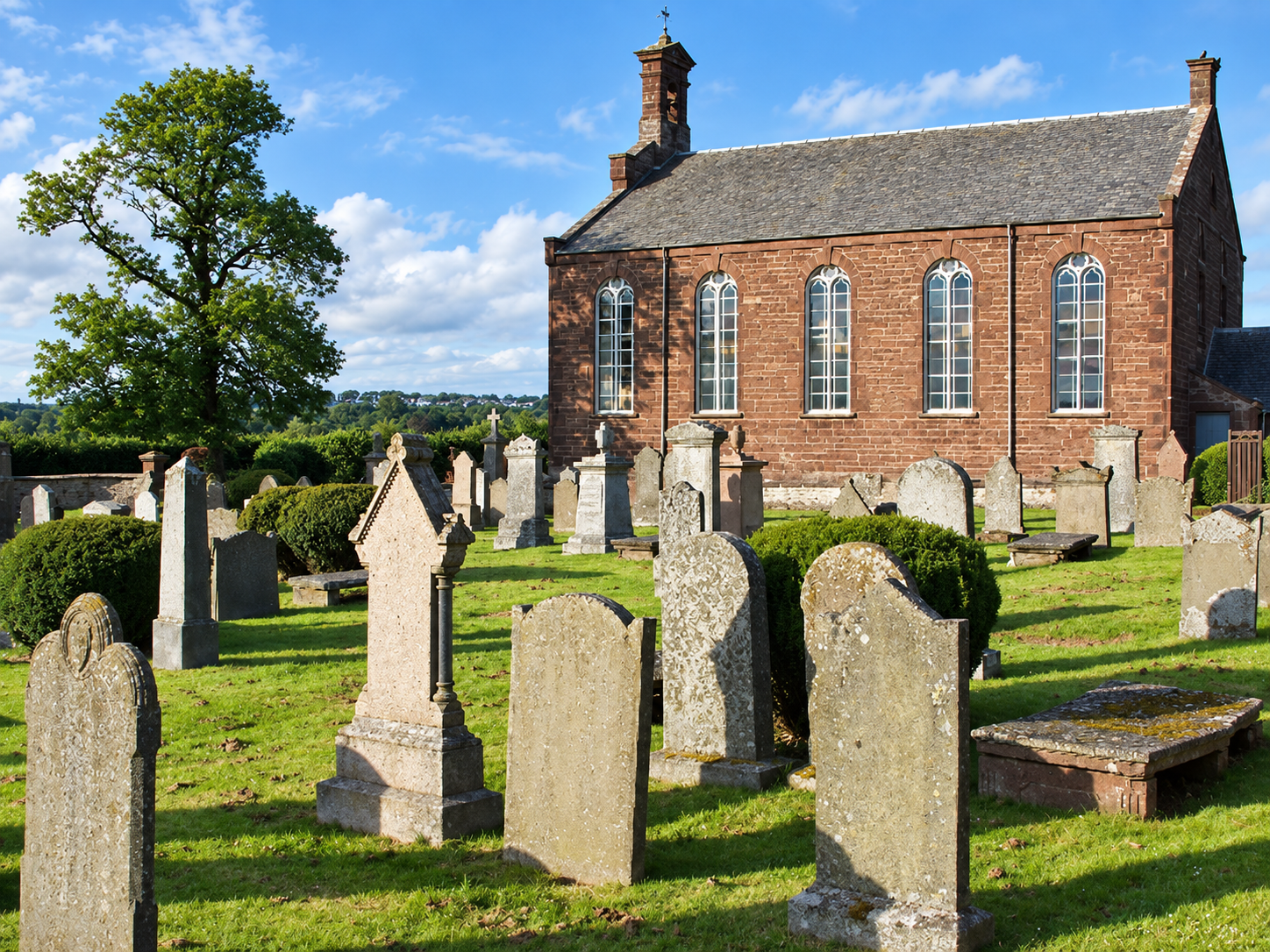
Monquhitter Churchyard itself, however, continued in use long after the Statistical Account was written. The latest burial identifiable in publicly searchable online records is that of Bert Thom, formerly of Cuminestown, who died at Inverurie Hospital on 6 April 2010 aged 85. His funeral service was held in Monquhitter Parish Church on 13 April at 11am, followed by interment in the churchyard. He was the widower of Jess Wilson and father of Irene, Heather, Albert and Gary.
That does not establish that Bert Thom was the most recent person buried there. Monquhitter remains an active burial ground, and the council’s internal burial register may contain later interments. Nor does the 1799 account prove that Monquhitter itself was the churchyard in which the porter belief was practised.
But if the old belief did belong to Monquhitter as well as the wider district, then the identity of the supposed “guard” would have changed every time another coffin entered the ground.
The ghost cannot be verified. The behaviour of the living, and the belief that produced it, can.
The Spanish Princess Who Had to Return for One Finger
Recorded in the Nineteenth Century | Kiel, or Cill Chaluim Chille, Morvern
John Gregorson Campbell preserved another version of the graveyard watch from Morvern, and this one carried with it a much older legend.
At Kiel, or Cill Chaluim Chille, a burial ground in Morvern, tradition said that a Spanish princess had once been interred. She was supposed to have been aboard one of the Armada vessels associated in folklore with the wreck or destruction of a ship in Tobermory Bay. The historical identity of this woman is not established; she belongs to local tradition rather than securely documented biography.
Two young men of the district, Campbell recorded, made a pact that whichever of them died first would have his graveyard watch kept by the survivor. One died, and the surviving man honoured the agreement.
While keeping watch he was said to acquire the ability to see both the ordinary world and the spirits moving through the churchyard. Each night he watched the ghosts leave the burial ground and return before morning. One spirit was always behind the others.
He eventually spoke to her.
According to the tradition, the lagging ghost was the Spanish princess. Her body, the story said, had later been taken back to Spain, but one little finger had been left behind in the Morvern grave. Because that fragment of her body remained at Kiel, her spirit was still obliged to return.
There is no documentary evidence that a Spanish princess was removed from this graveyard and repatriated to Spain, leaving a finger behind. Campbell presented the story as tradition.
Its interest lies in the logic of the belief. A whole body did not have to remain in the earth for a place to retain its claim on the dead. One finger was enough.
The Dead Man Who Asked to Have His Own Head Cut Off
Story Set in the Mid-Eighteenth Century; Recorded 1845 | Glencoe, preserved in the New Statistical Account for Laggan
Almost half a century after the Monquhitter account was published, another Statistical Account preserved something considerably stranger.
The New Statistical Account for Laggan, published in 1845, recorded a story said to belong to about the middle of the previous century. Its action was placed in Glencoe. A man had died and been buried “in the island”; neither his name nor the precise burial place was preserved in the printed account.
For several nights afterwards, according to the minister’s record, the dead man disturbed the neighbourhood by calling in a miserable voice for one particular person to come and relieve him. Eventually the man being summoned set out for the burial place during what the account called the dead hour of night.
There he supposedly found the corpse with its head and neck protruding above the ground.
The visitor demanded to know why the dead man was disturbing everyone. The answer concerned an oath made while alive. The corpse explained that in his younger days he had solemnly sworn to marry a particular woman and never forsake her for as long as his head remained on his body.
At the time he made the promise, however, he had been holding a button. Afterwards he broke the head of the button from its neck and persuaded himself that the wording of his vow had therefore been defeated.
Death, the story said, exposed the flaw.
The dead man told his visitor that he had been unable to rest day or night and would remain so as long as his actual head was attached to his body. He therefore asked the living man to cut it off.
The visitor was said to have struck through the neck close to the surface of the ground. The body then dragged itself back into the grave, leaving the severed head behind to “shift for itself”.
There is no surviving name for the deceased, no identifiable grave and no independent evidence that any such encounter occurred. The real historical resolution comes in the final sentence of the 1845 account. The minister wrote that some people in Glencoe still believed the story as firmly as they believed religious truth.
The corpse cannot be verified. The survival of the belief can.
Water and Milk Were Left for the Returning Dead
Nineteenth Century | Highlands and Islands, including Mull and Tiree
Not every belief about returning dead involved terror. Some were almost domestic.
John Gregorson Campbell recorded that after a corpse had been placed in its coffin and carried away for burial, the boards on which it had previously lain could be left undisturbed for the night. A drink of water would be placed on them in case the dead person returned thirsty. In some places, water or milk was left outside the door instead.
The same household might simultaneously take precautions against allowing the dead inside. In Mull and Tiree a sprig of pearlswort could be fixed above the lintel, a protective measure intended to keep the returning dead from entering the house.
There is no contradiction if the beliefs are understood on their own terms. A dead relative might deserve water and still not be wanted back inside the home. Hospitality and protection could exist side by side.
The collectors did not preserve the names of the households that did this. There is no known widow whose cup was later discovered empty and no identified cottage in which a deceased relative was reported drinking from the water left overnight.
What survives is the practice itself. For some families, burial did not immediately end the duties owed to the dead.
Even the dead might still need a drink.
The Shroud String That Could Bring the Dead Home
Nineteenth-Century Tradition | Highlands
The dead also had to be prepared correctly.
Campbell recorded the custom of cutting every string in the shroud before the corpse was finally placed in its coffin. The explanation attached to the practice involved a woman who, after burial, was said to have appeared to her friends and complained that not all the strings had been cut.
Her grave was supposedly opened.
According to the tradition, one fastening was indeed found still tied.
The string was cut and the dead woman was understood to have been released from whatever constraint had brought her back.
No secure name has been attached to the woman and no parish exhumation record has been found proving that the grave was actually reopened for this reason. The exhumation therefore belongs to the explanatory folklore surrounding the custom.
What is recorded more securely is the custom itself: every fastening on the shroud was to be cut.
A knot left tied could become unfinished business.
Some Dead Were Not Taken Out Through the Door
Nineteenth Century | Highlands and Islands
The route taken from house to grave could also change according to the manner of death.
Campbell recorded that the bodies of people who died by suicide were not always carried out through the ordinary doorway. Instead, an opening could be made between the wall and the thatch and the corpse taken out through it.
He added another stark detail: such bodies, along with those of unbaptised children, could be buried outside the common churchyard.
The practice was not universal across Scotland and should not be represented as though every Highland family observed it. Burial customs varied between parishes, denominations and generations, and the legal and ecclesiastical treatment of suicide changed over time.
What the source preserves is the physical logic of the custom. A death considered abnormal could be given a different exit from the house and a different place in the ground.
The body did not leave by the door used in life.
The Nicholsons Sent to Dunvegan for a Wax Shirt When Someone Died
Nineteenth-Century Recorded Tradition | Scorrybreck and Dunvegan, Isle of Skye
When somebody died in the Nicholson family of Scorrybreck on Skye, an unusual object had to be obtained from Dunvegan.
John Gregorson Campbell called it a Leine Chéir — a “wax shirt”. Despite the name, this was not ordinary clothing. It was cere-cloth, fabric impregnated with wax and used for wrapping a corpse before burial.
Campbell considered the custom remarkable because he knew of no other Highland example of cere-cloth being used in this way. He added that the Nicholsons of Scorrybreck were said to trace their family through Neacal Mòr of Mungastadt and that friendship between the Nicholsons and the chief of the MacLeods explained the connection with Dunvegan.
On every occasion of a death in the family, Campbell wrote, the wax shirt was sent for from Dunvegan.
The record does not tell us whether the same garment was repeatedly returned and reused, whether a fresh cere-cloth was prepared for each funeral, exactly where at Dunvegan it was stored or which Nicholson first introduced the practice. Those details are lost.
What survives is precise enough to be unusual. When death entered one Skye family, somebody had to make contact with Dunvegan and obtain the waxed wrapping in which the dead would be prepared.
Sir James Standsfield’s Corpse Was Said to Bleed for His Son
7–15 February 1688 | New Mills near Haddington, Edinburgh and Haddington
Sir James Standsfield of New Mills was dead, and his son Philip stood accused of murdering him.
The prosecution was not reconstructed centuries later from folklore. An authorised account of the trial was printed in 1688 “by authority”, preserving the case against Philip Standsfield and the extraordinary punishment imposed on him.
The trial took place on 7 February 1688.
Among the evidence was an episode rooted in an old European belief generally called cruentation or the ordeal of the bier. The belief held that the corpse of a murdered person might respond in the presence of the murderer, most famously by bleeding afresh.
When Sir James’s body was being placed in its coffin, Philip was present. Witnesses said blood issued from his father’s neck when Philip touched or handled him.
To those who believed in the bier-right, the dead man had identified his killer.
The prosecution contained considerably more than this incident, and it would be misleading to suggest that Philip was condemned solely because the corpse supposedly bled. But the episode was admitted into the evidential history of an actual Scottish murder trial.
The jury found Philip guilty.
The sentence was minute in its brutality. On 15 February, between two and four in the afternoon, he was to be taken to the Mercat Cross of Edinburgh and hanged on a gibbet until dead. His tongue was to be cut out and burned on a scaffold. His right hand was to be cut off and fixed to the East Gate of Haddington. His body was then to be hung in chains.
The printed title of the authorised trial account says the “doom and sentence” was duly carried out.
Later retellings place his chained corpse at the Gallow Lee between Edinburgh and Leith, although the wording of the authorised title simply records that his body was hung in chains. His property was also forfeited and his name formally disgraced in the sentence as later reproduced.
The corpse that supposedly accused Philip disappears from the record.
Philip’s punishment does not.
Christian Wilson Touched Her Brother Alexander — and the Record Says His Body Bled
1661 | Dalkeith and Niddrie, Midlothian
Christian Wilson, also known as “the Lanthorne”, had already attracted suspicion before her brother Alexander died.
The surviving dittay was based on examinations taken before Sir William Murray of Newtoun and other commissioners at Dalkeith on 14 June 1661. Named witnesses included James Wilson, Abraham Macmillan, William Crichton, Fyfe and George Erskine.
The record says there was enmity between Christian and her brother and that she had threatened him. On the day Alexander died, he was seen at about three in the afternoon apparently healthy and going about his business. At about five that evening he was found dead in his own house.
The description of the body is unusually specific. Alexander was naked, his face torn and injured, and a large piece of flesh had been removed from his cheek. Yet the witnesses said there was no blood on or around him.
Neighbours came to see the corpse. Christian, although she lived next door, did not.
That absence itself became suspicious.
The minister and bailies ordered her brought into the house. The surviving wording says she came trembling, refused to approach the corpse and protested that she had never touched a dead body in her life.
The officials and Alexander’s friends pressed her to touch him gently.
Before she did so, sunlight was shining into the room. Christian prayed that just as God had sent the sun to give light in the house, he would also give light to discover the murderer.
She then placed her fingers softly on the wound.
The record says blood rushed from it while her fingers were upon it.
The witnesses considered this astonishing because others had touched the corpse without producing the same effect. To them, Christian’s own prayer had been answered against her.
That was not the only allegation used to build the image of Christian Wilson as a witch. Another story concerned William Richardson of Dalkeith, who had struck one of her hens with a stone. Christian was accused of threatening that he would never throw another. Richardson then became violently ill, was said to have fallen into madness and died within days while crying out that Christian tormented him in the form of a grey cat.
Richardson’s nephew James later called Christian “the Lanthorne”, said in the source to be a supernatural name attached to her, and she was accused of threatening that he would die as his uncle had if he did not stop.
There was another incident while Christian was being transported to Niddrie to confront another accused woman. Janet Cock, herself a confessing witch, had supposedly joked to one of the guards, John Stevin, that the devil might raise a whirlwind and carry Christian away on the road.
The following day a sudden gust struck the party. Christian was blown from the pillion into water and had to be recovered by her guards. The weather itself was then folded into the accusations against her.
None of these allegations proves supernatural activity. They show how ordinary events, illness, coincidence, hostile reputation and the corpse test were assembled into a case.
Christian’s persecution had begun before 1661. Historian Brian Levack found that she had previously been held and then released on bond during the period of English occupation. After the Restoration, the machinery of Scottish witch prosecution restarted at extraordinary speed.
In 1661 Christian Wilson was finally burned for witchcraft.
The available sources do not give a sufficiently secure exact execution time or place for her to add one without qualification. What they do establish is that the woman whose brother’s corpse was said to bleed beneath her fingers did not survive the hunt that followed.
The living gave the blood its meaning.
Christian died because of the world in which that meaning was accepted.
Marion Pardoun Was Strangled at the Stake and Burned to Ashes
15–22 March 1644 | Hillswick, Northmavine, Scalloway and the Hill of Berrie, Shetland
Marion Pardoun, also recorded as Marion Peebles or Pardone, lived at Hillswick in Northmavine.
Her age is not entirely consistent across the scholarship. An earlier transcription described her as 39. The 2026 edition of her trial records by Julian Goodare and Liv Helene Willumsen describes her as over sixty. What is clear is that she was married to Svend Iverson, had adult children, employed a servant and was not among the poorest members of the community.
She was denounced by Janet Fraser, who had herself recently been executed for witchcraft.
The first formal steps were taken through the Presbytery of Shetland. A draft dittay containing fifteen points was presented on 15 March 1644. The material then passed into the hands of the secular authorities at Scalloway.
Marion’s neighbours accused her of an extraordinary range of harm. Sick people, diseased animals, spoiled brewing and damaged milk production were attributed to her. Some accusations concerned quarrels followed by sickness and then reconciliation. The record also claimed that ravens accompanied her, that she consorted with the devil and that she could assume the form of a porpoise.
The most spectacular accusation concerned four fishermen. Marion and another accused woman were alleged to have caused the boat to overturn in fair weather off Hillswick while Marion was transformed into a porpoise.
The dead bodies became part of the prosecution.
Marion and her husband Svend were brought to see the corpses days after the deaths and made to lay hands on them. The account says that blood, which was assumed to have vanished from the bodies in the ordinary course of death, appeared again from one corpse at the collarbone, hands and fingers.
Her interrogators treated that as divine revelation of murder.
On 21 March procurator fiscal James Gray asked that Marion Pardoun and Margareth Guthrumsdochter be put before an assize. The assize considered Marion’s dittay and found all but two points proved.
The sentence fell at Scalloway on 22 March 1644.
The older printed trial record states that Marion Peebles, alias Pardone, was to be strangled at a stake and burned to ashes at the Hill of Berrie for witchcraft and murder.
That sentence was carried out. Later Shetland historical work identifies the Hill of Berrie, or Gallow Hill above Scalloway, as the execution place. A modern memorial now stands in Scalloway to those killed in the islands’ seventeenth-century witchcraft prosecutions.
The allegation that Marion became a porpoise belongs to the prosecution.
Her death at the Hill of Berrie does not.
Sergeant Arthur Davies’s Ghost Entered a Murder Trial — and the Accused Men Were Acquitted
27 September 1749–12 June 1754 | Dubrach, Glenconie, Braemar and Edinburgh
Sergeant Arthur Davies served in General John Guise’s Regiment of Foot and in 1749 was stationed with soldiers at Dubrach or Glendee in Braemar.
Donald Farquharson knew him. At the later murder trial, Farquharson described Davies as sober, civil to local people and careful with his money. He said the sergeant carried gold in a long blue or green purse, silver in another, wore a silver watch, silver buckles at his shoes and knees, possessed two rings said to be gold, and sometimes wore a roe-skin vest or another with a white stripe beneath a blue upper coat. When hunting or shooting, Davies wore Highland brogues fitted for buckles and a laced hat with a silver button.
Farquharson last saw him on Wednesday 27 September 1749 before leaving for the fair at Kirkmichael.
When he returned, Davies was missing.
Soldiers searched the hills for several days without finding him.
Months later, another man, Alexander Macpherson, also known as MacGillas, found human remains in a peat moss between Glenchristie and Glenconie, two or three miles from Dubrach. He saw scattered bones, dark mouse-coloured hair, pieces of blue cloth and brogues from which the buckle straps appeared to have been cut.
What Macpherson said happened next brought the supernatural into a future murder trial.
He testified that while he was in bed, a figure appeared to him dressed in blue. At first he thought it was a living man, but the apparition identified itself as Sergeant Davies and told him that the sergeant had been murdered at the Hill of Christie.
The apparition instructed Macpherson to find the bones and ask Donald Farquharson to help bury them.
Macpherson did find the remains.
He initially delayed deciding what to do. According to his testimony, the apparition appeared again, this time naked, and reminded him to bury the body.
Macpherson eventually took Farquharson to the site. They gathered the bones, dug a hole in the moss with the shaft of a shovel, placed blue cloth beneath and above the remains, covered them with turf and buried Davies there rather than taking him to a churchyard.
Macpherson was asked whether he had questioned the apparition about the murderer. He said that on the first appearance he asked who had killed Davies, only to be told that if he had not asked the question the ghost might have been able to tell him. On the second appearance, Macpherson claimed, the apparition named Duncan Clerk and Alexander Macdonald.
He said the conversations with the ghost took place in Gaelic.
The case finally came before the High Court of Justiciary in Edinburgh’s New Session House on 10 June 1754. Duncan Terig, alias Clerk, and Alexander Bain Macdonald were prisoners in the Tolbooth of Edinburgh.
The court was presided over by Charles Erskine of Alva, Justice Clerk, with Alexander Fraser of Strichen, Patrick Grant of Elchies, Hugh Dalrymple of Drummore and James Ferguson of Killkerran sitting as commissioners of justiciary. The prosecution was brought by William Grant of Prestongrange, the Lord Advocate.
The apparition evidence did not stand alone. The prosecution also examined rings, a damaged gun, clothing, the accused men’s reputations and movements, and alleged possession of objects belonging to Davies.
The jury considered the indictment and the witnesses for both prosecution and defence.
On 12 June, it returned a unanimous verdict.
Duncan Terig and Alexander Bain Macdonald were not guilty.
They were dismissed from the bar.
A supposed ghost had named two murderers in a Scottish courtroom.
The jury let both men go.
Murdoch Grant, Kenneth the Dreamer and the Assynt Murder
March 1830–2 November 1831 | Drumbeg, Loch Torr na h-Eigin, Dornoch, Inverness and Edinburgh
Murdoch Grant was an itinerant pedlar from Rathbeg in Lochbroom who travelled through Assynt carrying goods for sale.
In March 1830 he disappeared.
Four weeks later his body was discovered in Loch Torr na h-Eigin, inland from Drumbeg. He had been known to carry a substantial quantity of goods and money, estimated in later archival material at about £40. None of it was found with the body.
At first there was uncertainty over whether he had died accidentally.
Hugh Macleod, a young local schoolmaster and son of Roderick Macleod, tenant farmer at Lynnmeanach, was among those regarded as educated and respectable enough to be consulted. Suspicion nevertheless began to move towards him.
Macleod was 21.
The Crown precognition later located the alleged murder and robbery on the footpath leading from Drumbaig towards Lochindarroch in Assynt.
Local attention sharpened when Macleod appeared to be spending money despite having left his teaching employment. A £5 note was a conspicuous possession for a young unemployed man in the district.
Then Kenneth Fraser entered the case.
He became known as Kenneth the Dreamer.
Fraser said he had seen Grant’s missing goods in a dream or vision beneath stones near Macleod’s home. According to the archival account, the description corresponded with a recognisable cairn and belongings connected with the murdered pedlar were found.
Later retellings debated whether Fraser had obtained his information in some less supernatural way, including through knowledge acquired while drinking with Macleod. The historical record cannot establish the origin of the dream. It can establish that Fraser presented his information in that form and that the discovery became part of the case.
Macleod was arrested and sent to Dornoch. The Dornoch Jail Book records him there on 10 May 1830. His house was searched and possessions associated with Grant were recovered.
The prosecution dragged on into the following year.
On 27 September 1831, an assize found Hugh Macleod guilty of murder and robbery at Inverness.
The sentence survives word for word in his death warrant.
Lords Moncreiff and Medwyn ordered Macleod returned to the Tolbooth of Inverness, where he was to be kept on bread and water until Monday 24 October. Between two and four that afternoon he was to be taken from the Tolbooth to the common place of execution of the burgh, or whatever place Inverness magistrates appointed, and hanged by the neck on a gibbet by the common executioner until dead.
The execution took place at the Longman, Inverness.
Later accounts describe a crowd numbering thousands.
The punishment did not end with death.
The warrant ordered Macleod’s body delivered to the Professor of Anatomy at the University of Edinburgh to be publicly dissected and anatomised.
On 2 November 1831, somebody at Edinburgh College wrote directly on the warrant acknowledging receipt of Hugh Macleod’s body on behalf of Dr Monro.
Later accounts say Macleod eventually confessed to a clergyman that he had killed Murdoch Grant with a hammer. The confession belongs to the subsequent history of the case rather than the surviving death warrant itself.
The murder began with a pedlar’s body hidden in a Highland loch.
It ended with the convicted killer’s body delivered to an Edinburgh anatomy room.
John Brugh Dug Up Corpses, Healed Cattle and Was Strangled and Burned
1643 | Fossoway, Glendevon, Muckhart and Edinburgh Castle Hill
John Brugh, or Johnne Brughe, came from the parish of Fossoway and Tullibole in Kinross-shire.
He was about 56 years old, married and had worked as a healer for decades. The Survey of Scottish Witchcraft describes him as a professional practitioner who received substantial payments in money and kind for treating people and animals.
Many of the accusations against him concern healing rather than harm.
He used spoken formulas, charms, objects and remedies for people, ale and livestock. The prosecution reinterpreted these activities as evidence of a demonic pact.
Other charges were darker.
Brugh was accused of digging up corpses at Muckhart and using human remains in magical practices. One account names Johne Chrystiesone, a servant, among the dead associated with the accusations.
Another episode involved cattle dying from disease. Brugh and a woman called Neane Nikclerith were said to have used enchanted stones in water to protect the herd. One animal too sick to walk was dragged from the byre and buried alive in a hole. The surviving cattle were then driven over the place.
The prosecution treated this as diabolical charming.
Brugh was found guilty.
Old witchcraft literature gives his execution date as 24 November 1643 and describes him as “worried and burnt”. In Scots legal and historical usage, “worried” in this context means strangled.
Historic Environment Scotland includes Johnne Brughe among known people executed for witchcraft at Castle Hill in Edinburgh in 1643.
His career as a healer had lasted perhaps thirty years.
His death took minutes.
Jon Neill and the Dead Man’s Hand
26 March–2 April 1631 | Berwickshire and Edinburgh Castle Hill
Jon Neill was about 36 years old and came from Berwickshire.
His prosecution contained one of the most macabre objects in the Scottish witchcraft record: the hand of a dead man.
Neill was accused of taking part in a magical conspiracy against Sir George Home of Manderston. The alleged ritual materials included an enchanted dead bird and a human hand removed from a corpse.
He was imprisoned in Edinburgh and brought to trial on 26 March 1631.
The central prosecution involved Sir Thomas Hope of Craighall, the Lord Advocate, and Alexander Colville, Justice Depute. The Survey of Scottish Witchcraft records a guilty verdict and no defence.
The sentence was death.
Neill was taken to Castle Hill, one of Edinburgh’s established execution places for people convicted of witchcraft.
The execution method is recorded as strangling and burning.
The execution was announced on 2 April 1631.
The dead person whose hand supposedly entered the magical plot has never been identified.
Jon Neill has.
His record ends at Castle Hill.
Issobell Watsonne Used Rowan, Wheat and Part of a Human Body in a Cure
1590 | Perthshire
Issobell Watsonne’s surviving record is much richer than the simple phrase “a dead person’s finger” suggests.
National Records of Scotland identifies material from her prosecution in 1590. One confession describes a cure involving nine grains of wheat, a piece of rowan and what the record calls a bone or joint with sinews still attached to it.
The treatment was given in response to a request made by the wife of James Kynaird, who sought help for her husband.
Watsonne initially said that the material had come from Sir Johne Row, minister of Perth. Her statement was challenged because the wheat appeared fresh, the rowan was green and the piece of bone still had fibres or tendons resembling lint strings attached to it.
She then gave another explanation.
She said she had obtained the objects from a female relative — the wording is difficult and has been interpreted as an aunt or mother-in-law — to protect herself against blows from the fairy folk, who she claimed struck her painfully at changes of the moon.
The same record says she connected promises or powers with the daughter of the Queen of the Fairies.
Later summaries described the body material as part of a dead person’s finger.
The rowan itself had a long Scottish history as a protective plant. What turned the episode into criminal evidence was the combination of healing practice, human remains and supernatural explanation.
Watsonne’s final legal fate is less clear.
No secure sentence or execution record has been located in the surviving material used here.
That absence cannot be repaired by assumption.
Issobell Watsonne appears in the archive with wheat, green rowan, human bone and a story about the fairy folk.
Then the record loses her.
Andro Man, the Queen of Elphen and the White Horses
1597–20 January 1598 | Aberdeen
Andro Man was an old man by the time Aberdeen authorities prosecuted him.
The Survey of Scottish Witchcraft gives his age as about seventy and associates him with Tarbruith in Aberdeenshire. He had a reputation as a folk healer and was accused of both beneficial and harmful magic.
His confession was taken on 21 October 1597. A royal commission followed in December, and he was tried in Aberdeen Tolbooth on 20 January 1598.
The officials involved included Provost Alexander Chalmer, Bailie Thomas Leslie and Peter Blackburn, Bishop of Aberdeen.
The supernatural world described in Man’s testimony is extraordinary.
He spoke of a figure he called Christsonday and of the Queen of Elphen. He said that when he was a boy, a supernatural being had appeared in the likeness of a woman whom he called the Queen of Elphen. Later testimony attributed to him described a sexual relationship with her lasting decades and children supposedly born from it.
He described Christsonday in several forms, including a stag, an angel in white and a supernatural knight.
One of the most vivid passages concerned Holy Rood Day. Man said he saw Christsonday come out of the snow in the shape of a stag while the Queen of Elphen and her company rode white horses.
He was also accused of healing.
One charge said that Elspet Boyne of Aird had suffered violent madness and that Man cured her by prayers, charms or enchantments. Another accused him of claiming that he could take milk from a cow whenever he pleased.
The authorities interpreted his fairy language through a Christian demonological framework. What Man called the Queen of Elphen could be recast as a devilish spirit; healing could become sorcery.
The assize found him guilty.
The Survey does not preserve a sentence, execution date, execution place or method. Other modern research projects list his outcome as execution, and later writers have commonly described him as burned.
The primary trial database itself is more cautious.
A final execution record sufficient to establish the precise manner and date has not been identified here.
The safest conclusion is therefore the one the surviving judicial record supports absolutely: Andro Man was convicted of witchcraft at Aberdeen in January 1598.
What happened immediately after that remains less securely documented than the trial that condemned him.
Dr Arthur Mitchell Went Looking for the Old Cures — and Found Them
1862 | North-West Highlands and Islands
By the middle of the nineteenth century, Scotland had railways, universities, formal medical institutions and a national system for supervising people then described as lunatics.
Dr Arthur Mitchell belonged to that modern administrative world.
He was Deputy Commissioner in Lunacy for Scotland and travelled through Highland and island communities observing the treatment of people suffering mental illness, epilepsy and conditions that earlier generations often explained through possession, supernatural attack or inherited folk belief.
In 1862 he presented a paper to the Society of Antiquaries of Scotland titled On Various Superstitions in the North-West Highlands and Islands of Scotland, Especially in Relation to Lunacy.
What makes Mitchell’s evidence unusually valuable is proximity.
He repeatedly insisted that he was not discussing the Middle Ages. He had met patients, spoken to witnesses and questioned people who had participated in rituals themselves.
Several of the practices were within living memory.
Some, he believed, were still being performed.
A Black Cock Was Buried Alive Where the Seizure Began
Recorded 1862 | North-West Highlands and Islands
One cure concerned epilepsy.
On the place where the person first suffered a seizure, a black cock was buried alive. A lock of the patient’s hair and parings from the fingernails could be buried with it.
Mitchell said he had personally seen at least three people with epilepsy for whom the procedure was said to have been performed.
He also spoke with a woman who had participated in one of the sacrifices and described the procedure to him in detail.
Later research into Mitchell’s notebooks found additional variations. In some examples, coins and red onions accompanied the cock and hair.
One school story was particularly striking. A boy had suffered a fit at school. Two men came carrying a live black cock and some of the boy’s hair. They opened a hole in the school floor at the place where the seizure had occurred, put the living bird and the hair into it, and closed the floor again.
The person who later told the story said he never saw the boy suffer another fit.
That claimed recovery cannot establish that the burial cured epilepsy.
Another case had the opposite outcome.
A doctor in an unnamed northern town was called to a poor man from the fishing population who had suffered epileptic seizures and had suddenly died. His friends told the doctor they at least had the comfort of knowing that everything possible had been tried.
When the doctor asked what they had done, they pointed to the place beneath the bed where a cock had been buried alive.
The ritual had not saved him.
Mitchell considered the persistence of the practice extraordinary because it occurred not in an isolated medieval world but in a town reached by railway, with several churches and schools.
Modern medicine had arrived.
The black cock had not yet gone.
A Human Skull Was Scraped Into Water as Medicine
Recorded 1862 | Ross-shire and the North-West Highlands
Mitchell found other epilepsy treatments in which the dead themselves became ingredients.
One family obtained part of the skull of a person who had died by suicide from a considerable distance away.
Material from the skull was scraped into water.
The liquid was then given to a young person suffering from epilepsy without telling the patient what had been mixed into it.
The journey involved in obtaining the remains is significant. This was not an object casually found in a nearby graveyard. Somebody went to considerable trouble because the family believed that the skull of a person who had died an unusual death possessed therapeutic value.
Mitchell did not preserve enough identifying information to reconstruct the patient’s later life securely.
The surviving account does not tell us whether the seizures stopped.
The family’s effort survives.
The outcome does not.
The Duncansby Head Skull Became a Drinking Vessel
Before 1862 | Duncansby Head, Caithness
Another skull case can be located more precisely.
Mitchell identified the dead woman only by the initials C. B.
She had died after going over Duncansby Head in Caithness.
Her body was buried.
Then, according to the information Mitchell investigated, the grave was disturbed so that the skull could be obtained.
The skull became a drinking vessel used as a remedy for epilepsy.
The patient was identified only by the initials J. B.
By the time Mitchell’s informant described the case, J. B. was dead.
The skull had survived as medicine.
The patient had not.
A Man Was Put in Bed With the Body of His Dead Mother
Before 1862 | Barvas, Isle of Lewis
At Barvas on Lewis, Mitchell recorded one of the most disturbing treatments in his entire inquiry.
A man suffering from severe mental illness and epilepsy was placed in bed with the corpse of his dead mother.
The practice was not presented to Mitchell as ancient legend.
He said he met numerous people who had known the man.
The treatment had a definite outcome.
It did not cure him.
The man later died during a fit.
Those around him had used the body of his own mother because they hoped contact with the dead might accomplish something ordinary medicine could not.
It failed.
Water Used to Wash a Dead Sister Was Given as Medicine
Before 1862 | Kintail
Another of Mitchell’s cases came from Kintail.
A person suffering seizures was reportedly given water in which the body of his dead sister had been washed.
Unlike many of Mitchell’s anonymous reports, this patient was someone Mitchell personally saw.
He also recorded what people around the man said happened afterwards.
The seizures became less violent and less frequent.
That does not establish causation. Epilepsy can fluctuate naturally; recollection can be mistaken; the improvement may have had nothing to do with the treatment.
Mitchell did not present it as a scientific cure.
But the reported outcome belongs to the historical account.
A man was given water used on the corpse of his sister.
Those around him believed his condition improved.
Mitchell later met him alive.
A Woman Was Buried at Low Water — and the Sea Returned Her
About 1822; Recorded 1862 | Ross-shire
Mitchell recorded another incident from around 1822 concerning a woman who had died by suicide.
The precise place name was partly obscured in the printed account.
Her body was buried at low water.
The sea exposed the grave.
The corpse was washed or uncovered back into the world of the living and ended up lying beside a road during snowy weather.
Mitchell’s informant said the woman’s body remained there for two days.
Eventually a local person of influence intervened.
The corpse was buried again.
Remarkably, the second burial followed broadly the same low-water principle, although greater care was taken to make the grave secure.
The informant said he had witnessed the episode.
The woman’s name was not printed.
Her burial failed once.
The sea gave her back.
Then the community put her into the ground again.
The Dead Were Blamed When the Herring Disappeared
Nineteenth Century | Loch Duich, Skye, Applecross and the West Highlands
The dead could also be blamed for what happened in the sea.
John Gregorson Campbell recorded a belief in the north, including Skye and Applecross, that no herring would be caught in water visible from the grave of a person who had died by suicide.
For fishing communities, this had consequences far beyond folklore.
A failed herring season could mean economic disaster.
Arthur Mitchell recorded an account from the Loch Duich area in which a body was blamed after the fish disappeared.
The corpse was exhumed.
It was carried away from the coast and taken to the top of the mountain dividing Inverness-shire from Ross-shire, far enough from the sea that its grave could no longer command a view of the water.
Then the story supplied its resolution.
The herring returned.
Mitchell did not prove that moving a corpse altered fish migration. He recorded that people said it did.
Within the belief, the cure had worked.
The People of Coigach Put a Body Back Into the Sea — and It Came Ashore Again
Nineteenth Century | Coigach and Aird Dhubh, Wester Ross
At Coigach, a body washed ashore.
Local people were said to have taken it back to the water and set it adrift.
The sea returned it.
The corpse came ashore again near the place where the man was believed to have died.
This time people did not return him to the water.
They carried the body inland and uphill to Aird Dhubh.
There it was buried where the grave could no longer be seen from the sea.
Mitchell preserved one final physical detail.
The ropes used to carry the corpse were said to have become visible again later.
His informant remembered the event well.
The dead man’s name disappeared.
The ropes remained in memory.
A Purifying Fire Was Lit Where the Body Came Ashore
Nineteenth Century | Loch Carron, Strome Ferry and Lochalsh
Another man was said to have died by suicide in Loch Carron.
His body came ashore near Strome Ferry.
Some years later the herring fishery was poor.
People gathered at the place where the corpse had been found and lit a large fire.
A similar act was remembered elsewhere in Lochalsh.
Later interpreters described the fire as purification or propitiation, connected with the belief that the dead person had damaged the fishery.
Mitchell does not tell us that the herring returned afterwards.
He does not identify every person who stood around the fire or preserve a speech explaining what they believed.
There is no responsible way to manufacture a resolution.
The record ends with the fire burning beside the shore.
The Little Loch Broom Coffin Was Dragged Into the Hills
Nineteenth Century | Little Loch Broom, Dundonnell and the Hills Beyond the Coast
Another body washed ashore on Little Loch Broom.
A rough deal box was hurriedly made to serve as a coffin.
The tools used to make the box were then reportedly sunk in the sea.
The coffin was not buried on the shore.
It was towed by ropes across the loch and then dragged up the hillsides to a remote place behind the mountain range west of Dundonnell.
The destination was deliberately chosen.
It lay beyond sight of the sea and beyond cultivated land.
The box, ropes and body were all taken into that lonely ground and buried.
A related nineteenth-century report describes another case in the Ullapool district in which a crowd resisted the official handling of a body because they believed burial on the wrong side of the river would bring famine or failure to sea and land. The horse was unhitched from the cart and the remains were wheeled for miles over the hills until they were buried about three miles from Ullapool on the road towards Rhidorroch Forest.
Police followed at a distance.
The fiscal at Dingwall was informed.
The reason given for these actions was not fear that the dead would walk.
It was fear that the dead, buried in the wrong place, could empty the sea.
Irvine Opened Its Graves — and About a Dozen Were Empty
1826 | Irvine Old Parish Churchyard, Ayrshire
By the 1820s Scottish families had another reason to fear what happened after burial.
Bodies really were disappearing.
Irvine Town Council recorded the crisis directly in 1826, describing “very distressing depredations” in Irvine Old Parish Churchyard caused by the disinterring and carrying away of the dead.
Suspicion fell on an organised group.
One suspected man was John Fletcher, born in Irvine in September 1798 to William Fletcher and Grizel Cowan. Fletcher was a surgeon, councillor, baillie and founding member of Irvine Burns Club.
Another was Robert Stein, a Glasgow carrier.
William Anderson, a butcher in Seagate, was also suspected.
So was James Wilson, the sexton and Town Officer responsible for the churchyard.
Wilson had recently built a house in West Road. In later local tradition it became known as the Resurrectionist House.
The council dismissed him.
Irvine had already formed a society to watch over new burials. The Town Council donated £10 to the organisation for several years and offered a £20 reward if resurrectionists were caught and apprehended.
Then officials tried a simple method of testing whether graves had been disturbed.
Coins were hidden beneath the turf of recent burials.
When the ground was inspected, many coins had disappeared.
The decision was made to open graves.
A large crowd gathered.
About a dozen were empty.
The search extended to Glasgow University, where one stolen corpse was identified and returned to Irvine for burial.
The town’s defences became increasingly physical. Bodies were wired to their coffins around the neck, feet and waist, with the wire secured to the outside of the coffin. A movable watch-house was installed.
Three men spent each night guarding the burial ground.
They carried oil lamps.
They also carried blunderbusses.
There was one final irony.
Nothing was proved against John Fletcher, but suspicion destroyed his standing in Irvine. He left the town for Ayr.
He died in November 1830 aged 32.
His body was brought home.
John Fletcher was buried in Irvine Old Parish Churchyard — the same ground whose missing bodies had helped ruin his life.
A Farmer’s Dog Frightened the Airth Body Snatchers Away
June 1820 | Airth Churchyard, Stirlingshire
An old man was buried in Airth churchyard on 13 June 1820.
Within days, resurrectionists came for him.
They opened the grave, broke into the coffin and began pulling the corpse out.
The theft was interrupted not by a watchman or constable but by a farmer passing nearby.
One of his horses was sick and he was travelling to obtain medicine.
His dog was with him.
As they passed the churchyard, the dog ran into the burial ground and began barking furiously. The farmer called it back.
The dog refused to come.
The men working at the grave fled.
The attempted theft was not discovered immediately. A day or two later schoolchildren noticed that earth had been removed from the grave and the turf carefully laid aside.
Local people opened it.
They found the coffin lid broken and the dead man partly pulled out.
The contemporary report does not name him.
Nor does it describe exactly how the body was subsequently restored to the coffin and grave.
It is reasonable to suppose that it was reburied, but that is an inference rather than something stated in the surviving report.
What is recorded is enough.
The resurrectionists reached the corpse.
A dog stopped them.
The Kingskettle Dead Were Fastened to Their Coffins With Iron
About 1820 | Kingskettle, Fife
At Kingskettle in Fife, fear of body snatchers survives as an object.
An iron collar dating from around 1820 was found bolted through the bottom of a coffin and fixed around the neck of the corpse.
Its purpose was brutally practical.
A resurrectionist might dig down, smash open a coffin and pull the body upwards.
The collar fixed the dead person to the coffin itself.
It was one of several methods developed in Scotland to protect recent burials during the weeks when a corpse remained useful to anatomists. Mortsafes, locked enclosures and night watches served the same purpose.
The person whose neck was held by the Kingskettle collar has not been securely identified in the museum account.
The individual biography disappeared.
The iron remained.
The Banchory-Ternan Watch-House Had a Hole for a Gun
1829–Present | Banchory-Ternan Parish Church Graveyard, Aberdeenshire
At Banchory-Ternan, the defence of the dead became architecture.
A circular two-storey watch-house was built in the graveyard of Banchory-Ternan Parish Church.
The date 1829 is carved into the stone above the bell.
The building is constructed of rubble, roofed in slate and topped by a conical roof incorporating a bell tower.
Below one of its small windows is a round opening.
The Aberdeenshire Historic Environment Record preserves the tradition that a gun was fired through it to frighten would-be body snatchers.
The watch-house survives.
It is protected as a Category B listed building.
It was restored and re-harled in 1998.
Nearly two centuries after the resurrectionists disappeared, the structure built to watch for them remains standing among the graves.
Peter McGall Was Found Sitting Between Two Men in a Cart
1826 | Edrom, Hardens Hill, Duns, Murray Street and Duns Market Square, Berwickshire
Peter McGall had been buried in Edrom churchyard for only a day or two when two travellers encountered a cart near Hardens Hill.
The men who found it were Mr Howden, a farmer from Whitelaw, and Mark Cossar, an innkeeper from Duns. They were returning from Gifford Fair.
The cart appeared to carry three passengers.
The man in the middle looked remarkably pale.
Howden and Cossar challenged the travellers.
The two living occupants ran away.
The third remained exactly where he was.
He was Peter McGall.
The recently buried man had been taken from his grave.
Howden and Cossar brought both body and trap back to Duns. McGall was prepared for burial again. Local history preserves the name of Mary Manuel of Allanton, who was said to have prepared McGall’s corpse on both occasions.
The magistrates impounded the horse and cart.
A horse dealer from Kelso came forward and reclaimed the horse, apparently having hired it out in the ordinary course of business.
Nobody claimed the trap.
The following spring, rumours circulated that someone intended to recover it.
Public anger rose.
The cart was being stored in Murray Street in Duns.
A crowd gathered.
The sheriff read the Riot Act.
The crowd broke into the store anyway, dragged the cart into Duns Market Square and burned it.
Local tradition continued to attach McGall to the landscape. The coffin from his first burial was said to have been discovered beneath a culvert on the Edrom road, which became known as McGall’s Bridge. Later local tradition claimed iron hooks once remained under the bridge where coffins could be kept dry until removed.
No surviving gravestone has been identified for Peter McGall and the Old Parish Registers have not yielded a clear record of either burial.
He was buried twice.
The cart that carried him out of the grave was burned by a mob.
Perth’s Corpse Watches Became Midnight Terror Campaigns
5 May 1631 | Perth
A lykewake was supposed to keep company with the dead.
In Perth, some people discovered another use for the long hours after midnight.
The kirk session complained in 1631 that people attending corpse watches were leaving the houses in which bodies lay and going through the town to disturb respectable neighbours.
They hammered on doors.
When the household woke, the pranksters announced that one of their close friends had suddenly become dangerously ill.
The alarmed residents got out of bed and hurried away to see the supposedly dying person.
Nobody was dying.
The message was false.
The kirk session regarded this not as harmless entertainment but as profane disorder associated with an occasion that should have been sober.
On 5 May 1631 it ordered that members of Perth Town Council meet with the session and frame an ordinance requiring sobriety and godly conduct at lykewakes. Those who caused profane disturbance were to be excluded.
The surviving record does not tell us whether the regulation stopped the midnight trick.
What it records is a seventeenth-century Scottish town trying to control people who had discovered that the fastest way to terrify a sleeping household was to arrive from a corpse watch and announce another death.
John Campbell’s Father Took His Hanged Son to a Doctor
5 April–14 May 1824 | Stirling Tolbooth, Canongate, Stirling and St Ninians
John Campbell was nineteen years old.
He had been born in 1804 at Bridge of Kelty near Callander and moved with his family to St Ninians while still young.
By 1824 he had accumulated a substantial record of theft and housebreaking.
His own confession listed stolen money, watches, whisky, hides, cheese, butter, pistols, socks and spectacles, taken during offences in Crieff, Stirling, St Ninians and elsewhere.
Campbell was being held in Stirling Tolbooth with David Ross, John Boax and James Smith pending trial.
The four men planned an escape.
David Ross’s wife smuggled tools into the jail: a screw auger, two keys, a small hand pitcher and two small chisels.
The prisoners bored through a cell door.
They opened further doors using keys found inside the building, passed through the courtroom and finally escaped through a window using blankets.
On 5 April 1824 Stirling Town Council authorised officials to investigate the escape and a reward was offered for the fugitives.
Campbell headed towards Edinburgh.
Sergeant Major McKenna of Edinburgh Police found him in a house in the Canongate and arrested him.
He was returned to face trial.
On 9 April 1824 Campbell was sentenced to death.
The court regarded the rapid escalation of his crimes as sufficiently serious to justify the sentence despite his age.
Five weeks later, on 14 May, he was hanged at Stirling.
His body remained suspended for about thirty-five minutes.
His father and brother were waiting nearby with a horse and cart.
When the body was released, they did not immediately take John Campbell home to bury him.
They drove him to a medical man in St Ninians.
They wanted him revived.
The practitioner warned Campbell’s father that there was no hope.
The family insisted that an attempt be made.
The body was rubbed.
The usual methods then used in attempts to restore circulation were applied.
Veins at the temples were opened.
Nothing worked.
John Campbell remained dead.
The Stirling Journal preserved one final detail through the archival account. The medical practitioner reportedly believed that if Campbell had hung for ten minutes less, the outcome might have been different.
Whether that was medically plausible cannot now be tested.
The effort failed.
John Campbell had escaped Stirling Tolbooth once.
His father could not bring him back from the gallows.
Sources
University of Edinburgh — Statistical Accounts of Scotland, Old Statistical Account, Appendix for Monquhitter, County of Aberdeen, Vol. XXI, 1799
https://libraryblogs.is.ed.ac.uk/statacc/2016/10/28/halloween-sports-and-spooks-in-the-statistical-accounts/
University of Edinburgh — Statistical Accounts of Scotland, New Statistical Account, Laggan, County of Inverness, Vol. XIV, 1845
https://libraryblogs.is.ed.ac.uk/statacc/2016/10/28/halloween-sports-and-spooks-in-the-statistical-accounts/
John Gregorson Campbell — Superstitions of the Highlands and Islands of Scotland, 1900
https://www.gutenberg.org/files/61730/61730-h/61730-h.htm
Aberdeenshire Council Historic Environment Record — Monquhitter Parish Church, Cuminestown, MAB23313
https://her.aberdeenshire.gov.uk/Monument/MAB23313/
Aberdeenshire Council — Burial Grounds
https://www.aberdeenshire.gov.uk/communities/bereavement/burial-grounds/
My Funeral Notices — Funeral Notice for Bert Thom, April 2010
https://www.myfuneralnotices.com/notices/view/188998/thom
Folger Shakespeare Library — The Tryal of Philip Standsfield, Son to Sir James Standsfield, of New-Milns, 1688
https://catalog.folger.edu/record/348637
National Library of Scotland / Robert Pitcairn — Criminal Trials in Scotland, material concerning Christian Wilson of Dalkeith, 1661
https://electricscotland.com/history/law/criminal03.pdf
Brian P. Levack — The Great Scottish Witch Hunt of 1661–1662, Journal of British Studies
https://www.cambridge.org/core/journals/journal-of-british-studies/article/great-scottish-witch-hunt-of-16611662/9171DFE323690FF52154827C73C70DCA
Julian Goodare and Liv Helene Willumsen, eds. — Scottish Witchcraft Trials: Marion Pardoun, Shetland, 1644
https://www.cambridge.org/core/books/abs/scottish-witchcraft-trials/marion-pardoun-shetland-1644/3FAEEB49917B67A026CA6A30C34B880F
Liv Helene Willumsen — Seventeenth-Century Witchcraft Trials: Shetland material concerning Marion Pardoun
https://era.ed.ac.uk/bitstream/handle/1842/6925/536643.pdf?sequence=1
Samuel Hibbert / Scottish Criminal Trial material — Marion Peebles alias Pardone, sentence of 22 March 1644
https://electricscotland.com/history/law/criminal03.pdf
University of Edinburgh — Survey of Scottish Witchcraft, Jon Neill
https://witches.hca.ed.ac.uk/trial/T/LA/24
University of Edinburgh — Survey of Scottish Witchcraft, Andro Man
https://witches.hca.ed.ac.uk/trial/T/JO/1298
University of Edinburgh — Survey of Scottish Witchcraft, Johnne Brughe
https://witches.hca.ed.ac.uk/
Historic Environment Scotland — Edinburgh Castle Esplanade Statement of Significance, including known witchcraft executions at Castle Hill
https://app-hes-pubs-prod-neu-01.azurewebsites.net/api/file/76099abb-305f-4264-bc4f-ae2101500cdb
Royal College of Nursing Foundation — Folk Healers and Midwives: Scottish Witchcraft Research List
https://rcnfoundation.rcn.org.uk/-/media/rcn-foundation/documents/witches-project—witch-list.pdf
National Records of Scotland — Issobell Watsonne, Rowan and Witchcraft Trial Material
https://blog.nrscotland.gov.uk/2020/11/01/oh-rowan-tree-thoult-aye-be-dear-to-me/
Sir Walter Scott, ed. — Trial of Duncan Terig, Alias Clerk, and Alexander Bain Macdonald for the Murder of Arthur Davies, 1754
https://www.gutenberg.org/files/26133/26133-h/26133-h.htm
High Life Highland Archives — Death Warrant for Hugh McLeod, Assynt, 1831, L/INV/HC/12/29
https://www.highlifehighland.com/highland-archive-centre/wp-content/uploads/sites/124/2016/10/Assynt-Murderer-Hugh-Macleod-L-INV-HC-12-29.pdf
Scottish Indexes — Crown Office Precognition Against Hugh MacLeod, AD14/31/93; related trial papers JC26/1831/74
https://www.scottishindexes.com/adentry.aspx?adid=831093
Arthur Mitchell — On Various Superstitions in the North-West Highlands and Islands of Scotland, Especially in Relation to Lunacy, Proceedings of the Society of Antiquaries of Scotland, Vol. IV, 1862
https://journals.socantscot.org/index.php/psas/article/view/4737
Archaeology Data Service — Proceedings of the Society of Antiquaries of Scotland, Vol. IV, pp. 251–288
https://archaeologydataservice.ac.uk/archives/view/psas/contents.cfm?vol=4
The Folk-Lore Journal, Vol. V — Nineteenth-Century Accounts of Burial Customs and the Herring Fishery in Wester Ross
https://electricscotland.com/history/men/folklorejournal05folkuoft.pdf
North Ayrshire Heritage — Resurrectionists in Irvine, based on Irvine Town Council records, 1826
https://naheritage.co.uk/stories/resurrectionists-in-irvine
Falkirk Local History Society — Airth North Churchyard and the 1820 Attempted Body Theft
https://falkirklocalhistory.club/wp-content/uploads/2021/07/airth-north-churchyard.pdf
National Museums Scotland — Kingskettle Coffin Collar and Scottish Body-Snatching Material
https://www.nms.ac.uk/discover-catalogue/the-coffins-found-on-arthurs-seat
Aberdeenshire Council Historic Environment Record — Banchory-Ternan Watch House, MAB41491
https://her.aberdeenshire.gov.uk/Monument/MAB41491
Dunse History Society — Resurrectionists and Rits: Peter McGall, Edrom and Duns
https://www.dunsehistorysociety.co.uk/resurrectionists-and-rits
National Library of Scotland — Perth Kirk Session Transcripts, 1577–1637, Adv.MSS.31.1.1–31.1.1A
https://manuscripts.nls.uk/subjects/323
Stirling Archives — Jailbreak at the Tolbooth and the Execution of John Campbell, 1824
https://www.stirlingarchives.scot/2024/10/01/jailbreak-at-the-tolbooth-and-the-execution-of-john-campbell-1824/
Scottish High Court of Justiciary — John Campbell Trial Papers, JC26/1824/40
https://www.scottishindexes.com/jcdetail.aspx?jcid=1824040&pid=182404001