
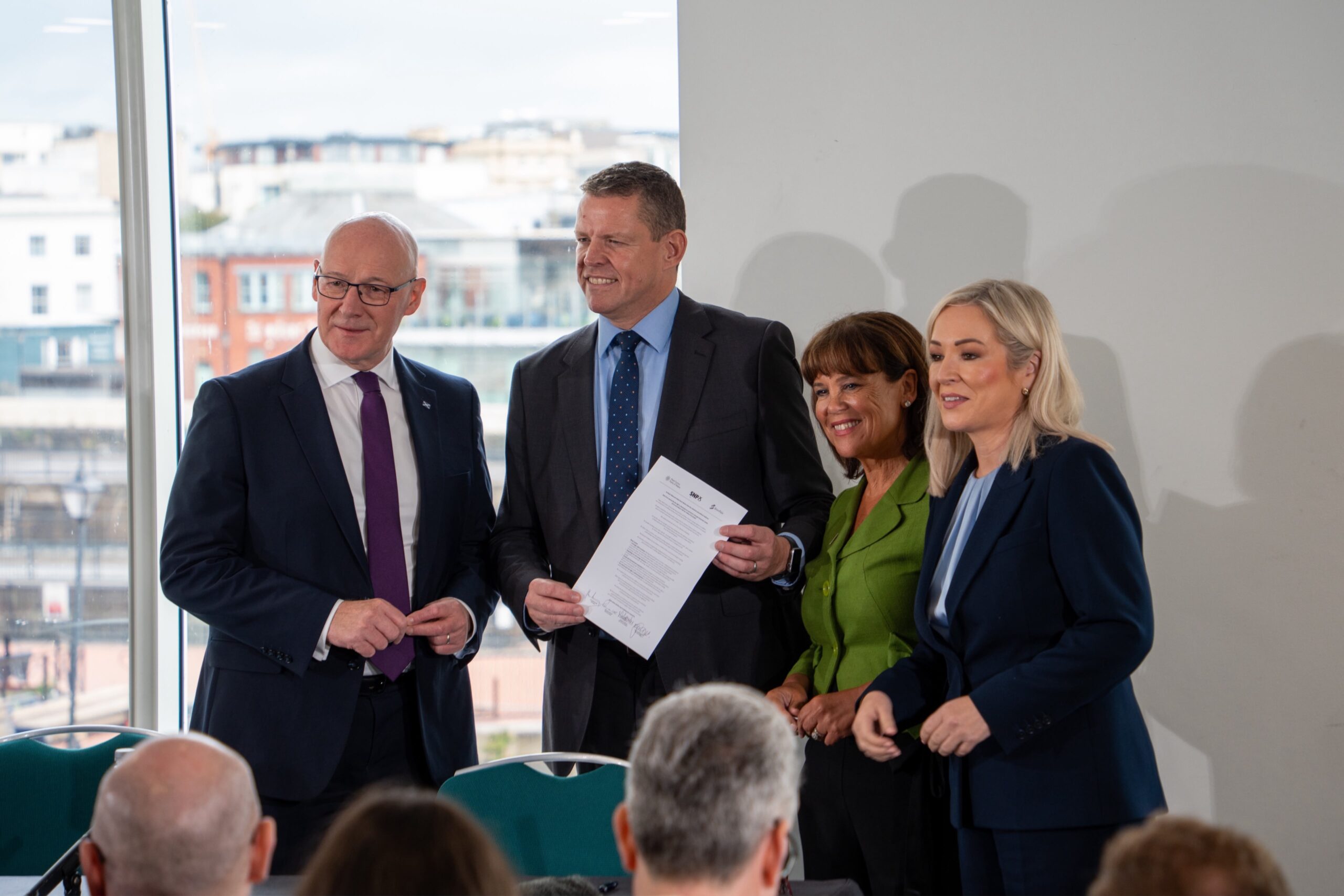
SNP, Plaid Cymru and Sinn Féin sign Cardiff pact declaring ‘constitutional change is coming’
The leaders of the SNP, Plaid Cymru and Sinn Féin have signed an agreement in Cardiff asserting their nations’ right to determine their own futures and calling on the UK Government to prepare for constitutional change, bringing the Scottish and Welsh independence and Irish reunification movements into formalised cooperation.
John Swinney, Rhun ap Iorwerth, Michelle O’Neill and Mary Lou McDonald met at St David’s Hotel in Cardiff Bay on Monday, 14 September 2026, before signing a memorandum of understanding between the SNP, Plaid Cymru and Sinn Féin.
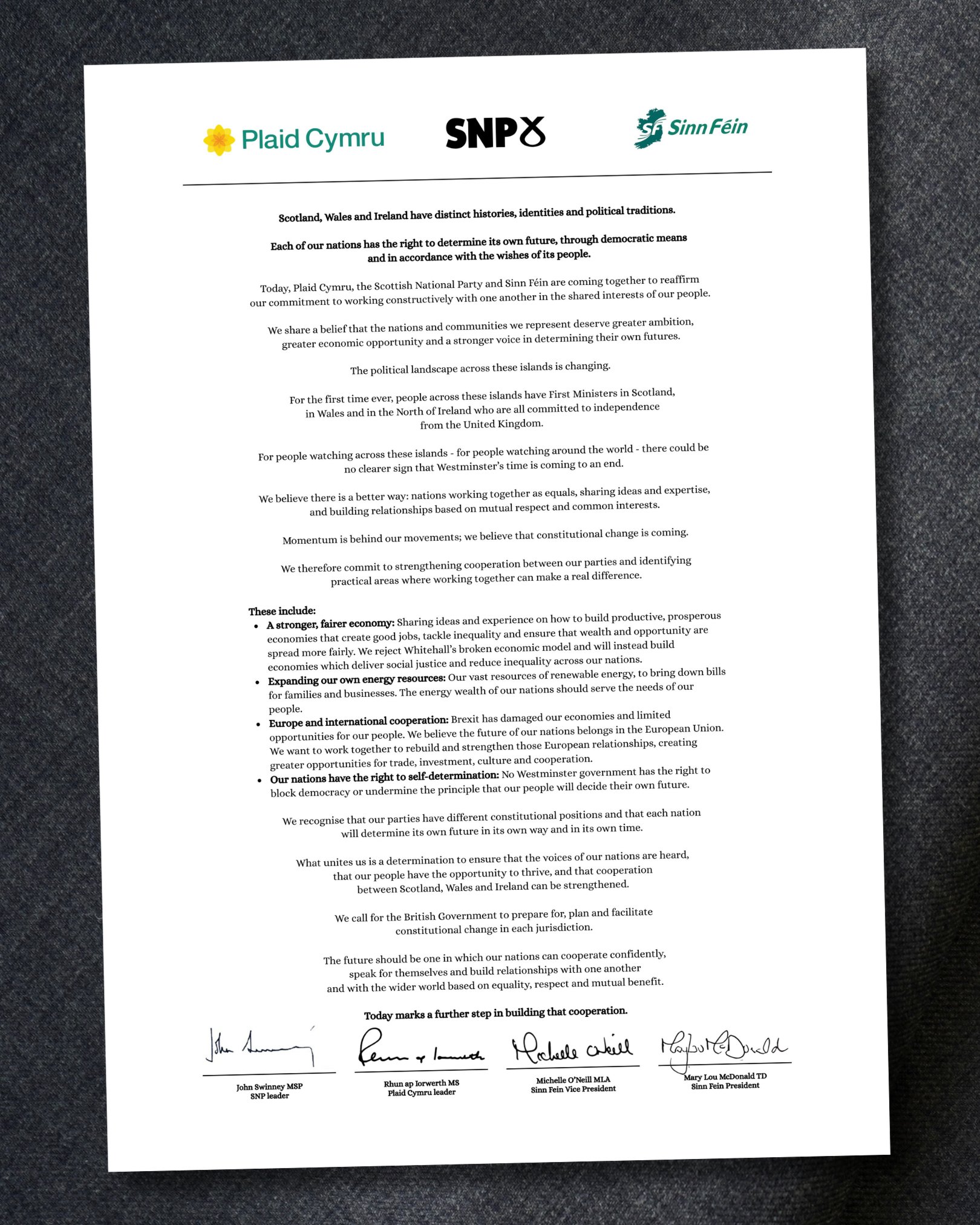
Swinney attended as SNP leader, ap Iorwerth as Plaid Cymru leader, O’Neill as Sinn Féin vice-president and McDonald as Sinn Féin president. Swinney, ap Iorwerth and O’Neill also hold the offices of First Minister in Scotland, Wales and Northern Ireland respectively, but the Cardiff agreement was made between their political parties rather than between the three devolved governments.
For the first time in the devolution era, the offices of First Minister in Scotland, Wales and Northern Ireland are held by politicians from parties committed to fundamental constitutional change.
The three movements are pursuing different outcomes. The SNP seeks an independent Scotland. Plaid Cymru seeks an independent Wales. Sinn Féin seeks Irish reunification, which would end Northern Ireland’s place within the United Kingdom.
Their Cardiff memorandum acknowledges those separate histories, political circumstances and constitutional routes while establishing a common position that the people of each nation should be able to determine their own future.
The document describes the political landscape across the UK and Ireland as changing, says momentum is behind the parties’ movements and declares that they believe “constitutional change is coming”.
It also states that “Westminster’s time is coming to an end”.
The parties call on the UK Government to “prepare for, plan, and facilitate constitutional change in each jurisdiction”.
They also recognise that their constitutional objectives will proceed separately. Scotland, Wales and Ireland are not placed on a common referendum timetable, and the memorandum does not attempt to create a single legal route applying to all three.
The agreement reaches beyond constitutional arrangements. The parties have committed themselves to closer cooperation on economic development, energy, Europe and international affairs, and state a shared belief that the future of their nations lies within the European Union.
The signing was followed by talks and a joint press conference in Cardiff.
Swinney said he believed Andy Burnham would be the last Prime Minister of the United Kingdom and argued that people in Scotland must be given an opportunity to determine the country’s constitutional future.
O’Neill placed the Cardiff meeting within Sinn Féin’s campaign for Irish reunification, while McDonald argued that the right to self-determination could not simply be removed from the political agenda by a British government.
Ap Iorwerth approached the agreement from the separate Welsh constitutional position. Plaid Cymru supports Welsh independence, but the party has not placed Wales on the same timetable as either the SNP’s proposed Scottish referendum or Sinn Féin’s campaign for an Irish unity poll.
The UK Government rejected the suggestion that the break-up of the United Kingdom was inevitable. Downing Street maintained that Burnham remained strongly committed to the Union and said the Government’s priorities were household finances and economic security rather than further constitutional referendums.
For the SNP, the Cardiff agreement formalises cooperation with two other nationalist parties at the same time that the Scottish Government is attempting to establish a lawful route through which another independence referendum could be held.
The Scottish constitutional effort has accelerated since the end of August.
On 28 August 2026, the Scottish Government published a new draft Independence Referendum Bill setting out the legislation it intends to introduce if Holyrood obtains the powers necessary to hold another vote.
The draft proposes asking voters the same question used in 2014: “Should Scotland be an independent country?”
It sets out the proposed franchise but contains no referendum date. The Scottish Government said when publishing the draft that the Bill would be introduced only once the necessary powers had been secured.
Four days later, on 1 September, the Government placed the pursuit of a lawful independence referendum within its Programme for Government for 2026 to 2031.
The programme also set out an intention to cooperate with political leaders in Wales and Northern Ireland over the ability of their populations to make constitutional choices.
On 10 September, four days before the Cardiff meeting, Swinney wrote to Prime Minister Andy Burnham asking for talks on a legal mechanism through which Scotland could hold another independence referendum.
The letter followed comments made by Burnham at Prime Minister’s Questions that day concerning the circumstances in which another constitutional vote might be considered.
According to Swinney’s letter, published by the Scottish Government, Burnham compared the Scottish position with the mechanism governing a border poll in Northern Ireland.
Swinney quoted Burnham as saying that a Northern Ireland border poll should be considered when there was a clear consensus and public opinion had changed sufficiently for such a call to be considered, adding: “I would say that it is exactly the same situation in Scotland.”
Swinney interpreted those words as recognition that sufficient public support for independence should result in an opportunity to vote and asked the Prime Minister to meet him to establish how such a principle could be converted into an agreed legal process.
The UK Government has continued to oppose another Scottish independence referendum.
When Burnham met Swinney in Glasgow on 23 July 2026, Downing Street said the Prime Minister had made clear that independence and another referendum were “off limits”, arguing that another constitutional vote would divert attention from economic growth and the cost of living.
The disagreement over how Scotland could hold another referendum has a direct historical precedent.
Scotland’s 2014 independence referendum did not take place because the Scottish Parliament possessed a permanent power to legislate for independence votes.
It followed an agreement between the Scottish and UK governments which temporarily altered Holyrood’s legislative competence.
On 15 October 2012, Prime Minister David Cameron and First Minister Alex Salmond signed the Edinburgh Agreement, alongside Scottish Secretary Michael Moore and Deputy First Minister Nicola Sturgeon.
The two governments agreed that Scotland’s independence referendum should have a clear legal basis, be legislated for by the Scottish Parliament, meet agreed standards of fairness and produce a result that both governments would respect.
They also agreed to promote an Order in Council under Section 30 of the Scotland Act 1998 giving the Scottish Parliament the necessary competence to legislate for that referendum.
The resulting Scotland Act 1998 (Modification of Schedule 5) Order 2013 was made on 12 February 2013 and came into force the following day.
It created a temporary exception to the constitutional matters normally reserved to Westminster, enabling Holyrood to legislate for a single-question independence referendum held before the end of 2014.
The Scottish Parliament subsequently passed the Scottish Independence Referendum Act 2013, which received Royal Assent on 17 December 2013 and set polling day for 18 September 2014.
Scotland voted on independence on 18 September 2014.
A total of 3,623,344 people voted, representing turnout of 84.6 per cent.
The result was 2,001,926 votes for No, representing 55.3 per cent of valid votes, and 1,617,989 votes for Yes, representing 44.7 per cent.
The temporary transfer of legislative power used for that referendum did not create a permanent right for the Scottish Parliament to legislate for subsequent independence votes.
No equivalent transfer has since been agreed.
The question of whether Holyrood could legislate for another referendum without Westminster’s agreement eventually reached the UK Supreme Court.
On 23 November 2022, the Court delivered its judgment following a reference by the Lord Advocate on whether the Scottish Parliament could legislate for a referendum asking “Should Scotland be an independent country?” without first obtaining additional legislative competence.
The Court unanimously concluded that it could not.
The Scotland Act 1998 reserves matters concerning the Union of the Kingdoms of Scotland and England and the Parliament of the United Kingdom.
The Supreme Court held that legislation for the proposed independence referendum would relate to those reserved matters.
The argument that the referendum would be advisory and would not itself make Scotland independent did not alter the Court’s conclusion. The judges found that the practical as well as formal legal consequences of the vote were relevant when considering its relationship with the Union.
The 23 November 2022 judgment remains the controlling judicial decision on Holyrood’s present competence to legislate independently for another independence referendum.
The Scottish Government has published, but not introduced, its new referendum bill, saying it will bring the legislation before Holyrood once the powers required for a lawful vote have been secured.
Northern Ireland operates under a different constitutional framework.
Schedule 1 of the Northern Ireland Act 1998 provides a statutory mechanism for a border poll and requires the Secretary of State to order one if it appears likely that a majority would vote for Northern Ireland to cease being part of the United Kingdom and become part of a united Ireland.
No equivalent standing provision exists in the Scotland Act requiring another Scottish independence referendum when support for independence reaches a particular level.
O’Neill attended the Cardiff meeting as a Sinn Féin leader. Irish reunification is not an agreed policy of the Northern Ireland Executive, whose mandatory power-sharing arrangements encompass parties with directly opposing constitutional positions.
Plaid Cymru also approaches constitutional change from a different legal and political position. It supports Welsh independence but does not share either Scotland’s previous referendum mechanism or Northern Ireland’s statutory border-poll provision.
The Cardiff agreement does not establish a common referendum timetable or a single constitutional process covering Scotland, Wales and Northern Ireland.
Instead, the three parties have agreed that each population should be able to determine its future through its own constitutional route and that Westminster should facilitate those processes.
Europe provides another point of agreement.
Scotland voted by 62 per cent to 38 per cent to remain in the European Union in the referendum held on 23 June 2016. Every Scottish local-authority counting area recorded a Remain majority.
Across the United Kingdom, Leave won by 51.9 per cent to 48.1 per cent.
The United Kingdom left the European Union on 31 January 2020.
The Scottish Government’s current policy is that an independent Scotland should seek membership of the European Union.
The Cardiff agreement places European relations alongside constitutional change, economic development, energy and international cooperation among the areas in which the SNP, Plaid Cymru and Sinn Féin intend to work together.
The events leading to Monday’s agreement now form part of a longer constitutional sequence in Scotland.
The Edinburgh Agreement was signed on 15 October 2012.
The temporary Section 30 order followed in February 2013.
Scotland voted on independence on 18 September 2014.
The UK Supreme Court ruled on Holyrood’s existing legislative competence on 23 November 2022.
The Scottish Government published its latest draft Independence Referendum Bill on 28 August 2026.
Its Programme for Government followed on 1 September.
Swinney asked Burnham for talks on a lawful referendum mechanism on 10 September.
On 14 September, the SNP, Plaid Cymru and Sinn Féin placed their separate constitutional movements within a signed framework for continued cooperation and called collectively on Westminster to prepare for constitutional change.
The Cardiff agreement does not alter the legal restrictions governing another Scottish independence referendum.
No referendum date has been set. No new Section 30 order has been agreed. No permanent power to legislate for independence referendums has been transferred to the Scottish Parliament.
What changed in Cardiff was the political relationship between the movements seeking Scottish independence, Welsh independence and Irish reunification.
For the first time while politicians from those movements simultaneously hold the office of First Minister in Scotland, Wales and Northern Ireland, their parties have put a common commitment to self-determination and continuing constitutional cooperation into a signed agreement.
Sources
Cardiff memorandum signing and statement
John Swinney, X, 14 September 2026
https://x.com/JohnSwinney
FM writes to PM on Scotland’s right to decide
Scottish Government, 10 September 2026
https://www.gov.scot/news/fm-writes-to-pm-on-scotlands-right-to-decide/
Programme for Government 2026 to 2031
Scottish Government, 1 September 2026
https://www.gov.scot/publications/programme-government-2026-2031/
Draft Independence Referendum Bill
Scottish Government, 28 August 2026
https://www.gov.scot/publications/draft-independence-referendum-bill-2026/
PM meeting with First Minister of Scotland John Swinney
Prime Minister’s Office, 10 Downing Street, 23 July 2026
https://www.gov.uk/government/news/pm-meeting-with-first-minister-of-scotland-john-swinney-23-july-2026
Agreement between the United Kingdom Government and the Scottish Government on a referendum on independence for Scotland
UK Government and Scottish Government, 15 October 2012
https://assets.publishing.service.gov.uk/media/5a7eae5740f0b62305b827ce/scottish_referendum_agreement.pdf
The Scotland Act 1998 (Modification of Schedule 5) Order 2013
UK Parliament, 12 February 2013
https://www.legislation.gov.uk/uksi/2013/242/contents/made
Scottish Independence Referendum Act 2013
Scottish Parliament, 17 December 2013
https://www.legislation.gov.uk/asp/2013/14/contents
Report: Scottish Independence Referendum
Electoral Commission, December 2014
https://www.electoralcommission.org.uk/research-reports-and-data/our-reports-and-data-past-elections-and-referendums/report-scottish-independence-referendum
Reference by the Lord Advocate of devolution issues under paragraph 34 of Schedule 6 to the Scotland Act 1998 — [2022] UKSC 31
UK Supreme Court, 23 November 2022
https://www.supremecourt.uk/cases/uksc-2022-0098
Northern Ireland Act 1998 — Schedule 1
UK Parliament, 19 November 1998
https://www.legislation.gov.uk/ukpga/1998/47/schedule/1