
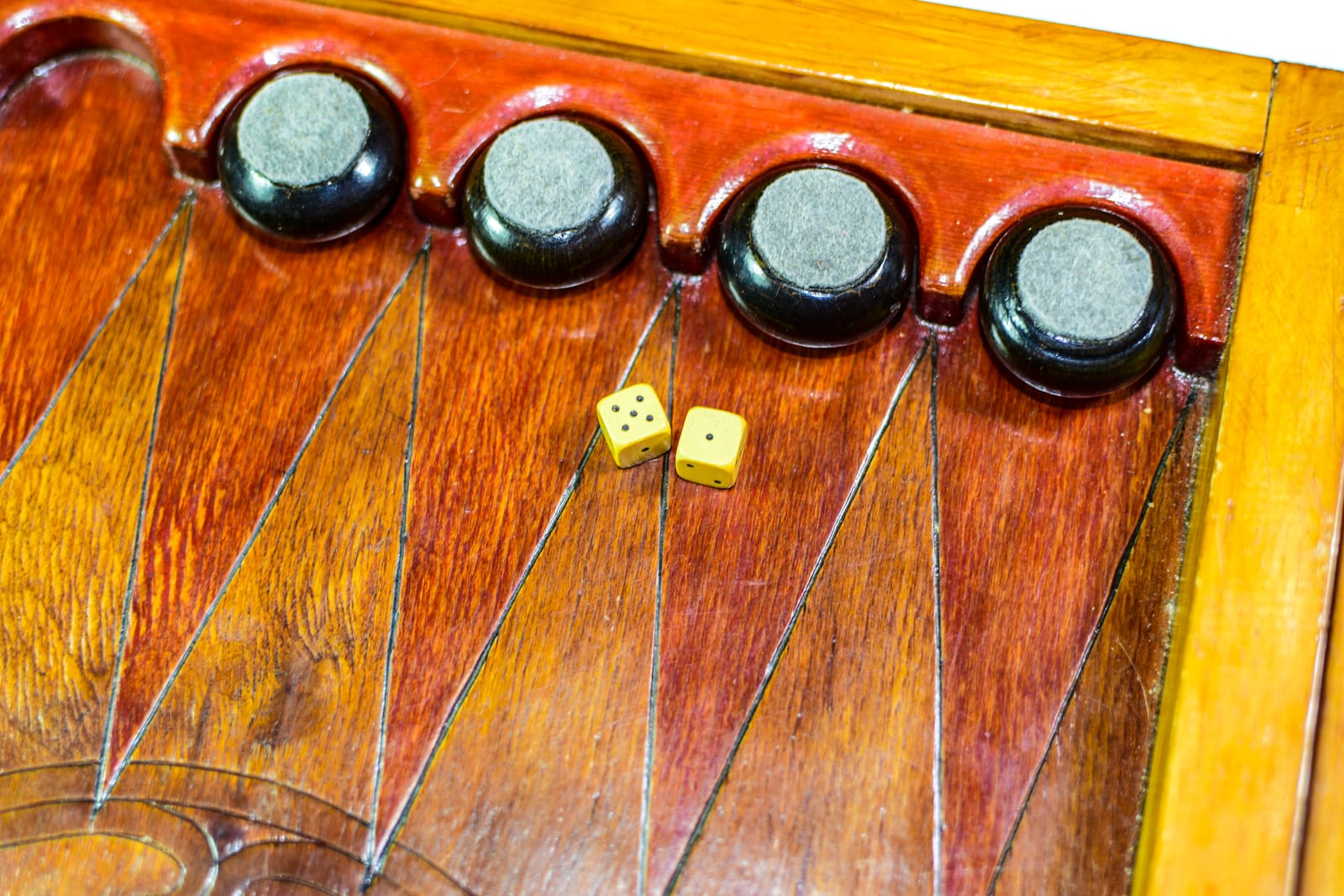
I discovered on Tuesday morning that backgammon is fashionable again. I was having my second cup of tea and reading about the things fashionable people are doing when I came across the news. Backgammon, it seems, has returned to drawing rooms, clubs and fashionable tables, where attractive people are once again moving little counters around expensive boards while looking as though they have understood the rules since birth.
“Backgammon is back,” I told Mr Gunn.
He looked up from his breakfast. “Where did it go?”
“Out of fashion.”
“When?”
“I don’t know.”
“Well, how do you know it’s back?”
“Because I’ve just read it.”
Mr Gunn considered this. “Did anybody tell the backgammon board?”
There are times when discussing fashion with Mr Gunn is like discussing soufflés with a Labrador. The basic information is received, but there is no appreciation of its wider significance. I explained that this was not merely people playing an old game. This was a revival. Backgammon was fashionable. There were beautiful boards and beautifully dressed people playing it in places where nobody appeared to have central heating problems.
“We used to try to play backgammon,” he said.
“I know.”
“In the caravan.”
“That is not quite the same.”
“Same game.”
“We had towels drying over the radiator.”
“We were still playing backgammon.”
This was irritating because he was right. Somewhere in the house we owned a backgammon board. We had tried to learn to play it years ago, before evenings became occupied by television subscriptions. I knew exactly where it was.
“It’s in the hall cupboard,” I said.
Mr Gunn stopped eating.
Our hall cupboard is where objects go after their useful lives have ended but before either of us has acquired the courage to throw them away. It contains three umbrellas, none of which can be trusted in weather; a badminton racquet without a shuttlecock; two folding chairs; several scarves belonging to people I no longer recognise; a hot-water bottle without a stopper; and enough unidentified electrical cable to reconnect the Highlands to the National Grid.
“You want me to go in there?”
“I want the backgammon board.”
“Today?”
“It’s fashionable now.”
He went. There was silence for several minutes, followed by a crash, a muttered word I shall not reproduce, and the sudden appearance in the hallway of a Christmas wreath. Mr Gunn eventually emerged carrying a brown case under one arm and a table lamp under the other.
“I found this as well.”
“I wasn’t looking for the lamp.”
“Neither was I.”
He handed me the backgammon board.
It was worse than I remembered. The cream counters had become the colour of old teeth, the stitching was grey and there was a sticky patch in one corner which Mr Gunn identified as Drambuie.
“How would Drambuie get inside a backgammon board?”
“We took it to the MacDonalds’ at New Year.”
“That was in the nineties.”
“Drambuie lasts.”
I smelled the corner and decided there are some historical questions better left unresolved.
By ten o’clock I had the board on the kitchen table with two cloths, cotton buds, warm water and a toothbrush. By noon, I had restored the counters to something approaching their original colour and discovered that the board itself was actually rather handsome.
Unfortunately, cleaning one old object exposes the condition of everything around it. Once the board was clean, the kitchen table looked disgraceful. Once I cleaned the table, I noticed the windowsill. By lunchtime I had polished the table, washed two windows, cleaned the skirting board and removed a mark from the door frame which had outlasted seven prime ministers.
Mr Gunn found me polishing the brass handle on the dining-room door.
“I thought you were cleaning the backgammon board.”
“I did.”
“Why are you cleaning the door?”
“People will be coming through it.”
This seemed perfectly obvious to me.
At about three o’clock, I decided that if we were going to participate in the revival of backgammon, we were going to do it properly. There was no point sitting around in old jumpers throwing dice while Mr Gunn watched television in the next room. Fashion had standards.
I sent a message to the ladies.
Backgammon evening here on Thursday. Seven o’clock. Backgammon is fashionable again. We are dressing up.
Effie replied first.
How much are we playing for?
Nothing. We are not gambling.
Morag appeared next.
What does dressing up mean?
Properly.
Jean asked:
Dinner properly or funeral properly?
Before I could answer, Agnes wrote:
Are we wearing hats?
I had said nothing about hats. This should have been the moment when I stopped it. Instead, I made the mistake of hesitating.
Margaret replied:
I’ll wear one if Agnes is.
Elspeth then announced that she still had the hat she had bought for Fiona’s wedding, and within five minutes a quiet evening of backgammon had acquired a dress code normally associated with the Royal Enclosure.
Thursday arrived with the kind of Highland weather that regards weather forecasts as a personal challenge. By five o’clock the wind was coming off the hill hard enough to rearrange the bins, and rain was travelling horizontally past the sitting-room windows. Mr Gunn looked outside and asked whether the ladies were still coming.
“Of course they are.”
“In hats?”
I chose not to answer.
I wore a navy dress and pearls. I had put out the restored board, proper glasses, little dishes of nuts and olives, and some cheese biscuits which I transferred from their packet onto a plate so they would not know where they came from. Mr Gunn surveyed the dining room.
“This is all for backgammon?”
“Yes.”
“We used to play it with a packet of crisps.”
“That was before it was fashionable.”
At seven minutes past seven I heard the doorbell.
I couldn’t tell which of my friends it was. Something wet, brown and flattened covered most of her head and one side of her face. A long feather was plastered across what I assumed was her forehead.
“Get me inside.”
It was Effie.
I pulled her through the doorway just as another gust came across the garden.
“What happened to you?”
“What do you think happened? Scotland happened.”
I was still staring at the thing on her head. It had clearly begun the evening as a hat. Beyond that, identification was difficult. It looked like an indistinguishable dead animal which had been found at the roadside and persuaded to attend dinner.
“Is that the new hat?”
“It was.”
Effie went directly to the hall mirror.
“Oh, for God’s sake.”
Behind her, a man was coming up the path carrying a bottle of wine and what remained of an umbrella.
Only then did I recognise Effie’s husband.
Her husband wisely handed me the wine and said nothing.
The next shape appeared through the rain. This one was green.
“Morag,” I said confidently.
It was not Morag.
It was Agnes.
Her hat had originally possessed a large decorative flower on one side. The flower was gone. What remained had collapsed over her left ear and was shedding water down her neck.
“You thought I was Morag.”
“No.”
“You said Morag.”
“I thought you were behind Morag.”
“There is nobody in front of me.”
This was true.
Agnes removed the hat and stared at it.
“My flower’s gone.”
A man appeared at the gate.
“There’s your husband.”
She looked over her shoulder.
“Did you see my flower?”
He stopped.
“What flower?”
Agnes looked at me.
“Thirty-seven years.”
I took her coat.
“Come in.”
Morag arrived next, or at least I assumed it was Morag because I could see her husband approximately twenty feet behind her attempting to lock the car while holding two bottles of wine under one arm.
Her hat was cream. Or had been. By the time it reached my front door it had become another indistinguishable wet animal, this one apparently larger and unhappier than Effie’s. The brim had folded down on both sides and the crown had sunk in the middle.
“Don’t.”
“I haven’t said anything.”
“You’re looking.”
“I have to look at you to let you into the house.”
She stepped inside and saw Effie.
Effie stared at Morag.
Morag stared at Effie.
There was a pause.
“Yours is worse,” Effie said.
“It is not.”
“It absolutely is.”
“At least mine still looks like a hat.”
Margaret came up the path holding her hat onto her head with both hands. She was leaning so far into the wind that, had it stopped suddenly, she would have arrived through my front window.
Her husband followed some distance behind with an umbrella.
“Help me!” Margaret shouted.
“I’m carrying the wine!”
A gust hit Margaret halfway up the path. Her skirt went one way, her hat went another and Margaret remained, through considerable effort, somewhere in the middle.
We got her inside.
Her husband arrived thirty seconds later.
“You could have helped me.”
“I couldn’t catch you.”
By now the husbands were accumulating beside Mr Gunn, with wine, damaged umbrellas and the relieved expression of a man who had successfully delivered his wife to somebody else’s house.
Then Jean arrived. She was wearing no hat.
Five women stared at her.
“What?”
“We’re wearing hats,” said Agnes.
“I can see that.”
“You said you were dressing up.”
“I am dressed up.”
“You haven’t got a hat.”
“I looked out the window before I left.”
There are occasions when superiority does not need to be expressed. It simply walks into your house with dry hair.
Jean’s husband came up the path behind her. He was carrying a bottle of whisky and no umbrella.
Mr Gunn opened the door for him.
“You all right?”
“Aye.”
That was the entirety of the male discussion concerning the weather.
The husbands had already discovered the sitting room. Mr Gunn put the television on and, within minutes, they had arranged themselves in the deeply familiar male formation of men who have been told there is an event happening in the next room but have no intention of attending it unless food becomes available.
“What are they watching?” Effie asked.
“Football,” called Mr Gunn.
“There isn’t any football on.”
There was a pause.
“There is now.”
We went through to the dining room. There was a gratifying silence when the ladies saw the table.
“Oh, this is lovely,” said Elspeth.
“Very smart,” said Margaret.
Morag looked at the backgammon board.
“Is that the fashionable one?”
“It’s ours.”
“How much was it?”
“I don’t remember.”
From the sitting room, Mr Gunn said, “£12.99.”
I looked towards the door.
One of the husbands laughed.
That was all it took. Within thirty seconds the men had established that the dining-room door was open far enough for them to hear everything while still maintaining that they were watching television. I decided to ignore them.
We poured the wine. Then we sat down and discovered that nobody could remember how to play backgammon.
“I thought you knew,” I said to Effie.
“Why would I know?”
“You asked how much we were playing for.”
“That doesn’t mean I know the rules.”
Agnes picked up one of the counters.
“What are these called?”
“Counters.”
“I thought they were men.”
“They may be men.”
Jean had taken out her phone.
“They’re called checkers.”
“We’re not playing checkers,” said Margaret.
“No, the pieces are called checkers.”
“That’s unnecessarily confusing.”
I produced the rules on my phone. This introduced us to the concepts of blots, points, bars, bearing off and something called the doubling cube.
Morag picked up the doubling cube.
“What’s this?”
“It doubles.”
“What?”
“The game.”
“How?”
“I haven’t got that far.”
Effie inspected it.
“It has sixty-four on it.”
“We are not playing sixty-four games,” said Elspeth.
“No, I think it doubles the stakes.”
Everyone looked at me.
“There are no stakes.”
Effie sat back.
“Then what are we doing?”
“We are playing backgammon.”
“For nothing?”
“For enjoyment.”
From the sitting room, one of the husbands called, “That won’t last.”
Agnes turned towards the door.
“Nobody asked you.”
“Just saying.”
“Watch your television.”
“We are.”
“Then how do you know what we’re doing?”
“You’re louder than the television.”
This received several male noises of agreement from the next room.
We divided into pairs and began. Or at least I believed we began. Within five minutes, Margaret accused Agnes of moving in the wrong direction, Agnes accused Margaret of inventing rules, and Morag had eaten most of the cheese biscuits.
“You’ve moved that twice,” Margaret said.
“I have not.”
“You were there.”
“I was not there.”
“I saw you.”
“Well, you should have said something before I moved.”
From the sitting room came a male voice.
“She was there.”
Agnes turned around.
“Who said that?”
Nobody answered.
“Which one of you said that?”
The television suddenly became louder.
“Cowards,” said Agnes.
Jean, meanwhile, had become suspiciously competent. She was moving counters with the confidence of a woman who had somehow progressed from not remembering the rules to conducting a military campaign in less than twenty minutes.
“You’ve played this before,” I said.
“No.”
From the sitting room came her husband’s voice.
“Yes, she has.”
Jean stopped.
“Nobody asked you.”
“Every Sunday at your mother’s.”
“That was years ago.”
“Twenty years.”
Effie sat back.
“I knew it.”
Jean raised her voice.
“Would you like to come in here and play?”
“No.”
“Then be quiet.”
There was a short pause.
Her husband added, “Your mother used to cheat as well.”
Jean stood up.
Mr Gunn increased the television volume.
“Sit down,” I told her.
“I am going to kill him.”
“Not during the first game.”
Jean sat down.
“My mother did not cheat.”
From the sitting room came, “She absolutely did.”
“MR GUNN.”
“Wasn’t me.”
I was beginning to understand that separating husbands and wives by one internal wall does not constitute separate entertainment.
By nine o’clock the hats were drying, the wine was disappearing and somewhere along the way fifty-pence pieces had appeared on the table. I did not see who introduced them. This is often the way with social decline. One moment six respectable women were enjoying an ancient game of strategy; the next there was £3.50 beside the wine bottle and Effie was demanding change for a tenner.
Mr Gunn called through, “Are you gambling now?”
“No.”
“Sounds like gambling.”
“It is fifty pence.”
One of the husbands said, “That’s how it starts.”
Effie raised her voice.
“How what starts?”
“Crime.”
I went through to the sitting room to replenish the nuts and found four pairs of shoes lined up beneath the coffee table. The men were sitting with drinks in their hands watching what appeared to be a documentary about bridges.
I took the bowl of nuts and returned to the dining room.
By the third game, Effie had become convinced that Jean was deliberately leaving pieces exposed in order to lure people into taking them. Margaret believed this was against the spirit of the evening.
“It’s strategy,” said Jean.
“It’s entrapment,” said Margaret.
“It’s backgammon.”
“It’s underhand.”
One of the husbands called, “That’s what strategy is.”
Margaret looked towards the sitting room.
“Do you play backgammon?”
“No.”
“Then how would you know?”
“I was in the Army.”
Margaret stared towards the sitting room for a moment. I could see her deciding whether twenty-five years of military experience entitled a man to comment on a game he had already admitted he did not play. She decided that it did not.
“You were in the Army twenty-five years ago.”
“Strategy doesn’t expire.”
“Neither does interfering, apparently.”
That ended the military contribution for a while, and we returned to the board. By then, however, the evening had reached the stage where backgammon was still officially the reason we were there but had ceased to be the most interesting thing in the room. Jean was winning, Morag was eating steadily, and the rest of us were dividing our attention between the game, the wine and the condition of the hats drying in the hall.
It was Effie who noticed the smell first.
“Is something burning?”
Everyone stopped.
I smelled the air.
“No.”
Agnes smelled it too.
“There is definitely something.”
We followed the smell into the hall and discovered that Agnes’s hat had slipped sideways against the radiator. It was not on fire, but one side had become distinctly warmer than the other and the damp wool had acquired the odour of something being slowly prepared for supper.
“My hat,” Agnes said.
“It’s fine.”
“It cost £120.”
“That doesn’t make it less hot.”
By then the husbands had heard us and begun appearing from the sitting room, one by one, still carrying their drinks. There is no quicker way to attract men from another room than the possibility that something mechanical, electrical or combustible has gone wrong.
Mr Gunn lifted the hat from the radiator and inspected it.
“It’s all right.”
Agnes looked at him.
“How do you know?”
“It’s not on fire.”
This was technically true, although it was not the standard by which Agnes judged millinery.
While we were all standing in the hall, Margaret suddenly pointed at one of the husbands.
“There’s your flower.”
Agnes turned.
The missing flower from her hat was attached to the back of his jumper.
Nobody spoke for several seconds.
He twisted around, unsuccessfully trying to see it.
“How did that get there?”
Agnes removed it carefully.
That sent us back into the dining room, although by then the men had lost some of their commitment to the television. They lingered near the doorway, looking at the board with the guarded interest of people who had spent the evening insisting they were not interested in something and were now beginning to regret the position.
I brought out sausage rolls.
This changed everything.
Within seconds, the husbands were in the dining room.
Mr Gunn took one.
“I thought you were watching television.”
“We were.”
The sausage rolls were placed beside the backgammon board and, almost immediately, one of the men pointed at the position of the counters.
“You’ve got that wrong.”
Six women looked at him.
He stopped chewing.
“What?”
Jean narrowed her eyes.
“You remember how to play.”
He looked towards the other husbands. This was a mistake, because several of them had already acquired the expression of men who knew exactly what was about to happen.
“A bit.”
I looked at Mr Gunn.
He became very interested in his sausage roll.
“Do you remember how to play?” I asked him.
“Of course.”
I stared at him.
“You have been sitting in the next room all evening while we read the rules on my phone.”
“You didn’t ask.”
This was the moment when I understood that there are two kinds of knowledge in marriage: information freely offered, and information a husband will carry silently to the grave unless a direct question is asked.
Jean’s husband admitted that he knew as well. So did two of the others. Within five minutes, the men who had spent three hours watching television were standing around the table correcting our moves, discussing the doubling cube and helping themselves to the sausage rolls.
At eleven o’clock we began finding coats. The hats required more thought. Effie tried hers on, looked in the hall mirror and immediately took it off again. Agnes held hers at arm’s length. Morag simply refused to wear hers.
“I’m not going back out in that thing.”
Mr Gunn opened the hall cupboard and produced a cap.
“Wear this.”
Morag looked at it.
“I’m wearing a dress.”
“It’ll keep your head dry.”
She considered the cap, then the ruined hat.
She put on the cap.
Fashion has limits.
Eventually everyone made it outside. The rain had eased, but the wind had not. Effie was halfway down the path when a gust caught the remains of her hat and lifted it clean out of her hands.
We all watched it disappear into the darkness.
Effie looked at her husband.
“Well?”
He looked towards the field.
“It was £85,” she said.
He sighed and went after it.
Mr Gunn and I stood in the doorway watching his torch move behind the hedge.
“Do you think he’ll find it?” I asked.
“Hope not.”
I closed the door before Effie could hear him.