
In little more than a decade, Scotland has watched a familiar piece of civic life disappear from hundreds of communities. The story begins with quiet rationalisation, passes through mass closures and parliamentary revolt, and ends (for now) with a new experiment in shared banking.
Modern Scot investigation | 13 August 2026
There is a particular irony in Scotland losing its banks.
This is a country that helped teach the modern world how to bank.
Bank of Scotland was created by Act of the Scottish Parliament in 1695, when credit was scarce and merchants needed a financial system capable of supporting trade and industry. What followed was one of the most distinctive banking cultures in Europe: competing Scottish banks, their own notes, extensive branch networks and financial innovations that would be studied far beyond Scotland.
For generations, the bank became part of the architecture of Scottish life.
Which makes what happened next all the more remarkable.
There is a building somewhere in Scotland that still looks exactly like a bank.
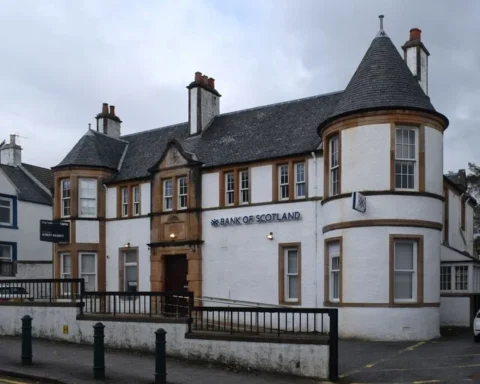
It may be sandstone, built with the confidence of another century. There will be steps worn smooth by generations of customers, tall windows and a doorway deliberately designed to look solid. Banks once built premises to advertise permanence before anyone had coined the phrase “brand identity”.
The lettering has gone now.
Perhaps it is a restaurant. Perhaps a charity shop. Perhaps flats. Perhaps the windows have simply been papered over and the old banking hall sits empty behind them.
What happened inside that building has been repeated across Scotland on an extraordinary scale.
For generations, the bank branch was an ordinary piece of Scottish infrastructure. It sat beside the chemist, the butcher, the post office and the council building. Farmers used it. Shopkeepers carried their takings through its doors. Older customers knew the staff. Young people opened their first accounts there. Executors appeared with death certificates. Families arranged mortgages. Businesses borrowed money.
Then, beginning quietly and accelerating with remarkable speed, the branches began to go.
What looked at first like corporate tidying became something much larger: a retreat from the Scottish high street that has changed the financial geography of the country.
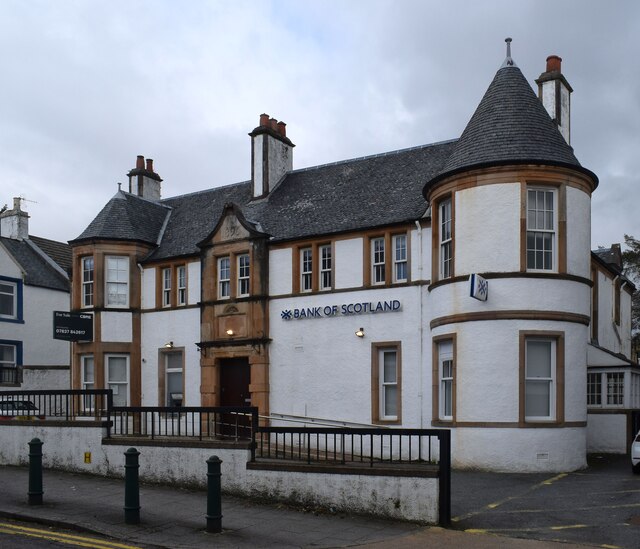
The former Bank of Scotland at Kyle of Lochalsh, its white-painted walls, sandstone dressings and turreted bays giving the branch the appearance of a small civic institution rather than an ordinary shopfront. The bank has gone; the building remains. Photograph: Bill Harrison / Geograph, CC BY-SA 2.0.
The Initial Cuts
The modern story begins around 2015.
There was no single morning on which Scotland was informed that its branch-banking system was about to be dismantled. Instead there were announcements from individual institutions, usually presented in the language of efficiency, changing customer behaviour and declining footfall.
The argument was not fictitious. Banking really was changing.
Smartphones were becoming financial instruments. Customers who once visited a branch to check balances, transfer money or pay bills could increasingly do all three while sitting at the kitchen table. Debit cards and contactless payments were reducing some uses of cash. Banks could see transactions migrating online.
The response was incremental.
A branch serving one part of Edinburgh disappeared. Another in Glasgow followed. Duplicate premises were consolidated. Smaller branches with falling traffic became vulnerable.
The difficulty with the early period is that these closures were scattered through corporate announcements, local newspaper reports and records that were never designed to become a permanent national archive.
Some branches have proved surprisingly difficult to reconstruct only eleven years later.
Among the institutions disappearing during this period was something more unusual: Airdrie Savings Bank, founded in 1835 and for generations one of Scotland’s last independent savings banks. Its eventual closure in 2017 was different in character from an individual branch rationalisation. An entire Scottish banking institution disappeared.
By then the gentle language of adjustment was becoming difficult to reconcile with the scale of what followed.
2017: The Cull Becomes Visible
If the first phase could be understood as rationalisation, 2017 made the national pattern impossible to miss.
Clydesdale Bank announced a programme involving 40 Scottish branches, stretching across cities, commuter towns and rural communities. Modern Scot’s reconstructed records include places such as Banff, Bathgate, Bearsden, Beith, Bellshill, Brechin and Buckie.
Dalkeith, Dunoon, East Kilbride, Edinburgh Leith Walk and even an Edinburgh University branch were among the same programme.
Royal Bank of Scotland then announced the planned closure of 62 Scottish branches, saying branch transactions had fallen by around 40 per cent in three years as customers changed the way they banked.
This was something different.
A network assembled over generations could now be reduced through national programmes decided in months.
The effects were particularly stark in northern Scotland. Communities in Caithness, Sutherland and Easter Ross had distances that looked modest in a boardroom presentation and rather less modest when driven in winter.
Banks saw falling transactions.
Communities saw the removal of buildings, staff, cash facilities, business services and accumulated local knowledge.
Both descriptions could be true at the same time.
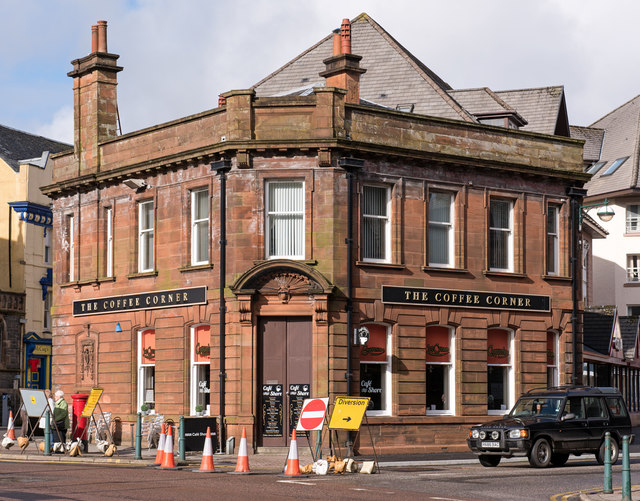
The former Clydesdale Bank in Oban, completed in 1915 to designs by Glasgow architects Baird & Thomson. The bank later moved elsewhere and the Category C-listed red-sandstone building became a coffee shop — one of many Scottish banking halls to outlive the institutions that commissioned them. Photograph: The Carlisle Kid / Geograph, CC BY-SA 2.0.
Westminster Notices
By 2018 the dispute had reached Parliament.
The House of Commons Scottish Affairs Committee opened an inquiry into RBS’s programme of Scottish closures and took evidence from senior executives, unions, rural organisations and the Post Office.
The political argument was unusually revealing.
RBS maintained that customers were moving towards digital services and that maintaining poorly used premises could not be justified indefinitely. Opponents argued that national averages concealed the conditions faced by rural communities, older customers, small businesses and people who did not have reliable digital alternatives.
The committee’s intervention eventually led to pressure on RBS to reconsider part of the programme. Ten branches received temporary reprieves while the bank reviewed their future.
But the wider retreat continued.
By March 2019, the Scottish Affairs Committee was referring to 399 branch closures in Scotland since 2015, largely involving RBS, Bank of Scotland and Clydesdale Bank.
Four years had been enough to alter the country’s banking landscape.
The argument over the closures also established a principle that has largely survived ever since: governments could scrutinise, cajole and regulate the consequences, but banks remained commercial institutions making decisions about their own branch estates.
That distinction would become increasingly important.
The Rural Quarantine
A closed bank means something different in Portree than it does in central Glasgow.
That is the point at which national statistics begin to conceal more than they reveal.
In densely populated areas another branch may be a bus journey away. In rural Scotland, a closure can move banking into another town, another county or, in island communities, across water.
When the Scottish Affairs Committee examined access to cash in 2022, it heard that the nearest alternative Virgin Money branch for customers affected by the Portree closure was 80 miles away and involved a ferry transfer.
For customers of the closed Wick branch, the nearest alternative was said to be 101 miles away.
Those distances alter the economics of ordinary banking.
A shopkeeper cannot put a week’s cash takings into an app.
Neither can a hotel, pub, café, market trader or community organisation.
Cash has to be stored securely until somebody physically takes it somewhere. What appears on a corporate spreadsheet as the elimination of an underused branch can therefore transfer time, mileage, risk and cost directly to customers.
The consequences are not confined to businesses.
Parliament’s 2022 investigation estimated that around 500,000 people in Scotland remained reliant on cash, while warning about the particular effects of continuing branch and ATM reductions on vulnerable people and those in isolated or rural locations.
Digital banking solved an enormous number of problems.
It did not abolish geography.
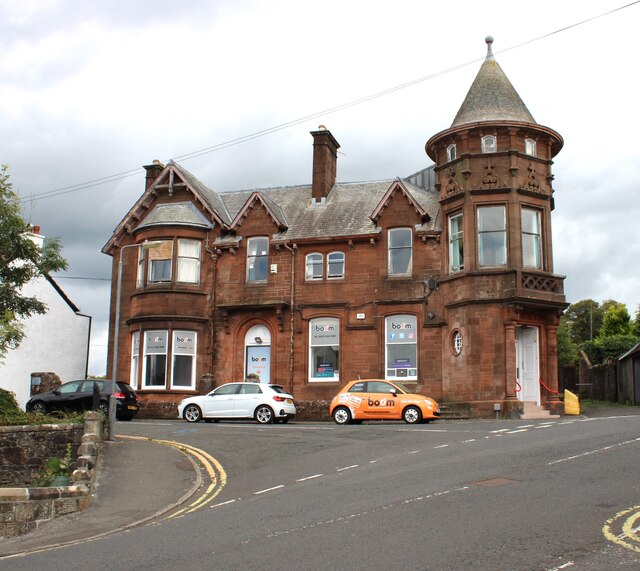
The former Clydesdale Bank in Beith, built in Mauchline red sandstone in 1906 and now Category B listed. Its corner tower and elaborate frontage were designed for an age when a bank building was expected to communicate security and permanence. The branch closed in 2017. Photograph: Richard Sutcliffe / Geograph, CC BY-SA 2.0.
The Pandemic Accelerator
Then came 2020.
The movement towards online banking was well established before COVID-19. It would be inaccurate to claim that the pandemic created the closure programme.
What it did was accelerate behaviour already moving in that direction.
Branches temporarily closed or operated under restrictions. Customers who had never intended to become digital bankers suddenly had a powerful reason to learn. Contactless payments became ordinary even among people who had previously preferred cash.
Some of that behaviour persisted.
The result arrived at exactly the point when banks were already reconsidering the economics of their estates.
Santander, TSB, Virgin Money and others continued substantial closure programmes through the pandemic period and its aftermath. Modern Scot’s records include Santander branches at Dalkeith, Edinburgh Morningside Road, Glasgow Kilmarnock Road and Glasgow Sauchiehall Street among the 2021 closures.
The Financial Conduct Authority became sufficiently concerned about the conditions surrounding closure decisions that it developed increasingly formal expectations about how banks should assess their effects on customers.
The important distinction, however, remained.
Regulation could make the process more responsible.
It could not make the old branch network return.
The Post Office Patchwork
As branches disappeared, one institution increasingly appeared in banks’ explanations of what customers should do next.
The Post Office.
The arrangement made sense. Britain already had a large network of Post Office counters, many in communities where bank branches were disappearing. Through agreements with the banks, customers could carry out basic transactions including depositing and withdrawing cash, paying in cheques and checking balances.
For many communities, that service has been indispensable.
But a Post Office counter and a bank branch are not interchangeable institutions.
The Post Office can handle many routine transactions. It cannot make every banking decision, resolve every account problem or reproduce the full range of specialist services that once existed behind the doors of a conventional branch.
There are practical limits too. Cash deposit limits, for example, are set by individual banks rather than by the Post Office.
For a small personal transaction this may be unremarkable.
For businesses handling cash, the difference becomes more consequential.
The Post Office therefore became the patch applied to a shrinking branch system — an extraordinarily useful patch, but a patch nevertheless.
Then a different model began to appear.
The Shared Bank Arrives
The Banking Hub is perhaps the most interesting admission contained within the entire bank-closure story.
It acknowledges that after years of customers being told that banking had become digital, there remains enough demand for physical, face-to-face banking to require buildings with people in them.
The difference is that the building is now shared.
A Banking Hub normally provides a common counter service operated by the Post Office, while representatives from participating banks attend on different days. Customers can perform everyday transactions and arrange to speak face-to-face with somebody from their own bank.
It is not the restoration of the traditional branch.
It is something new: banking infrastructure separated from the individual bank’s desire to maintain its own premises.
That model is spreading across Scotland.
It has emerged in communities that have already lost branches and in places facing the departure of their remaining banks. Modern Scot’s public directory now records conventional branches alongside Banking Hubs and branches already scheduled to close.
Since September 2024, a new statutory access-to-cash regime has also required designated banks and building societies to assess gaps in local cash provision and address significant deficiencies.
There is a rather important catch.
The FCA’s powers do not prevent a bank from closing a branch. The regulator can require measures to protect reasonable access to cash where a closure produces a significant gap, but those measures may be an ATM, a Post Office facility or a Banking Hub rather than another conventional branch.
The policy objective is therefore no longer preservation of the branch network.
It is mitigation of what happens after that network disappears.
Counting What Disappeared
That brings Scotland to the present position.
Which? now calculates that 751 of the 1,041 Scottish branches in its tracking baseline have closed since 2015, with another eight scheduled to go. It says Scotland was the first part of the UK to lose more than half of its banking network.
Modern Scot has spent months reconstructing the underlying history branch by branch.
The work has produced a searchable national database containing current banking locations, Banking Hubs, scheduled closures and, at the time of publication, 714 individually identified historic branch closures.
Readers can search the database here:
https://modern.scot/scotland-bank-access/
The work is continuing.
The difference between the 714 presently reconstructed branches and the Which? control total does not mean the remaining closures are being ignored. It means they are being subjected to a stricter test before being entered into a database intended to become a permanent public record.
The hardest cases are disproportionately old ones: early closures, unusual institutional branches, addresses that changed, branches absorbed in mergers and sites that have largely disappeared from the modern internet.
Modern Scot will add them as the evidence is recovered.
The Ghost on the Corner
The national argument over bank closures has often been framed as a contest between nostalgia and technology.
That is too simple.
Few people seriously propose returning to an age when every transfer required a visit to the bank and every balance enquiry required a cashier. Online banking is faster for millions of people. Mobile applications are useful. Contactless payment is convenient.
The question is what else was contained inside the thing that disappeared.
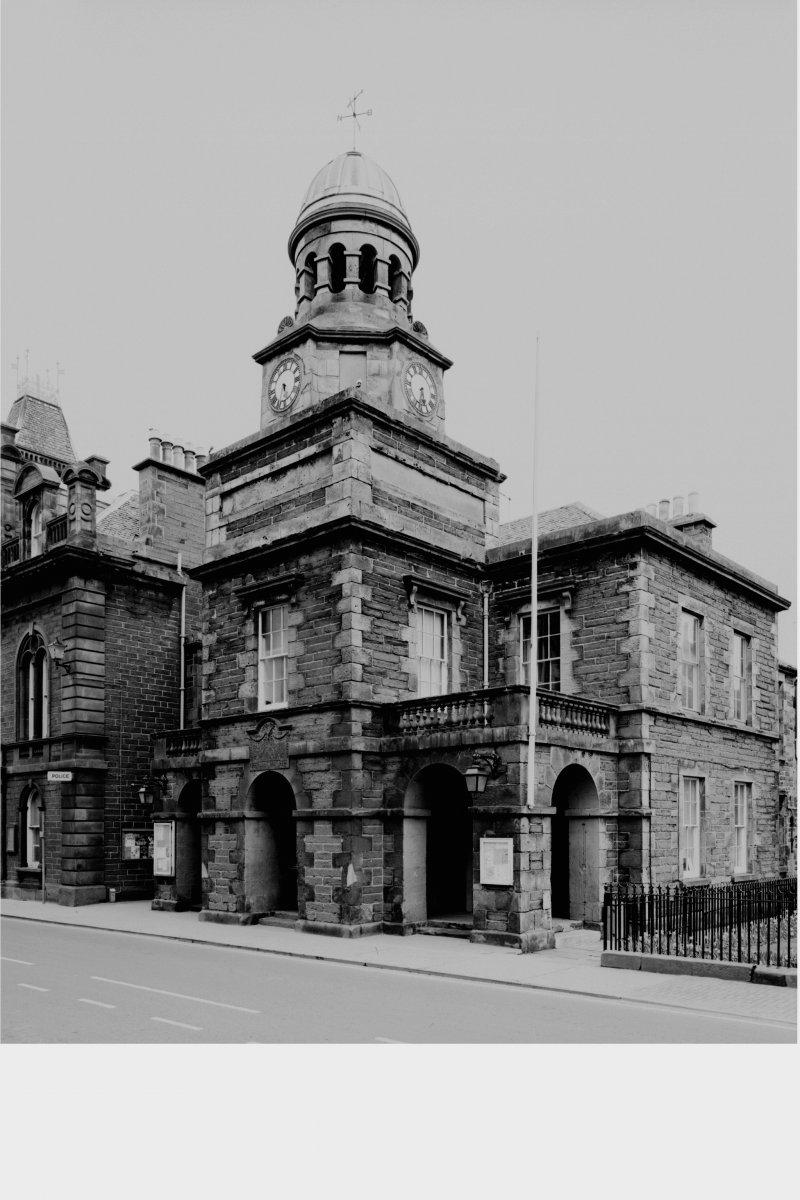
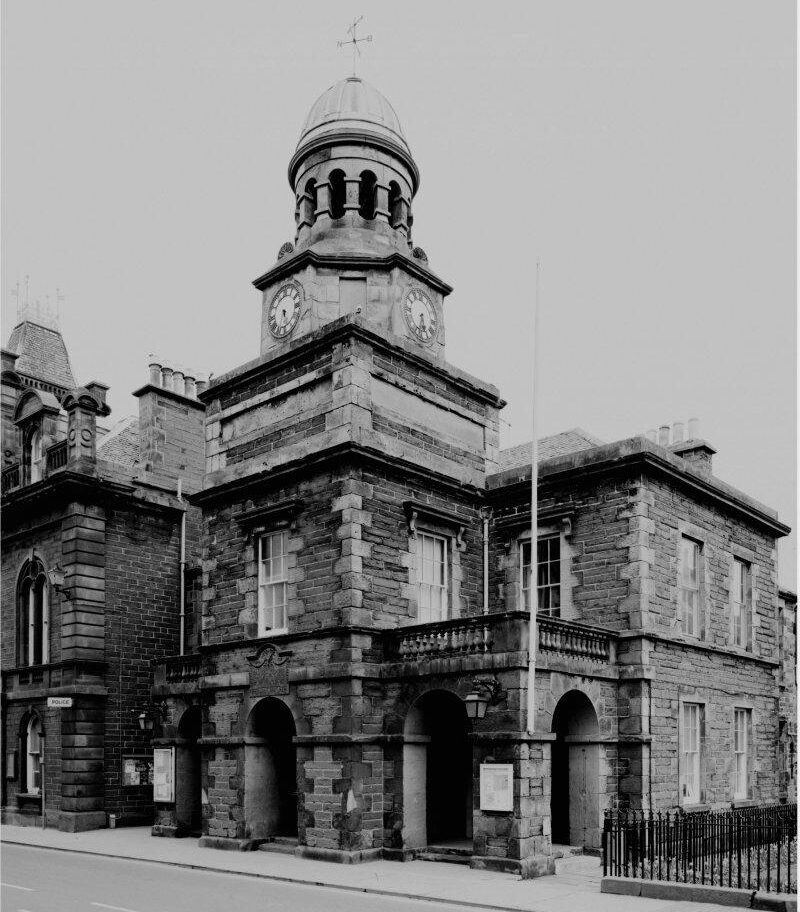
The former Royal Bank of Scotland at 1 Bridge Street, Wick, a monumental stone banking building whose clock tower still dominates the streetscape. The branch was part of the great retreat from physical banking in the Highlands. Photograph: Historic Environment Scotland / Trove.
A bank was a private company, certainly.
It was also part of the machinery of a town.
Its presence brought workers into the high street. Businesses deposited cash. Customers obtained help. Financial problems had a physical place where they could be taken. The building itself often occupied a prominent position because banking once considered visibility and permanence commercially valuable.
The new system distributes those functions elsewhere.
Cash may go through the Post Office. Advice may be obtained by telephone. Payments travel through an app. More complex matters may require a journey. A Banking Hub may restore a measure of personal service on particular days.
It may prove to be a perfectly workable settlement.
But it is not the system Scotland had.
In barely a decade, a country with one of the most recognisable banking traditions in the world has conducted a vast experiment in removing the physical bank from everyday life.
The experiment is still under way.
There are buildings across Scotland that retain the architecture of confidence long after the institution that commissioned it has gone.
They are the ghosts on the corner.
And beneath the arguments about apps, efficiency, cash and commercial freedom lies a quieter question that will probably take another decade to answer.
The banks say their customers left the branches. Scotland’s high streets tell the other half of the story. Technology moved fast, leaving behind those great old buildings… beautiful monuments built to promise permanence, suddenly without a purpose. The customers moved on. The banks moved out. The buildings remained, keeping watch over the towns they had served.
Search the Modern Scot Scotland Bank Access Database
Modern Scot’s developing national database brings together current bank branches, Banking Hubs, scheduled closures and individually researched historical closures across Scotland. The historical record is still being reconstructed. If you remember a branch that closed and believe it should be included — particularly if you have an old address, photograph, closure notice or other evidence — please contact Modern Scot.
https://modern.scot/scotland-bank-access/
The historical archive will continue to be expanded and corrected as additional branch-level evidence is recovered.
Sources
Which? — Bank branch closures: is your local bank closing?
https://www.which.co.uk/money/banking/switching-your-bank/bank-branch-closures-is-your-local-bank-closing-ayYyu4i9RdHy
House of Commons Scottish Affairs Committee — Access to cash in Scotland
https://publications.parliament.uk/pa/cm5803/cmselect/cmscotaf/80/report.html
House of Commons Scottish Affairs Committee — RBS branch closures inquiry
https://committees.parliament.uk/work/4697/rbs-branch-closures-inquiry/
Financial Conduct Authority — Helping people access cash
https://www.fca.org.uk/firms/access-to-cash
Financial Conduct Authority — PS24/8: Access to cash
https://www.fca.org.uk/publications/policy-statements/ps24-8-access-cash
Post Office — Banking Hubs
https://www.postoffice.co.uk/bankinghubs
Post Office — Everyday Banking
https://www.postoffice.co.uk/everydaybanking
Modern Scot — Scotland Bank Access
https://modern.scot/scotland-bank-access/