
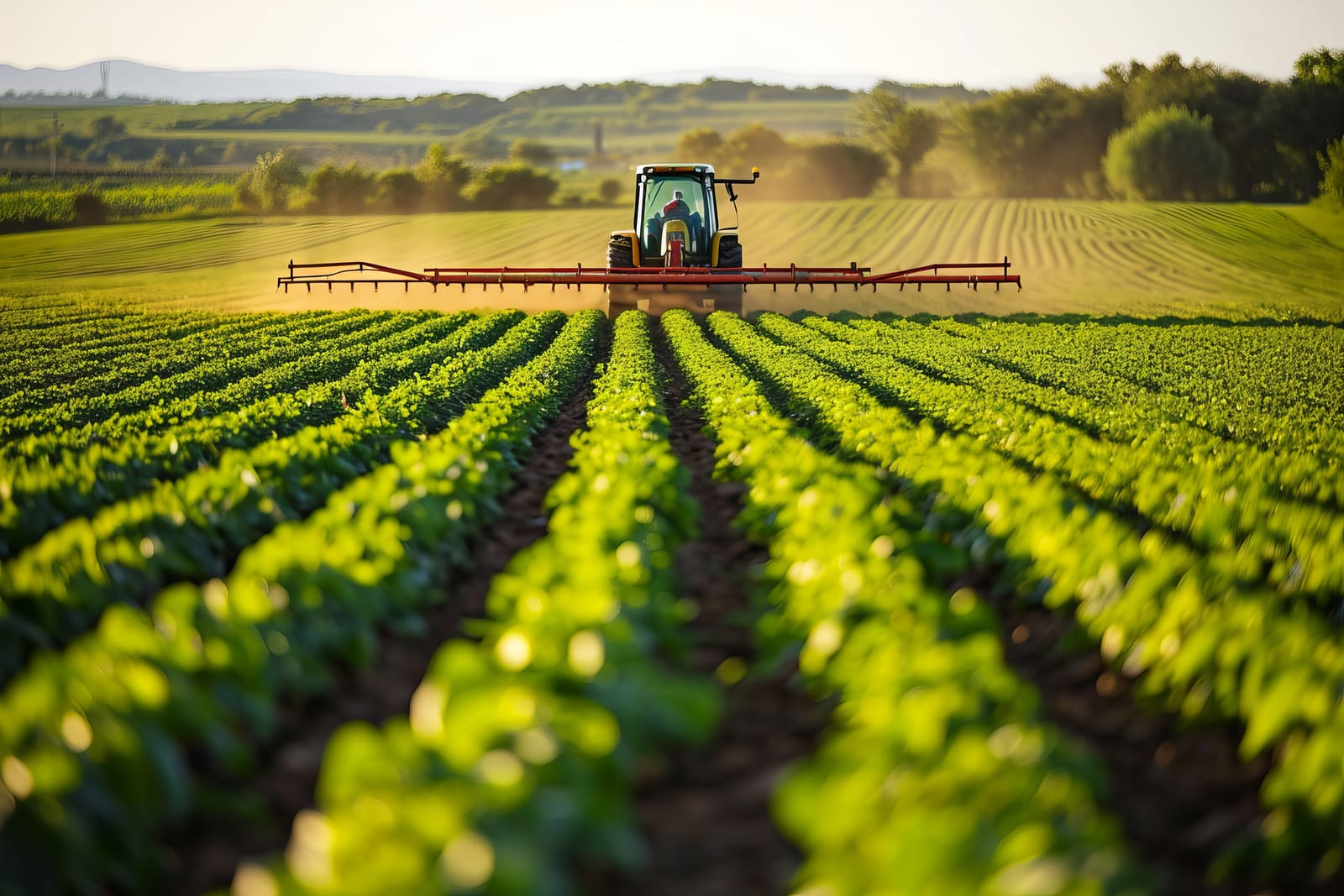
Almost every hectare of Scotland’s arable farmland received a pesticide treatment in 2024.
The country’s arable crops covered about 502,400 hectares. Once repeat treatments through the growing season were counted, from herbicides, fungicides, insecticides, growth regulators, seed treatments and others, pesticide applications amounted to just over five million treated hectares. Around 1,300 tonnes were applied.
Scotland can therefore estimate with considerable precision which substances farmers use, on which crops, in what quantities and how often. Ware potatoes receiving pesticide treatment averaged 13.5 applications. Seed potatoes averaged 10.7. Herbicides or desiccants reached 97 per cent of arable land; fungicides also reached 97 per cent.
The precision begins to diminish once the chemical has left the sprayer.
Scotland does not have an equivalent national census showing how much pesticide residue remains in agricultural soil. Its principal national air-quality network does not routinely measure pesticides. The latest comprehensive national survey showing what councils spray onto streets, paths, parks and other public ground records use in 2019.
Water is different.
There, Scotland has repeatedly found evidence of pesticides making the journey beyond the place where they were intended to work.
That journey — from field, pavement, pet or garden into soil, drain, burn, river and eventually a treatment works — reveals a much larger pesticide system than the familiar image of a tractor moving through a crop. It also exposes an unusual imbalance in Scotland’s environmental knowledge. The country knows a great deal about what is applied. It knows considerably less about what remains afterwards.
Five million treated hectares
The five-million-hectare figure does not mean Scotland somehow sprayed an area ten times larger than its arable land. It records repeated treatments.
A cereal field might receive a herbicide early in the season, followed by fungicides and a growth regulator. Potatoes may require repeated protection against diseases such as blight. One physical hectare can therefore appear many times in the treated-area statistics.
The Scottish Government’s 2024 survey estimated that 98 per cent of the country’s arable area received at least one pesticide treatment. The average treated arable field received four spray applications, excluding seed treatment, although use varied sharply by crop.
Spring barley dominates Scottish arable farming, accounting for more than half the area surveyed. Wheat represented another fifth.
Potatoes demonstrate how intensive crop protection can become. Ware potatoes receiving pesticide treatment averaged 13.5 applications and seed potatoes 10.7. Those figures describe pesticide operations rather than thirteen different highly toxic chemicals, and individual treatments can involve substances with very different risk profiles.
“Pesticide” itself covers a wide range of products: herbicides, fungicides, insecticides, molluscicides, nematicides, growth regulators, seed treatments and some biological and physical controls. A tonne of one substance cannot automatically be compared with a tonne of another. Toxicity, persistence, mobility through soil, effects on aquatic life and danger to non-target insects vary considerably.
Scotland’s pesticide story therefore cannot be understood from tonnage alone.
But neither can the scale be ignored.
The spraying does not stop at the farm gate
Scottish councils are substantial pesticide users in their own right.
The latest nationwide survey of council weed control is now old enough to create an information problem of its own. It records activity in 2019 and was published in 2022.
Twenty-seven councils, representing most of Scotland’s population, reported applying 15.2 tonnes of herbicide active substance. Almost 99 per cent by weight was glyphosate.
The chemicals were being used for familiar municipal work: controlling weeds pushing through pavements, vegetation around street furniture, invasive plants, roadside growth, parks and other public spaces.
Where councils specified the type of surface being treated, 55 per cent of herbicide applications were made to hard surfaces.
That changes the pathway a chemical can take.
On cultivated land, water can infiltrate soil. On concrete, paving and tarmac it may instead travel towards gutters, gullies and drainage systems.
Councils themselves were already trying to reduce chemical dependence. Every authority responding to the 2019 survey reported measures intended to minimise herbicide use, while environmental concerns were the leading reason given for adopting non-chemical methods. Three councils had prohibited or restricted glyphosate on some surfaces and another was reviewing its use.
Yet Scotland cannot currently answer a simple national question: how much herbicide are all 32 councils applying now?
Agricultural pesticide surveys continue to be refreshed.
The comparable national council weed-control figure remains anchored in 2019.
The pesticide network inside homes, farms and food stores
Councils also deploy rodenticides. A Scottish Government survey found that 27 local authorities used approximately 12.2 tonnes of rodenticide bait during 2023. The figure initially appears large, but almost all that weight was food material used to attract rats and mice. The active rodenticide contained in the bait amounted to less than one kilogram.
About 8.8 tonnes of bait was used in domestic settings. Councils also treated industrial and commercial premises and, in some areas, agricultural holdings on behalf of farmers. More than 99 per cent of the rodenticide products used by weight were based on second-generation anticoagulants, with bromadiolone the principal active substance.
These poisons create a different environmental pathway from crop sprays because the animal that consumes them can move. A poisoned rat or mouse may leave a building before it dies and subsequently be eaten by a fox, owl, buzzard or another scavenger. Anticoagulant residues can persist particularly in liver tissue, allowing the chemical to move through a food chain even though the predator never encountered the original bait.
Scottish wildlife surveillance has repeatedly detected anticoagulant rodenticides in non-target species. The problem is sufficiently established that rodenticide stewardship requires bait to be controlled, carcasses to be recovered where possible and exposure beyond the intended pest species to be minimised. Scottish Government reporting has also recorded the withdrawal of authorisation for second-generation anticoagulant rodenticides for some open-area uses after 2024.
The connection with food production is equally close.
In 2024 Scottish arable farms used an estimated 46 tonnes of rodenticide products, around 25 tonnes of them bromadiolone products. Ninety-two per cent of rodenticide bait by weight was grain-based, and farms using rodenticides were significantly more likely to have grain stores.
Bromadiolone is not authorised for application to food crops. Grain manufactured as poisoned bait is not grain intended for milling or human consumption, and rodenticides must be kept away from food and animal feed.
Those precautions exist because accidental transfer is possible.
Government guidance for livestock and poultry premises specifically warns against contamination of feedstuffs, animals and products such as eggs. Experimental research has also demonstrated that bromadiolone can pass into egg yolk when laying hens consume poisoned bait.
Scotland’s pesticide-poisoning records contain a more direct example of what can happen when those controls are deliberately ignored. In 2011 investigators examined an incident in which bread had been adulterated with blue bromadiolone-treated grain and left where a dog encountered it. The animal survived. It was recorded as deliberate misuse rather than normal pest control, but the case demonstrates how easily a rodenticide carried in edible grain bait can be moved into something that resembles ordinary food.
Domestic animals introduce another pesticide route altogether.
Many flea and tick treatments used on cats and dogs contain potent insecticidal substances. Among them are fipronil and imidacloprid, chemicals designed to remain effective on an animal’s skin or coat after treatment. Their usefulness against parasites also means residues can persist long enough to leave the animal through washing, bathing, contact with household surfaces or wastewater.
SEPA’s 2024 monitoring programme looked specifically for these compounds in Scottish waters.
Fipronil was detected at least once at 16 per cent of the surface-water locations sampled. Imidacloprid appeared at four per cent. The highest concentration of fipronil was measured in the Quhomery Burn, a tributary of the River Ugie in Aberdeenshire, while the highest imidacloprid concentration was recorded in the River Annan in Dumfries and Galloway.
Neither substance was detected in the 24 groundwater samples included in the programme.
Those detections do not establish that every residue originated with household pets. They do demonstrate that pesticidal chemicals associated with veterinary treatment are reaching Scottish rivers.
The route is fundamentally different from a tractor spraying a field. A cat treated inside a home, a dog washed after receiving flea medication, a poisoned rat leaving a building and a bait station beside a grain store all sit within the same larger chemical system.
Scotland’s pesticide use therefore does not end at the farm gate. It reaches cereal stores, livestock buildings, pavements, parks, kitchens, pets, drains and rivers — and in some cases continues moving after the original treatment has already done its job.
The river supplying Peterhead
The River Ugie flows through an intensively farmed part of Aberdeenshire before contributing raw water to the Forehill treatment works serving Peterhead and surrounding communities.
By 2011 the Drinking Water Quality Regulator considered the pesticide risk serious enough to require formal action from Scottish Water.
The regulator identified chlortoluron, isoproturon, 2,4-D, linuron, MCPA, MCPP, metazachlor and metaldehyde among the substances capable of threatening compliance with the drinking-water standard.
Individual pesticides in drinking water are subject to a prescribed concentration of 0.1 micrograms per litre.
Nine pesticide exceedances were recorded nationally during 2011, most associated with the Forehill supply. The regulator attributed the contamination to pesticides entering the Ugie from intensive agricultural activity in the catchment.
Scottish Water initially worked with farmers and others to reduce losses from land.
Eventually, treatment had to change as well.
A granular activated-carbon stage was introduced at Forehill in 2014 specifically to improve pesticide removal. A regulatory inspection the following year described it as successful.
Later Scottish research still found metaldehyde above the 0.1 microgram-per-litre threshold in raw water from both the Ugie and the Deveron.
The significance lies in the word raw.
The presence of pesticides in a river supplying drinking water does not mean consumers were routinely being supplied unsafe water. Treatment sits between catchment and tap.
Scotland’s public drinking-water performance remains exceptionally high. In 2025, 137,947 regulatory tests were undertaken at consumers’ taps and 99.88 per cent met the required standards.
The Ugie story demonstrates something different.
A pesticide can be legally applied to land, leave its intended location, enter a river, reach a drinking-water intake and require additional infrastructure to remove it before the water reaches a home.
The cost of pesticide use therefore does not necessarily remain with the person applying it.
Some of that cost can travel downstream.
What happens in soil
Water is only one route.
Once a pesticide reaches a field, several things can happen. Some substances break down comparatively quickly, while others bind to clay or organic matter and remain in the soil for longer. More mobile compounds can dissolve in water and move down through the soil profile, while substances attached to soil particles can leave a field with eroded sediment.
The outcome depends on the chemistry of the pesticide, soil type, rainfall, temperature and the interval between application and subsequent weather.
Scotland has considerable information about soil condition, but its own national soil programme acknowledges that important monitoring gaps remain.
The State of Scotland’s Soil work identified a lack of systematic monitoring capable of describing all the pressures affecting Scottish soils and their consequences. Subsequent programmes have sought to develop a national monitoring framework, but no simple nationwide pesticide-residue dataset exists comparable with the government’s detailed surveys of pesticide application.
That creates an unusual asymmetry.
Scotland can estimate that approximately 1,300 tonnes of pesticide were applied to arable crops in a particular year. It cannot produce an equally comprehensive number for the pesticide residues remaining across Scotland’s agricultural soils afterwards.
Those figures would never be expected to match. Many substances degrade, and residues depend on timing, soil type, rainfall, microbial activity and chemistry.
But the difference between measuring application and measuring environmental presence is fundamental.
Scotland is much better at the first.
The air is an even larger blind spot
Pesticides can also leave their intended targets through the air.
Fine spray droplets can travel with wind. Dust can move beyond the application area. Some substances can volatilise after treatment. Wind speed, nozzle height, droplet size, temperature and atmospheric conditions can all influence the distance travelled.
Operators are required to minimise off-target movement, and product authorisations can specify conditions governing application, buffer zones and spraying methods.
Yet Scotland’s principal national air-quality monitoring network measures pollutants such as nitrogen dioxide, particulate matter, ozone, sulphur dioxide and carbon monoxide. Pesticides are not part of the routine pollutant suite presented through that network.
That does not establish widespread pesticide contamination of Scottish air. It means the national system used to tell the public what is in Scotland’s air is not designed to answer that question.
There is therefore no comparable nationwide public dataset showing concentrations of agricultural and amenity pesticides in the air across rural Scotland.
The absence of measurements cannot be treated as evidence that residues are present at harmful levels.
Neither can it demonstrate that they are absent.
Legal does not mean immobile
Approval is another point at which public understanding can become muddled.
A pesticide authorised for use in Great Britain has passed a regulatory process assessing whether specified uses meet legal requirements.
It does not follow that the substance is harmless under every condition.
Authorisation can govern the crop, concentration, number of treatments, timing, equipment, operator protection, environmental precautions and distances from sensitive areas. Using an authorised product outside those conditions is unlawful.
But the fact that a farmer or council worker complied with an authorisation does not create an invisible wall around the treated ground.
Chemicals remain subject to rain, wind, drainage, soil chemistry and biology.
That is why drinking-water monitoring, environmental-risk assessments, restrictions on application and buffer zones exist in the first place.
Glyphosate illustrates the difference between approval and permanence particularly clearly.
It remains approved in Great Britain, but its approval has been extended only until 15 December 2026 while the Health and Safety Executive carries out a full renewal assessment using updated scientific, technical and regulatory evidence.
The process considers human toxicology, operator exposure, consumer exposure, environmental fate and effects on non-target organisms.
Its current legal status therefore does not guarantee its future status.
Regulation changes as evidence changes.
Scotland has committed to reducing pesticide pressure
The governments of Scotland, England, Wales and Northern Ireland published a new Pesticides National Action Plan in March 2025.
Its headline target is not a simple ten per cent reduction in tonnes sprayed.
Instead, the governments adopted a Pesticide Load Indicator incorporating 20 measures intended to describe environmental pressure, including toxicity to different organisms and persistence in the environment.
Each indicator is intended to fall by at least ten per cent by 2030 from a 2018 baseline.
The approach recognises a basic flaw in measuring pesticide policy solely by weight.
Removing a large volume of a relatively low-risk substance could produce an impressive tonnage reduction while doing less environmental good than reducing a much smaller quantity of a highly persistent or ecologically damaging substance.
Scotland is also attempting to expand Integrated Pest Management, in which crop rotation, monitoring, resistant varieties, mechanical approaches and biological controls are used to reduce dependence on chemical intervention.
That transition is already visible in parts of Scottish horticulture.
But the national target also exposes another imbalance.
Government can calculate changing pesticide pressure most confidently where it already possesses strong usage statistics.
The further the system moves away from commercial agriculture, the less comprehensive the national picture becomes.
Sources
Scottish Government, Pesticide Usage in Scotland: Arable Crops and Potato Stores 2024, 29 October 2025.
https://www.gov.scot/publications/pesticide-usage-scotland-arable-crops-potato-stores-2024/
Scottish Government, Pesticide Usage in Scotland: Local Authority Integrated Weed Control Survey 2019, 16 March 2022.
https://www.gov.scot/publications/pesticide-usage-scotland-local-authority-integrated-weed-control-survey-2019/
Scottish Government, Pesticide Usage in Scotland: Rodenticide Use by Local Authorities 2023, 12 March 2025.
https://www.gov.scot/publications/pesticide-usage-scotland-rodenticide-use-local-authorities-2023/
Scottish Government, Pesticide Usage in Scotland: Rodenticides on Arable Farms 2024, 2025.
https://www.gov.scot/publications/pesticide-usage-scotland-rodenticides-arable-farms-2024/
Scottish Government, Pesticide Poisoning of Animals in Scotland 2011, Wildlife Incident Investigation Scheme, 2011.
UK Government, Code of Practice: Prevention and Control of Rodent Infestations on Poultry Farms, current guidance.
https://www.gov.uk/government/publications/code-of-practice-prevention-and-control-of-rodent-infestations-on-poultry-farms
European Food Safety Authority, Review of the Existing Maximum Residue Levels for Bromadiolone, 2020.
https://pubmed.ncbi.nlm.nih.gov/32625497/
Scientific study, Bromadiolone Residues in Eggs Following Exposure of Laying Hens, 2010.
https://pubmed.ncbi.nlm.nih.gov/20875232/
Scottish Environment Protection Agency, Water Quality Monitoring 2024: Pet Treatments, current publication.
https://beta.sepa.scot/topics/chemicals/water-quality-monitoring-2024-pet-treatments/
Drinking Water Quality Regulator for Scotland, Forehill Supply Zone — Undertaking under the Water (Scotland) Act 1980, May 2011.
https://dwqr.scot/media/xqdjgmti/forehill-supply-zone-peterhead-may-2011.pdf
Drinking Water Quality Regulator for Scotland, Annual Report 2011.
https://dwqr.scot/media/uj4kzbio/dwqr-annual-report-2011.pdf
Drinking Water Quality Regulator for Scotland, Technical Inspection of Forehill Water Treatment Works, March 2015.
https://dwqr.scot/media/l4yfcb2t/forehill-wtw-aberdeenshire-march-2015.pdf
Scottish Government / Drinking Water Quality Regulator, Drinking Water in Scotland 2025, 27 August 2026.
https://www.gov.scot/news/drinking-water-in-scotland-2025/
Plant Health Centre, Assessing the Impact of Metaldehyde Withdrawal in Scotland, 2018.
https://www.planthealthcentre.scot/sites/www.planthealthcentre.scot/files/2019-02/phc2018_02_project_report_-_metaldehyde_withdrawal_0.pdf
Scotland’s Soils, Soil Monitoring, current guidance.
https://soils.environment.gov.scot/soils-in-scotland/soil-monitoring/
Scottish Air Quality, Pollutant Coverage of the Air Quality Scotland Network, current data.
https://www.scottishairquality.scot/data/sos/pollutants
Health and Safety Executive, Active Substance Renewal: Glyphosate, current as September 2026.
https://www.hse.gov.uk/pesticides/active-substances/glyphosate-renewal.htm
UK Government, Scottish Government, Welsh Government and Northern Ireland Executive, UK Pesticides National Action Plan 2025, 21 March 2025.
https://www.gov.uk/government/publications/uk-pesticides-national-action-plan-2025