
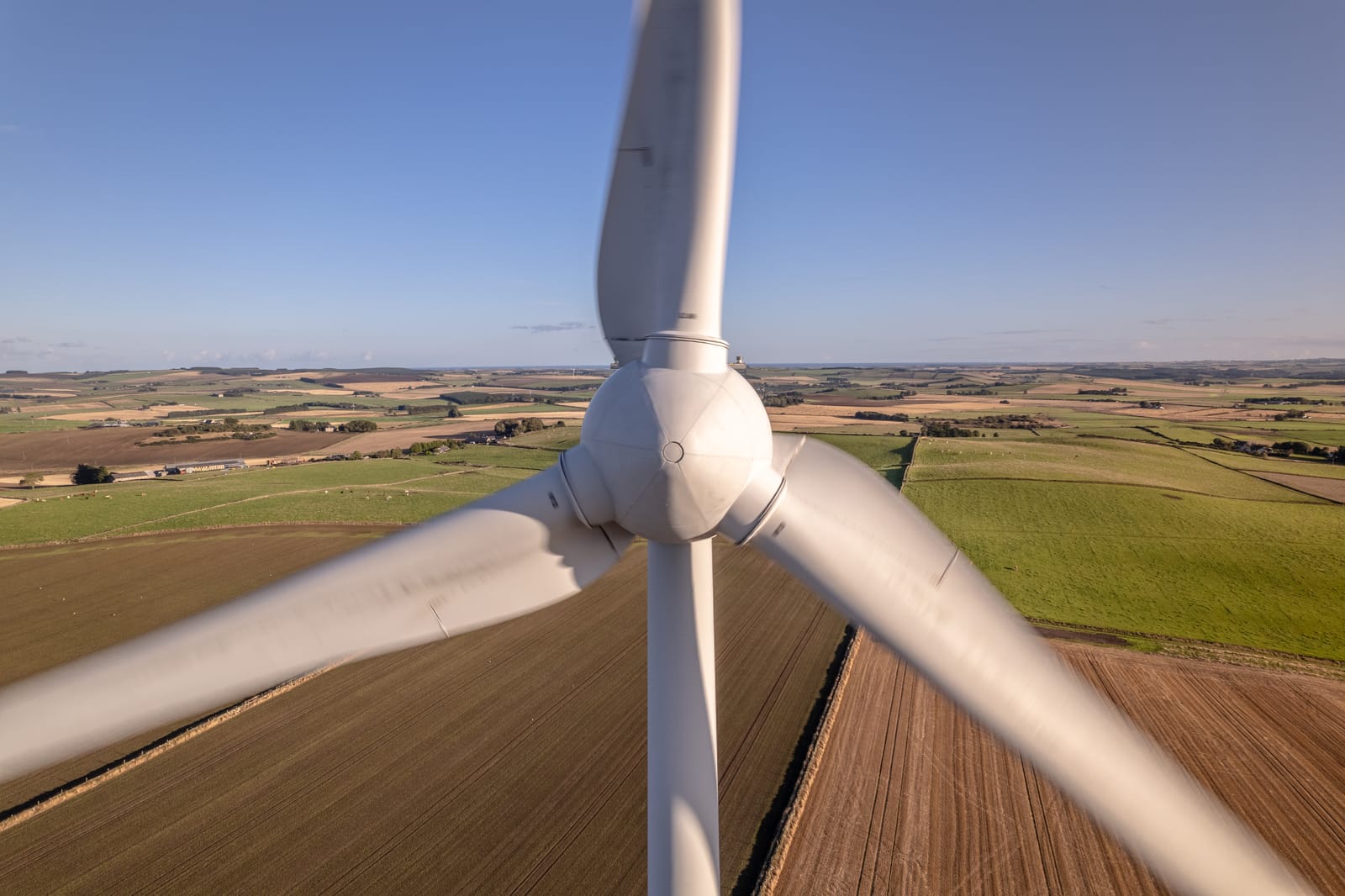
New figures say Scotland’s net zero economy supports more than 105,000 jobs and contributes £10.2 billion in economic value. Those numbers matter, but they do not answer the harder Scottish question: who owns, controls and benefits from the energy system being built around the country? The BBC’s report on Scotland’s green economy is not wrong, but it is incomplete. A serious Scottish reading must look beyond the jobs figure and ask whether Scotland is gaining lasting power from the new energy economy, or simply hosting more of the infrastructure on which others depend.
Scotland’s green economy is real. That should be said plainly. Scotland’s coal industry was real too, and its history should make the country cautious about energy figures presented without questions of ownership and control. For generations, Scottish colliers, coal bearers and salters were held in a legal condition described at the time as “slavery or bondage”, bound to coal mines and salt works and, in some cases, transferred with them when the works were sold. The 1775 legislation began to dismantle that system, but full liberation did not come until 1799. It is a hard Scottish memory: an energy industry can be real, productive and nationally important while the people and communities inside it remain trapped by a system they do not control.
New analysis commissioned by the Energy and Climate Intelligence Unit, with work by CBI Economics and The Data City, says net zero related industries in Scotland now support more than 105,000 jobs and contribute £10.2 billion in Gross Value Added. The same research says the sector represents 4.9 per cent of Scotland’s economic output and involves around 3,000 businesses, most of them small and medium sized firms.
Those figures are significant. They show that Scotland’s energy transition is not merely a promise about some distant industrial future. It already includes renewable generation, hydro, offshore wind, transmission infrastructure, solar installation, heat pumps, engineering, consultancy, manufacturing and local firms trying to build practical businesses around lower carbon systems.
But figures can be true and still leave out the central issue. The question for Scotland is whether Scotland owns enough of the system, trains enough of its people, captures enough of the value and has enough control over the rules that shape the energy economy being built around it.
Scotland can produce power and still lack power. It can host turbines, hydro schemes, pylons, substations, converter stations, ports and cables, while the commanding decisions sit elsewhere. It can provide the landscape, the wind, the water and the communities asked to live beside the infrastructure, while much of the ownership, regulation, pricing and long term return is decided through a wider Great Britain system.
This is not an argument against the green economy. It is an argument against treating the green economy as a comforting headline. Scotland has heard comforting energy stories before. Hydro transformed the Highlands. Oil transformed Aberdeen. Renewables may now transform the country again. But history shows that an energy boom does not automatically produce lasting national security, fair household bills, strong local communities or durable Scottish ownership.
The historical lesson is visible in the very landscape often used to illustrate Scotland’s renewable strength. The Hydro Electric Development Scotland Act 1943 created the North of Scotland Hydro Electric Board, whose purpose was to bring electricity to the north and develop generation across the Highlands. Scotland’s hydro story was not born as a branding exercise. It was part of a public mission to modernise places that had long been treated as remote.
Loch Mullardoch is a useful reminder. Historic Environment Scotland records Mullardoch Dam as the largest dam built by the North of Scotland Hydro Electric Board, 727 metres long and 48 metres high. The Highland landscape has carried Scotland’s electricity ambitions for generations, long before today’s net zero vocabulary arrived.
Scotland’s modern renewable output is also substantial. Scottish Government statistics show that Scotland generated a record 38.5 TWh of renewable electricity in 2025. In 2024, renewables made up 73.1 per cent of electricity generated in Scotland, while low carbon generation, including nuclear and pumped storage, accounted for 91.5 per cent.
A country producing large volumes of low carbon electricity should be able to ask why households still face punishing bills, why communities hosting infrastructure do not always see clear local reward, and why Scottish energy abundance does not automatically translate into Scottish energy security.
The Scottish Government has previously described the interaction between devolved policy and the reserved regulation of energy networks as increasingly complex. It has targets for decarbonisation and fuel poverty, but the regulation of gas and electricity networks sits within a reserved and Great Britain wide structure.
That means many of the decisive levers are not held wholly in Scotland. The Scottish Parliament has planning, consenting, economic development and heat policy responsibilities, but electricity market regulation, gas and electricity supply, and the wider network price control framework are not simply Scottish instruments. Scotland may host the assets, but the system is not arranged as a Scottish national energy system.
This is where the BBC framing needs to be widened. To say Scotland’s green economy supports 105,000 jobs is useful. To say it contributes £10.2 billion is useful. But the public also needs to know who owns the generating assets, who owns the transmission infrastructure, who receives the regulated return, who pays for network expansion through bills, and how much of the £211 billion investment pipeline will become Scottish industrial strength rather than merely Scottish construction activity.
The investment pipeline is enormous. Reporting on the CBI Economics research says Scotland is associated with about £211 billion of planned energy infrastructure investment, around a third of the UK total. That could bring jobs, contracts and training. It could also intensify the old problem of Scotland being rich in resources while others design the terms on which those resources are used.
The regional pattern is important. Perth and Kinross is identified as a hotspot, with hydro and onshore wind forming part of the local economic picture. Aberdeen is linked to offshore wind, hydrogen, carbon capture and the transition from oil and gas. East Lothian is tied to transmission infrastructure and specialist manufacturing. These places are where the new energy economy will shape land, work, housing, transport, skills and local expectations.
Oil and gas workers facing uncertainty cannot be dismissed as yesterday’s story. The transition must not become a tidy spreadsheet in which one set of jobs is waved away and another is announced in a different column. Offshore energy has supported skilled work, local economies and family livelihoods in Scotland for decades. If net zero is to command trust, it must show how skills are transferred, wages protected and communities sustained, not merely how a national total can be made to look reassuring. That means Scottish firms in the supply chain, Scottish apprenticeships linked to real work, and colleges aligned with the jobs actually being created.
It also means scrutiny of ownership. A job located in Scotland is good. But a Scottish owned company, a Scottish controlled asset, a Scottish training route and a durable Scottish industrial base are even better. If Scotland hosts the wind, the water, the grid routes and the disruption, but sees ownership and returns flow elsewhere, the country will have gained activity without gaining enough power.
None of this requires party politics. It is a civic question for every Scot. Households in Aberdeenshire, East Lothian, Perthshire, the Highlands and Glasgow all pay bills. All need secure infrastructure. All need jobs for young people. All have an interest in whether Scotland’s energy future is being built for Scotland as well as through Scotland.
The green economy is welcomed where it brings skilled work, useful investment and cleaner power. But Scotland should not be expected to applaud every number without asking who owns it? Who controls it? Who pays for it? Who profits from it? Who carries the disruption? Who gets the long term benefit?
The BBC report is right that Scotland’s green economy is now significant. But significance is not sovereignty, and activity is not the same as control. Scotland has a real green economy. What it does not yet have is a power system clearly owned, governed and priced in a way that guarantees Scotland will be one of its principal beneficiaries.
That is the story beneath the BBC headline. Scotland is not short of energy. It is short of certainty that the value created from its energy future will remain rooted in the country that makes so much of it possible.