
A 16-year-old girl was seriously sexually assaulted in Springburn Park on the evening of 26 June. Police Scotland later arrested and charged a 36-year-old man in connection with the attack. He appeared at Glasgow Sheriff Court on 6 July, made no plea and was remanded in custody. He was expected to return to court within eight days.
That was not an online invention. It was not a misunderstanding created by social media or an abstract argument about immigration. A girl was attacked in a public park, and people living in the surrounding community were entitled to be angry.
Protests and disturbances subsequently spread through parts of Glasgow, including Royston, Cranhill and Castlemilk. Some gatherings followed genuine criminal allegations. Others were directed towards addresses circulated online without adequate verification. Police said an innocent person was targeted through mistaken identity in Castlemilk. Five officers were injured across three disturbances, and arrests were made over alleged attacks on police.
Violence against officers, threats towards innocent residents and the publication of unverified private addresses cannot be defended as lawful protest. A crowd cannot determine guilt, and a person’s appearance, name or presumed nationality cannot substitute for evidence.
It would be equally dishonest, however, to describe Glasgow’s anger principally as a product of misinformation or racism. The anger is rooted in a documented rise in sexual violence and a growing belief that the institutions responsible for public protection are not providing either safety or a complete account of what is happening.
Scotland recorded 16,430 sexual crimes in 2025–26. At least 32 per cent involved a victim under 18. Recorded rape and attempted rape rose by 11 per cent in one year, from 2,897 to 3,229, and by 72 per cent over ten years. The total is now at its highest recorded level since 1971. Of the offences recorded under the current sexual-offences legislation, 95 per cent had female victims.
The figure must be stated accurately. It does not mean that 32 per cent of girls in Glasgow have been raped, nor is it a Glasgow-only measure. It means that at least 32 per cent of all sexual crimes recorded across Scotland involved someone under 18. The Scottish Government says that the precise age of the victim cannot generally be established from the national data supplied by Police Scotland.
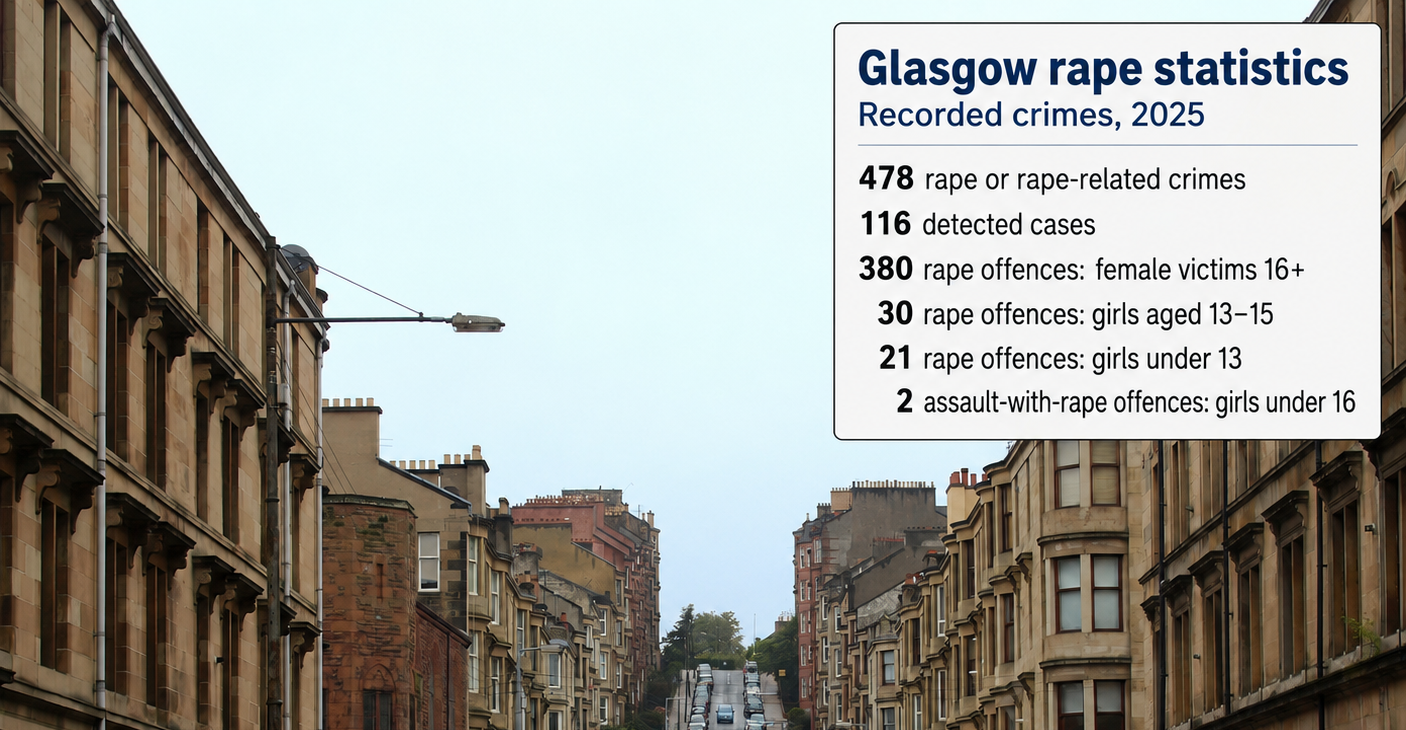
The Glasgow figures that are available are grim enough without exaggeration. A Police Scotland freedom-of-information disclosure recorded 478 rape or rape-related crimes in Greater Glasgow during 2025. Of those, 116 were detected, meaning that an accused had been identified and police considered there to be sufficient evidence for possible criminal proceedings.
Within the core rape classifications, the table recorded 380 rapes involving female victims aged 16 or over, 30 involving girls aged 13 to 15 and 21 involving girls under 13. It separately recorded two further assault-with-rape offences involving girls under 16. These are recorded crimes, not population percentages, and a detected offence is not the same as a conviction. They nevertheless provide a clearer picture than the vague national language usually offered when public concern reaches boiling point.
The wider rise in rape cannot honestly be attributed entirely to immigration. Scottish Police Authority analysis found that more than half of reported rape crimes had a domestic element, commonly involving a partner or former partner. Recent rapes remained the largest category, while rape of women aged over 16 had risen by 41.8 per cent between 2019–20 and 2024–25. Sexual violence in Scotland is therefore broader than stranger attacks or offending by recent arrivals.
That wider truth does not remove the public’s right to ask about crimes committed by foreign nationals, asylum seekers or people without lawful immigration status. Those are legitimate questions, particularly when particular cases have become linked to migration and when communities believe that information is being withheld.
Police Scotland’s 2025 Glasgow disclosure listed 43 accused records as British and 12 under identified non-British nationalities. In 62 cases, nationality was not recorded or was listed as unknown. More than half of the entries therefore supplied no usable nationality information.
A separate disclosure concerning rape accusations in Greater Glasgow during 2024 recorded accused people across several ethnic categories, including White Scottish, Other White British, Asian, African and other groups, with 28 records lacking ethnicity. That table cannot establish immigration status, and neither disclosure links the accused person’s nationality or ethnicity to the victim’s ethnicity.
The claim that official figures prove an increase in rape by immigrants against white women cannot presently be substantiated from Scotland’s published data. The necessary linked information is not routinely published. That does not prove the concern is imaginary. It shows that government has failed to collect or release the information needed to test it properly.
Ethnicity, nationality and immigration status are not interchangeable. A foreign national may have lived lawfully in Britain for decades. An asylum applicant is not automatically in the country illegally. A British citizen may belong to any ethnic group. Public debate becomes less truthful when these categories are collapsed into one another, but it also becomes less truthful when officials use statistical deficiencies to avoid answering legitimate questions.
The Scottish Government acknowledged in a 2025 freedom-of-information response that it held no information on recorded offences committed by people without legal immigration status after arriving in Scotland. It also held no information about such individuals’ criminal convictions in their countries of origin.
That is an institutional failure shared across government.
Immigration, asylum, border control and removal are reserved to the UK Government. Policing, justice, health, education, housing and social services are largely devolved. Glasgow City Council has responsibilities involving child protection, social work, schools, community safety, public spaces and support for people affected by violence. The powers are divided between institutions, but a girl walking through a Glasgow park does not experience public administration in constitutional compartments. She experiences whether she is safe.
The UK Government is responsible for knowing who has entered the country, on what legal basis, whether identity and security checks have been completed, and what happens when a foreign national is convicted of a serious crime. It should provide Scottish authorities with reliable immigration-status information and explain clearly when deportation is legally available, pursued, delayed or prevented.
The Scottish Government cannot respond to every question about offender nationality by observing that immigration is reserved. Policing, criminal-justice policy, victim services and the quality of Scottish crime data sit within devolved government. It should be possible to publish annual figures distinguishing accused people from convicted offenders, nationality from immigration status, and recent arrivals from long-established residents, while preserving the identities of victims and respecting due process.
Glasgow City Council cannot police the border or direct criminal prosecutions. It can be judged on local safeguarding, social-work capacity, school protection, lighting and maintenance of public spaces, support for victims, community communication and whether credible concerns are addressed before rumours take their place.
The contrast with the political energy devoted to online child safety is difficult to ignore. The UK Government has announced that children under 16 will be prevented from using certain social-media services from spring 2027. Platforms will be expected to operate stronger age-assurance systems, while livestreaming and communication with strangers will be restricted for older teenagers. Ministers have presented the programme as decisive action to protect childhood.
Online exploitation, abuse and manipulation are real and require intervention. Children do not, however, exist only online. They also inhabit parks, streets, schools, buses, housing estates and town centres.
Government appears capable of designing a national system intended to verify the age of every child attempting to access a social-media platform. Yet the public cannot obtain a routine Glasgow table showing how many girls under 16 were raped or seriously sexually assaulted, how many cases led to charges, how many reached court, how long proceedings took, how many accused were repeat offenders, or what immigration action followed a conviction where relevant.
There is no comparable ministerial timetable promising that girls will be safer in public places by spring 2027. There is no equivalent national announcement explaining what measurable reduction in rape will be achieved, who will be accountable if it is missed, or what immediate intervention follows when the figures continue to rise.
It would be wrong to claim that police officers, social workers, health professionals and specialist charities have no interest in protecting girls. Many work daily with victims in distressing circumstances. The failure lies at the level of political priority, institutional coordination, resources, transparency and measurable outcomes.
The answer is not to abandon online protection. It is to apply the same determination to the physical world.
Lawful protest remains part of a free society. Glasgow residents have the right to demand safer streets, stronger policing, honest immigration information and effective action against sexual offenders. That right does not extend to attacking officers, intimidating families or deciding guilt through social-media speculation.
Government also has obligations. It cannot use the existence of false rumours to dismiss the genuine crimes that preceded them. A mistaken address does not make the underlying sexual violence imaginary. The presence of racists at a gathering does not mean that every parent asking why girls are unsafe is motivated by race.
Women and girls must not become incidental figures in a political contest over immigration. Their protection must not depend on whether an offender belongs to a category that one side wishes to emphasise or another wishes to avoid.
The standard should remain the same: investigate serious allegations promptly, prosecute where the evidence permits, remove dangerous offenders from the public, deport foreign offenders where the law provides for it, publish honest information and protect innocent people from collective blame.
Glasgow’s anger did not begin with an online rumour. It began with women and girls being attacked, with recorded rape reaching its highest level in more than half a century, and with institutions that still cannot provide the public with a complete account of who is offending, what happens afterwards and why the numbers continue to rise.
A government that promises to protect children from strangers online must show equal resolve when the danger is waiting in a park.
Sources
Police Scotland, “Man arrested and charged in connection with serious sexual assault in Springburn Park, Glasgow”, July 2026.
Scottish Government, Recorded Crime in Scotland 2025–26, June 2026.
Police Scotland, FOI 26-0040, “Crime Stats — Sexual/Rape — accused nationality — Glasgow — 2025”, March 2026.
Police Scotland, FOI 25-0272, “Crime stats — Rape — ethnicity of suspects including Glasgow — 2024”, June 2025.
Scottish Police Authority, “Deep Dive Analysis of Rape and Sexual Crime”, March 2025.
Scottish Government, “Illegal immigration and crime statistics: FOI release”, December 2025.
UK Government, “New rules to protect children online”, July 2026.
The Guardian, “Police warn about protest misinformation amid Glasgow disorder”, 10 July 2026.