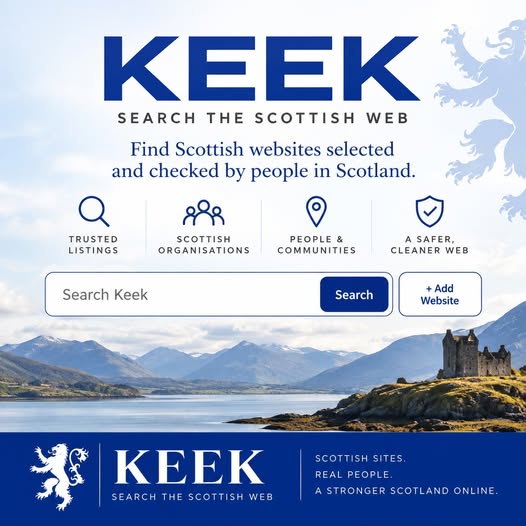
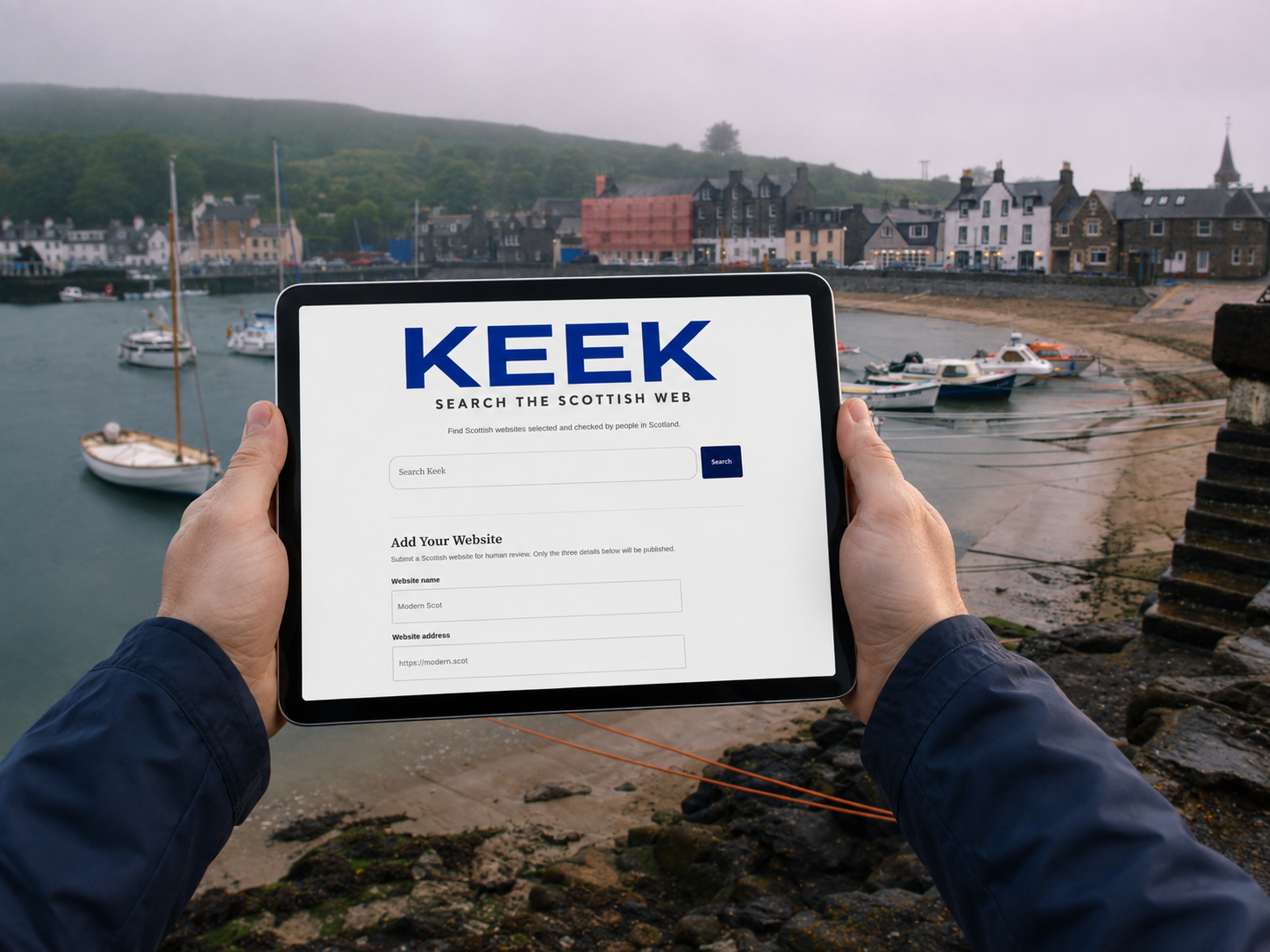
Modern Scot has launched the beta version of KEEK, a human-reviewed search engine for Scottish websites built without paid rankings, sponsored placement or hidden adjustments intended to favour one business over another.
Scotland has thousands of independent businesses, community organisations, visitor attractions, cultural institutions and specialist services. Many are valuable within their own places and sectors, yet remain remarkably difficult to find online.
Modern Scot has launched KEEK in response to that problem.
Now available in beta at modern.scot/keek, KEEK is a search engine created specifically for the Scottish web. It has been designed to help residents and visitors find genuine Scottish businesses, organisations, services and destinations without requiring those websites to compete against global companies, paid placements and ranking systems that are neither visible nor easily understood.
The principle behind it is straightforward: Scotland deserves a better way to be found online.
Modern Scot believes the dominant search model has failed to serve Scotland as clearly or fairly as it should. A person searching for a local business can be shown national chains, commercial intermediaries, sponsored pages or results selected through complex algorithms whose priorities are not disclosed to the public. Smaller Scottish organisations may exist only a few miles from the person searching and still appear far below larger businesses with greater budgets and more sophisticated search-engine marketing.
KEEK takes a different approach.
It does not sell ranking positions. It does not accept payment in exchange for appearing higher in the results. Businesses will not be able to purchase prominence over other relevant Scottish organisations, and listings will not be quietly rearranged to reward whoever has spent the most.
Modern Scot considers that form of “pay to play” visibility ethically difficult to justify. Search results shape where people spend money, what places they visit and which organisations they discover. When those results are altered by commercial payments or opaque ranking decisions, users are not always seeing the clearest answer to their question. They are seeing an output shaped by a system whose incentives may be different from their own.
KEEK is being built around relevance, clarity and human review instead.
Every public listing contains three basic pieces of information: the name of the business or organisation, its website address and one sentence explaining what it does or the mission it serves. Those entries are checked by a person before they are approved.
Human review does not mean that KEEK will attempt to judge which Scottish business is “best”. It means that listings can be checked to establish that the website exists, that the organisation has a genuine connection to Scotland and that its description is reasonably accurate, useful and free from misleading promotional claims.
The search engine is intended for businesses, charities, public bodies, cultural organisations, community groups, visitor attractions, accommodation providers, independent retailers, trades, professional services and other websites with a clear and meaningful connection to Scotland.
It is not intended for spam pages, copied directories, placeholder websites, thin affiliate sites or businesses attempting to use multiple duplicate entries to dominate the results.
The aim is to create a practical index of Scottish online life rather than another advertising marketplace.
That distinction could be particularly useful in rural and island communities, where local services are often spread across wide areas and may not have large digital-marketing budgets. A family-run guest house, regional museum, village shop, croft business, independent bookshop or local tour provider may offer exactly what a user needs while remaining almost invisible within conventional search results.
Visitors face a similar problem. Someone planning a trip to Scotland may wish to find locally owned accommodation, independent food businesses, cultural venues or activities connected to the place they are visiting. Instead, search can repeatedly direct them towards the same booking platforms, international operators and heavily promoted destinations.
KEEK is intended to make Scotland’s smaller and more distinctive websites easier to discover directly.
The service remains in beta, which means it is still being populated, tested and refined. It should not yet be treated as a complete record of every Scottish website. The beta allows Modern Scot to examine how people search, identify gaps and improve the way results are presented before the full launch.
The search engine currently sits within Modern Scot at modern.scot/keek, but the completed service is expected to move to its own dedicated domain. That will allow KEEK to develop as a distinct Scottish search platform while retaining the principles established during the beta.
The directory will grow substantially over the coming days. Around 4,600 businesses and organisations receiving Modern Scot’s weekly newsletter are to be added automatically on a rolling basis. Their inclusion will be free.
Other Scottish organisations do not need to wait to be added.
A submission form is available on the KEEK page. Applicants are asked to provide only their website name, website address and one sentence explaining the purpose or mission of the organisation. Those are the three details intended for publication.
The sentence should tell users what the organisation actually does. It need not be a slogan, sales pitch or collection of search terms. A clear description such as “An independent bookshop and café serving the Scottish Borders” is more useful than a paragraph filled with promotional claims.
Submissions are reviewed before publication. Inclusion is not automatic, and submitting a website does not create a right to appear. Modern Scot may decline entries that have no meaningful Scottish connection, contain misleading information, duplicate an existing listing or appear to have been created primarily to manipulate search results.
There is no charge to submit a website and no fee for inclusion.
KEEK’s ranking system is intended to remain understandable. Results should respond to the words entered by the user and the information contained in the approved listing. Relevant results may also be ordered using basic factors such as how closely the business name or description matches the search.
The system is not intended to create secret commercial advantages. There will be no paid route to the top of the results and no sponsored listing presented as though it were an ordinary answer.
That does not mean KEEK will never need editorial rules or technical development. Any useful search engine must decide how to handle spelling, similar names, duplicate websites, inactive organisations and vague searches. Those decisions will be refined during the beta. The difference is that the purpose of those refinements will be to improve the usefulness of the search, rather than to sell preferential access to it.
KEEK will also need the public’s help. Scotland’s online economy is too large and dispersed for one publication to identify every genuine organisation immediately. Businesses, local groups and readers can assist by submitting Scottish websites that should be included and by reporting records that are outdated, duplicated or incorrect.
The project begins from a belief that digital visibility has become part of economic and civic infrastructure.
Scotland should not have to rely entirely on systems built elsewhere, for global markets, to decide which parts of the country are visible.
KEEK will not replace the enormous technical reach of the world’s largest search engines, nor is that its immediate ambition. Its purpose is narrower and more practical: to search the Scottish web deliberately, to check what it includes and to give genuine Scottish organisations a fair opportunity to be seen.
The beta is now open.
Scottish businesses and organisations can submit their websites at modern.scot/keek