
South Lanarkshire Council has submitted the Full Business Case for Larkhall’s replacement leisure centre after the project’s budget more than doubled and residents successfully pressed for indoor sports space to be restored to the design.
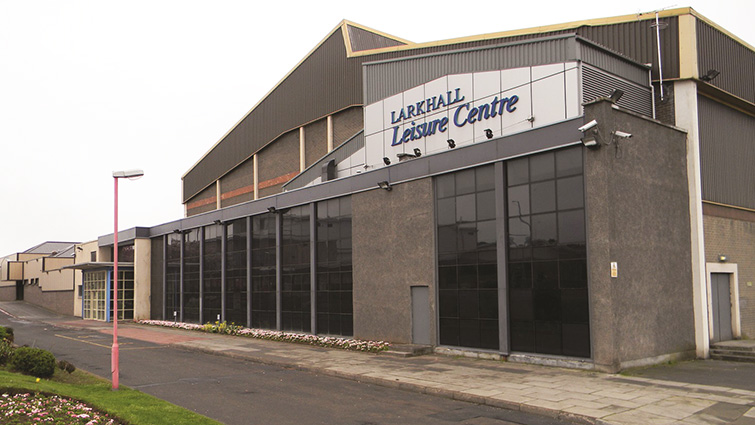
The proposed £27.82 million replacement for Larkhall Leisure Centre has entered the final City Deal approval process, with South Lanarkshire Council seeking authority to proceed with the main construction contract.
The Full Business Case has been submitted to the Glasgow City Region City Deal, whose appraisal process will test the project’s costs, procurement arrangements, risks and claimed benefits before the City Deal contribution is released.
The submission does not mean that the remaining approval is automatic. Under the City Deal’s assurance framework, business cases are examined by an independent appraisal team within the regional Programme Management Office. A Full Business Case must demonstrate that the project remains viable and worthwhile, while approval provides permission for investment and the award of contracts.
South Lanarkshire Council has already selected BAM Construction to carry out the work through hub South West Scotland. Holmes Miller is the project architect, with Blyth and Blyth providing engineering services and Wallace Whittle responsible for environmental building systems.
The new centre will replace a building dating from the 1960s and will contain a 25-metre, six-lane swimming pool. A movable floor will allow the water depth to be altered for swimming lessons, disability access, training and other uses, while tiered seating will provide space for spectators during aquatic events.
The plans also include a gym with cardiovascular and resistance equipment, sauna and steam rooms, a fitness and dance studio capable of accommodating yoga, Pilates and community events, and a three-court games hall suitable for badminton, pickleball and five-a-side football.
Changing facilities are intended to meet current accessibility standards. The architects say the building has been designed around natural light, clear internal routes and flexible spaces that can accommodate users of different ages and abilities.
A Leisure Centre Built Around Housing Growth
The project is being presented as a replacement for an ageing public facility, but its financial origins lie within a much larger housing programme.
Larkhall Leisure Centre is one of seven infrastructure projects within the Larkhall Community Growth Area. The programme also includes school extensions, nursery provision, new roads and changes to junctions around the A72 and M74.
The original City Deal business case envisaged the construction of 1,750 homes accommodating approximately 5,000 additional residents. Public investment in roads, schools and leisure facilities was intended to allow the housing programme to be completed over 15 years rather than the 25 years expected without intervention.
That earlier case anticipated £238 million of private investment in housing and on-site infrastructure, together with developer contributions and further council spending. The leisure centre is therefore part of the public infrastructure being used to support and accelerate a substantial expansion of Larkhall, rather than an isolated recreational project.
Council leader Maureen Devlin said the facility was an essential part of the infrastructure required to support approximately 1,700 new homes.
“This is the next important step in delivering a brand-new, state-of-the-art leisure centre that the community can be proud of, and which is fit for generations to come,” she said.
“With a now revised budget of £27.8 million, the new Larkhall Leisure Centre will be the most expensive facility, outwith the secondary schools’ programme, that the council has built.”
Budget Has More Than Doubled
The current cost is considerably higher than the £11.9 million funding package previously assembled for the project.
South Lanarkshire Council approved another £12 million in February 2024, increasing the available budget to £23.9 million. A further £3.85 million was authorised in February 2025, principally to enlarge the proposed games hall after residents objected to the earlier design. Minor subsequent adjustments have placed the confirmed budget at £27.82 million.
The council is providing £21.85 million. The remaining £5.97 million is being drawn collectively from Glasgow City Region City Deal funding, the UK Shared Prosperity Fund, Place Based Investment funding, regeneration funding and a SportScotland grant.
Earlier council papers identified £3 million of City Deal funding, £1.6 million from Place Based Investment, £1 million from the Shared Prosperity Fund and £300,000 from a regeneration capital fund. The council’s current project page lists the funding sources but does not provide an updated amount for each external contribution.
The increase should not be described simply as a conventional construction overrun because the principal contract has not yet begun and the scope has changed. However, it does mean that the public funding required is now more than twice the amount initially assembled.
Part of that increase can be traced directly to public pressure.
Consultation during 2024 found strong support for the pool, gym and fitness facilities, but the absence of a sufficiently large games hall prompted objections from sports organisations and residents. Larkhall Plan Partnership and Larkhall Community Council organised a campaign that collected about 2,000 petition signatures and generated at least 113 emails to the council leader.
The council subsequently approved the additional £3.85 million and revised the plans to include the three-court hall. The episode provides a clear example of consultation altering a major public project rather than merely accompanying a decision already settled.
The three-court hall will nevertheless be smaller than the indoor sports provision some campaigners originally sought. Community representatives had argued that replacing the existing centre with reduced hall capacity would place pressure on clubs and activities already affected by the loss of other local venues.
Energy Claims Await Measurable Detail
Holmes Miller says the building will use cross-laminated timber, passive solar design, thermal zoning and high-performance materials. It is being developed according to “Passivhaus principles” and is expected to use substantially less operational energy than a conventional leisure centre.
Neither the council’s announcement nor its public project page gives a target for annual energy consumption, a predicted reduction against the present centre or confirmation that independent certification will be sought. Swimming pools are particularly demanding public buildings because water and air must be heated, treated and circulated for long periods. The eventual energy model will determine whether the architectural ambition produces the promised reduction in operating costs.
Although the 14 July announcement says construction is expected to begin during August, the council’s dedicated project page gives a more precise date of 7 September 2026 for the start of the main works, subject to outstanding approvals and agreements.
Advanced work began in mid-May and includes drainage, vegetation removal, site hoardings, construction of a haul road and partial demolition of the existing leisure centre. The intention is for that work to continue directly into the main building programme.
The existing centre is expected to remain partly operational during construction. Games halls and pitches at Larkhall Academy have also been made available for community bookings during evenings and limited weekend hours, although those arrangements cannot provide unrestricted daytime replacement capacity.
The new building is currently scheduled for completion in April 2028. Demolition of the remaining old centre and completion of the wider site are expected to continue until September of that year.
Before the main contract can proceed, the regional City Deal process must determine whether the Full Business Case meets its financial, economic and delivery requirements. The project has passed its local political test. It must now demonstrate that the revised £27.82 million scheme can be delivered within budget and operated affordably once the builders have gone.
Sources
South Lanarkshire Council — Business Case Submitted For New Leisure Centre
https://www.southlanarkshire.gov.uk/view/news/article/3018/business_case_submitted_for_new_leisure_centre
South Lanarkshire Council — Larkhall Leisure Centre Replacement Project
https://www.southlanarkshire.gov.uk/LarkhallLeisureCentre
Glasgow City Region — South Lanarkshire Community Growth Area Projects
https://glasgowcityregion.co.uk/our-region/partners/slc/
Glasgow City Region — Assurance, Governance And Programme Management Framework
https://glasgowcityregion.co.uk/wp-content/uploads/2021/04/Assurance_Framework_2019-1.pdf
Glasgow City Region — Larkhall Community Growth Area Outline Business Case Executive Summary
https://onlineservices.glasgow.gov.uk/councillorsandcommittees/viewSelectedDocument.asp?c=P62AFQDN0GDX81Z3ZL
Holmes Miller — Larkhall Leisure Centre Project
https://www.holmesmiller.com/project/larkhallleisurecentre
Holmes Miller — Planning Submitted For New Larkhall Leisure Centre
https://www.holmesmiller.com/news/planning-submitted-for-new-larkhall-leisure-centre
Larkhall Plan Partnership — Larkhall Leisure Centre Campaign And Project History
https://larkhallplanpartnership.org.uk/project/larkhall-leisure-centre/