
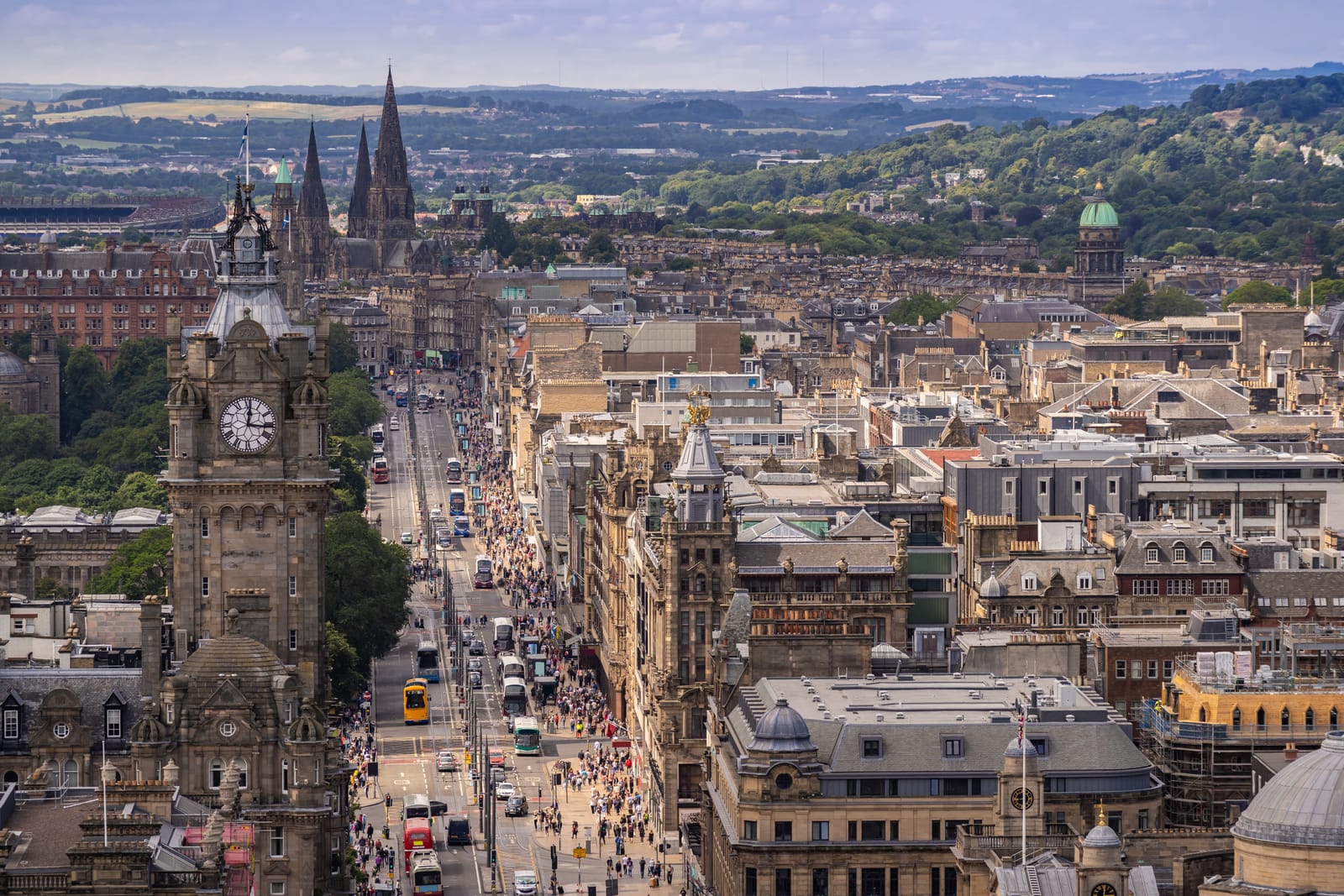
The council’s annual overview records Michelin restaurants, airport passengers and festival attendances. It omits crime entirely and leaves the capital’s legal failures on homelessness in separate committee papers.
Edinburgh’s latest official statistical portrait can tell residents that the city has 34 restaurants listed by Michelin, that its airport handled 15.8 million passengers and that major festivals recorded 3.91 million attendances.
It cannot tell them how much crime was recorded in the capital.
The 45-page Edinburgh by Numbers 2025 report contains sections on population, health, employment, the economy, tourism, education, property, the environment and transport. There is no section on crime or community safety. It provides no Edinburgh figures for violence, sexual offences, rape, shoplifting or antisocial behaviour.
That omission is more than a matter of editorial taste. The council describes Edinburgh by Numbers as an annual statistical overview and a starting point for obtaining a broad picture of how Edinburgh “lives, works and grows”. The document is therefore intended to influence how residents, businesses and outside investors understand the city.
The picture it presents is largely favourable.
Edinburgh’s population increased by 9.4 per cent between 2014 and 2024, reaching an estimated 530,680. Its employment rate among people aged 16 to 64 was 83.2 per cent, the highest among the major UK cities included in the council’s comparison. Median hourly pay reached £20.49, also the highest among those cities outside London.
The city’s gross value added reached £65,500 per resident in 2023. That is a measure of economic production divided by population, not the income received by each person. Edinburgh’s finance and insurance sector generated £8.8 billion, exceeding the combined output of several other large parts of the local economy.
Tourism supplied another set of impressive figures. Edinburgh received approximately five million staying visits in 2024, while visitor spending was reported at £2.57 billion. Airport passenger numbers exceeded their pre-pandemic level, rising from 14.7 million in 2019 to 15.8 million in 2024.
These figures are legitimate measures of Edinburgh’s economic strength. They do not, however, amount to a complete account of life in the city.
The latest Scottish Government statistics show that Police Scotland recorded 744 crimes for every 10,000 Edinburgh residents in 2025–26. That was the third-highest local-authority rate in Scotland, behind Dundee at 929 and Glasgow at 849, and considerably above the national rate of 569.
Recorded-crime rates require careful interpretation. They show crimes entered into police systems, not every crime committed, and the Scottish Government warns that many offences are never reported. A resident-population rate may also appear higher in a capital whose streets, venues and transport systems are used by large numbers of visitors and commuters who are not included in the population denominator.
Those qualifications are reasons to explain the figures, not reasons to omit them.
The absence of information about sexual crime is particularly conspicuous. Across Scotland, recorded sexual crimes rose by ten per cent in 2025–26, from 14,892 to 16,430. Recorded rape and attempted rape increased by 11 per cent, from 2,897 to 3,229. The Scottish Government notes that 26 per cent of sexual crimes were recorded at least one year after the alleged offence, so annual figures include both recent and historical reports.
Those are national figures and should not be presented as Edinburgh’s local totals. The problem is that the council’s statistical overview provides no Edinburgh total, rate or trend against which residents can assess the local position.
Policing is not controlled by the council, but that does not adequately explain the omission. Edinburgh by Numbers already draws upon data produced by the Office for National Statistics, National Records of Scotland, tourism researchers, airport operators and other outside organisations. Police and Scottish Government statistics could have been treated in the same way.
The report’s treatment of housing presents a similar difficulty.
Its property pages describe house prices, ownership, private renting, social housing and construction. The separate records of the council’s homelessness service reveal a much more urgent part of the housing system.
In May, Edinburgh Council acknowledged that it was not complying with the Housing (Scotland) Act 1987 or the Homeless Persons (Unsuitable Accommodation) (Scotland) Order 2014. These laws require councils to provide accommodation to qualifying homeless households and restrict the use of unsuitable temporary accommodation.
On 16 March 2026, the council had 9,331 open cases involving households assessed as homeless. Between April 2025 and February 2026, 3,605 households were assessed as homeless, an increase of 442, or 12.3 per cent, from the corresponding period.
A total of 971 households were living in accommodation officially classed as unsuitable. During February alone, the council recorded 614 failures to provide accommodation, affecting 259 households. Those failures represented 54.6 per cent of requests for temporary accommodation during the month.
The financial consequences have become substantial. Edinburgh’s temporary-accommodation budget increased from £28 million in 2019–20 to £80 million in 2025–26. The council says it is developing a £1.6 billion housing and homelessness programme and has set March 2027 as its target for addressing failures to accommodate households and the use of unsuitable accommodation.
None of these figures appears in the annual statistical portrait.
The council does publish performance and committee reports separately, and its statistics page directs readers elsewhere for information about its performance. That administrative separation may explain where the homelessness figures have been placed. It does not explain why a publication offering a broad picture of life in Edinburgh includes residential sales worth billions of pounds but not the number of households the council is legally failing to accommodate.
The account of business activity is less an omission than a matter of presentation.
The report uses the official statistical terms “business births” and “business deaths”. In ordinary language, these mean registered businesses beginning and ceasing operations. The report says Edinburgh has returned to positive business growth since the pandemic, but its explanatory text does not state the latest number of businesses that opened and closed.
A separate economic study commissioned by the council gives the figures more plainly. In 2023, 2,105 registered businesses started operating in Edinburgh and 1,970 ceased operating, leaving 135 more openings than closures.
That was still a weaker position than five years earlier. The number of businesses starting in 2023 was 17.5 per cent lower than in 2018, while the number ceasing operations was 0.8 per cent higher. The figures exclude unregistered enterprises and do not reveal why each business closed. They cannot establish how many were forced out by insolvency, rent, redevelopment or reduced trading, and how many closed voluntarily.
A useful annual account would provide the plain totals, compare them with previous years and identify which sectors and parts of the city are gaining or losing businesses. Saying only that growth has returned conceals the fact that Edinburgh was producing substantially fewer new registered businesses than in 2018.
The festivals page creates a different kind of uncertainty.
Edinburgh by Numbers describes 3.91 million “attendees” at the city’s major festivals in 2024. The heading immediately above the figure describes online and in-person “attendances”. These are not the same thing. One person attending six performances creates six attendances but remains one attendee.
Festivals Edinburgh records 3,914,838 attendances in 2024, up from 3,447,973 in 2023. It estimates that those attendances represented 851,052 individual people, but that figure was calculated by applying an assumed average of 4.6 attendances per person derived from earlier audience research. It is an estimate, not a separate count of 851,052 visitors.
The council report does not provide a consistent year-on-year measure of pedestrian footfall during the festivals. It therefore cannot show whether more people were walking through Princes Street, George Street, the Royal Mile or local commercial districts, nor whether increasing festival attendance translated into increased visits to ordinary shops and businesses.
Festival admissions, unique visitors, city-centre footfall and spending are four different measurements. A public statistical report should not allow them to blur into one large and agreeable number.
Edinburgh is not a city whose economic achievements need to be invented. It has high employment, strong pay, major financial industries, exceptional international connections and an enormous cultural reach.
A credible civic portrait would be strengthened rather than diminished by placing the harder figures beside them.
The twentieth edition of Edinburgh by Numbers should include a community-safety section, Edinburgh-specific crime trends, straightforward figures for businesses opening and ceasing operations, comparable event-period footfall and the principal measures of homelessness and statutory housing compliance.
A reader should not have to leave the council’s broad statistical overview and locate a separate committee paper to discover that the same authority is failing to meet two of its basic legal duties towards homeless households.
Sources
City of Edinburgh Council — Edinburgh Statistics And Data
https://www.edinburgh.gov.uk/strategy-performance-research/edinburgh-statistics-data
City of Edinburgh Council — Edinburgh By Numbers 2025
https://www.edinburgh.gov.uk/downloads/file/30669/edinburgh-by-numbers-2025
Scottish Government — Recorded Crime In Scotland 2025–26
https://www.gov.scot/publications/recorded-crime-scotland-2025-26/
Scottish Government — Recorded Crime In Scotland 2025–26: Total Recorded Crime
https://www.gov.scot/publications/recorded-crime-scotland-2025-26/pages/total-recorded-crime/
Scottish Government — Recorded Crime In Scotland 2025–26: Sexual Crimes
https://www.gov.scot/publications/recorded-crime-scotland-2025-26/pages/sexual-crimes/
City of Edinburgh Council — Allocations Policy Suspension And Homelessness Update, May 2026
https://democracy.edinburgh.gov.uk/mgConvert2PDF.aspx?ID=98009
City of Edinburgh Council — Edinburgh Economic Needs Study: Economic Overview
https://www.edinburgh.gov.uk/downloads/file/39274/economic-needs-study-economic-overview
Festivals Edinburgh — Overview Of 2024 Audiences
https://www.edinburghfestivalcity.com/assets/000/000/814/Overview_of_2024_Audiences__May_2025__original.pdf