
A national portrait of Scotland through land, homes, people, services and power.
A thousand years from now, if historians look back, they may not ask whether Scotland had enough determination. They may ask whether the country noticed, in time, that the ordinary bond between land and people was changing. They may ask whether homes were treated as dwellings or merely as assets. They may ask whether rural places were loved as living communities or merely admired as scenery. They may ask whether cities were allowed to become engines of opportunity only for those who could afford admission. They may ask whether a nation that spoke often of self determination understood that self determination begins not in a chamber, but in the ability of people to remain in the places that made them.
That is the landscape the data shows. Not a country without hope. Not a country with a single enemy. A country at a threshold, carrying great assets, deep memory, severe pressures and unfinished decisions. Scotland is still legible. The task now is to read it honestly. And to take the right actions.
This article was created by reading Scotland through trusted public records: land and property ownership, housing use, second homes, empty homes, short term lets, homelessness, population, school rolls, deprivation, crime, care, rural access, digital connectivity, transport, tourism pressure and community ownership. The purpose is not to produce a grievance. It is to describe a country as accurately as the public evidence allows, then ask what a serious country should do next.
The central finding is this: Scotland is not facing one crisis. It is facing a crisis of permanence. The systems that allow people to live, work, raise children, care for the old and exercise meaningful local control are no longer aligned in enough places. Land can be owned without being lived on. Homes can exist without housing the people a community needs. Tourism can bring income while consuming local capacity. Population can rise nationally while particular places age, thin and lose children. Public services can be expected to cover geographies that markets will not sustain. Crime can remain historically lower than past peaks while trust in the condition of places is still weakened by disorder, vacancy, fear and fragile local institutions.
CHART 1: External ownership land area by council
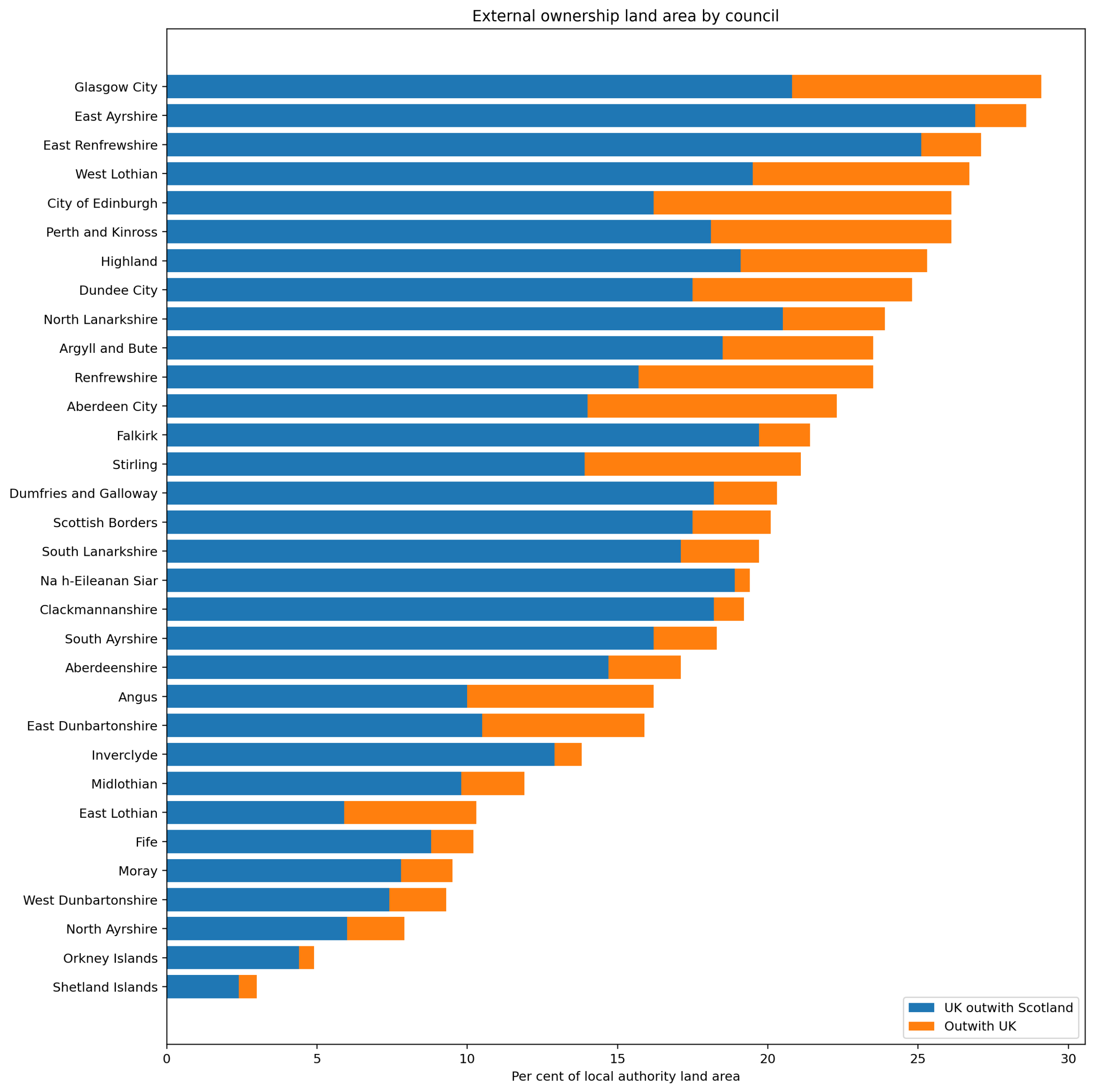
The Registers of Scotland Country of Origin Report 2025 gives the base ownership layer. It records owner address at the time of registration, not nationality, motive, current residence or present use. That warning matters. The report counted 2,020,466 registered Land Register titles as at 31 December 2025. Of these, 92.8 per cent had an owner address in Scotland, 5.6 per cent had an owner address elsewhere in the UK, 1.4 per cent had an owner address outwith the UK, and 0.2 per cent were Government, Crown or British Forces Post Office categories. Scotland is therefore not, by title count, chiefly owned from outside Scotland. But the land area picture is different: titles with owner addresses outwith the UK represented 4.4 per cent of Scotland’s land area, while titles with UK owner addresses outwith Scotland represented 17 per cent. Title count alone is too blunt for a country of cities, crofts, farms, estates, islands, flats, harbours, forests and fields.
The first problem, then, is not ownership alone. It is the distance that can open between control and consequence. Land is not merely an asset. It decides where homes can be built, where food can be grown, where energy infrastructure lands, where forests stand, where communities expand, where roads and services must run, and where public decisions are felt. Scotland does not need a politics of suspicion. It needs a politics of legibility. The country should be able to see, council by council and community by community, how ownership, land use, housing use, vacancy, planning status, community ownership and local pressure sit together. A serious nation cannot govern what it has made difficult to see.
CHART 2: Housing stock under pressure
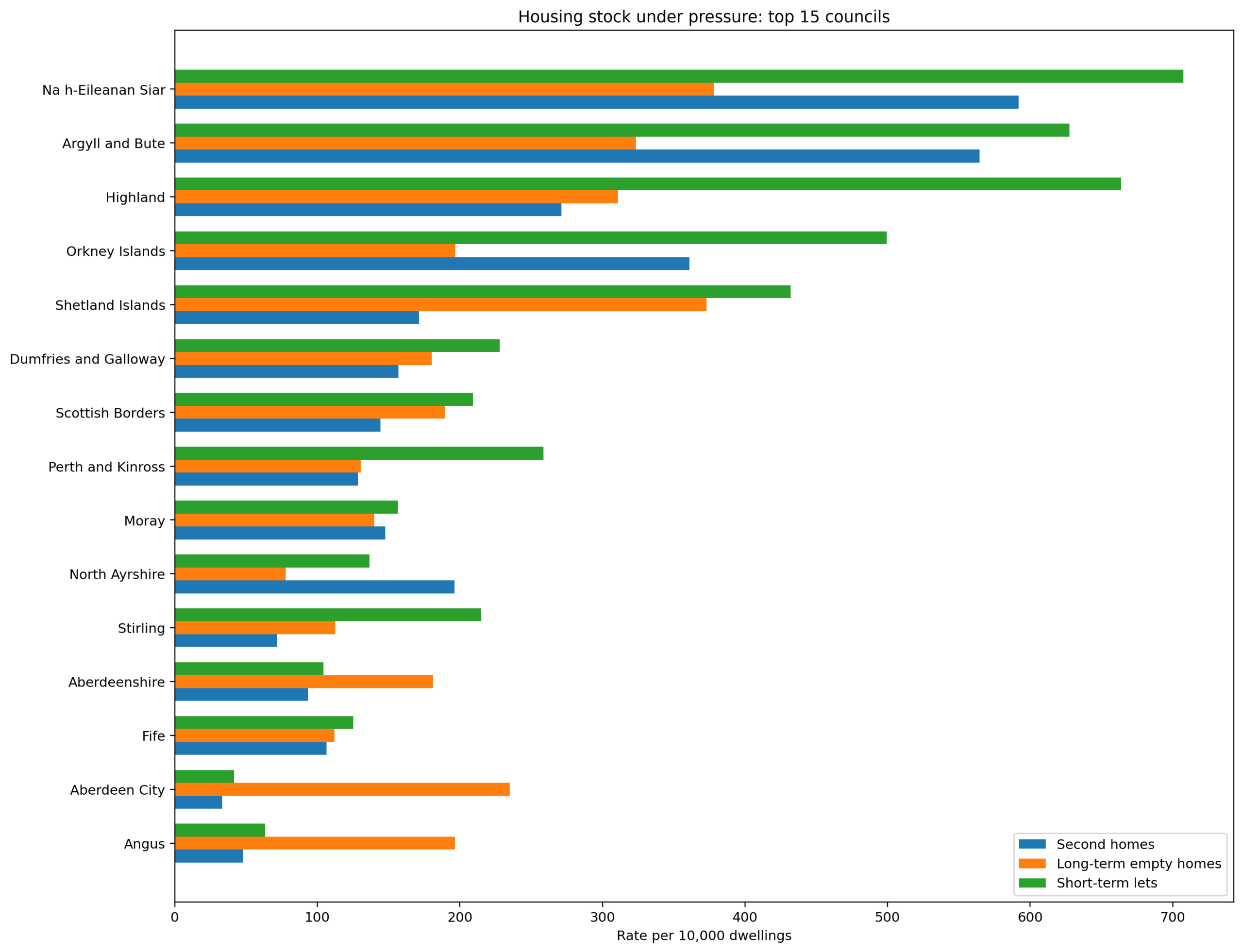
The second problem is that homes and dwellings are no longer the same thing. In September 2025, Scotland had 20,927 second homes, 44,453 properties liable for council tax that had been empty for more than six months, and 32,337 long term empty homes. These figures sit beside a homelessness system under acute pressure. Scotland had 17,240 households in temporary accommodation at 31 March 2025, including 10,180 children. No honest analysis should claim that one number directly causes the other. But no serious country can pretend that second homes, long term empty homes, visitor accommodation and temporary accommodation are separate moral universes. They are all part of the same national settlement.
The answer is not simply to build and hope. Scotland needs a Homes First settlement that distinguishes permanent homes, second homes, long term empty homes, short term lets, social housing, temporary accommodation and buildings capable of rescue. Long term empty homes should move from tolerated category to national recovery programme. Councils need repair finance, acquisition funds, council backed leasing, stronger compulsory sale powers where neglect is persistent, and the staffing to use those powers. The purpose is not punishment. It is return to use.
The third problem is visitor pressure without enough community protection. Tourism is not an enemy. In many places it supports wages, ferries, restaurants, galleries, trades, food producers, hotels and international recognition. But the short term lets data shows why tourism can no longer be treated as pure gain. Scotland had 32,317 short term let licences or exemptions in operation at 31 December 2025. The national rate was 118 active licences per 10,000 dwellings, while Na h Eileanan Siar had 707, the highest rate in Scotland. The majority of active licences, 25,131 or 78 per cent, related to secondary letting, where the property is not the host’s primary residence.
The remedy is a local capacity test. Councils should be able to manage secondary letting at neighbourhood, island or community level where short term lets, second homes, school roll decline, workforce shortages and service fragility overlap. Primary residence home sharing should not be treated the same as whole dwelling conversion into visitor stock. Tourism should be welcomed, but it should also pay visibly into the places it strains, through local visitor levies, cruise levies where appropriate, and ring fenced funds for housing, roads, waste, toilets, ferries and local services. A visitor economy that displaces the resident economy has misunderstood hospitality.
CHART 3: Acute housing need
The fourth problem is homelessness amid unused capacity. In 2024 to 2025, 34,067 households were assessed as homeless in Scotland. Those households contained 53,720 people, including 15,046 children. At 31 March 2025, the number of households in temporary accommodation reached 17,240, the highest in the series. These figures are not abstract. They describe families, children, single people, women leaving danger, people leaving institutions, people priced out, people waiting, people being managed through a system that has run out of ordinary exits.
The solution should be a permanent home guarantee for families with children. That does not mean pretending homes can be conjured by rhetoric. It means making the reduction of children in temporary accommodation a national test of housing policy. Acquisition of existing homes, social rent delivery, empty homes work, modular housing, public land release and planning reform should be treated as one emergency system. Scotland should not have children growing up in temporary accommodation while recoverable homes sit unused and visitor markets continue to expand without sufficient restraint.
CHARTS 4a and 4b: Demographic fragility by council
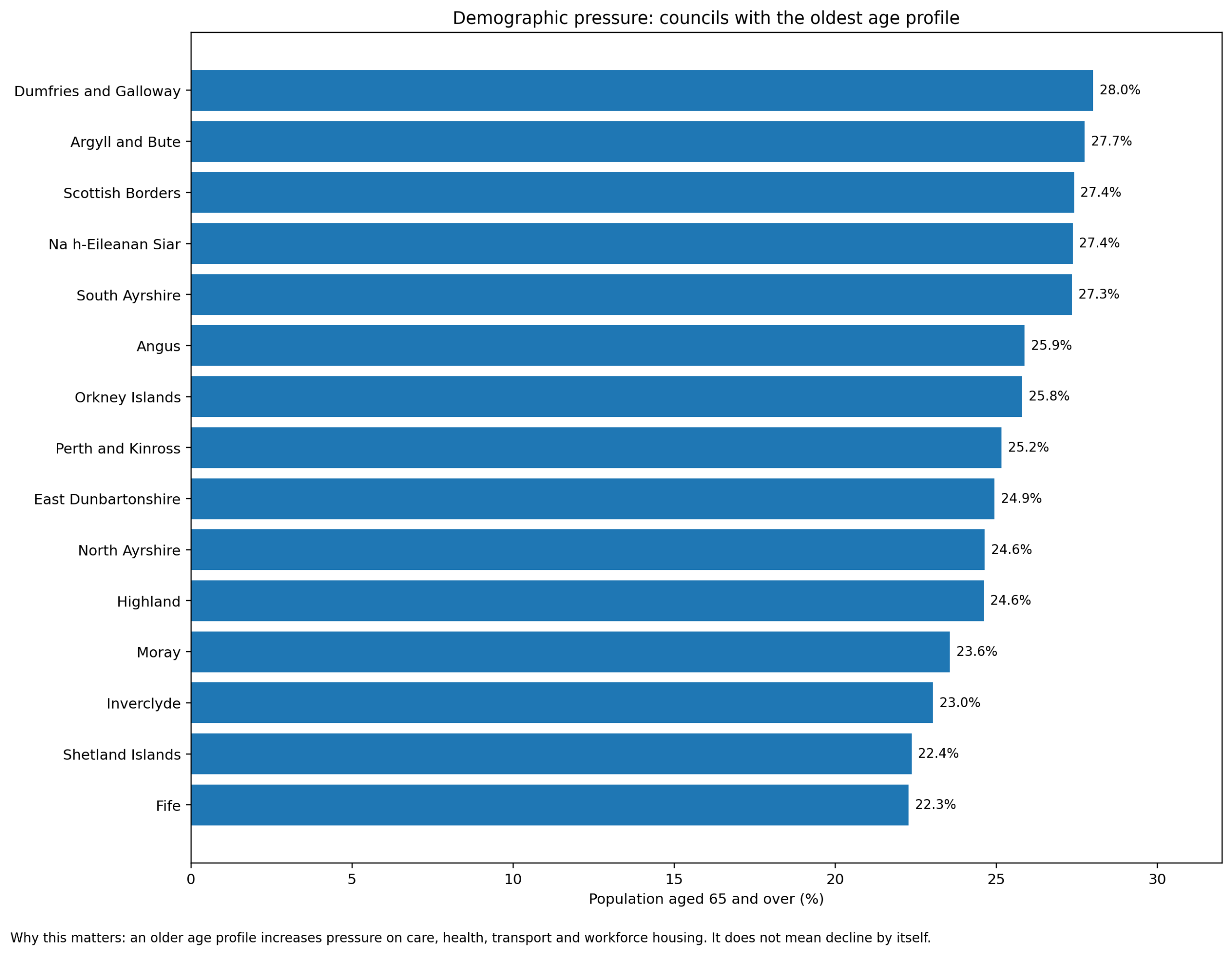
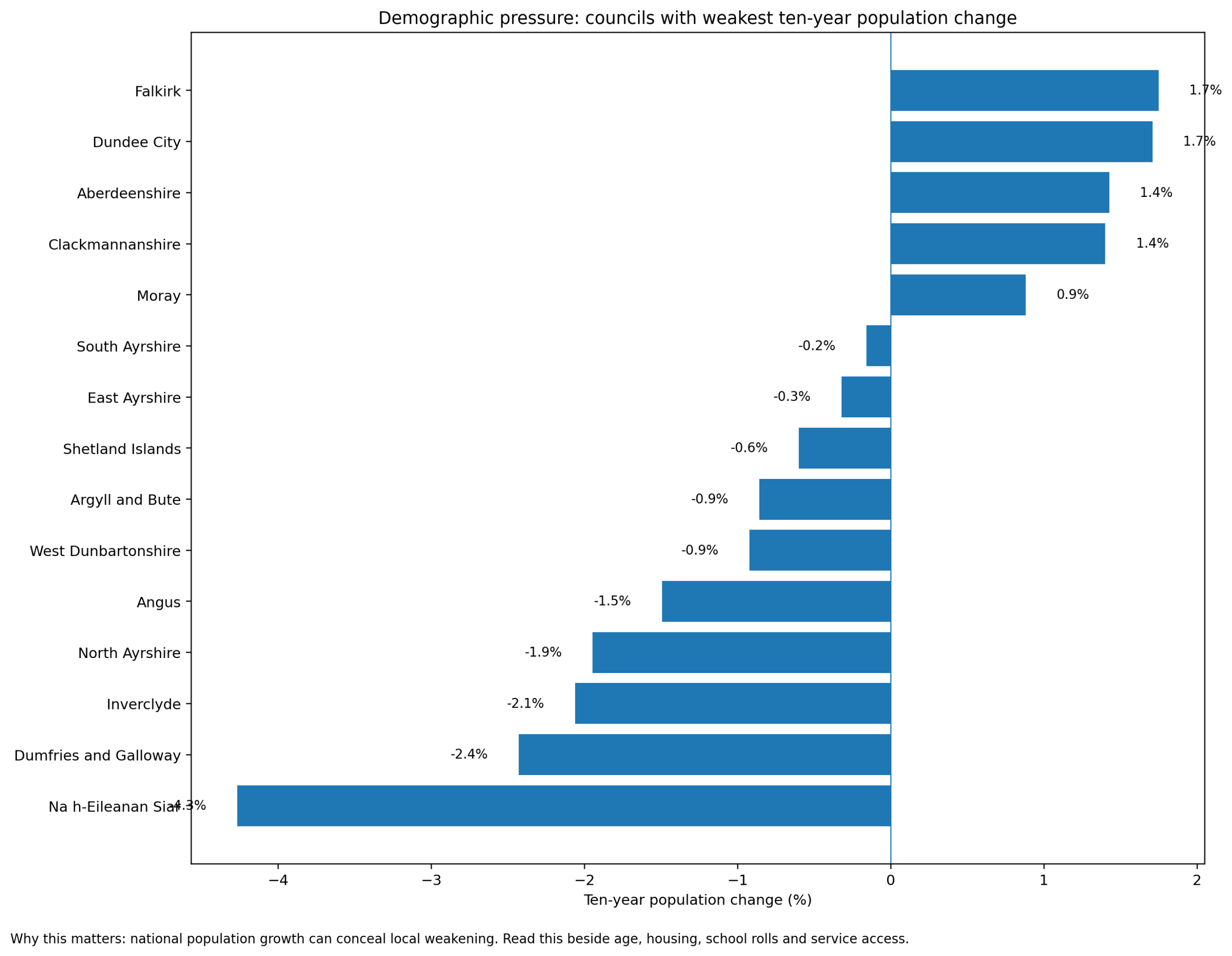
The fifth problem is demographic imbalance hidden beneath national growth. Scotland’s population was estimated at 5,546,900 in mid 2024, the highest on record. The population increased by 40,900 over the year, with migration the main driver. Natural change was negative, with 46,400 births and 62,000 deaths. Migration is therefore not incidental to Scotland’s future. It is part of how the country is being maintained.
National growth, however, can conceal local fragility. A place can gain people and still lose balance. It can gain residents but lose workers. It can attract retirees but lose young families. It can grow on paper while becoming older, thinner and less able to staff care, schools, ferries, farms, shops, kitchens, trades and public services. Scotland needs a population renewal strategy by place, not slogan. That means welcoming people who wish to settle, work and belong, while also making it possible for those already here to remain. Rural and island settlement must be tied to housing, childcare, broadband, transport, employment and access to care. Cities must give young workers real routes into secure rental and ownership. Population policy that does not reach housing policy is only arithmetic wearing a rosette.
The sixth problem is the thinning of childhood in some places. Scotland had 695,923 pupils in 2025, down 6,505 from 2024. Primary pupils fell by 7,023, while secondary and special school pupils rose slightly. Teacher numbers rose to 53,475 full time equivalents, and the pupil teacher ratio improved from 13.3 to 13.2. These figures should not be filed away as education administration. School rolls are one of the most intimate measures of whether a place has a future tense.
A country that wishes to remain inhabited must ask whether its housing, planning, transport and economic policies help families stay. Rural schools should not be judged only as buildings with pupil numbers. They are civic anchors. When a school closes, a community often loses one of the last institutions saying the place expects children. Scotland needs a Children in Place test for planning, housing, school estates and transport. It should ask whether decisions make it more or less possible for families to remain near work, grandparents, care, childcare and school.
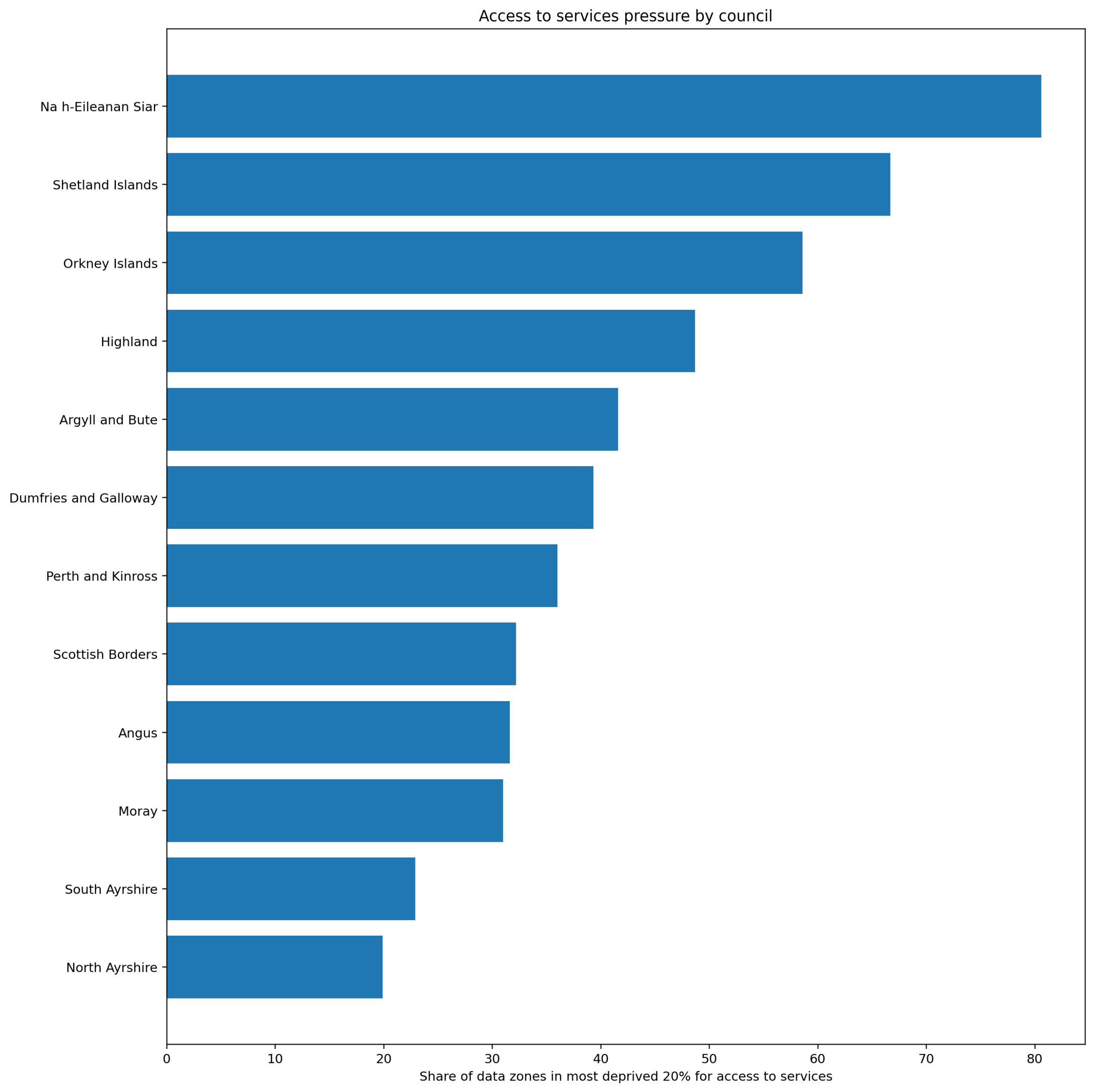
CHART 5: Access to services pressure by council
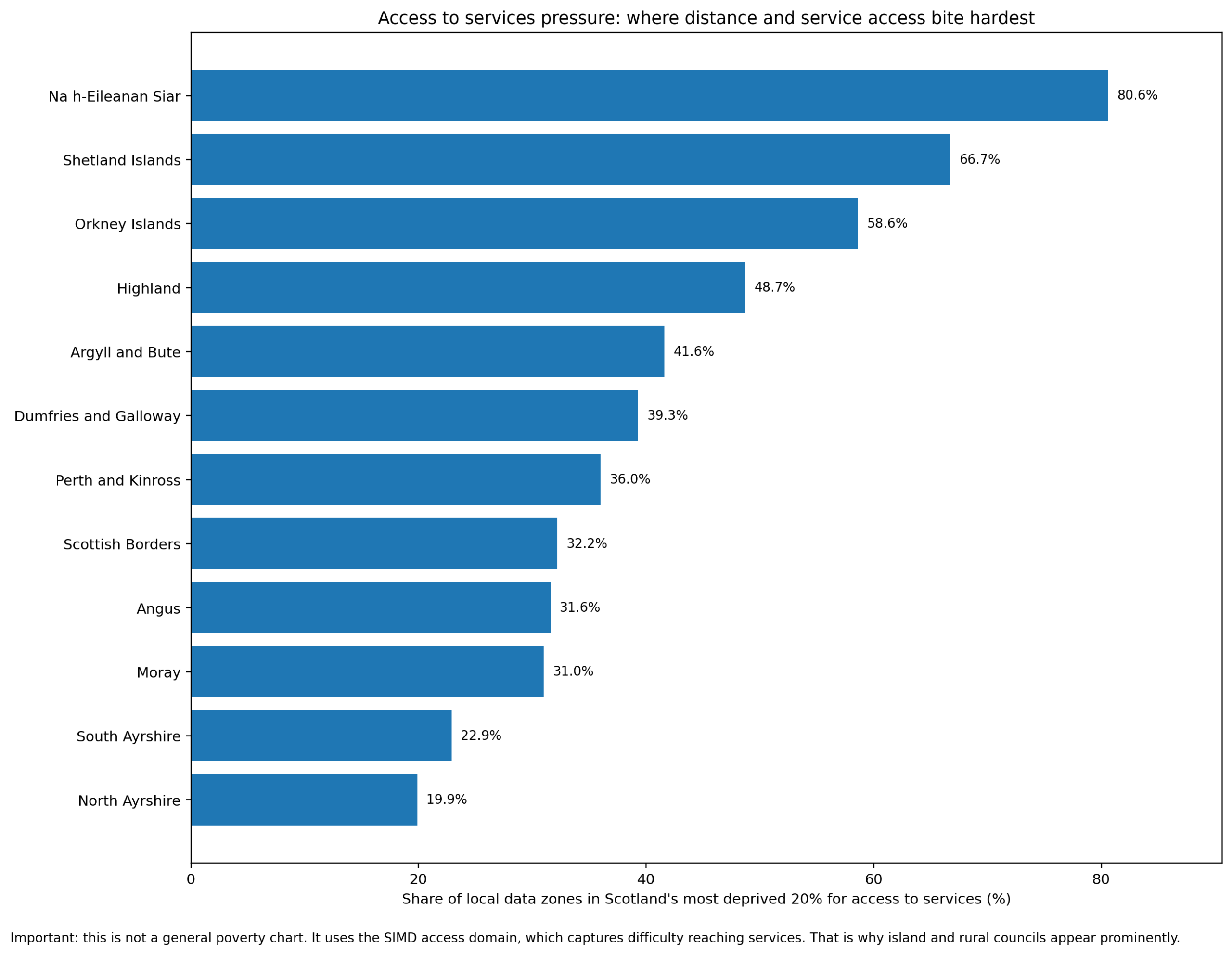
The seventh problem is rural distance being mistaken for rural charm. Rural Scotland is not a view. It is a working system. The Scottish Government’s rural trends work brings together evidence across agriculture, marine activity, transport, housing, population, skills, environment, climate, economy, digital access, health, social care, culture and social justice. That is the correct scale of thought. A rural housing shortage is never only a housing shortage. It is also a staffing problem, a school problem, a care problem, a transport problem, a broadband problem, a fuel problem and eventually a democracy problem.
The answer is a rural minimum service standard. Every rural and island community should be assessed against minimum viable access to housing, primary care, school transport, broadband, public transport, food supply, emergency response, social care, childcare and winter resilience. Where markets cannot provide, public policy must. That is not subsidy as charity. It is the cost of remaining a country rather than a set of profitable corridors.
The eighth problem is uneven digital access. The Scottish Islands Data Overview 2025 records real progress, including superfast broadband availability of between 78 and 99 per cent in island local authorities, while gigabit capable broadband in Orkney rose from 1 per cent in 2021 to 18 per cent in 2025. Progress is genuine. So is the gap. Digital access is no longer a convenience. In remote Scotland it is work, health access, education, business resilience, public administration and the possibility of staying.
Scotland needs a digital right to remain. Every inhabited island and remote mainland community should have a funded route to reliable high speed connection, backup resilience and public digital access points. When health, education, benefits, banking, business support and public forms move online, poor connectivity becomes a new form of distance.
The ninth problem is care being placed on fragile local foundations. Public Health Scotland’s care home statistics show that during 2024 to 2025, 82 per cent of stays for residents in care homes fully or partially funded by a local authority were within care homes provided by the private sector, and that the highest care home resident rate by age was among those aged 85 and over. In an ageing country, care is not merely a health service issue. It is a housing issue, a workforce issue, a transport issue and a local economy issue.
The answer is a Care Near Home covenant. Housing policy should be directly tied to care workforce planning. Councils and health and social care partnerships should be able to designate key worker homes for carers, nurses, ambulance staff, teachers, ferry workers and emergency workers in pressure areas. A care rota cannot be staffed by admiration. It requires people who can afford to live close enough to turn up.
The tenth problem is public safety without enough civic repair. Recorded crime does not show a country collapsing into disorder. Police recorded 299,111 crimes in Scotland in 2024 to 2025, slightly below the previous year and 2 per cent lower than ten years earlier. Recorded crime remained 51 per cent below its 1991 peak. That matters. It should prevent lazy alarm. But public safety is not only the number of crimes recorded. It is also whether people feel that streets, town centres, transport routes, housing estates and rural places are governed, cared for and answerable.
The response should be civic repair policing, not enforcement alone. Local safety plans should connect recorded crime, antisocial behaviour, vacant property, addiction services, youth provision, mental health, lighting, transport access and town centre decline. Police cannot be asked to repair what housing, health, planning, schools and economic policy have left broken. They are the last line, not the whole constitution.
The eleventh problem is transport dependence without enough resilience. Transport Scotland’s 2025 statistics show the breadth of the system, covering road vehicles, traffic, casualties, bus and rail passengers, freight, air and water transport. Bus remained the dominant public transport mode in 2024 to 2025, while ferry statistics for 2024 recorded 9.7 million passengers and 3.5 million vehicles across ferry routes. In island and rural Scotland, transport is not a convenience. It is access to hospitals, schools, shops, work, family, food, repairs and dignity.
The answer is to treat lifeline transport as social infrastructure. Ferry reliability, rural buses, school transport, community transport and road resilience must be part of the same permanence policy as housing and care. A home that cannot reliably reach work, school, hospital or food is not fully connected to the life of the country.
CHART 6: Structural overlap index
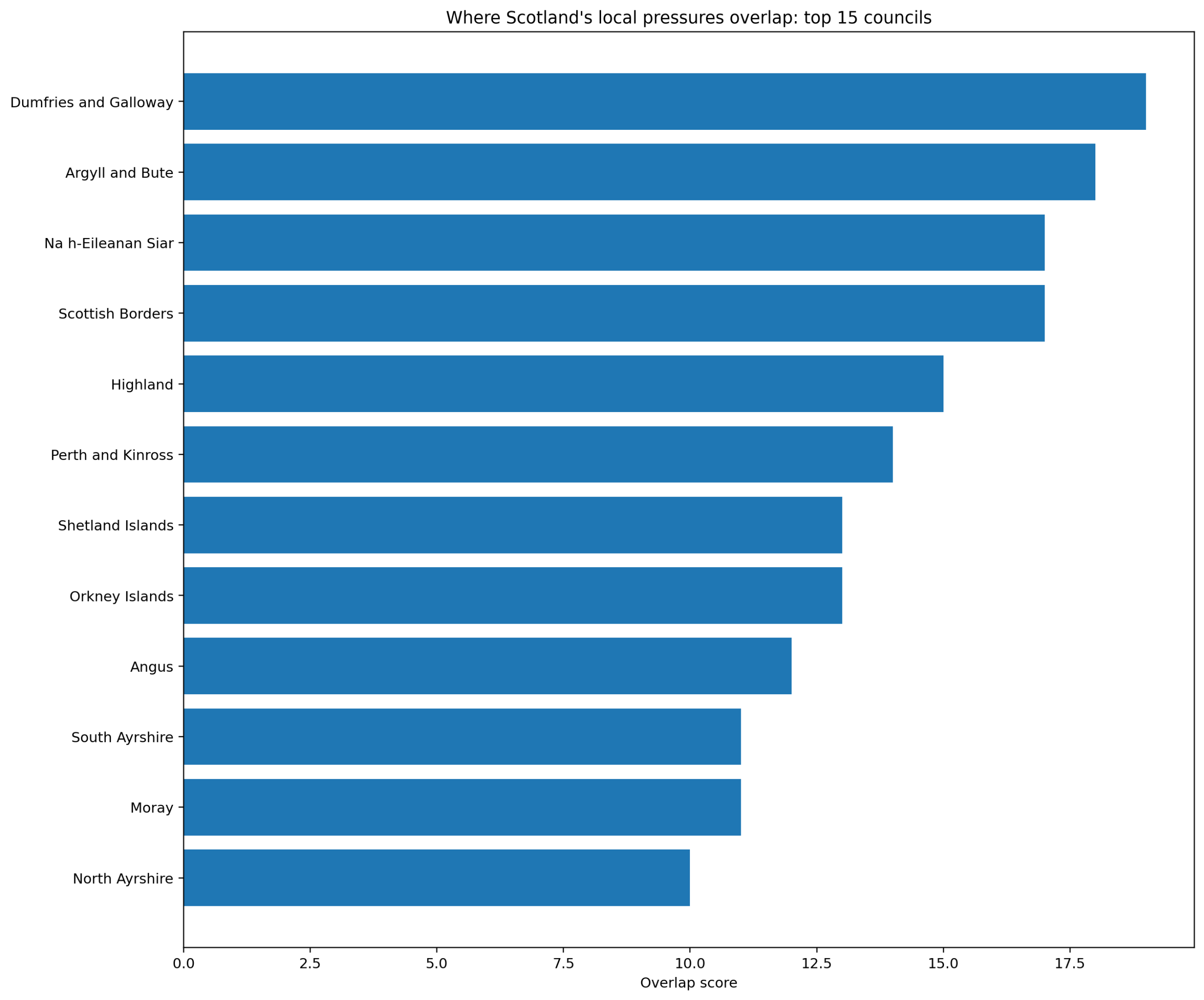
The twelfth problem is deprivation being treated as one thing. The Scottish Index of Multiple Deprivation measures relative deprivation across income, employment, education, health, access to services, crime and housing. Its great lesson is that hardship has different shapes. Urban poverty, rural isolation, island distance, housing shortage, poor health and weak access to services are not interchangeable, but they can overlap. A country that only recognises deprivation when it looks urban will misread rural Scotland. A country that romanticises rural hardship will fail it with a smile.
Scotland needs a layered need formula for funding. Public money should follow the combination of pressures, not only population size, historic allocation or departmental habit. A small island community with high access deprivation, high housing pressure, fragile transport and an older population may need more support per head than a larger area with easier geography. Fairness is not sameness. It is accuracy.
The thirteenth problem is that local control remains too exceptional. Community ownership is one of the most hopeful facts in the record. In 2024, Scotland had 853 assets in community ownership, owned by 503 groups, covering 213,803 hectares, or 2.7 per cent of Scotland’s total land area. Na h Eileanan Siar contained 153,678 hectares of community owned land, 72 per cent of Scotland’s total community owned land area. Highland and Argyll and Bute together contained 326 assets, 38 per cent of all assets in community ownership. Local control is not fantasy. It already exists at scale.
The solution is a community right to build, buy and hold. Scotland should make it easier for community bodies, local housing trusts, development trusts and councils to acquire land and buildings for permanent local use. Community ownership should not depend on heroic volunteers navigating a legal labyrinth while well advised capital moves faster. The state should build the bridge, not merely applaud those who swim.
The national answer is not one policy. It is a new settlement around permanence. Scotland should ask, before every major decision: does this make it easier or harder for ordinary people to remain in the places that need them.
That requires a Permanence Test written into housing, planning, tourism, transport, land reform, rural policy, health and economic development. Can workers live near the work. Can families remain near schools. Can older people receive care near home. Can young people find secure housing. Can visitor economies support resident economies rather than displace them. Can land decisions answer to local consequence. Can public services operate in the geography they are asked to serve. Can communities hold assets that matter to their future.
This is where politics must grow up. Scotland does not need another elegant strategy document placed reverently beside the previous elegant strategy document. It needs a visible national programme with numbers, deadlines and local accountability.
That programme should begin with a Scotland wide land, housing and permanence dashboard, updated annually, showing ownership, housing use, vacancy, short term lets, homelessness, population age, school rolls, access deprivation, crime, community ownership and service fragility by council and smaller area.
It should include a national empty homes recovery corps, stronger local powers over secondary letting, key worker and community housing zones, a community benefit test for public land disposal, a rural and island service standard, housing tied directly to care workforce planning, core funding for community ownership and local housing trusts, tourism pressure plans in high demand areas, and an annual State of Scotland’s Places report to Parliament written in plain language.
The deeper point is constitutional in the older and better sense of that word. A constitution is not only a legal document. It is the arrangement by which a people can live together with order, liberty, responsibility and memory. If Scotland wishes to speak seriously about its future, it must speak not only of sovereignty, but of settlement. Not only of powers, but of homes. Not only of institutions, but of the people who must live under their decisions.
The data does not say Scotland is broken. It says Scotland is misaligned. That is a more useful diagnosis, because misalignment can be corrected. Homes can be returned to use. Visitor pressure can be managed. Community ownership can be expanded. Rural services can be treated as national infrastructure. Care workers can be housed. Children can be planned for. Public money can follow layered need. Land can be made more legible. The country can decide that permanence is not nostalgia, but policy.
Scotland’s danger is not that it lacks beauty, history, talent or identity. Its danger is that these may be mistaken for enough. A country can be admired from the outside while becoming harder to inhabit from within. It can be photographed, marketed, governed and celebrated, yet still fail the nurse looking for rent, the teacher priced out of the village, the young family leaving the island, the older person waiting for care, the child in temporary accommodation, the ferry worker commuting absurd distances, the crofter watching land values drift beyond local life, the city worker whose wages cannot open the city’s door.
That is what must now be said plainly. Scotland is not short of romance. Scotland is short of alignment.
The test before the country is whether it can arrange land, homes, labour, services and power so that ordinary people may remain in the places that made them. If it can, Scotland will not merely preserve itself. It will understand itself. If it cannot, the records will still be there for those who come later: title by title, dwelling by dwelling, household by household, child by child, showing the moment when the nation was warned, quite plainly, by its own numbers.
Suggested Considerations on Voting Patterns
This data may also help explain why Scotland votes so differently from place to place. The data does not prove party preference, nor should it be used to reduce voters to housing statistics, land records or demographic charts. Voting is shaped by history, identity, leadership, trust, local memory, public services, family experience and the character of candidates themselves. But the evidence does suggest that different parts of Scotland are living through different versions of the national question.
In the central belt and the major cities, politics is often filtered through rent, employment, poverty, transport, public services, homelessness and the cost of opportunity. In the Highlands, islands and rural south, the pressure may feel different: distance, housing availability, second homes, visitor accommodation, ageing communities, fragile care systems, school rolls, ferry and road reliability, land use and the practical ability of younger households to remain. These are not separate from politics, but they are deeper than party politics. They are the conditions through which politics is experienced.
That may be why national messages do not land evenly across Scotland. A voter in Edinburgh, Glasgow, the Highlands, Orkney, Shetland, the Borders or Dumfries and Galloway may all be asked the same constitutional or economic question, but they are not answering it from the same civic landscape. One may be thinking about rent. Another about a ferry. Another about a school roll. Another about care for an ageing parent. Another about whether a son or daughter can ever afford to live nearby. The ballot paper is national. The pressure behind it is often local.
The point is not that data predicts democracy. It does not. The point is that democracy cannot be understood without place. Scotland’s voting differences may therefore be less mysterious than they first appear. They may be the political expression of a country whose regions are no longer experiencing land, housing, services, work and permanence in the same way. That is not a partisan conclusion. It is a civic warning. A nation that wishes to govern itself well must first understand why its people are not all standing on the same ground.
Sources
Registers of Scotland, Country of Origin Report 2025, data extract from the Land Register as at 31 December 2025.
Scottish Government, Second Homes and Empty Properties in September 2025.
Scottish Government, Short Term Lets Licensing Statistics Scotland to 31 December 2025.
Scottish Government, Homelessness in Scotland 2024 to 2025.
National Records of Scotland, Mid 2024 Population Estimates.
Scottish Government, Pupil and Teacher Characteristics 2025.
Scottish Government, Scottish Index of Multiple Deprivation 2020.
Scottish Government, Recorded Crime in Scotland 2024 to 2025.
Public Health Scotland, Care Home Statistics for Scotland 2024 to 2025.
Scottish Government, Trends in Rural Scotland: a working paper 2025.
Scottish Government, Scottish Islands Data Overview 2025.
Transport Scotland, Scottish Transport Statistics 2025.
Scottish Government, Community Ownership in Scotland 2024.