New rules will restrict where some foods can be displayed and how they can be promoted, changing supermarket entrances, checkouts, aisle ends and online stores while leaving the products themselves on sale.
The familiar supermarket offer of buying several packets, bottles or boxes for less than their individual price will disappear from many products in Scotland from 1 October, when new rules governing the promotion and placement of foods high in fat, sugar or salt come into force.
The Food (Promotion and Placement) (Scotland) Regulations 2025 will change both where qualifying products can appear inside larger shops and the types of promotional offers retailers can use to sell them. The restrictions extend online, meaning the effects will also be visible on supermarket websites and apps rather than ending at the shop door.
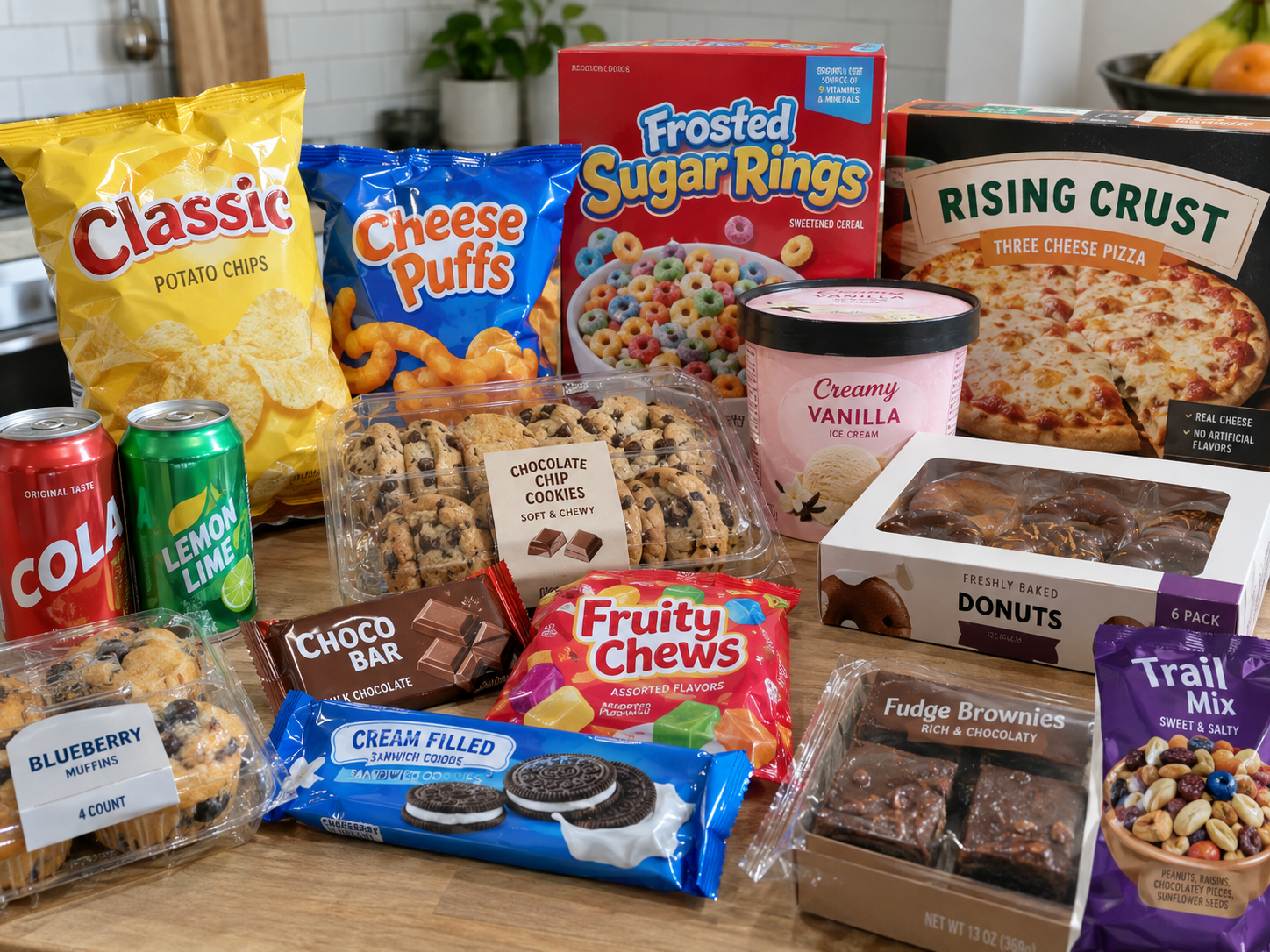
The rules do not ban sweets, crisps, cakes, breakfast cereals, pizzas, ice cream, sugary soft drinks or the other categories covered by the regulations. They do not impose maximum prices or prevent shops reducing the ordinary price of an individual product. Instead, they remove particular promotional techniques from products that both fall within specified categories and are classified as less healthy under the nutrient profiling system used by the regulations.
From 1 October, affected retailers will no longer be able to use promotions such as “buy one get one free”, “three for two”, “three for £10” or offers promising an additional quantity free where a qualifying high-fat, sugar or salt product is involved. The restriction can also apply where the promotion combines a restricted food with something outside the regulations. Scottish Government guidance gives the example of a newspaper offered with a chocolate bar free: where the chocolate falls within the regulated categories and nutritional threshold, describing it as free would make the promotion unlawful.
Ordinary price reductions remain possible because the regulations are directed at volume promotions rather than every form of discounting. A retailer can reduce the price of one qualifying item without requiring the customer to buy additional units. Meal deals are also outside the new restrictions, as are alcohol promotions, which are regulated through separate legislation.
The second major change concerns location. In qualifying stores with at least 185.8 square metres, or 2,000 square feet, of relevant floor space, restricted products will no longer be permitted in some of the positions retailers have traditionally used to attract attention. These include entrances, checkout areas and aisle ends. Equivalent restrictions apply to prominent parts of qualifying online stores, including locations designed to expose customers to products as they enter or complete a purchase.
The placement provisions are significant because supermarket merchandising has long been built around the value of particular positions inside a shop. An aisle-end display is visible from more than one direction and does not require the customer to enter the aisle containing the product. Checkout displays capture customers who have already completed most of their shopping, while entrance displays reach almost everyone entering the premises. Under the new system, some of the foods most commonly associated with those locations will have to be moved elsewhere.
Not every retailer is affected. The main promotion restrictions apply to businesses with 50 or more employees that sell products falling within the regulations. Smaller businesses are therefore outside most of the regime. Location restrictions apply only to qualifying stores with at least 2,000 square feet of relevant sales area, providing another exemption for smaller premises.
There are further limits on the types of food covered. A product must be prepacked, belong to one of the categories listed in the regulations and be assessed as less healthy under the nutrient profiling model before the promotion restrictions apply. Loose bakery products and foods made and packed within the shop, for example, generally sit outside the main restrictions. The Scottish Government’s public guidance uses fresh pizzas prepared and packed in a shop and loose pastries as examples of products not covered in the same way as qualifying prepacked equivalents.
The distinction means two foods that appear similar to customers may be treated differently depending on how they are produced and packaged. A prepacked cake that falls within a scheduled category and exceeds the nutritional threshold may be subject to restrictions while a loose product from an in-store bakery may not be. Retailers therefore have to identify not merely broad categories of food but the regulatory status of individual stock lines.
Restaurants, cafés and takeaways are largely outside the placement and volume-promotion regime. One provision reaches further into the hospitality sector: businesses with 50 or more employees can no longer offer free refills of qualifying soft drinks containing added sugar. That restriction applies even though the wider rules on supermarket display and multi-buy promotions do not generally apply to food prepared and sold in the out-of-home sector.
The regulations create practical work for retailers before the first customer encounters any difference on a shelf. Businesses must determine which products meet both the category and nutritional tests, alter promotional systems so prohibited offers do not appear, change store layouts where affected products currently occupy restricted positions, and ensure online shopping systems do not display them in prohibited digital locations.
On-pack promotions create another complication. Products are often manufactured for sale across Britain rather than specifically for Scotland, meaning packaging may already carry a printed multi-buy offer. Scottish guidance says qualifying retailers may continue selling such stock, but where a prohibited volume promotion appears on the packaging they must make clear that the offer is not available in Scotland.
The regulations are deliberately close to systems already operating elsewhere in Britain. Equivalent location and promotion restrictions have been introduced in England and Wales, and the Scottish Government says businesses favoured alignment during consultation because supermarket distribution, manufacturing and promotional systems commonly operate across the UK rather than within separate national supply chains.
There are nevertheless Scottish differences. Government implementation guidance notes, for example, that Scotland and Wales apply aisle-end restrictions to all aisle ends covered by the regulations rather than only those located beside principal customer routes.
The scale of implementation extends beyond the largest supermarket names. Scottish Government economic analysis estimated in 2024 that around 5,500 retailers could potentially fall within the regulatory landscape, although individual obligations depend on employee numbers, store size, the products sold and the exemptions contained in the regulations.
The Government’s business assessment recognises that the changes carry costs. Its central estimate for the final package put one-off transition costs at approximately £1.9 million, including familiarisation, product assessment and store planning, with recurring costs estimated at about £1.7 million a year. Those calculations are models rather than bills that individual businesses will necessarily experience, and the assessment describes the results as illustrative because retailers and manufacturers may change their behaviour once the system is operating.
The same modelling anticipates changes in commercial behaviour. Retailers can replace restricted foods in valuable entrance, checkout and aisle-end positions with products that are outside the regulations. Manufacturers can reformulate existing products or launch alternatives capable of passing the nutrient profiling test. The assessment also acknowledges that restricting multi-buy promotions removes one method by which suppliers and retailers compete on price and could affect the way new high-fat, sugar or salt products are introduced to the market.
Retail trade groups have spent much of this year preparing stores for implementation. The Scottish Grocers’ Federation has produced compliance guidance for the sector and has previously raised concerns about the practical work involved in applying the system, particularly as retailers have to decide whether individual products fall within the regulatory definition rather than relying simply on familiar descriptions such as confectionery or snacks.
The Scottish Government’s case for the restrictions is based on public health rather than retail regulation as an end in itself. Its assessment argues that prominent displays and volume offers increase purchases of foods that people had not intended to buy or encourage greater quantities to be purchased. The policy is intended to alter that environment without removing the products from sale.
Its economic assessment models the health and wider economic benefits over 25 years at between approximately £2 billion and £2.4 billion, principally through increased economic output, lower NHS and social-care costs and the modelled value of improved health. The central estimate is approximately £2.29 billion. Those figures are projections based on assumptions about how purchasing and calorie consumption change after the restrictions and should not be read as money that will automatically be saved.
The direct effect on shoppers will be easier to observe.
From October, the packet of sweets beside a supermarket till may be somewhere else. A qualifying soft drink may no longer be offered as two bottles for a reduced combined price. A supermarket website may stop placing particular products prominently as customers enter its digital store or reach the online checkout. Other foods will occupy the physical and digital spaces that become available.
At the same time, the same restricted products can remain on shelves and can still be sold at reduced individual prices. Smaller retailers remain largely outside the regime, while loose and freshly prepared foods can fall outside restrictions applying to prepacked equivalents.
Enforcement will sit primarily with Scotland’s local authorities acting as food authorities. They will be able to use powers contained in the regulations and existing food legislation, including compliance notices, where qualifying businesses fail to meet the new requirements. Failure to comply can amount to an offence.
The rules arriving on 1 October therefore represent neither a prohibition on particular foods nor a general regulation of supermarket prices. They alter the commercial mechanisms used to place and promote a defined group of products, transferring some of the most valuable promotional spaces in larger Scottish shops to other goods and removing multi-buy incentives from products that meet the statutory test.
What replaces them — in aisle ends, at checkouts and in the promotional budgets of manufacturers and supermarkets — will become visible when Scotland’s retail shelves change next month.
Sources
Scottish Government — Food promotion rules in Scotland from 1 October 2026
https://www.gov.scot/publications/food-promotion-rules-scotland/
Scottish Government — Food (Promotion and Placement) (Scotland) Regulations 2025: implementation guidance
https://www.gov.scot/publications/food-promotion-placement-scotland-regulations-2025-implementation-guidance/
Scottish Government — Which businesses must comply with the promotion restrictions?
https://www.gov.scot/publications/food-promotion-placement-scotland-regulations-2025-implementation-guidance/pages/3/
Scottish Government — What food is in scope
https://www.gov.scot/publications/food-promotion-placement-scotland-regulations-2025-implementation-guidance/pages/4/
Scottish Government — Volume price promotions
https://www.gov.scot/publications/food-promotion-placement-scotland-regulations-2025-implementation-guidance/pages/5/
Scottish Government — Location promotions
https://www.gov.scot/publications/food-promotion-placement-scotland-regulations-2025-implementation-guidance/pages/6/
Scottish Government — Food (Promotion and Placement) (Scotland) Regulations 2025: Business and Regulatory Impact Assessment
https://www.gov.scot/publications/bria-food-promotion-placement-scotland-regulations-2025/
Scottish Government — Scottish Firms Impact Test
https://www.gov.scot/publications/bria-food-promotion-placement-scotland-regulations-2025/pages/6/
Scottish Government — Competition Assessment, including the estimate of 5,500 potentially affected retailers
https://www.gov.scot/publications/bria-food-promotion-placement-scotland-regulations-2025/pages/7/
Scottish Government — Enforcement, sanctions and monitoring
https://www.gov.scot/publications/bria-food-promotion-placement-scotland-regulations-2025/pages/12/