
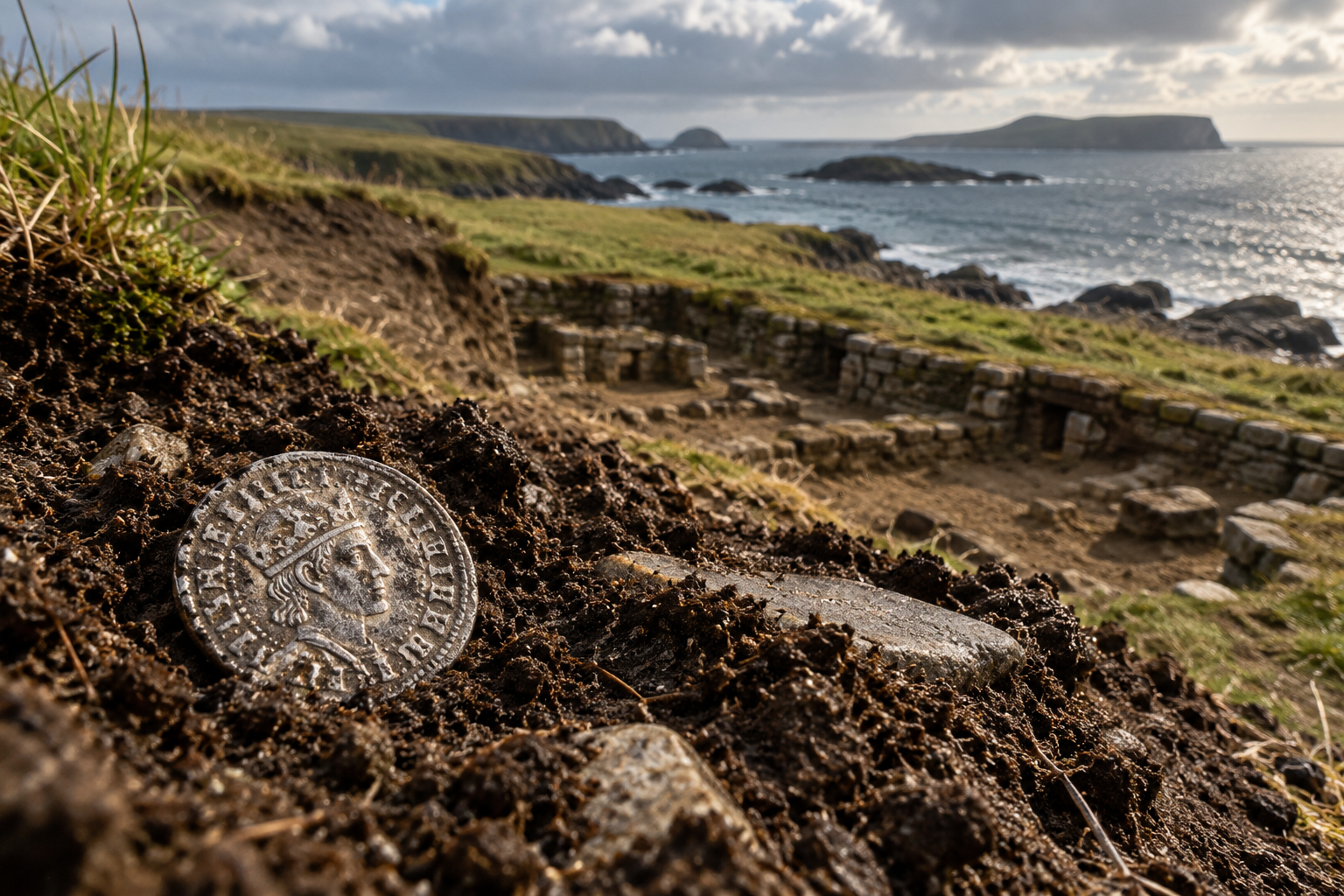
The Shetland discovery comes from an eroding coastal site already yielding evidence from the Bronze Age, Iron Age and Norse periods. Its precise ruler and mint have not yet been published, but earlier finds show English silver travelling deep into the Scandinavian world of the Northern Isles.
An Anglo-Saxon coin discovered at Gletness in Shetland has been identified by Archaeology Shetland as the northernmost example yet found in the United Kingdom, extending the known geographical reach of such coinage farther into the North Atlantic than previous recorded finds.
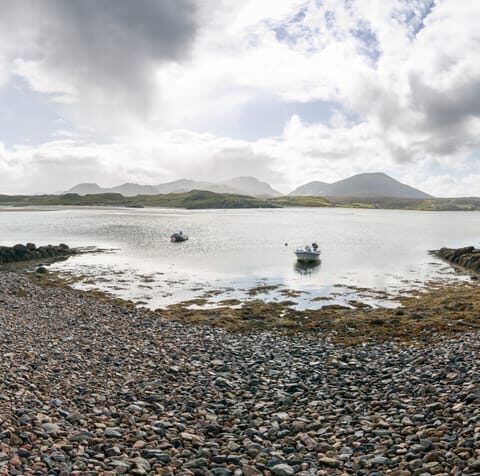
The coin was recovered at Gletness in the parish of Nesting on the east side of Mainland Shetland, at a coastal archaeological landscape where remains spanning thousands of years are being progressively exposed by erosion. Its detailed numismatic identification — including the ruler under whom it was struck, its mint, moneyer and precise coin type — has not yet been published. Those details will ultimately determine whether the object belongs to the period of established Norse settlement in Shetland or represents something earlier and considerably more unusual.
The absence of that identification is significant because an Anglo-Saxon coin can often be dated much more closely than the stone buildings and occupation deposits around it. Later Anglo-Saxon pennies commonly carry the king’s name and, on the reverse, information identifying the moneyer responsible for striking the coin and frequently the mint where it was produced. A sufficiently preserved specimen can therefore sometimes be placed not simply within a century but within a particular reign, issue and monetary system.
What is already known about Gletness gives the discovery an unusually rich archaeological setting.
The stretch of shoreline was investigated in detail in 2025 by the SCAPE Trust and Archaeology Shetland after years of monitoring increasingly vulnerable remains. Trial excavation and recording between 29 May and 3 June examined both a suspected Bronze Age burnt mound and an eroding settlement represented by drystone structures at the coast edge. The work was undertaken because active erosion was damaging archaeology that researchers and landowners had watched for more than a decade.
The western part of the investigation confirmed a complex burnt mound containing large paving slabs, extensive deposits of heat-cracked stone and a corbelled subterranean structure holding a waterlogged deposit, interpreted by the excavators as a possible well. Burnt mounds are generally associated with the Bronze Age and the repeated heating of stones before their immersion in water, although the exact activities carried out at such sites remain debated.
Farther east, excavation and cleaning of the exposed coastal section revealed foundations belonging to one or more substantial Iron Age structures. Pottery recovered from occupation and demolition deposits was considered likely to be Middle to Late Iron Age in date. The surviving mound was composed largely of truncated stone walls, tumble and occupation material containing peat ash, charcoal, shell, animal bone and pottery.
Immediately offshore are the fragmentary remains of what is recorded as a possible broch on the small islet of Litilom. The relationship between land and water there has changed markedly. Research used in the Gletness project estimates that relative sea level in Shetland was between 1.2 and 2.9 metres lower around 2,000 years ago. The feature now separated from the settlement by water would during the Iron Age have occupied a small headland on the side of a bay, with the settlement behind it.
The Bronze Age landscape would have looked different again. The Gletness report estimates that the coastline may then have lain between 150 and 300 metres farther seaward than it does today. What is now a line of small islands and tidal water formed part of a much broader low-lying coastal landscape.
The site did not cease to accumulate evidence after the Iron Age. Finds previously recovered from around Vardasta at Gletness include saddle and rotary querns and a Viking or Norse comb. Medieval and later pottery has been recovered from the foreshore, while the 2025 excavation found a Norse-type net sinker in the upper deposits. The excavators described the evidence for Norse-age and later activity as slight and cautioned that the upper levels are disturbed, containing a mixture of prehistoric, Norse and modern material.
That caution is important when considering the new coin. Its presence cannot by itself demonstrate that Anglo-Saxons lived at Gletness, nor would an English coin establish English political control of Shetland. Coins could travel very considerable distances from the authorities and mints that produced them, and the Northern Isles were deeply connected to Scandinavian networks during the Viking Age.
In Anglo-Saxon England, a penny was part of a controlled monetary system in which its official type, weight and silver content mattered. In Scandinavian Scotland, silver could operate differently. Archaeological research into Viking and Norse exchange shows that metal was frequently valued according to weight and purity rather than solely according to the monetary authority stamped on it. Coins could circulate alongside silver ornaments and ingots and could themselves be treated as pieces of valuable metal.
That distinction offers one explanation for the presence of English money so far north. A coin bearing the name of an English king did not have to remain within an English monetary economy. Once carried into Scandinavian networks, its silver could be useful whether it remained intact, was accumulated in a hoard, exchanged as bullion or eventually cut into smaller pieces.
Shetland already has important evidence of precisely this movement of Anglo-Saxon coinage into a Norse environment.
At Old Scatness in the South Mainland, archaeologists recovered a silver coin of King Æthelstan, whose reign ran from 924 to 939. Research on the excavation records the coin as having been minted at Chester or York and considers it likely to have remained in circulation between about 930 and 970. It came from a distinctive deposit overlying earlier Pictish structures during a period in which the character of the settlement was changing. By the end of the tenth century, Old Scatness was clearly Scandinavian in character.
Æthelstan is an especially significant ruler in the history of English coinage. His reign accompanied the consolidation of a kingdom extending across much of what became England, and his coins travelled beyond the political territory from which they originated. The Old Scatness penny is direct evidence that one of them reached Shetland.
Another Anglo-Saxon penny was found at Jarlshof, also in the South Mainland. The established numismatic record identifies it as a First Hand type of Æthelred II, struck at York. Æthelred reigned from 978 to 1016, apart from the brief interruption of his rule in 1013–14, during one of the most intense periods of Scandinavian military activity and movement of silver between England and the Viking world.
The Jarlshof coin was not an isolated indication of English money reaching Shetland. In 1830 a major silver discovery was made at Quendale in Dunrossness, subsequently referred to under several names including Garthsbanks. Nineteenth-century descriptions record a horn containing Anglo-Saxon coins accompanied by silver arm-rings. Later numismatic work indicates that the coin element extended across a long chronological range, from Æthelstan through later tenth-century rulers and into the reign of Æthelred II.
Only a small part of that coin assemblage survives in identifiable form, and early accounts of the circumstances are imperfect. Even so, the chronological spread of the Quendale material suggests that English pennies had been reaching Shetland across much of the tenth century rather than through a single isolated event.
Together, Old Scatness, Jarlshof and Quendale establish an important point about the Gletness discovery. It is not the first Anglo-Saxon coin to reach Shetland. What appears to make it exceptional is where within Shetland it was found.
The principal earlier examples lie around Dunrossness in the far south of Mainland. Gletness is much farther north, in Nesting, at approximately 60 degrees north. The difference in latitude places the new discovery roughly 40 kilometres north of the well-documented Old Scatness and Jarlshof finds. Archaeology Shetland’s description of the coin as the northernmost Anglo-Saxon example yet found in the UK therefore represents a geographical extension of an already established pattern rather than the first evidence of this coinage in the islands.
The earlier finds also provide a basis for considering the likely age of the unidentified Gletness coin, although they cannot identify it.
The strongest working possibility is a silver penny of the tenth or early eleventh century: broadly the period represented by the Æthelstan coin at Old Scatness, the Æthelred penny at Jarlshof and the Anglo-Saxon component of the Quendale hoard. Such a date would fit an established archaeological pattern in which English silver moved into Scandinavian Scotland during the Viking Age.
It remains an inference, not an identification.
There is a much more unusual alternative. If the Gletness object proved to be one of the earlier Anglo-Saxon silver coinages of the seventh, eighth or ninth centuries, its historical implications would be different. Earlier Anglo-Saxon coins are rare in northern Scotland, and a genuinely pre-Viking example from Shetland would require the geographical and chronological evidence to be reconsidered well beyond the already remarkable northern location of the find.
Nothing yet published about the Gletness coin justifies that conclusion. Until the object has been formally identified, the tenth-century Viking-age context remains the more conservative hypothesis because it fits both the known Shetland coin record and the evidence for later activity at Gletness.
Even if that hypothesis proves correct, the eventual identification could reveal considerably more. A king’s portrait and inscription can establish the issuing authority; the reverse legend may identify a moneyer and mint. Different designs were introduced as English rulers periodically changed their coinage, giving numismatists another means of narrowing the date. Wear can indicate that a coin remained in use for some time after striking, while its archaeological context may establish whether it was lost during occupation, deliberately deposited or moved from its original layer by later disturbance.
The mint could also alter the geographical story. York would provide an obvious connection with a major northern English centre deeply entangled with the Scandinavian world during the tenth century. A coin from a southern or western English mint would demonstrate a longer monetary journey before it reached Shetland. The Quendale material already shows that Shetland’s connections were capable of drawing silver from a wide monetary geography.
Single coins and hoards answer different archaeological questions. A hoard such as Quendale represents the deliberate accumulation of wealth and may contain material gathered over decades. A solitary coin can represent something much more immediate: an object carried, handled and eventually dropped or deposited at a particular settlement. Its value as evidence depends heavily on knowing exactly where and within what archaeological layer it was found.
That makes the continuing work at Gletness important beyond the coin itself. The coastline is actively removing the context in which such objects survive. The 2025 excavation was undertaken because structures that had persisted for centuries were becoming increasingly exposed and truncated by the sea. Artefacts recovered from the foreshore include material from widely separated periods because erosion is cutting through deposits that accumulated over a very long span of occupation.
At Gletness, the sea is consequently doing two contradictory things: revealing archaeology and destroying the relationships between objects, buildings and layers that allow archaeologists to understand it. A coin recovered in isolation can identify a date and ruler; a coin securely related to a floor, midden, demolition layer or structure can say considerably more about the people who possessed it.
The discovery therefore adds two records to the same piece of shoreline. It extends the known northern distribution of Anglo-Saxon coinage in the UK while adding another fragment to a Gletness landscape that already contains Bronze Age activity, substantial Iron Age occupation and evidence of a later Norse presence.
The remaining questions are unusually precise. The ruler has yet to be publicly identified. So have the mint, moneyer and coin type. Its exact date, condition and archaeological context have not yet been fully published.
When those details emerge, they should reveal whether the newest object from Gletness belongs to the same tenth- and early eleventh-century flow of English silver already documented elsewhere in Shetland, or whether a very small coin has pushed the history of contact with the islands farther back as well as farther north.
Sources
Archaeology Shetland — announcement of the Anglo-Saxon coin discovery at Gletness
https://www.facebook.com/ArchaeologyShetland/posts/1527903789374031/
SCAPE Trust — Archaeological Investigation at Gletness, Shetland: Data Structure Report, September 2025
https://scapetrust.org/wp-content/uploads/reports/Gletness-DSR-Sept-2025.pdf
SCAPE Trust — Archaeological Investigation at Gletness, Shetland project page
https://scapetrust.org/case-studies/archaeological-investigation-at-gletness-shetland-data-structure-report/
Archaeology Shetland — Excavation and the Story of Four Sites, including Old Scatness
https://www.archaeologyshetland.org/post/2015/10/28/in-depth-excavation-and-the-story-of-four-sites
British Numismatic Society — Currency Under the Vikings: Ireland, Wales, Man and Scotland, including the Æthelstan find from Old Scatness and Æthelred II find from Jarlshof
https://www.britnumsoc.org/publications/Digital%20BNJ/pdfs/2007_BNJ_77_7.pdf
Society of Antiquaries of Scotland — Anglo-Saxon and Viking-period coin finds from Scotland, including the Jarlshof Æthelred II penny
https://archaeologydataservice.ac.uk/catalogue/adsdata/arch-352-1/dissemination/pdf/vol_116/116_301_374.pdf
Oxford Academic — The Viking Age in Scotland: What Does Landnám Look Like? Excavations at Swandro and Old Scatness
https://academic.oup.com/edinburgh-scholarship-online/book/56965/chapter-abstract/455416879
Oxford Academic — Viking and Norse Bullion Economies in Scandinavian Scotland
https://academic.oup.com/edinburgh-scholarship-online/book/56965/chapter-abstract/455431563
Scottish Society for Northern Studies — The Penny in the Pennylands, including the Shetland coin record and Quendale hoard
https://www.ssns.org.uk/wp-content/uploads/2019/09/Smart_1985_Vol_22_pp_65_70.pdf
Scottish Society for Northern Studies — The Viking-Age Silver Hoard(s) from Shetland
https://www.ssns.org.uk/wp-content/uploads/2019/09/Graham-Campbell_2010_Vol_41_pp_13_21.pdf
National Museums Scotland — Understanding hoards in the Viking Age and the role of coin and bullion silver
https://www.nms.ac.uk/discover-catalogue/understanding-hoards-in-the-viking-age