

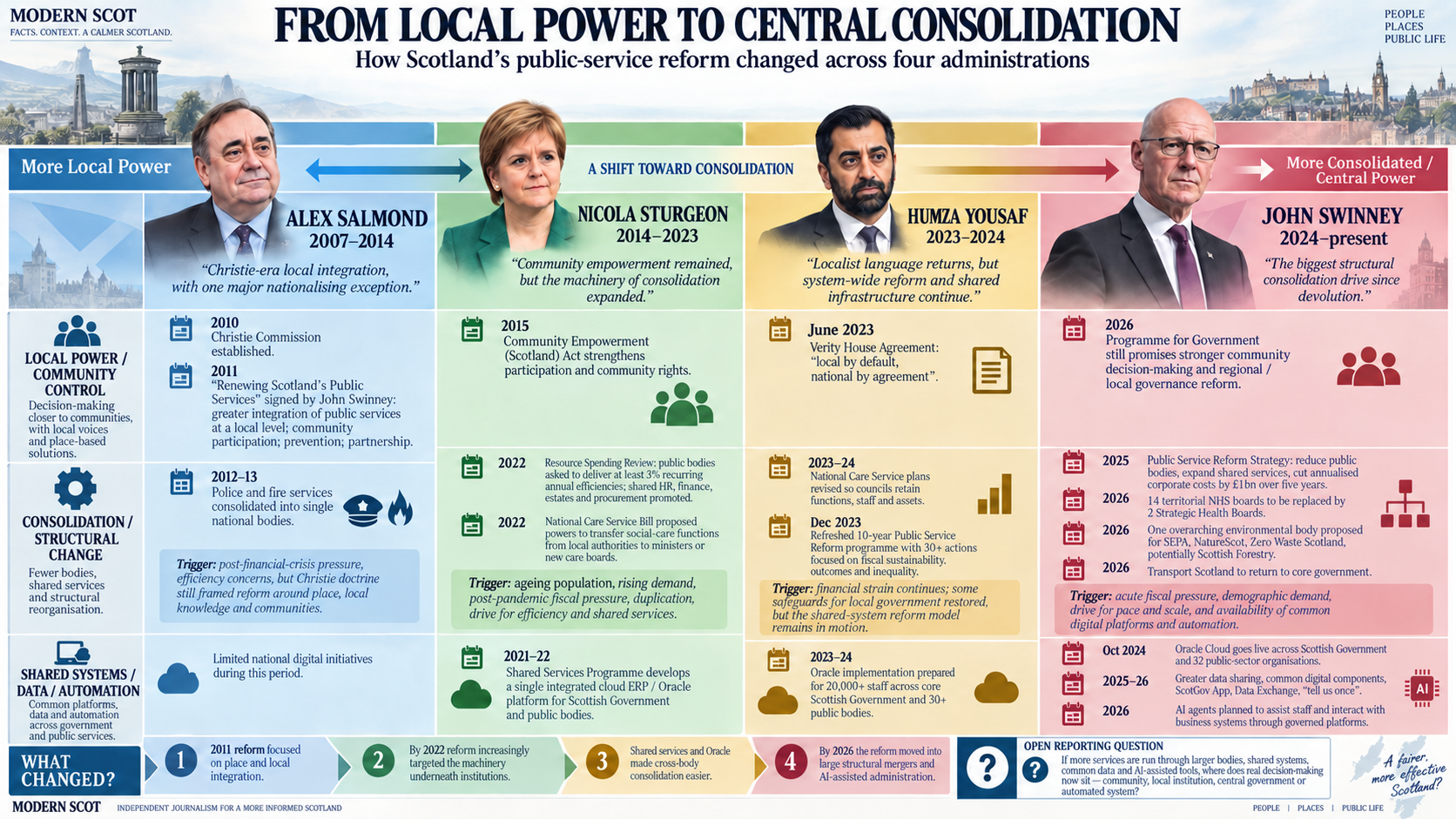
The same politician who signed the Scottish Government’s response to the Christie Commission, placing local integration, community participation and effective local delivery among the foundations of reform, now leads a programme to reduce public bodies, replace 14 territorial health boards with two strategic boards, consolidate corporate systems, expand data sharing and introduce AI-assisted administration. The documentary record shows how Scotland’s model of public-service reform changed across the Salmond, Sturgeon, Yousaf and Swinney administrations.
On 21 September 2011, John Swinney signed the foreword to Renewing Scotland’s Public Services: Priorities for Reform in Response to the Christie Commission, the Scottish Government’s formal response to the Christie Commission. Alex Salmond was First Minister and Swinney was Cabinet Secretary for Finance, Employment and Sustainable Growth. The document set out four pillars for reform: a shift towards prevention; greater integration of public services at local level through partnership, collaboration and effective local delivery; greater investment in the public-service workforce; and a sharper focus on performance, transparency, innovation and digital technology. Swinney’s name, title and signature appear beneath the foreword.
The emphasis on locality ran through the substance of the response. It said effective locally integrated provision was crucial to improving outcomes and identified partnership at local-authority level as central to that work. Christie had argued that public services should be built around people and communities, drawing on local capacity while strengthening autonomy and resilience. The Government’s response described place-based partnership and joint planning as mechanisms through which better outcomes and better use of resources could be achieved.
That emphasis on local decision-making also sat within the Salmond Government’s wider constitutional argument for independence. The 2013 independence white paper, Scotland’s Future, argued that decisions about Scotland should be taken by the people who live in Scotland rather than at Westminster. It also said independence would create an opportunity to entrench the position of local government in a written constitution and consider the appropriate responsibilities of councils and communities. The document stated that local authorities were democratically accountable to their own electorates, not to the Scottish Government.
Salmond made the link between national self-government and local subsidiarity more explicit in the Lerwick Declaration of July 2013. Responding to the campaign by Scotland’s island councils for greater control, he said the principle of self-determination meant supporting subsidiarity and local decision-making. The subsequent Empowering Scotland’s Island Communities programme examined how Orkney, Shetland and the Western Isles could gain greater influence over economic, fiscal, environmental and resource questions in the event of independence.
The independence case being advanced by Salmond’s Government therefore operated on two levels. It argued that powers exercised at Westminster should move to Scotland because decisions affecting Scotland were better made by people living here. At the same time, it said some powers exercised nationally should sit closer to councils and communities for the same reason: decisions should be taken as close as practical to the people and places affected.
That did not prevent the Salmond Government from creating national structures where it believed consolidation was justified, most notably Police Scotland and the Scottish Fire and Rescue Service. But the formal constitutional prospectus placed local democracy, subsidiarity and community empowerment alongside Scottish national self-government rather than treating all newly devolved authority as power that should remain at the centre.
Fifteen years later, Swinney is First Minister. On 1 September 2026, his Government announced that Scotland’s 14 territorial NHS boards would be replaced by two strategic boards and that the number of special health boards would be reduced further. It also proposed bringing SEPA, NatureScot and Zero Waste Scotland into one overarching environmental organisation, potentially with Scottish Forestry; returning Transport Scotland to core government; examining other transport bodies for merger; considering consolidation of public-land organisations; rationalising inspectorates; and reviewing the remaining public-body landscape for efficiency, joint working or merger.
The programme reaches beneath the institutional map as well. Corporate services are increasingly shared, estates and procurement are being treated across organisational boundaries, data is intended to move more readily between services, and a “tell us once” model is being developed. The Public Service Reform Strategy places Shared Services, data collection, digital resources, national procurement and Intelligent Automation within the same efficiency programme and sets a target of reducing annualised Scottish Government and public-body corporate costs by £1 billion over five years.
The published record does not show that Swinney has formally abandoned local government or community participation. His Government continues to support policies described in terms of subsidiarity and stronger community decision-making. What the record does show is a substantial alteration in the machinery through which Scottish public administration is being organised. Swinney is the clearest point of continuity across that period: finance secretary throughout the Salmond administration, Deputy First Minister for most of the Sturgeon years, outside government during Humza Yousaf’s premiership, and First Minister from May 2024.
The documentary question is therefore not dependent on speculation about his personal motives. It is how a reform programme that placed unusually strong emphasis on local integration evolved into one increasingly built around larger institutions, common infrastructure, shared data and nationally scalable technology.
Salmond: Reform Around Place
The starting point was never completely decentralised. Salmond’s government also created Police Scotland and the Scottish Fire and Rescue Service, replacing eight regional police forces and eight regional fire and rescue services. National consolidation was therefore already present within the early reform programme, justified on the basis that duplication could be reduced while local delivery was preserved.
Even with that important exception, the language of the 2011 Christie response was heavily concerned with place. Local services were expected to work together, budgets could be planned jointly, and frontline workers and communities were treated as sources of knowledge about how services should be organised. The Government described greater integration at local level as one of the four foundations of reform and said effective place-based partnership could improve outcomes and make better use of public resources.
The financial pressure was already present. Christie was commissioned because increasing demand and constrained public expenditure were expected to make the existing model more difficult to sustain. The important point is that the principal response was not simply to move administration upwards. A substantial part of the answer was to make organisations cooperate more effectively around the communities they served.
Sturgeon: The Administrative Direction Changes
Nicola Sturgeon became First Minister in November 2014, and the early part of her administration strengthened the localist side of the settlement through the Community Empowerment (Scotland) Act 2015. The legislation created stronger mechanisms for community bodies to participate in public decision-making and seek control of public assets. Local empowerment therefore did not disappear when Salmond left office.
By the later Sturgeon period, however, the administrative programme was moving in a different direction. The 2022 Resource Spending Review required public bodies to plan for recurring annual efficiencies of at least 3 per cent and identified shared services, the public estate, procurement and grant management as areas where savings should be pursued. It explicitly said bodies maintaining their own HR or finance functions should examine whether corporate services could be shared, while the estate programme called for fewer buildings, more co-location and greater interoperability across the public sector.
The difference was significant. Christie had largely asked how separate organisations could work together around people and places. The newer model increasingly asked why those organisations needed to maintain separate administrative machinery. Human resources, finance, procurement, property and technology could increasingly be provided collectively. A public body did not have to disappear for part of its operational independence to move elsewhere.
The same spending review also gave the digital programme a clearer system-wide form. It described centralised payments, a digital identity programme, cloud adoption and common platforms capable of cutting across organisational boundaries. The stated purpose was to allow organisations to direct more staff and resources towards frontline services rather than maintaining duplicate back-office processes.
The National Care Service Tested the Limits
The National Care Service (Scotland) Bill, introduced in June 2022 by Health Secretary Humza Yousaf, went further than shared administration. As introduced, it would have allowed Scottish ministers to transfer specified social-care functions from local authorities and health boards to ministers or new care boards. Parliamentary briefing material described those care boards as directly accountable to Scottish ministers and directly funded by them, unlike the existing integration arrangements that linked accountability to health boards and local authorities. The Bill also contained mechanisms for transferring staff, property and liabilities.
The proposal generated sustained concern about local accountability and was subsequently altered. By 2023, the emerging agreement with COSLA meant councils would retain functions, staff and assets that earlier versions of the scheme had contemplated transferring. The episode showed that movement towards national structures was neither automatic nor uncontested.
Yousaf: Local by Default, While Reform Continues
Humza Yousaf became First Minister in March 2023. Three months later, his Government and COSLA signed the Verity House Agreement, adopting the maxim “local by default, national by agreement”. The agreement said public responsibilities should generally be exercised by the authorities closest to citizens and required local government to be involved from the beginning when ministers explored national delivery models affecting councils.
That was a strong restatement of the localist principle, but it did not stop the wider reform infrastructure. Yousaf’s administration continued work on public-sector reform, digital transformation, the public estate, common digital components and shared administrative systems. The Scottish Government’s Shared Services Programme was preparing the Oracle Cloud platform that would later replace older HR and finance systems across core government and dozens of public bodies.
The Yousaf period therefore does not fit neatly into either a local or central column. It restored an unusually explicit statement of local-government autonomy while continuing development of the administrative infrastructure that made greater system-wide sharing possible.
Swinney: Consolidation Becomes Structural
Swinney returned as First Minister in May 2024. Oracle Cloud went live that October as part of the existing Shared Services Programme, moving the Scottish Government and 32 public-sector organisations onto common corporate infrastructure. The platform’s HR component was rolled out across a customer base of around 20,000 users, while finance modules were introduced in stages during October.
The Public Service Reform Strategy published in June 2025 expanded the programme beyond shared administration. It formalised a “Once for Scotland” approach to Shared Services, with plans to add suitable organisations to the common HR, finance and purchasing platform and build shared services at greater scale. The same strategy made Intelligent Automation a national workstream, proposing a hub-and-spoke model across core government and key public bodies and describing AI-enabled automation as a means of increasing capacity, reducing costs and addressing cross-cutting operational challenges.
By 2026, the reform had moved beyond common systems to the institutional map itself. The Programme for Government says the 14 territorial NHS boards will be replaced by two strategic boards and the number of special boards reduced further. It proposes a single overarching environmental body for SEPA, NatureScot and Zero Waste Scotland, potentially including Scottish Forestry, while other parts of the public-body landscape are to be reviewed for consolidation.
The Government is simultaneously pursuing Democracy Matters, which continues to describe subsidiarity and stronger community decision-making as objectives. A joint Scottish Government-COSLA statement in March 2026 reaffirmed the Verity House principle that decisions should be local by default and national by agreement and said proposed community-governance reforms would strengthen communities’ rights and powers.
The two programmes, however, are at different stages. The Government has already specified that 14 territorial health boards will become two strategic boards. Community-level reform still requires further decisions on governance, funding, implementation and legislation. That difference in timing and specificity will be important as the programme develops.
The Same Signature at Both Ends
That is what makes Swinney’s position unusual. In 2011, his signature appeared beneath a Government response that placed local integration among the central pillars of reform. In 2026, he is First Minister of an administration pursuing larger strategic institutions, fewer public bodies and more shared administrative infrastructure.
The contrast now sits directly with Swinney. In 2011, he signed a Government response that made “greater integration of public services at a local level” one of four pillars of reform and said effective local delivery should be driven by partnership and collaboration. In 2012, he told Parliament that local government was a “central participant” in reform and described collaboration among councils, health services, police and the third sector at local level as central to the Christie agenda.
By 2025, Swinney was still presenting his programme as a continuation of Christie, describing empowerment, integration, efficiency and prevention as Christie’s four principles. But his Government’s practical programme now includes replacing 14 territorial health boards with two strategic boards, reducing public bodies, bringing national environmental organisations into one body, expanding shared corporate systems and developing AI-assisted administration.
Swinney’s answer is that larger strategic structures can coexist with stronger communities. In September 2026 he described the programme as a “rebalancing of power”, arguing for stronger regions alongside community empowerment and saying some councils are too small to be strategic while others are too large to be local.
What he has not yet set out in comparable detail is how the authority moving upward into two strategic health boards, national bodies, shared systems and centralised corporate services will be matched by statutory, financial and executive powers moving downward. The upward changes are already named and structured. Much of the downward programme remains in consultation, route maps and future governance proposals.
That leaves Swinney with a question his own record makes unavoidable: if local integration and effective local delivery were central enough to public-service reform for him to sign them into policy in 2011, why are some of the most concrete reforms he now leads organised at a much larger national or regional scale? Financial pressure, demographic change and new technology explain why reform has accelerated. They do not, by themselves, explain why consolidation has become the preferred institutional answer.
What Did Voters Actually Approve?
The 2026 election returned the SNP as the largest party with 58 of the Scottish Parliament’s 129 seats, leaving it short of an overall majority. The party’s election programme contained a broad public-service reform commitment, including reducing public bodies and greater use of technology, while also promising greater power for people and communities. The specific institutional map announced in September was more detailed than that electoral proposition.
In particular, voters were not presented before polling day with a manifesto proposal setting out the subsequent 14-to-two territorial health-board structure or the named combination of SEPA, NatureScot and Zero Waste Scotland into one overarching environmental body. The relevant distinction is therefore not that reform was absent from the electoral programme, but that the commitment voters saw was broader than the structural design subsequently announced.
Measures requiring legislation will now proceed through a Parliament in which the Government cannot provide an outright majority on its own.
Twenty Thousand Users, One Corporate Platform
Oracle provides the clearest existing example of what shared administration means in practice. The platform now connects Scottish Government core and 32 public-sector organisations, with the HR element rolled out to around 20,000 users and finance functions introduced across the same shared environment.
That does not mean every user can see every record, since access is controlled through roles and permissions, and Oracle should not be confused with a single repository for health records, social-care records or all citizen information. Its significance is that legally separate organisations can retain their statutory identities while relying on the same underlying administrative platform for important corporate functions.
Cloud infrastructure can provide professional backup, replication, cybersecurity and disaster recovery that older independent systems may struggle to reproduce. It can also create common dependencies. When organisations maintain separate systems, some failures remain confined to one organisation; when many organisations depend on one platform, the resilience of that platform, and of the networks required to reach it, becomes more important.
Scottish public-sector cyber-resilience requirements call for tested backups, disaster-recovery plans, alternative transmission paths where necessary and contingency mechanisms capable of maintaining essential services, even at a reduced level, when primary networks or information systems fail. What is much less visible publicly is the detailed local fallback position for each organisation using the common platform: whether urgent purchasing or payroll can continue, which critical information remains accessible locally, how long an organisation can function without the system, and what happens when the cloud platform itself remains operational but a rural or island office loses the telecommunications connection required to reach it.
These are not arguments against cloud computing. They are questions created by dependence on common infrastructure. Removing duplicated administration can reduce unnecessary cost, while independent communications routes, backups and locally accessible critical information can also provide resilience. The distinction depends on what is being duplicated.
From Separate Records to “Tell Us Once”
The next layer concerns citizen information. The Government is developing a “tell us once” model, shared data definitions, common datasets, Data Exchange and reusable digital services. The intention is to reduce repeated requests for the same information across different parts of government and make data more useful across organisational boundaries.
That does not establish that every Scottish citizen record is being placed into one national database. It does indicate movement away from information remaining entirely isolated within individual institutional systems and towards controlled reuse and interoperability. A state does not require one physical database for information to become more accessible across multiple public services.
ScotAccount: Scotland Already Has Digital Identity Infrastructure
ScotAccount forms part of this architecture. It allows people to use one account across participating Scottish public services and can support identity verification and reuse of verified identity attributes. At 1 June 2026, the Scottish Government reported just over 768,000 registered ScotAccount accounts and confirmed that the service processes biometric data derived from official documentation and a user selfie.
ScotAccount is therefore digital identity infrastructure, but it is not presently a compulsory national identity system. The Scottish Government has also said there are currently no plans simply to connect ScotAccount to the proposed UK national digital identity infrastructure. Discussions with the UK Government about interoperability and federation with GOV.UK One Login remain exploratory, with no agreed technical design or data flows recorded at the time of the Government’s August 2026 FOI response.
Questions Readers May Have
Is Scotland building a digital identity system that could become difficult to opt out of later?
Scotland already has a government digital-identity system in ScotAccount. It is designed to let one account be used across multiple public services, verify identity and reuse verified attributes such as name, date of birth and address. The Scottish Government currently says ScotAccount is voluntary and that offline routes to public services are maintained for people who cannot or choose not to use digital channels.
The important limitation is that this is the present policy position. The ScotAccount equality assessment repeatedly recommends maintaining offline routes, but that is not the same thing as an entrenched guarantee that every Scottish public service must always offer an equally usable non-digital route regardless of future policy. The practical safeguard therefore depends on whether offline access remains funded, staffed and genuinely equivalent as more services adopt common digital infrastructure.
For anyone concerned about becoming trapped in a digital identity system, the test is not simply whether use is described as voluntary today. It is whether a person can still obtain the same public service, challenge a decision, prove their identity and reach a human being without being compelled into the digital route.
Why isn’t John Swinney calling the wider programme a system ready for digital ID?
The Scottish Government does use the term digital identity for ScotAccount. It describes ScotAccount as a common service through which people can sign in to multiple public services, prove their identity and reuse verified attributes such as their name, date of birth and address.
What the Government does not do is describe the entire public-service reform programme as a digital-ID programme. The wider architecture is instead described through terms such as joined-up digital public services, common platforms and components, Data Exchange, “tell us once”, the ScotGov App, shared datasets and automation.
Those descriptions do not alter the underlying technical relationship. ScotAccount is being developed as a reusable identity component within a broader system designed to allow public services to work across organisational boundaries. The Government’s digital delivery plan explicitly says common platforms and components are to be embedded across the public sector and identifies ScotAccount as a central component of that work.
In that limited and factual sense, parts of the emerging architecture are already digital-identity ready: participating services can be designed to use a common Scottish Government identity service rather than each creating its own method of proving who a person is.
That is not the same as saying Scotland has adopted a compulsory national digital ID. It has not. Nor does it establish that every Scottish public service will require ScotAccount.
The question for the public is therefore less about the label attached to the programme and more about how the infrastructure is ultimately used. If more services become dependent on the same identity layer, the practical significance of ScotAccount increases even without a formal announcement that Scotland has moved to a universal digital-ID system.
The safeguards to watch are consequently concrete ones: which services require verified digital identity; whether an equally usable non-digital route remains available; which identity attributes can be reused between services; whether people can see and challenge that reuse; and whether future governments could expand the system without requiring a new Act of Parliament or another direct public decision.
There is no evidence in the published record establishing that John Swinney is deliberately avoiding the term “digital ID”. What the record does establish is that the Scottish Government openly describes ScotAccount as digital-identity infrastructure while presenting the much larger programme under the broader language of public-service reform and joined-up digital services.
Could a future Scottish Government make ScotAccount effectively compulsory even if it remains technically “voluntary”?
A service can remain formally voluntary while becoming difficult to avoid if the offline alternative is slower, harder to find, available only by telephone, or dependent on limited office hours. The Scottish Government’s current policy recognises that not everyone can or will use ScotAccount and says services adopting it should maintain offline routes.
The question to monitor is therefore not only whether the word “voluntary” remains in government policy. It is whether people continue to have a practical, accessible and reasonably equivalent way to obtain the underlying service without the digital identity system.
Banking provides a useful comparison. Customers are not legally required to use online banking, yet branch closures have removed face-to-face banking from many communities and prompted the creation of banking hubs and new regulatory protections for access to cash. In March 2026, the Scottish Parliament heard that communities from Tain to Castle Douglas had lost bank branches, while the FCA says its powers cannot prevent branches closing and are instead directed principally at preserving access to cash.
A service can therefore remain formally optional while the practical alternative becomes less available. For ScotAccount, the relevant test will be whether people who decline the digital route continue to have realistic access to the same public service through staffed, non-digital channels.
Does one ScotAccount mean all of my information is being put into one government database?
No evidence establishes that Scotland is creating one database containing every citizen record. ScotAccount is intended to verify identity and allow certain verified attributes to be reused across services. Other public services continue to operate their own systems and hold their own records.
The concern arises from the wider architecture rather than ScotAccount alone. The Government is simultaneously developing Data Exchange, common data definitions, reusable datasets and a “tell us once” approach. Those systems can make information held by separate organisations more interoperable without physically storing everything in one database.
That means the relevant question is not only “where is my data stored?” but “which services can retrieve it, under what authority, for what purpose, and can that access later be withdrawn?”
Once information is being reused between public services, can that sharing be rolled back?
Technically, systems and permissions can be changed. Legally, data sharing still requires a lawful basis and must comply with data-protection law.
The harder question is practical reversibility. Once services, staffing models and administrative processes are redesigned around shared data, reversing the arrangement may require rebuilding systems, restoring separate datasets, recreating local capability and changing contracts. The more public services become designed around interoperability, the greater the cost and organisational difficulty of returning to isolated systems.
That does not make reversal impossible. It means reversibility should be designed in before dependence becomes deep.
Is Scotland becoming locked into Oracle?
The Scottish Government itself has long recognised vendor lock-in as a cloud risk. Its cloud guidance warns that cloud services can become “sticky”, says organisations should plan how they would exit a provider, use standards that improve portability and know the cost of switching and extracting their data.
Oracle therefore should not be treated as an irreversible constitutional structure. Contracts can end and systems can be replaced.
But contractual reversibility and practical reversibility are different things. The more organisations redesign HR, finance, purchasing, staffing and internal processes around one platform, the more costly and disruptive departure can become. A credible safeguard is therefore not merely having a contract end date. It is having a tested exit plan, portable data, documented processes and the institutional ability to operate on another system.
The Scottish Government’s own cloud guidance says public bodies should understand how they would move their data to another provider and should know their switching and exit costs.
How many organisations now depend on Oracle, and what exactly is inside it?
The shared Oracle Cloud service is used by the Scottish Government and 32 other public-sector organisations. The platform principally covers corporate functions including HR, finance and purchasing. It is not a single repository for NHS patient files, social-care case records or all information held about Scottish citizens.
The scale matters because organisational independence can survive legally while administrative dependence increases. A regulator, agency or public body may retain its statutory identity while relying upon a common external platform for payroll, personnel administration, purchasing and financial management.
What happens if Oracle is working but a local office cannot reach it?
That is one of the unresolved resilience questions.
Audit Scotland has reported that Oracle Cloud databases and configurations are backed up and tested, that Oracle is responsible for full-stack disaster recovery, and that controls at the UK cloud data centres were operating effectively in the period examined.
That addresses resilience at the platform level. It does not by itself answer what happens in an island, rural office or individual public body if local internet or telecommunications fail while the central cloud service remains operational.
The important questions are whether critical information remains accessible locally, whether payroll and urgent purchasing can continue, whether staff have manual procedures, and how long the organisation is expected to operate without access to the central platform.
A backup held remotely is valuable if the cloud platform fails. It does not solve a local communications outage if staff cannot reach either the live system or the backup.
Is removing local duplication always a good thing?
No single answer applies to all duplication.
Two departments manually doing identical administrative work may represent unnecessary cost. Two independent network routes, local copies of critical records or separate emergency procedures may provide resilience.
Scottish Government cloud guidance itself recognises that increasing reliance on cloud services makes internet availability more important to business continuity and says organisations should consider that risk when adopting cloud systems.
The relevant question is therefore what is being removed. Eliminating duplicate bureaucracy and eliminating independent fallback capability are not the same reform.
Could Scotland become so dependent on one technology supplier that changing policy later becomes impractical?
That is the classic vendor-lock-in problem, and the Scottish Government’s own cloud guidance explicitly recognises it. The recommended safeguards include open standards, data portability, exit planning and understanding the cost of switching suppliers.
The risk grows when a supplier provides not only software but also becomes embedded in processes, staff training, data structures and integrations with other systems. At that point, a government may remain legally free to change supplier while facing a large practical cost for doing so.
The relevant accountability question is therefore whether exit plans exist before dependence becomes difficult to unwind.
Is AI going to make decisions about people?
The Scottish Government’s published programme does not establish that autonomous AI has been given authority to make Scottish statutory decisions. It does say that, from 2026, AI agents will be developed that can assist staff, access information and interact with business systems, and that AI and automation are intended to become part of ordinary government working by 2030.
That makes the boundary between assistance and decision-making important.
A system does not have to issue the final legal decision to influence an outcome. It can determine which cases are prioritised, what information a staff member sees, which risks are flagged, what recommendation is generated or whether a case is routed for further scrutiny.
The Scottish Government’s new AI guidance says human oversight and accountability are central concerns, but the precise override arrangements will depend on the individual system.
Can a person demand a human decision instead of an automated one?
UK data-protection law provides particular protections where a decision is made solely by automated means and has legal or similarly significant effects. In those circumstances, additional safeguards apply, including rights concerning human intervention, explanation and challenge in relevant cases.
The difficulty is that many systems may not be classed as “solely automated”. If AI makes a recommendation and a human formally approves it, the legal position can be different even if automation substantially shaped the result.
That is why the practical questions matter: Did the human genuinely review the case? Could they depart from the automated recommendation? Could the citizen see that automation had been used? Could an error be corrected?
Who decides what an AI or automated system is allowed to do?
The software does not decide its own legal authority. Ministers, Parliament, public bodies, officials and contractors can all contribute to the rules embedded in a system through legislation, policy, procurement specifications, workflow design and access permissions.
The accountability problem becomes harder when those layers are distributed. A public official may be legally responsible for a decision while the workflow, scoring model or software used to reach it was designed or supplied elsewhere.
A strong governance model therefore requires a named public authority to remain responsible for the decision and to retain the ability to understand, audit, alter and override the technology used.
Could a computer effectively say “no” while a human remains responsible only on paper?
Yes, that is technically possible, which is why meaningful human oversight is different from merely placing a human name at the end of an automated process.
If an automated system filters, scores or rejects a case before a person sees it, the practical decision may already have been shaped substantially by software. The relevant safeguard is whether the human decision-maker sees the underlying evidence, can disregard the system’s recommendation and has sufficient authority and time to exercise independent judgement.
Is digital consolidation weakening local government?
It does not automatically remove councils’ statutory powers. A council may retain the legal power to make a decision while depending increasingly on national platforms for finance, procurement, identity, records or administrative workflow.
The issue is therefore operational independence. If a local institution cannot administer its responsibilities without centrally controlled systems, changes to those systems can affect what the local institution can practically do even where its legal powers remain unchanged.
The question for the consolidation programme is whether local institutions retain enough control over systems, records, staff and budgets to exercise their statutory powers independently when circumstances require it.
Is Scotland becoming less locally controlled?
The answer is mixed.
The Community Empowerment legislation remains in force, and both the Verity House Agreement and the 2026 Democracy Matters programme continue to endorse subsidiarity and stronger community decision-making.
At the same time, the Government is moving specific institutional and administrative functions into larger national or regional structures.
The measurable test is therefore not the language used by either side. It is what statutory powers, budgets, assets and decision rights actually move downwards compared with those moving upwards.
Could NHS Scotland simply be merged into NHS England?
Not by NHS England itself. Health is devolved, and NHS Scotland and NHS England are legally and institutionally separate systems.
A constitutional transfer of Scottish health powers into a UK-wide structure would require legal change. Technical cooperation, common data standards, procurement frameworks or interoperable systems are different from constitutional merger.
The relevant longer-term question is whether increasing technical dependence can reduce operational separation even while constitutional authority remains formally devolved.
Could shared digital infrastructure make a future merger easier?
It could make technical integration easier.
If organisations already use compatible identities, common data standards, shared platforms and interoperable systems, fewer technical barriers may remain if a future government later decides to combine functions.
That does not make a merger inevitable. It does mean technical architecture can make some future policy choices easier to implement than others.
If Scotland ever wanted to reverse the consolidation, could it?
Legally, governments and Parliaments can change policy, amend legislation and replace systems.
Practically, reversal becomes harder as institutions are abolished, staff are redeployed, offices close, records move, local systems are retired and administrative processes are rebuilt around common infrastructure.
This is why reversibility should be treated as a design question rather than assumed. A genuinely reversible reform would retain clear legal ownership of data, portable records, documented exit procedures, alternative suppliers, local contingency capability and enough institutional knowledge to re-establish separate operations if a future Parliament chose to do so.
Scottish Government cloud guidance already recognises the need for exit planning and protection against vendor lock-in.
What happens to paper records and local copies?
Existing public-records and retention duties do not disappear because administration becomes digital. Scottish Government records are subject to retention and disposal schedules, and selected records are transferred permanently to National Records of Scotland.
What has not been established is that every critical local record will continue to exist locally after further digitisation and consolidation.
That is the practical question: if the central system cannot be reached, which information still exists where the service is actually being delivered?
Can someone still walk into an office, use paper and speak to a person?
Current Scottish Government digital policy says offline routes are to be maintained for people who cannot or choose not to use digital services.
The safeguard is only meaningful, however, if the alternative continues to exist in practice. An offline route that requires travelling much farther, waiting substantially longer or navigating an understaffed telephone service is not necessarily equivalent to the digital route.
As the public-body landscape changes, the question should therefore be tested service by service: where is the office, who answers the telephone, can paper still be used, can a person obtain a human review, and does refusing the digital route materially disadvantage access to the service?
What protections would prevent Scotland becoming trapped in systems it could not later undo?
The most concrete safeguards are not slogans about digital inclusion. They are structural.
A reversible system would have enforceable non-digital access where necessary; clear limits on what identity information can be reused; published data-flow diagrams; human review and appeal rights; data portability; open technical standards; supplier exit plans; independent backups; local continuity arrangements; transparent procurement contracts; audit access; retention of essential public records; and a clear statutory authority responsible for every consequential decision.
Several of those principles already appear separately in Scottish Government cloud, records, data-protection and digital-inclusion policies.
The unanswered question is whether they will remain strong enough as the systems become more interconnected.
That is the point at which digital convenience becomes a question of constitutional and administrative resilience.
The Question Left by Fifteen Years of Reform
The structure has changed. In 2011, the Scottish Government described integration principally in terms of public organisations working together around local places. By 2026, integration also means common national systems, shared corporate services, interoperable data, fewer institutions and automation operating across organisational boundaries.
Legal powers can remain devolved while administrative machinery becomes increasingly common. A health body may retain statutory responsibility while using centrally supplied technology; a regulator may remain formally independent while depending on common administrative infrastructure; a citizen may deal with several legally separate organisations through one identity service; and a local body may remain responsible for a service while depending on remote systems to administer it.
That changes the questions required to understand where power sits. The issue is not simply which organisation still exists, but who controls the money, writes the rules, holds the records, configures the system, can override an automated recommendation, can continue operating when a connection fails, and can still make a decision locally without referring upwards.
In 2011, John Swinney signed a Scottish Government reform programme that placed local integration, community participation and effective local delivery among its foundations. In 2026, John Swinney leads a Government reducing the institutional landscape while expanding shared administration, shared data infrastructure and automation. Salmond commissioned Christie; Sturgeon’s administration retained community empowerment while developing shared services and efficiency measures; Yousaf restated “local by default, national by agreement” while the digital and fiscal reform infrastructure continued; and Swinney has taken those systems into a much larger institutional restructuring.
The objectives used to describe reform have remained familiar — sustainability, prevention, joined-up services and better outcomes. The machinery chosen to pursue them has changed considerably. The remaining question is how much authority each level still possesses when the institutions, systems, records, data and administrative machinery underneath them become increasingly shared.
Sources
Scottish Government, Renewing Scotland’s Public Services: Priorities for Reform in Response to the Christie Commission, 21 September 2011.
Commission on the Future Delivery of Public Services, Report on the Future Delivery of Public Services, June 2011.
Scottish Government, Community Empowerment (Scotland) Act 2015 and subsequent review material.
Scottish Government, Investing in Scotland’s Future: Resource Spending Review, 31 May 2022.
Scottish Parliament, National Care Service (Scotland) Bill and Stage 1 committee material, 2022–24.
Scottish Government and COSLA, New Deal with Local Government — Verity House Agreement, 30 June 2023.
Scottish Government, Programme for Government 2023–24.
Scottish Government, Consolidated Accounts for the year ended 31 March 2024 and Consolidated Accounts for the year ended 31 March 2025.
Scottish Government, Scotland’s Public Service Reform Strategy: Delivering for Scotland, June 2025.
Scottish Government, Public Service Reform Strategy: Impact Assessments, July 2025.
Scottish Government, Scottish Public Sector Cyber Resilience Framework v2.0.
Audit Scotland, Scottish Government Annual Audit Report 2024/25.
Scottish Government, Democracy Matters: Route Map to Reform, March 2026.
Scottish Government, ScotAccount Equality Impact Assessment, March 2026.
Scottish Government, FOI/202600516387, ScotAccount hosting infrastructure and jurisdictional risk assessment, July 2026.
Scottish Government, FOI/202600515415, Queries concerning interoperability between ScotAccount and GOV.UK One Login, August 2026.
Scottish Government, Serving Scotland: Our Five-Year Plan, August 2026.
Scottish Government, Programme for Government 2026 to 2031, 1 September 2026.
Scottish Parliament, 2026 Election Results.
Scottish National Party, Scottish Parliament Election Manifesto 2026.