
North Ronaldsay will spend the coming winter dependent on temporary diesel generation after replacement of its failed electricity cable to Sanday was delayed until spring 2027. Residents with small-scale renewable generation have also faced losses while the island operates under emergency network arrangements.
North Ronaldsay will remain on temporary diesel generation through winter after plans to replace its failed subsea electricity cable this autumn were pushed back to spring 2027.
The cable linking the island to Sanday failed in February and was later found to be beyond repair. SSEN moved to a full replacement, requiring a new route, marine surveys, design work and environmental approvals before installation could begin.
That work has taken longer than first expected. Survey activity continued through the summer, while route design and consent requirements had to account for nesting birds, seal protections and other onshore and marine sensitivities. By September, the remaining installation window had narrowed too far for the work to be completed before winter.
SSEN says the replacement will now be installed at the earliest available opportunity in spring 2027.
Until then, the island’s electricity supply will continue to depend on temporary generation. Fuel is being stockpiled ahead of winter because bad weather can interrupt ferry access and make deliveries more difficult.
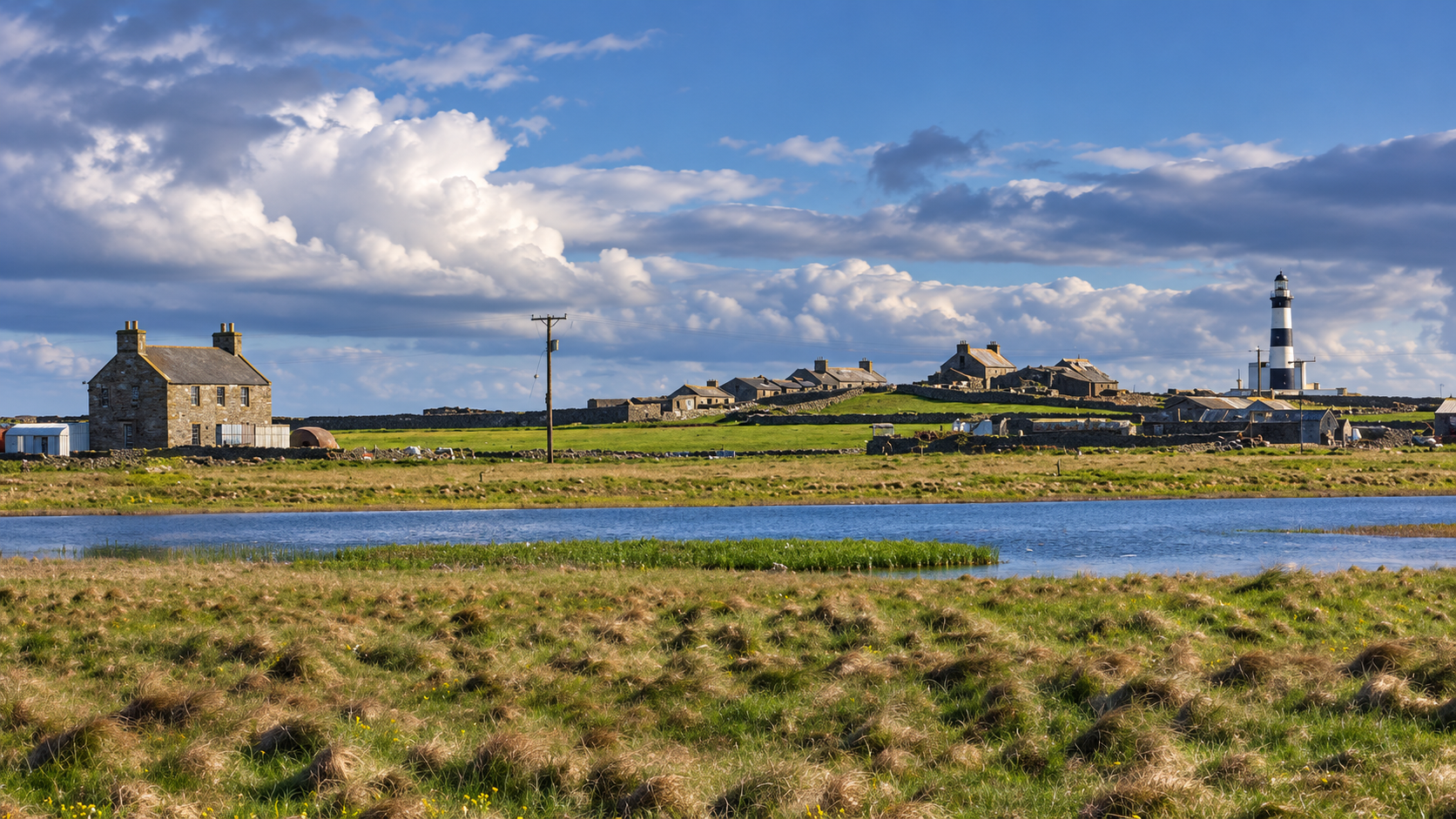
North Ronaldsay is the most northerly of Orkney’s inhabited islands, and the cable failure has exposed how much electricity security can depend on a single local connection. Temporary generation can keep homes and businesses supplied, but it also creates a new reliance on fuel deliveries, storage capacity and backup equipment through the most difficult part of the year.
The failure has also affected residents with their own renewable generation.
North Ronaldsay has a long history of small-scale wind power, including community-owned turbines and private household systems. Under the present emergency network arrangement, some local generators have been asked not to export electricity.
That has left some households facing financial losses, and SSEN is now establishing compensation arrangements for those affected.
The position is technically awkward but straightforward in principle: having turbines on the island does not mean those turbines can independently support the local network when the normal subsea connection is unavailable. Generation, protection systems, voltage control and network balancing all have to work together.
North Ronaldsay has therefore spent months with renewable generation physically present on the island while diesel maintains the system.
The Replacement Cable Could Carry More Than Electricity
The new link also creates an opportunity to address another longstanding infrastructure weakness.
Modern subsea electricity cables can include fibre-optic capacity for network communications. In June, Orkney MSP Liam McArthur asked the Scottish Government to support use of that fibre for wider digital connectivity to North Ronaldsay.
He told Parliament that SSEN had indicated it was open to allowing access to fibre within the replacement cable if a telecommunications provider became involved.
The issue sits alongside a separate history of communications failures across Orkney’s northern isles.
North Ronaldsay and neighbouring islands have experienced outages affecting broadband, mobile communications and digital services, while fibre deployment across the smaller islands remains uneven.
The failed electricity cable therefore intersects with a second infrastructure question: whether the replacement can provide both a stronger power connection and an additional digital route.
No telecommunications provider has yet been publicly confirmed for such an arrangement.
The opportunity nevertheless exists because the cable is being replaced rather than repaired.
Route Surveys Are Complete, but Installation Must Wait
The survey programme between Sanday and North Ronaldsay provides a visible record of how far the replacement project has progressed.
Marine notices show that remotely operated and crewed survey systems have been used to examine the cable corridor, collecting geophysical information from the seabed.
Operations were carried out during the summer and were completed in September.
That work will feed into the final design and installation planning.
Cable installation in exposed northern waters depends on vessel availability, sea conditions, regulatory approvals and a sufficiently reliable weather window. Once autumn conditions deteriorate, the probability of completing a marine installation without interruption falls sharply.
Waiting until spring extends the period of temporary generation, but it also avoids attempting a major subsea installation during the least predictable part of the year.
SSEN says the replacement will be installed at the earliest available opportunity in spring 2027.
A Wider Question of Island Resilience
The failed Sanday–North Ronaldsay connection is a small piece of Scotland’s electricity system, but it sits inside a much larger programme of investment across Orkney.
SSEN’s network planning documents describe growing electricity demand and generation across the islands and the need for substantial reinforcement extending towards 2050.
A new high-capacity transmission connection between Orkney and mainland Scotland is already under construction, while distribution networks across individual islands continue to depend on smaller subsea links.
Those two scales of infrastructure can exist at the same time.
An island group may be connected to major national energy projects while an individual community remains vulnerable to the failure of one local cable.
North Ronaldsay’s experience also shows that resilience cannot be measured solely by installed renewable capacity.
The island has wind generation. It has community interest in battery storage and new renewable systems. What it currently lacks is its normal connection to the neighbouring island network.
Until that is restored, electricity security depends on temporary generators, stored fuel, ferry access and equipment intended as contingency infrastructure rather than permanent supply.
The replacement cable is now expected in spring 2027.
For North Ronaldsay, the coming winter will therefore be managed not by the permanent infrastructure beneath the sea, but by temporary generation on land and the fuel reserves assembled before the weather closes in.
Sources
Electrical Infrastructure (Orkney) — Portfolio Question Time
Scottish Parliament, 10 June 2026
https://www.parliament.scot/chamber-and-committees/official-report/search-what-was-said-in-parliament/meeting-of-parliament-10-06-2026?iob=223693&meeting=20168
Sanday to North Ronaldsay Route Survey — Notice to Mariners
Scottish and Southern Electricity Networks / XOCEAN, 2026
https://www.orkneyharbours.com/site/assets/files/8905/01599-sse-ukx-cabl_sanday_to_north_ronaldsay_notice_to_mariners_rev05.pdf
Sanday to North Ronaldsay — Route Survey
KIS-ORCA, September 2026
https://kis-orca.org/news/?id=6066
Orkney Islands 2050 Whole Systems Engineering Justification Paper
Scottish and Southern Electricity Networks, 2025
https://www.ssen.co.uk/globalassets/about-us/projects-and-live-works/howsum/2025-january-submission/appendix-4a—orkney-ejp-redacted.pdf
SHEPD Network Development Report 2026
Scottish and Southern Electricity Networks, 2026
https://www.ssen.co.uk/globalassets/about-us/dso/publication–reports/network-development-report/2026/shepd-network-development-report-2026.pdf
McArthur seeks government support for replacement of electrical infrastructure
Office of Liam McArthur MSP, 10 June 2026
https://www.liammcarthur.org.uk/news/article/mcarthur-seeks-government-support-for-replacement-of-electrical-infrastructure
North Ronaldsay Trust — Community Wind Turbines
North Ronaldsay Trust
https://northronaldsaytrust.com/past-projects/
North Ronaldsay Ferry Information
Orkney Ferries
https://ferries.orkney.com/islands/north-ronaldsay