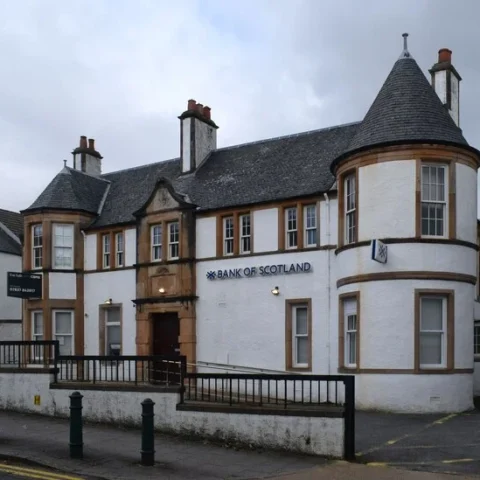

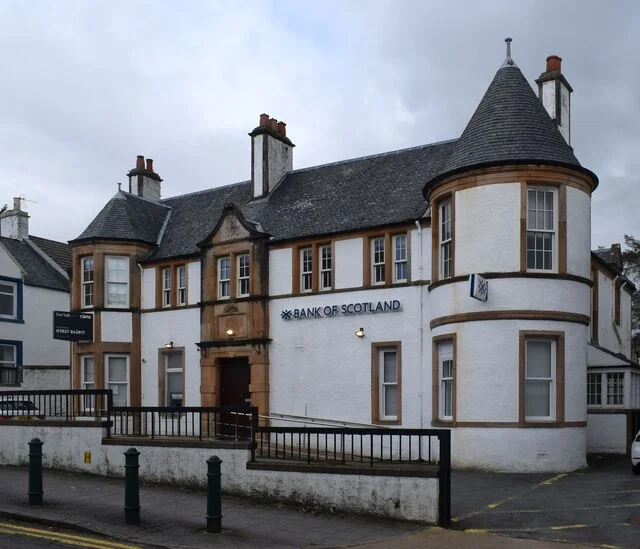
The rapid disappearance of conventional branches is now being followed by an expanding system of shared banking hubs. They restore cash services and scheduled face-to-face access, but they do not recreate the bank branch that disappeared.
Scotland’s retreat from traditional high-street banking is producing a second physical network in its place: shared premises where customers of competing banks use the same counter and wait for their own institution’s representative to visit on a particular day of the week.
The banking-hub system has moved far beyond the two-community experiment that began in 2021. Cash Access UK now says 237 hubs are operating across the United Kingdom, alongside more than 140 separate deposit services, with the broader network handling nearly one million customer visits or transactions a month. LINK, which assesses the effect of branch closures and gaps in access to cash, said by 28 September that 283 banking hubs had been recommended.
Modern Scot reconstructed the scale of the preceding branch closures in August in A Country Without Tellers: How Scotland Lost Its Banks. That investigation found a country in which hundreds of conventional branches had disappeared and in which shared hubs were emerging as the principal physical response when access to cash became inadequate.
The hub network is now large enough to examine separately from the closures that created the need for it.
A banking hub is not another bank branch
A banking hub is a shared facility established through Cash Access UK rather than a branch belonging to one bank. Its ordinary counter service is operated by the Post Office and is generally available from Monday to Friday between 9am and 5pm.
Customers of participating banks and building societies can use that counter for routine transactions such as cash deposits and withdrawals, paying in cheques, checking balances, paying utility bills and obtaining change for registered businesses.
More complicated banking is provided through a different system. Individual banks send community bankers to the hub on scheduled days, allowing customers to speak privately with somebody from their own institution about matters that cannot be dealt with at the shared counter.
The result is a physical banking service with two layers: everyday cash functions available throughout the working week and bank-specific advice available only when the relevant institution is present.
That becomes clear when individual Scottish timetables are compared.
At Bathgate, Santander attends on Monday, Royal Bank of Scotland on Tuesday, Lloyds, Halifax and Bank of Scotland on Wednesday, TSB on Thursday and Barclays on Friday. At Banff, Bank of Scotland attends on Tuesday, Royal Bank of Scotland on Wednesday and TSB on Friday, with no community banker listed on Monday or Thursday.
Helensburgh’s temporary hub lists Royal Bank of Scotland on Monday, Santander on Tuesday and Lloyds, Halifax and Bank of Scotland on Wednesday. The shared counter remains available on Thursday and Friday, but no individual community banker is listed for those days.
Other Scottish communities now operating hubs include Alexandria, Bo’ness, Brechin, Forres, Linlithgow, Auchterarder and Dunbar, while temporary premises are being used in some places as permanent sites are developed.
A customer can therefore regain a place in town where money can be deposited and withdrawn without regaining a conventional branch of his or her own bank.
Scotland was part of the original experiment
Cambuslang was one of the first two communities in the UK to test the hub model, opening alongside Rochford in England at the end of April 2021. The pilot was created to examine whether a shared building could preserve access to physical banking after individual branches had gone.
Five years later, what began as an experiment has become infrastructure.
Cash Access UK said in April 2026 that 234 hubs had already been delivered across the UK and 276 recommended, with 101 new hubs opening during 2025 alone. It recorded an average of 167 transactions a day at hubs and said the network of hubs and other cash services was approaching one million customer transactions each month.
The expansion matters because the policy objective has changed from preserving every bank’s individual branch estate to preserving reasonable access to cash after those branches close.
Since September 2024, the Financial Conduct Authority’s access-to-cash regime has required designated banks and building societies to assess and address significant gaps in local cash provision. LINK carries out assessments when participating banks announce closures or when communities request a review.
If LINK concludes that additional provision is needed, the answer can be a banking hub, an ATM, a deposit service or another cash solution. It does not have to be a replacement conventional branch.
The regulatory framework therefore accepts the continued commercial closure of individual branches while seeking to protect access to essential cash services around the consequences.
What has been restored and what has not
For businesses that handle cash, a hub can restore one of the most practical functions lost with a branch.
A shop, pub, café, hotel, market trader or community organisation cannot deposit physical takings through an app. Removing the final local bank can turn a routine end-of-day task into a journey, sometimes over considerable distances in rural Scotland. A shared counter can bring that function back into the town.
For personal customers who do not use online banking, the hub also restores somewhere to withdraw money, pay in cash or cheques and carry out basic account activity with human assistance.
What it does not automatically restore is continuous access to the staff of an individual bank.
A traditional branch combined the counter, the bank’s own employees and its wider advisory functions in one permanent institution. In a hub, the physical infrastructure remains but the individual banks rotate through it. A customer whose bank attends on Wednesday may have to return on Wednesday for a matter that requires that bank’s representative.
That is neither evidence that the hubs have failed nor that they are equivalent to the system they replace. It is a different service design.
It also helps explain why raw counts can mislead. One new banking hub cannot simply be counted as one branch restored. A hub can serve customers of several banks at once and therefore replace some functions of multiple closed branches, while still offering less continuous bank-specific presence than any of those branches once provided.
The next measure is geography, not simply openings
Modern Scot’s August investigation found that Which? counted 751 closures from a Scottish baseline of 1,041 branches since 2015, while Modern Scot’s own historical reconstruction had individually identified 714 closures at the time of publication. The work showed how rapidly the conventional network had contracted and how difficult some earlier closures were to reconstruct even a decade later.
The expanding hub system creates a new dataset that can now be measured against that lost geography.
The useful questions are no longer simply how many hubs have opened in Scotland, but which communities have received them, how long they waited after their final branch closed, how far customers would otherwise have had to travel and whether permanent premises were secured quickly after a temporary service began.
Those measurements matter particularly in rural and island Scotland. A ten-mile gap in an urban area and a ten-mile gap involving infrequent public transport, winter roads or a ferry are not equivalent forms of access.
The scheduled community-banker timetables add another measure: how often customers of each institution can obtain face-to-face bank-specific help without travelling elsewhere.
That is the second chapter of Scotland’s bank-closure story.
The first was the disappearance of individual institutions from hundreds of high streets. The replacement is not a return to the old arrangement, but a shared network designed around common cash infrastructure and rotating access to the banks themselves.
For communities that had reached the point of having no bank at all, that can be a substantial restoration of service.
For Scotland as a whole, it marks something larger: the physical bank has not vanished completely. It is being rebuilt in a form in which the building is shared, the counter is common and the individual bank may be present only one day a week.
Previous Article:
- Modern Scot — A Country Without Tellers: How Scotland Lost Its Banks, 13 August 2026. Read the earlier Modern Scot investigation.