
Planning applications across Scotland describe communications kiosks equipped with defibrillators and advertising screens. Behind that description is a privately operated platform capable of combining telephony, public Wi-Fi, digital information, commercial advertising and mobile-network infrastructure.
On Wednesday, 23 September, West Lothian councillors will consider two planning disputes over structures proposed for town-centre pavements in Broxburn and Bathgate. In the council papers they are described simply as digital communications kiosks incorporating a defibrillator and advertising display. One would stand on East Main Street in Broxburn and the other on George Street in Bathgate. Taken by themselves, the applications appear to concern modern replacements for traditional telephone boxes, supplemented by emergency equipment and a digital screen. The documents submitted by the company behind them show that the structures are part of something considerably broader.
New World Payphones is pursuing digital kiosk installations across several Scottish local authority areas, and its own planning material describes a platform capable of combining public telephony, an interactive touchscreen, local information and wayfinding, public Wi-Fi, a defibrillator, digital advertising and equipment capable of hosting small-cell mobile telecommunications infrastructure. Similar proposals have appeared in West Lothian, Midlothian, Edinburgh, Glasgow, Dundee and South Lanarkshire, placing individual decisions about street furniture within a wider programme of privately operated digital infrastructure being introduced through Scotland’s planning system.
The clearest account of how the system works appears in documents submitted for proposed kiosks in Penicuik and Dalkeith. New World Payphones describes the communications equipment and advertising display as a single integrated scheme rather than two independent elements and states that commercial advertising provides essential funding for the modernisation and maintenance of the network. The arrangement is therefore more closely integrated than a telephone standing beside an unrelated poster site: the public communications functions and the commercial display form parts of the same operating model.
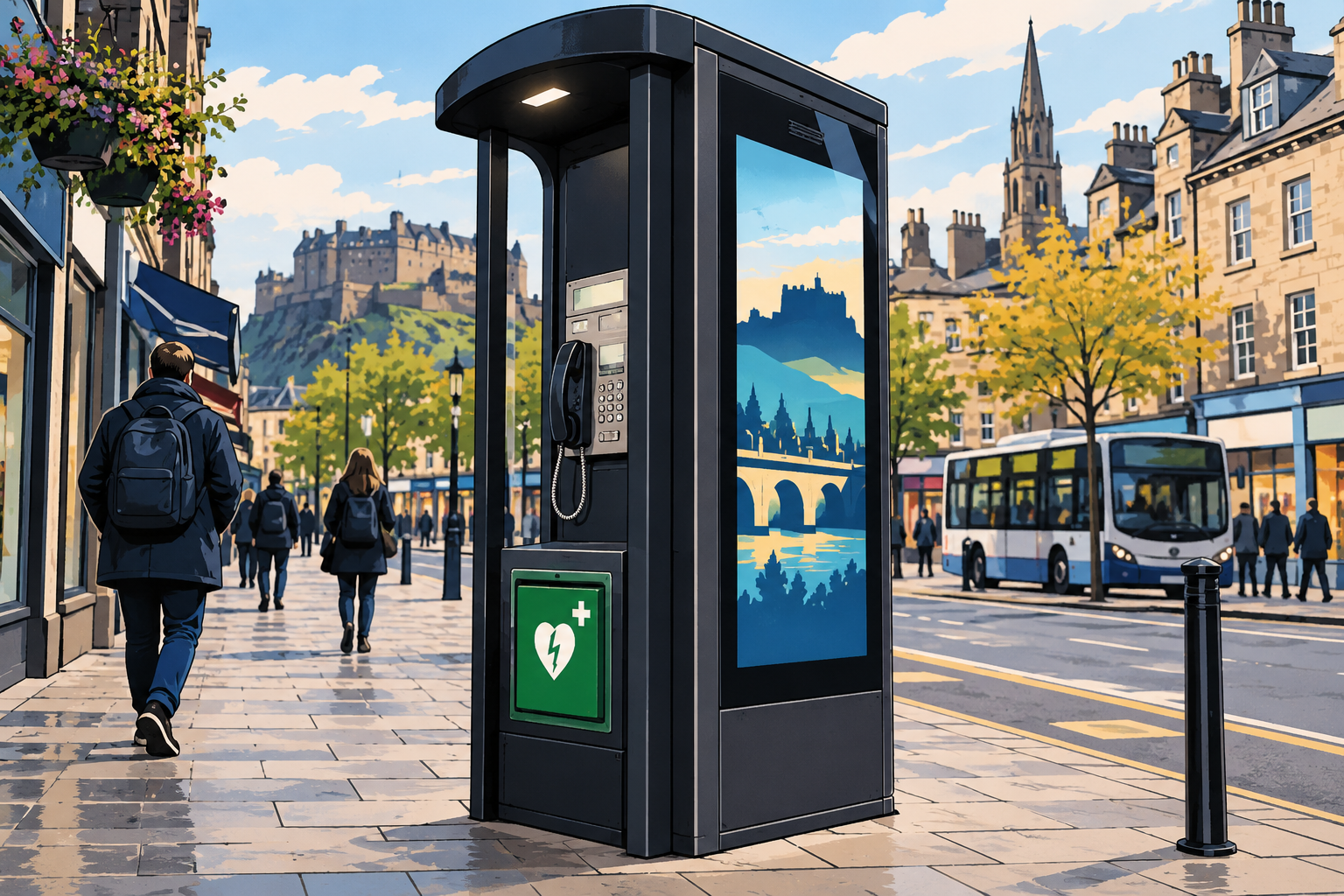
The Midlothian specification gives a detailed picture of the equipment. The public-facing side would contain a telephone capable of accepting card, contactless and cash payments, alongside an interactive touchscreen providing maps, local information and wayfinding. The structure can accommodate public Wi-Fi or small-cell telecommunications equipment and contains an automated external defibrillator. A digital advertising screen of approximately 1.6 metres by 0.9 metres occupies the reverse side, with advertisements changing at intervals of at least ten seconds and light sensors adjusting the screen according to surrounding conditions. The company proposes giving the council one free ten-second slot each hour for public information, emergency messages or local events.
The small-cell capability gives the structure a function less immediately apparent from its appearance on the pavement. New World Payphones says licensed infrastructure providers can install equipment within the kiosk where additional mobile capacity is required, allowing the structure to support 4G coverage and future 5G deployment. Small cells provide mobile-network capacity over shorter distances than conventional masts and can be used in busy urban areas where operators require more coverage without installing another large mast or cabinet. The planning documents establish that the kiosk has been designed to accommodate that equipment; they do not establish that every proposed Scottish kiosk will contain a small cell, and Modern Scot has found no evidence showing that such equipment is intended to be activated at the Broxburn or Bathgate sites.
The business behind the programme is also different from the traditional image of a payphone operator. New World Payphones operates through NWP Street Limited, which Companies House records show is controlled by Bauer Media Outdoor UK Limited. New World Payphones became part of the Clear Channel outdoor-advertising business in 2016 before Clear Channel’s northern European operation was acquired by Bauer Media Group and became Bauer Media Outdoor. The kiosk programme therefore sits within a business whose wider activities include digital outdoor advertising, roadside displays, bus shelters, retail advertising and other forms of commercial street infrastructure.
Earlier this year Bauer said it intended to install more than 100 new communications kiosks equipped with defibrillators by the end of 2026. The programme was announced alongside expansion of the company’s digital advertising estate, engineering operations and data capabilities. Bauer has said its first new defibrillator kiosk in Lewisham was used in an emergency within 48 hours of being installed, while planning material submitted in Scotland states that the defibrillators would be subject to regular checks and registered on The Circuit, the national network used by emergency services to identify publicly accessible equipment during cardiac arrests.
The emergency function is therefore not incidental. If a cardiac arrest occurs nearby, ambulance-service personnel can identify a registered unit and direct a caller to it. New World Payphones has described work with the Community Heartbeat Trust and Resuscitation Council UK as part of the programme. The result is an unusual combination: potentially life-saving emergency equipment housed within infrastructure whose continuing modernisation and maintenance are financed through commercial advertising.
That combination is now appearing repeatedly in Scottish planning records. West Lothian has considered proposals in Broxburn, Bathgate, Whitburn and Livingston, with planning permission for the physical structures and consent for the advertising displays dealt with separately. The Broxburn and Bathgate cases return to the council’s Local Review Body on 23 September following refusal, while a Whitburn proposal has already gone through the review process. Midlothian has received applications for kiosks outside Penicuik Jobcentre and Morrisons in Dalkeith, and applications using the same general model have appeared in Dundee and South Lanarkshire.
Edinburgh has been dealing with New World Payphones proposals for several years. In February 2025 the council refused applications at Frederick Street and South Charlotte Street, with further advertising applications following. Some of the proposed sites lie within conservation areas and the city’s World Heritage Site, bringing questions of illuminated advertising, street clutter and the character of historic streets into the same planning process as telecommunications infrastructure. Glasgow has also considered New World Payphones proposals, including a kiosk near Jamaica Street and Clyde Street, where material submitted during the planning process described the project as part of a wider programme to rationalise and modernise the company’s communications estate in the city.
The relationship between telecommunications and advertising within these structures has been tested before. In 2019 New World Payphones reached the Court of Appeal in England following a dispute with Westminster City Council over the planning status of its kiosks. The technical description recorded by the court included public Wi-Fi, small-cell telecommunications equipment, near-field communication, Bluetooth technology and a large digital advertising screen. The dispute concerned whether a structure serving both telecommunications and advertising purposes could rely upon planning rights intended for telecommunications development. The Court of Appeal concluded, under the English rules applying to that case, that the advertising function could not simply acquire the planning status of telecommunications equipment. The judgment does not determine Scottish applications, which are considered under Scotland’s own planning regime, but it provides a documented account of the broader technological functions that have formed part of the company’s kiosk design.
A separate question concerns the wider digital capabilities of Bauer Media Outdoor. Its current UK commercial privacy notice applies across an advertising estate that includes phone kiosks, bus shelters, billboards and free-standing digital panels. The company states that some of its structures carry Wi-Fi sensors capable of detecting devices searching for wireless networks. Bauer says raw device identifiers are not retained and that hashed identifiers are used to produce anonymised and aggregated audience counts. Its privacy documentation also says Bluetooth beacons operate at a small number of sites and that cameras or CCTV are used on some advertising structures for security, safety or confirmation that advertisements have been displayed. Bauer also describes the use of audience-measurement partners and aggregated information concerning movement around advertising locations.
Those disclosures establish capabilities within Bauer’s wider estate; they do not establish that the kiosks proposed in West Lothian, Midlothian or elsewhere in Scotland contain those systems. There is no evidence in the planning material examined by Modern Scot showing that the Broxburn or Bathgate kiosks would contain Wi-Fi detection sensors, Bluetooth advertising beacons, cameras or computer-vision equipment. Public Wi-Fi provision should not itself be confused with passive detection of nearby devices. They are technically and legally different functions.
The planning application title reveals relatively little about the final specification of the equipment. A structure can be designed to accommodate telecommunications hardware without that hardware being installed, just as technologies described in a parent company’s privacy policy may operate elsewhere in its advertising estate without being present at a particular Scottish site. Establishing precisely how an individual kiosk operates requires its final hardware specification, network configuration and any data-protection documentation attached to the installation.
The commercial arrangements are similarly difficult to establish from planning papers alone. New World Payphones says the kiosks are supplied and maintained without charge to councils and that advertising income supports the network. The documents do not necessarily show who pays for electricity and fixed communications connections, whether the operator pays for occupation of the pavement, whether councils receive a share of advertising income, what a mobile-network provider would pay to install small-cell equipment, or what becomes of the structures if the advertising business supporting them changes.
New World Payphones describes itself in planning material as an Electronic Communications Code operator and says it manages a national network of approximately 2,000 communications kiosks. Electronic Communications Code status can give telecommunications operators statutory rights relating to the installation and maintenance of network apparatus. For councils, the result is a structure sitting at the intersection of planning law, roads legislation, telecommunications regulation and advertising control rather than an ordinary piece of commercial street furniture.
The technologies themselves are not novel when considered separately. Public telephones have occupied Scottish pavements for generations. Digital advertising screens are widespread. Mobile telecommunications equipment is increasingly embedded in streets and buildings. Public Wi-Fi is routine, while publicly accessible defibrillators are now installed in shops, stations, community buildings and other locations across the country. The change lies in the consolidation of several of those functions within one privately operated structure whose commercial and communications uses are interdependent.
For local planning authorities, however, the applications continue to arrive one location at a time. Councillors and planning officers are asked to consider dimensions, pedestrian movement, illuminated advertising, road safety, conservation areas and the visual effect of a structure at a particular address. The planning trail across Scotland shows that those individual structures form part of a much larger deployment.
Bauer Media Outdoor says more than 100 new communications kiosks with defibrillators are intended to be installed across the UK during 2026. Scottish planning records already show the model moving through local authority systems in West Lothian, Midlothian, Edinburgh, Glasgow, Dundee and South Lanarkshire. The applications establish that the platform can combine public communications, digital advertising, emergency equipment and additional telecommunications infrastructure. They do not, in every case, disclose the final hardware installed, the functions that will be activated, the data systems that will operate at the site or the detailed commercial arrangements governing the equipment.
When West Lothian’s Local Review Body considers the Broxburn and Bathgate applications on Wednesday, the formal question before councillors will concern two individual structures on two individual pavements. The documents surrounding them show that those structures belong to a considerably larger network whose precise technical and commercial configuration is not always visible from the planning description attached to it.
Sources
West Lothian Council — Local Review Body agendas, planning applications and review papers relating to digital communications kiosks in Broxburn, Bathgate and Whitburn.
https://coins.westlothian.gov.uk/Agenda.asp?meetingid=10565
New World Payphones — Kiosk information and specifications.
https://newworldpayphones.co.uk/kiosk/
New World Payphones Street Limited — Planning, Design & Heritage Statement, Midlothian, March 2026.
https://docs.planning.org.uk/20260330/216/TCFV9YKVGID00/u63ttc68nmil9sgf.pdf
Dundee City Council — Planning application records and weekly lists relating to New World Payphones digital communications kiosks.
https://www.dundeecity.gov.uk/
City of Edinburgh Council — Planning records concerning New World Payphones applications, including Frederick Street and South Charlotte Street.
https://www.edinburgh.gov.uk/
Glasgow City Council — Planning and local-review documentation concerning New World Payphones proposals at Jamaica Street and Clyde Street.
https://onlineservices.glasgow.gov.uk/
Companies House — NWP Street Limited, company number 04413822.
https://find-and-update.company-information.service.gov.uk/company/04413822
Bauer Media Outdoor — Corporate information and communications-kiosk programme.
https://www.bauermediaoutdoor.co.uk/
Bauer Media Outdoor — Commercial Privacy Notice.
https://www.bauermediaoutdoor.co.uk/legal/commercial-privacy-notice
Court of Appeal — New World Payphones Ltd v Westminster City Council & Anor [2019] EWCA Civ 2250.
https://www.bailii.org/ew/cases/EWCA/Civ/2019/2250.html
Resuscitation Council UK — The Circuit and publicly accessible defibrillator information.
https://www.resus.org.uk/