


At eleven minutes past two, my mobile informed me that a parcel had been delivered.
This was encouraging, as I had been at home all afternoon and had heard neither a van nor a knock at the door. The animals had heard nothing either, and they can hear a food packet being opened in another room through two closed doors and a running washing machine.
The message included a photograph.
It showed a cardboard box beneath something green.
The green object might have been a plant pot. It might also have been a wheelie bin, a hedge or a small shrub in another county. The image had the murky confidence of surveillance footage shown during an appeal for witnesses.
The parcel was described as having been left in a safe place.
I put on my coat.
The parcel contained curtain hooks. They cost £4.89 and had already travelled farther than I had this year. According to the tracking history, they had left a warehouse, passed through four distribution centres, crossed several local authority boundaries and reached the Highlands before disappearing into what the courier considered a safe place.
I checked the front step, although I had already seen the front step several times that afternoon. I checked the back door, the shed, the coal bunker and the space behind the recycling bin where delivery drivers occasionally place items with the solemnity of men concealing state papers.
There was nothing.
My husband suggested checking the neighbour’s house.
I asked which neighbour.
He said the one with the similar house.
This did not narrow matters appreciably. Half the Highlands consists of similar houses separated by several miles, a cattle grid and a historical disagreement about access rights.
I began with the nearest cottage.
There was no parcel on the steps, but there was a pair of wellington boots, a folded feed sack and a small wooden stool which had not appeared in the delivery photograph. I moved on.
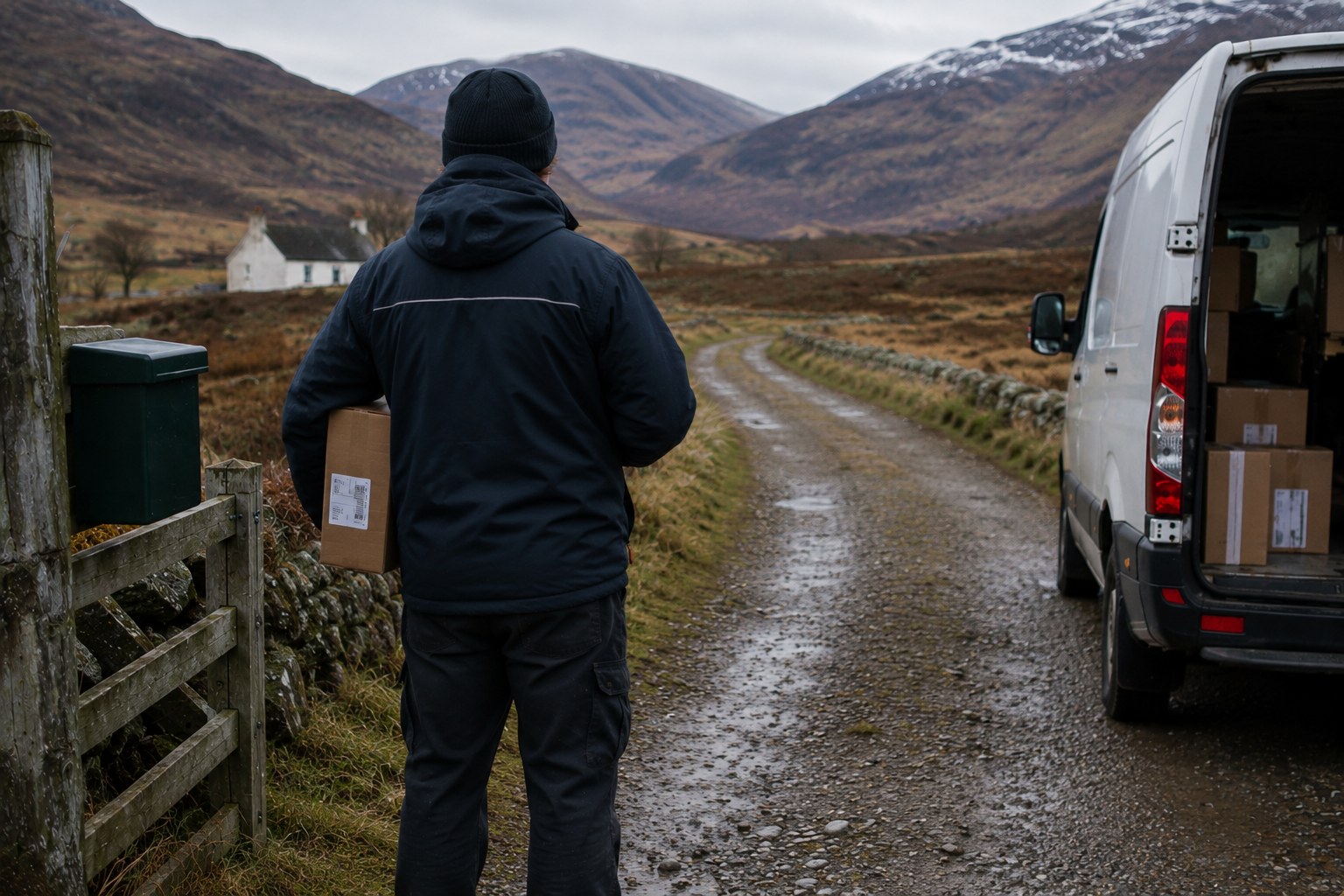
Rural delivery is not easy, and I have some sympathy for those required to perform it. Houses have names rather than numbers. Postcodes can cover areas of considerable ambition. Roads become tracks, tracks become gateways and gateways occasionally lead to fields in which no human being has conducted business since 1987.
Satellite navigation is not always helpful. One driver once phoned to say that his map had brought him to a burn. He sounded as though he believed this was my fault.
Another arrived from the opposite direction after following a forestry road and appeared at the gate looking less like a courier than the survivor of a minor expedition. I gave him tea.
I do not expect perfection. I expect only that the word “delivered” should retain some connection with the arrival of the object.
Modern commerce has developed a more flexible interpretation.
There was a time when the postman knew the name of every house, the inhabitants, the dog and, quite often, who had fallen out with whom. A letter addressed only to “Mrs Mackenzie, near the old bridge” stood a reasonable chance of arriving before lunch.
Today, a parcel supplied with a full postcode, satellite coordinates, a mobile phone number and live tracking can be placed in a hidden spot and declared successfully delivered.
We have gained satellites and lost the ability to find a front door.
The old postman’s knowledge was informal, human and difficult to enter on a spreadsheet. He knew which track remained passable after rain, which gate led to which cottage and where an elderly resident lived alone.
Modern systems possess considerably more data, but data is not the same as knowing where somebody is.
A parcel may now be delivered to a doorstep, a neighbour, an outbuilding, a hedge, a shed or a location described simply as “other”. Once it has been scanned and photographed, it enters the realm of administrative truth.
The parcel is no longer missing. The customer is merely unable to locate it. This distinction appears to matter greatly to computer systems.
The tracking page showed a green tick beside the word “Delivered”. The company had evidence that its work was complete. Somewhere, a dashboard had improved. A target had been met. A small box had turned the correct colour.
Only the curtain hooks remained unresolved.
This is not confined to parcels.
More and more of modern life is measured by recording an action rather than confirming an outcome. The system can prove that it has done something. The citizen is left to discover whether anything has actually happened.
The receipt has begun to replace the result.
A referral may exist without an appointment. A repair may be scheduled without a date. A fault may be closed because someone has updated the record. A complaint may be resolved on the system while remaining entirely unresolved in the life of the person who made it.
Every institution possesses a dashboard showing progress.
Every kitchen table possesses somebody trying to work out where the progress went.
In rural places, the gap between the recorded outcome and the actual one is often concealed by people quietly correcting it.
Someone recognises the steps in the photograph.
Someone knows the delivery driver.
Someone telephones a cousin three glens away.
Someone puts the parcel in the car and finishes the journey.
The error disappears because the community repairs it before it becomes visible to the organisation that made it. This is usually called resilience. Rural resilience is often admired most warmly by those who benefit from it being free.
A delivery company can use fewer drivers, tighter schedules and automated routes because it knows, although it may never say so, that people in small communities will complete the final stage among themselves.
A parcel left at the wrong cottage will probably reach the right one.
An elderly neighbour’s shopping will be brought in.
A prescription will be collected by whoever is already going into town.
A stranded motorist will be found by someone with a tow rope, a flask and no official role whatsoever.
Neighbourliness is one of the finest things about rural life.
It is also becoming an increasingly useful item in other people’s business models.
The delivery charge remains commercial.
The last mile becomes voluntary work.
After several calls and a closer study of the photograph, I recognised a green container beside a door and a strip of roughcast wall.
The parcel was sitting beneath a plant pot outside a building that had been empty for more than ten years.
It was 4.5 miles from my home.
The company later emailed to ask how satisfied I was with the delivery.
There were five stars available. I gave it four. The safe place had been extremely hard to guess.