
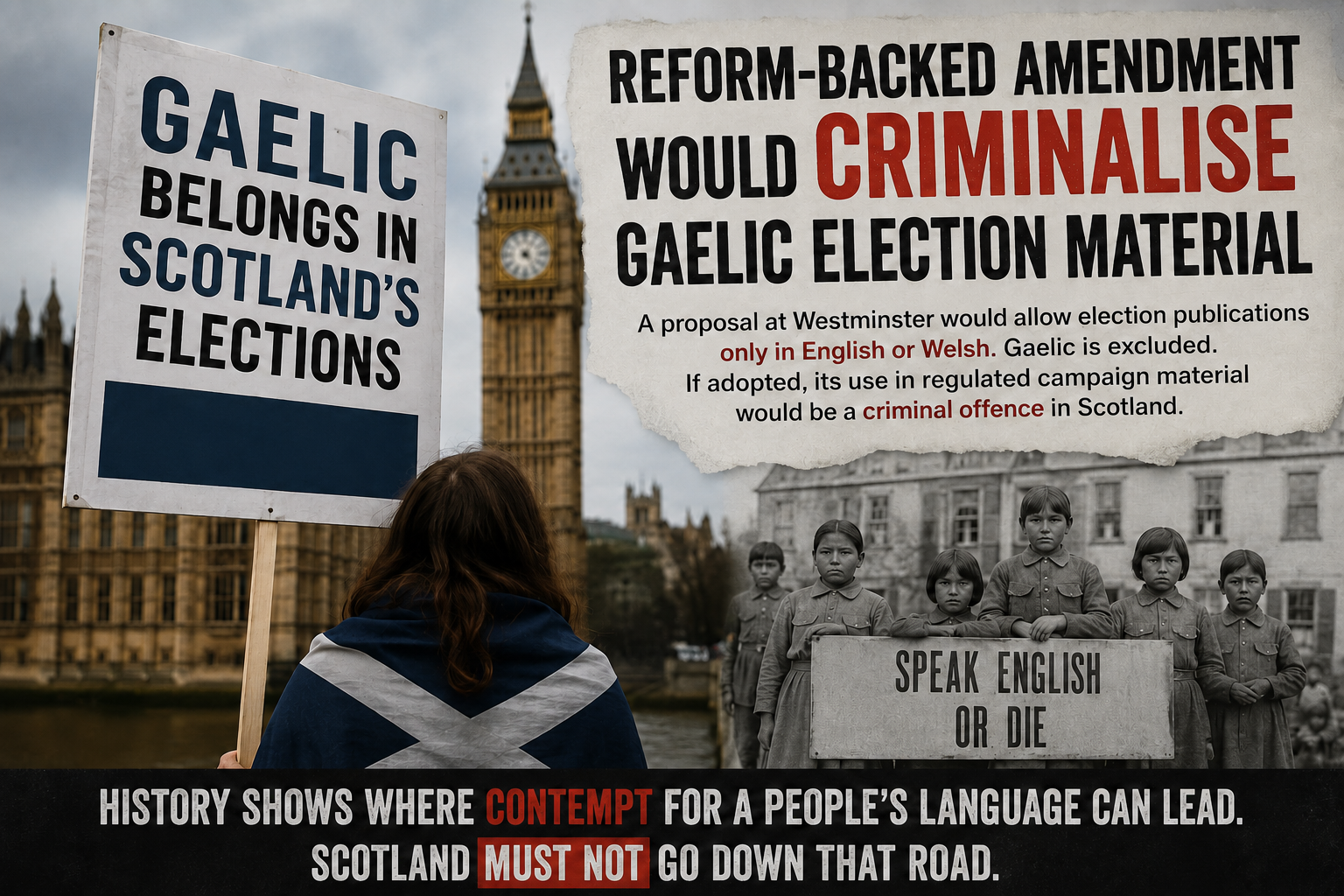
A proposal submitted at Westminster would allow election publications only in English or Welsh. Gaelic is neither named nor protected. If adopted, the clause would make Gaelic-only regulated campaign material a criminal offence in Scotland.
New Clause 107 to the Representation of the People Bill was tabled by Richard Tice and supported by Lee Anderson, Sarah Pochin, Danny Kruger, Robert Jenrick, Andrew Rosindell and Suella Braverman.
The clause, titled “Requirement that political literature be in English or Welsh”, would prohibit the printing or publication of election bills, placards, posters and other regulated documents unless they were written in one of those two languages.
The restriction would also apply to election material published by political parties. Breaching it could lead to a fine or imprisonment for up to six months. Candidates, election agents, registered parties and party officers could also be found to have committed an illegal electoral practice.
The explanatory statement says the clause would require election material to be published “only in English or Welsh”.
The effect in Scotland would be stark. A party could publish a Welsh-language leaflet in Lewis, Skye or Inverness, while a Gaelic-language leaflet distributed in the same places would fall outside the permitted wording. Scots, Irish, Cornish and Ulster Scots are also excluded.
This is not government policy and it is not law. New Clause 107 is an opposition amendment to a Labour Government bill. Even if it is defeated, however, the proposal is not politically harmless.
Seven MPs have formally suggested that democratic communication in Scotland should be restricted to English and Welsh, with criminal penalties available against those who cross that boundary.
The clause is new. The belief behind it, that a dominant culture may decide where another people’s language is permitted to exist, is centuries old.
Languages are rarely destroyed by a single decree. They are weakened through a succession of exclusions.
Not in this school.
Not in this court.
Not in this office.
Not on this form.
Not during this election.
Each restriction may be presented as narrow, orderly or practical. Together, they reduce a living language to something tolerated in songs, ceremonies and museums but excluded from power.
The United States provides a documented warning of what can follow when contempt for an Indigenous culture is allowed to become administration.
For generations, Native American, Alaska Native and Native Hawaiian children were removed from their families and sent to federal boarding schools intended to assimilate them into the dominant society.
The schools formed part of a wider system of territorial dispossession and cultural destruction. Children were given English names, had their hair cut and were discouraged or prevented from speaking their own languages or practising their religions and traditions.
The US Department of the Interior has identified 408 federal boarding schools operating between 1819 and 1969, including 21 in Alaska. Its investigation found marked or unmarked burial sites at approximately 53 schools and described a system intended to achieve cultural assimilation through the forced removal of Indigenous children.
In 2024, the President of the United States formally apologised for a programme the federal government acknowledges sought to erase Native cultures and assimilate Native children.
New Clause 107 is not a boarding-school system. Gaelic-speaking children are not being removed from their homes under its provisions, and the histories should not be treated as identical.
The warning lies in the attitude that comes first.
The United States did not begin by openly declaring that it intended to destroy languages carried by peoples who had lived on the continent for thousands of years. Suppression was described as education, advancement, integration and national unity.
The dominant culture appointed itself the judge of which languages belonged in public life. Indigenous languages were treated as barriers to progress rather than repositories of law, memory, knowledge and identity.
The same assumption underlies any proposal declaring that one historic language may be used in democratic speech while another may not.
Importance of Gaelic in Scottish Culture
Gaelic is not a foreign intrusion into Scotland. It has been spoken on this land since long before the modern British state existed. It carries place names, literature, music, memory and an understanding of Scotland formed centuries before any MP now sitting at Westminster acquired the power to legislate.
Its speakers do not require permission from Reform UK to address one another in their own country.
The amendment’s supporters may argue that elections require a common language or that multilingual campaigning allows parties to send different messages to different communities.
Concerns about inconsistent or misleading campaign material can be addressed by requiring parties to publish translations, retain public archives of every version and accept responsibility for every claim they distribute.
The answer is transparency.
The answer is not to criminalise the language.
Restricting Gaelic would not make elections more honest. It would decide which voters may be addressed in the language of their community and which must accept the language selected for them by Parliament.
The protection of Welsh also exposes the weakness of any claim that the amendment is simply about administrative clarity. Welsh is properly protected. Gaelic is not. No explanation is offered for why one historic language of these islands is authorised while another is excluded.
The result is discriminatory. There is no need to speculate about private motives. The wording permits English and Welsh, excludes Gaelic and attaches criminal penalties to the distinction.
Cultural contempt is not always expressed through declarations of hatred. It can be written into rules that define one culture as normal and another as an exception to be managed, restricted or removed.
Unchecked disdain becomes exclusion. Exclusion becomes policy. Policy shapes institutions and public life. A generation later, the decline produced by those decisions is described as though it happened naturally.
The amendment should be withdrawn. Every MP who signed it should explain why Welsh was protected while Gaelic was left outside the law.
Gaelic belongs in Scotland’s elections because Gaelic belongs in Scotland.
Parliament may regulate campaign finance, imprints and electoral conduct. It has no moral authority to declare the historic language of a people unfit for democratic speech.
Sources
UK Parliament — Representation of the People Bill: publications and amendment papers
https://bills.parliament.uk/bills/4080/publications
House of Commons — Notices of Amendments as at 14 July 2026, New Clause 107, pages 129–130
https://publications.parliament.uk/pa/bills/cbill/59-02/0004/amend/rop_rm_rep_0714.pdf
UK Parliament — Representation of the People Bill: parliamentary stages
https://bills.parliament.uk/bills/4080/stages
US Department of the Interior — Federal Indian Boarding School investigative findings
https://www.doi.gov/pressreleases/department-interior-releases-investigative-report-outlines-next-steps-federal-indian
US Department of the Interior, Indian Affairs — Federal Indian Boarding School Initiative
https://www.bia.gov/service/federal-indian-boarding-school-initiative
Scottish Languages Act 2025
https://www.legislation.gov.uk/asp/2025/10/enacted
Gaelic Language (Scotland) Act 2005
https://www.legislation.gov.uk/asp/2005/7/contents/enacted