More than 100 workers at Europe’s largest and oldest grain distillery are preparing for three weeks of industrial action as Diageo restructures its global business and reviews jobs across Scotland. The dispute brings the company’s billion-dollar cost-cutting programme into one of the industrial sites on which its Scotch whisky business depends.
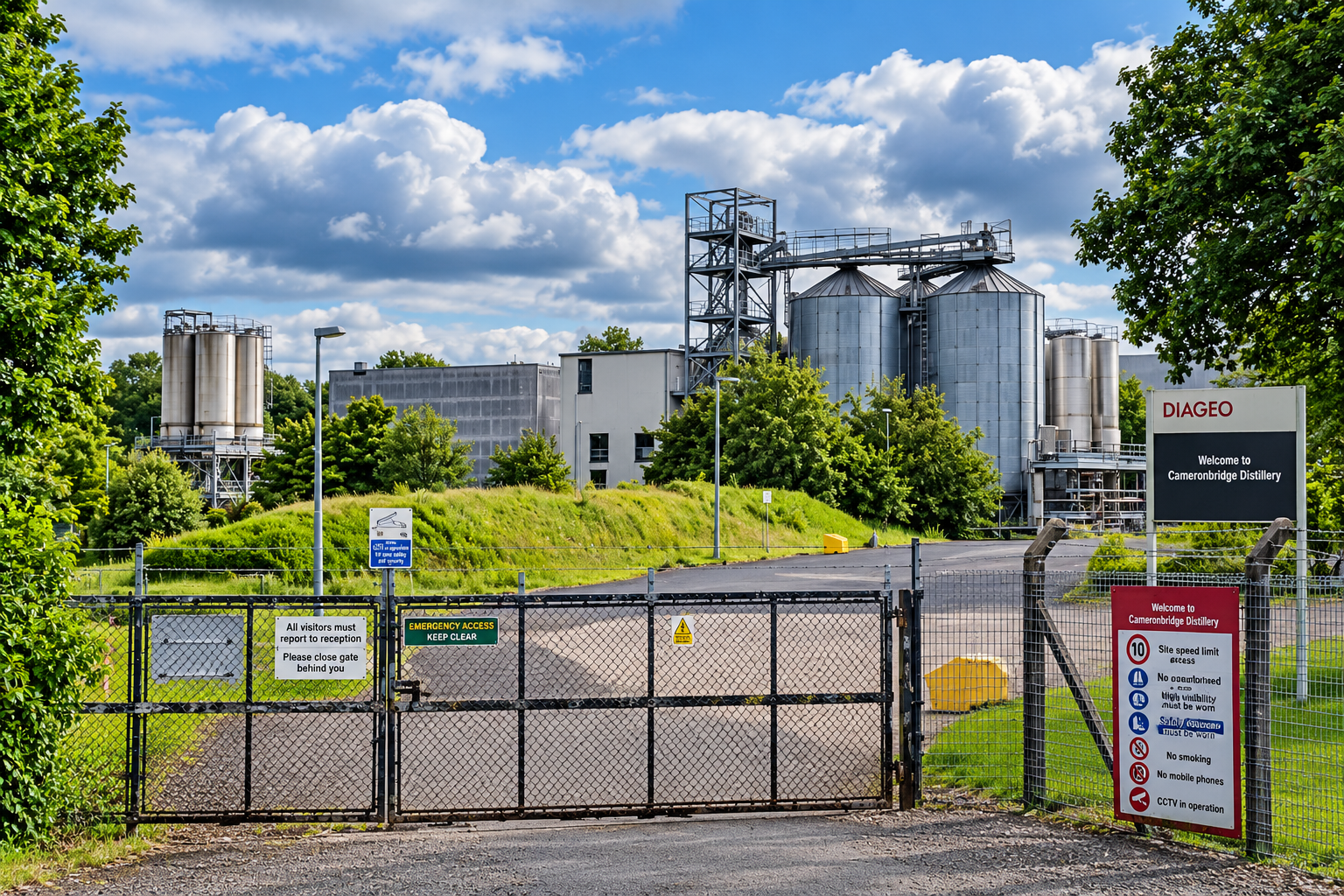
Production at Diageo’s Cameronbridge distillery in Fife, Scotland faces three weeks of disruption after workers voted for strike action in a dispute over proposed job cuts, bringing the effects of the drinks group’s global restructuring programme directly into its Scottish manufacturing operations.
More than 100 Unite members are due to begin action on 28 September. All participating workers are expected to strike on the opening day before groups of distillation and process controllers, machine and distillery operators, technicians, engineers, quality-control analysts and process chemists take successive action through to 15 October.
Unite says the pattern has been designed to bring production at Cameronbridge to a standstill.
Whether the disruption reaches that scale will depend on Diageo’s operational response, but the industrial significance of the site is not in doubt.
Cameronbridge employs around 200 people and is described by the union as Europe’s largest grain distillery. Diageo has previously described it as its largest distillery and a major production centre for grain whisky used in brands including Johnnie Walker, as well as spirits including Smirnoff, Gordon’s and Tanqueray.
More than 70 roles at the site are under review, according to Unite.
The dispute is part of a much wider reorganisation taking place inside Diageo.
The group, one of the world’s largest alcoholic drinks companies, is restructuring its operations around a programme intended to reduce costs by approximately $1 billion a year. It plans to spend about $1.2 billion carrying out the changes over two years.
Around $850 million of the eventual annual savings are expected to come from a redesigned operating structure, with approximately another $150 million coming from changes to the supply chain.
By the beginning of September, Diageo said it expected to have implemented around 90 per cent of its planned restructuring changes.
The programme reaches far beyond Scotland. Diageo operates more than 110 manufacturing sites and sells more than 200 brands across around 180 countries and territories. It employed more than 27,500 people globally at the end of its latest financial year.
Scotland remains unusually important within that system.
Diageo says it directly employs more than 3,000 people in Scotland and owns 31 Scotch whisky distilleries alongside bottling, warehousing and other production facilities. Its latest gender pay reporting put employment in the Diageo Scotland legal entity at 3,405 people.
That makes the proposed reductions more than a dispute affecting one Fife workplace. They form part of a restructuring exercise passing through one of Scotland’s largest private manufacturing employers and an industry that connects production sites with farming, maltings, engineering, haulage, warehousing, packaging, cooperage, ports and tourism.
Unite says hundreds of Scottish jobs are affected by Diageo’s proposals across the country. It has accused the company of failing to provide sufficient detail about the proposed redundancies at Cameronbridge and has raised concerns about removing posts without an equivalent reduction in expected production.
Those are union claims and are contested within an industrial dispute. The company’s published financial statements provide a different view of the pressures driving the restructuring.
Diageo entered the programme after a period in which its global sales weakened and parts of the drinks market became more difficult.
Reported net sales for the year to 30 June 2026 were $19.64 billion, down 3 per cent from the previous year. Organic net sales fell 2 per cent.
North America and Asia Pacific were among the weaker parts of the business, while Europe, Latin America and the Caribbean, and Africa performed more strongly.
Reported operating profit fell by 27.2 per cent to $3.16 billion.
That number, however, includes large restructuring and impairment charges and does not mean the underlying business suffered an equivalent collapse in trading profitability.
Operating profit before exceptional items was $5.68 billion. On an organic basis it increased by 2 per cent, helped by cost savings.
Diageo incurred about $900 million of restructuring charges during the financial year, including approximately $752 million associated with implementation of its new operating framework. It also recorded around $1.5 billion of impairment charges, largely connected with its Turkish business and the value of several brands and assets.
The company is therefore restructuring from a position that combines falling reported sales and substantial exceptional costs with continued underlying operating profits measured in billions of dollars.
That combination lies behind much of the industrial argument now reaching Cameronbridge.
For management, the restructuring is intended to make Diageo more competitive, reduce duplication and produce a simpler global organisation capable of generating better returns while releasing money for investment.
For the union, the continued profitability of the company weakens the case for removing jobs from established production operations.
The disagreement is particularly sharp at a plant where the proposed reductions are being considered without, according to Unite, a corresponding reduction in production expectations.
Cameronbridge is not an interchangeable office operation.
Grain distilleries occupy a particular place within Scotch whisky production. Malt whisky is made in batches in pot stills, while grain spirit can be produced continuously and at very large scale. It provides the base spirit used alongside malt whiskies in blended Scotch, the category responsible for much of the volume sold internationally.
The Fife site has developed around that scale.
Diageo invested £65 million in a bioenergy and water-treatment facility at Cameronbridge more than a decade ago. The company said the system was designed to supply as much as 95 per cent of the distillery’s energy requirements through biomass combustion and anaerobic digestion while recovering water used during production.
In 2022 the company described Cameronbridge as the largest whisky and alcohol distillery to receive certification under the Alliance for Water Stewardship standard.
The size of the installation reflects the industrial volumes moving through the site.
Its output supports products sold far beyond Scotland, which means a prolonged interruption can move through supply chains that extend from distillation into maturation, blending, bottling and distribution.
That does not mean supermarket shelves will immediately empty if production stops for several weeks. Scotch whisky is matured for years and the industry maintains extensive stocks. Production and supply chains operate over long time horizons.
A loss of output at a high-volume grain distillery can nevertheless create operational consequences that are different from those produced by disruption at a smaller site.
Diageo’s restructuring is taking place against a difficult wider period for Scotch whisky.
The industry remains one of Scotland’s most important exporters, but producers have faced weaker demand in some international markets, high financing and inventory costs, changing consumer behaviour and repeated uncertainty over international trade.
Whisky requires capital long before it produces revenue. Spirit distilled today may remain in a warehouse for years before it can be sold. Companies therefore have to make production and staffing decisions against expectations of demand that extend far beyond the current quarter.
Large producers have responded by reviewing costs, inventories and investment while seeking to protect established global brands.
For Diageo, the restructuring extends across that global system. Scotland is one part of it, but it is a part containing production assets that cannot simply be moved from one country to another if the product is to remain Scotch whisky.
By law, Scotch must be distilled and matured in Scotland.
The workforce therefore sits inside an unusual economic relationship. Global management can alter corporate structures, administrative functions and investment priorities across continents, but much of the physical production behind the company’s Scotch portfolio remains rooted in specific Scottish sites.
Cameronbridge has been one of those sites for generations.
The present dispute places the future shape of that workforce against the company’s effort to reduce costs globally.
Diageo says its restructuring will generate approximately $1 billion in annual savings and allow money to be reinvested in innovation and competitiveness while protecting underlying profitability.
Unite says workers in Scotland are being asked to bear part of the cost.
Unless an agreement is reached before 28 September, that disagreement will move from consultation papers and restructuring plans onto the production floor at Cameronbridge.
For three weeks, the economics of one of the world’s largest drinks companies will meet the people operating one of Scotland’s largest distilleries.
Sources
Unite the Union — “Last orders” for Diageo as strike action announced by Unite, 17 September 2026.
https://sharepoint.unitetheunion.org/news-events/news/2026/september/last-orders-for-diageo-as-strike-action-announced-by-unite
Unite the Union — Strike action set to hit Diageo’s Cameronbridge distillery over job cuts, 10 September 2026.
https://sharepoint.unitetheunion.org/news-events/news/2026/september/strike-action-set-to-hit-diageo-s-cameronbridge-distillery-over-job-cuts
Diageo — 2026 Preliminary Results, year ended 30 June 2026.
https://www.diageo.com/en/news-and-media/press-releases/2026/2026-preliminary-results-year-ended-30-june-2026
Diageo — Capital Markets Day: building a more competitive business, 6 August 2026.
https://www.diageo.com/en/news-and-media/press-releases/2026/diageo-capital-markets-day
Diageo — Annual Report 2026.
https://www.diageo.com/en/investors/results-reports-and-events/annual-report-2026
Diageo — Our Scotch Whisky Portfolio.
https://www.diageo.com/en/our-brands/scotch-whisky
Diageo — Cameronbridge receives Alliance for Water Stewardship recognition.
https://www.diageo.com/en/news-and-media/stories/2022/diageo-s-largest-distillery-has-received-world-first-recognition-for-water-stewardship
Diageo — Gender Pay Gap Report for Great Britain and Scotland, 30 March 2026.
https://www.diageo.com/en/news-and-media/stories/2026/diageo-publishes-gender-pay-gap-report-for-great-britain-and-scotland